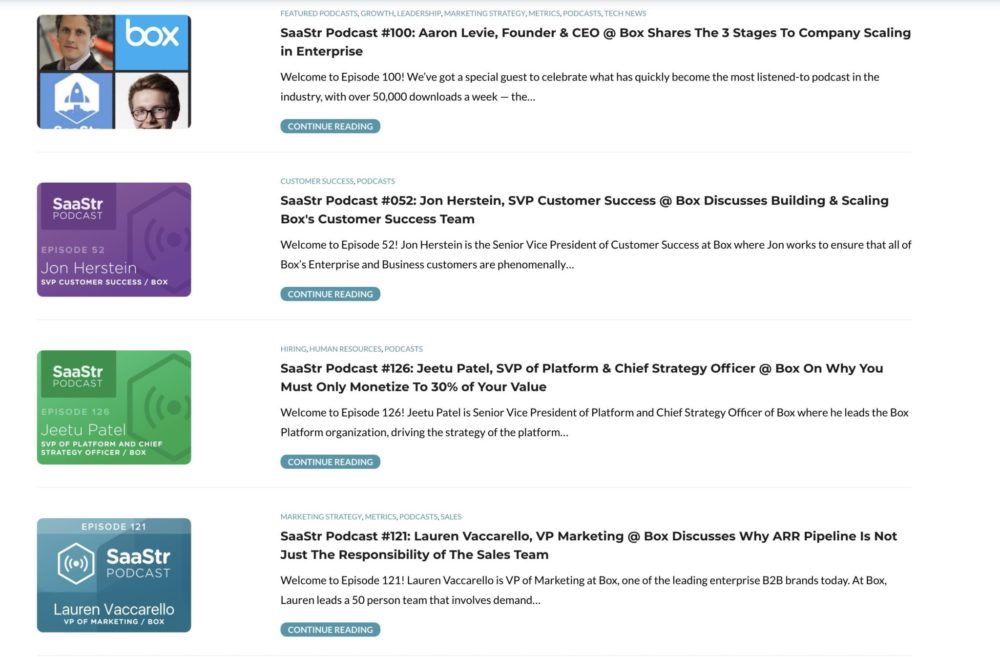
If you like your SaaS lessons practical, sharp, and only slightly caffeinated, this Box-heavy run of SaaStr podcasts is a pretty great place to spend your listening time. The four episodes cover leadership, customer success, platform strategy, and marketing, which is basically the full operating system of a modern B2B SaaS company. You get Aaron Levie on scaling Box, Jon Herstein on making customer success more than a fancy support label, Jeetu Patel on building platform value without pricing like a villain in the final act, and Lauren Vaccarello on why revenue pipeline is not sales’ problem alone.
Together, these conversations show why Box became such a useful case study in enterprise SaaS. The company grew from an early cloud file-sharing challenger into a much larger content and workflow platform serving enterprises at scale. That matters because the lessons in these podcasts are not theoretical. They come from leaders dealing with real complexity: large accounts, evolving products, cross-functional handoffs, developer ecosystems, long sales cycles, and the eternal B2B question of how to grow without turning your org chart into a haunted house.
What makes these SaaStr podcasts especially worth revisiting is that each one focuses on a different growth muscle. Aaron tackles the CEO lens. Jon gets into the post-sale engine. Jeetu deals with platform thinking and sustainable scale. Lauren ties marketing directly to revenue, nurture, segmentation, and even post-purchase impact. Put them together and you do not just get four good interviews. You get a compact masterclass in enterprise growth.
Why This Box Quartet Still Hits So Hard
There are plenty of startup podcasts that sound exciting for 20 minutes and evaporate from your memory by lunch. These are not those. The Box episodes work because they focus on durable problems: how a founder changes as a company scales, how customer success should partner with sales on big accounts, how platform leaders think about value creation, and how marketing should own more of the customer journey than “we got the click, good luck everybody.”
That last point matters a lot. In modern B2B, the clean borders between sales, marketing, product, and customer success are blurrier than ever. Buyers expect personalization, faster answers, smoother handoffs, and actual business outcomes. So these podcasts feel surprisingly current, even if they first aired years ago. Good enterprise strategy ages more like a leather jacket than a social media trend.
Podcast #1: Aaron Levie on the Three Stages of Company Scaling in Enterprise
What makes the episode stand out
Aaron Levie’s SaaStr appearance is the big-picture episode in the set. The conversation centers on how Box grew from a startup founded by four friends into a major enterprise software company, and how leadership has to change as that journey gets messier, larger, and more public. It is the sort of conversation that founders need before they realize they need it.
Best takeaway: scaling changes the CEO before it changes the org chart
The most useful idea here is not just that companies evolve in stages. It is that CEOs have to evolve right alongside them. In the earliest phase, speed and conviction matter most. Later, repeatability matters. Then, once the company is operating at serious scale, communication, transparency, planning discipline, and decision quality become non-negotiable. Founders who still want to run a later-stage company like a dorm-room project usually discover that chaos is not a growth strategy.
This episode also lands because Aaron talks about enterprise software without making it sound like a spreadsheet in a blazer. He has long pushed the idea that enterprise products and consumer-grade usability are converging. That framing helped Box compete in a market where buyers wanted security and governance, but users still wanted software that did not feel like punishment.
Why founders should care
If you are building in SaaS, this podcast is a reminder that growth is not one long victory lap. Each phase creates a new management problem. What got you from zero to one will not necessarily get you from ten million to one hundred million in annual recurring revenue. That is not bad news. It is just enterprise reality, and reality is a useful coworker even when it is mildly rude.
Podcast #2: Jon Herstein on Building and Scaling Box’s Customer Success Team
Why this one matters
Jon Herstein’s episode is where the shiny top-of-funnel talk stops and the real work begins. Customer success is one of those functions everyone claims to love, right up until budget season. But in enterprise SaaS, especially with large accounts, strong customer success can be the difference between durable expansion and a churn story nobody wants to explain on Monday morning.
Best takeaway: customer success is not support with better manners
One of the most valuable themes in Jon’s conversation is how Box defines customer success in a more strategic way. The function is about adoption, outcomes, retention, expansion support, and long-term value realization. In other words, it is not just answering tickets and hoping the renewal fairy stops by later.
The episode also digs into one of the hardest questions in B2B SaaS: where does sales stop and customer success begin, especially in large enterprise accounts? Jon’s framing is useful because it treats the relationship as a partnership rather than a territorial dispute. Sales may drive the initial commercial motion and expansion opportunities, but customer success helps ensure the customer actually gets value, builds trust, and has a reason to grow with the vendor over time.
Why operators should listen closely
Jon also talks about career paths inside customer success, and that matters more than it sounds. Great CS teams do not scale by goodwill alone. They need role clarity, development opportunities, operating rhythm, and leaders who understand that retaining top CS talent is part of retaining customers. Companies often say they are customer-centric. The better question is whether their org design behaves like it.
If Aaron’s podcast is about how the company scales, Jon’s is about how the relationship with the customer scales. That is an equally important part of the story.
Podcast #3: Jeetu Patel on Platform Strategy and Monetizing Only a Slice of Your Value
The big idea
Jeetu Patel’s episode might be the sneakiest powerhouse of the four. The title alone grabs attention: why you should only monetize to 30% of your value. That idea sounds counterintuitive until you think about it for more than six seconds, which is sadly longer than many pricing meetings last.
The principle is simple: if your product delivers way more value than you charge for, customers feel smart buying it, partners feel motivated building around it, and your platform earns room to expand. If you try to extract every ounce of value upfront, you may improve a spreadsheet for a quarter while quietly murdering goodwill, adoption, and ecosystem growth.
Best takeaway: platforms win by making others more successful
Jeetu’s discussion goes beyond pricing philosophy. He talks about small, high-performing teams, solving genuinely hard problems, and doing unscalable things first so you can later scale the right things. That is such a good enterprise lesson because platform strategy often fails when leaders try to jump straight to scale theater. They want a giant ecosystem, lots of developer love, and beautiful monetization dashboards before they have actually built something developers find useful.
The smarter route is more humble. Solve painful problems. Make the tooling clear. Keep governance strong. Let developers and customers create additional value on top of your core system. Box’s platform story fits that approach well because enterprise customers do not just want storage; they want workflows, security, integrations, automation, and a way to bring content into the rest of their stack without setting off a compliance alarm.
Who should revisit this episode
Founders building API-first products, platform leaders trying to grow partner ecosystems, and pricing teams tempted to “maximize monetization” will all get something from this one. It is the kind of episode that quietly improves strategic judgment, which is a much rarer gift than another hot take about growth hacks.
Podcast #4: Lauren Vaccarello on Why ARR Pipeline Is Not Just Sales’ Job
Why this episode feels extra relevant now
Lauren Vaccarello’s conversation is a terrific antidote to lazy B2B thinking. She argues that pipeline is not just the responsibility of sales, and that idea has only become more relevant as buying journeys have become more complex. Prospects do not move through funnels like obedient little marbles. They research, stall, compare, loop in stakeholders, vanish, come back, and then ask for one more security review because apparently suspense is part of procurement.
Best takeaway: marketing owns more than awareness
Lauren’s podcast tackles sales and marketing alignment, lead nurturing beyond email, segmentation, and the role of marketing after the deal is closed. That mix is gold for growth teams because it treats marketing as a revenue-driving function across the customer lifecycle, not a department that stops working once a lead is handed over.
Her view of lead nurturing is especially useful. Good nurture is not just a sequence of polite emails trying very hard not to be ignored. It is messaging, timing, segmentation, content relevance, and knowing where a buyer actually is in the decision process. Great B2B marketing helps buyers build confidence, not just awareness. That is a big difference.
Even better, Lauren’s lens extends past acquisition. Post-purchase marketing matters because customers still need education, reinforcement, onboarding support, expansion context, and reasons to become advocates. In enterprise SaaS, the close is not the end of marketing’s job. It is often the start of marketing’s most valuable work.
The Real Pattern Across All Four SaaStr Podcasts
The reason these four Box episodes work so well together is that they tell one connected story. Aaron shows how a company scales. Jon shows how customers stay successful as the company matures. Jeetu shows how product and platform strategy create expandable value. Lauren shows how revenue responsibility stretches across teams and across the lifecycle.
Put differently, this is a blueprint for enterprise SaaS maturity:
Leadership has to evolve
A founder’s instincts matter, but systems, communication, and organizational clarity matter more as scale increases.
Retention is strategic, not administrative
Customer success is a growth function when it is tied to adoption, outcomes, and expansion collaboration.
Platforms need trust before they need extraction
Developers, customers, and partners stick around when a platform solves meaningful problems and leaves room for others to win.
Revenue is cross-functional
Marketing, sales, and post-sale teams all influence pipeline quality, conversion quality, and lifetime value.
That is why these episodes are so useful for founders and operators. They are not isolated lessons. They are connected operating principles.
Who Should Listen to These Box SaaStr Episodes?
If you are a founder, start with Aaron and Jeetu. You will get the macro strategy and the platform mindset.
If you lead customer success, start with Jon, then go to Lauren. You will hear how value delivery and lifecycle messaging reinforce each other.
If you run marketing, Lauren is the obvious first stop, but Aaron is a close second because brand and category positioning get much clearer when you understand the CEO’s scaling logic.
If you are a revenue leader, listen to all four in order. You will hear what a more complete growth system sounds like when leadership, customer outcomes, product strategy, and marketing are pulling in the same direction.
Experience in the Wild: What These Podcast Lessons Look Like in Real SaaS Teams
Here is the part many leaders will recognize immediately: the lessons from these four SaaStr podcasts sound elegant in theory, but in practice they usually arrive disguised as operational headaches. A founder starts saying, “We are getting bigger, but why do decisions feel slower?” That is the Aaron Levie episode showing up in real life. The company has outgrown improvisation, but the leadership habits have not caught up yet. Meetings get crowded. Priorities start competing instead of lining up. Suddenly everyone wants alignment, but nobody can explain who owns what. Welcome to the next stage of scaling. Please enjoy your complimentary dashboard and mild existential confusion.
Then the Jon Herstein lesson appears. Sales closes a promising enterprise logo, the celebration happens, screenshots are posted, and then the post-sale handoff lands with all the grace of a folding chair tossed down a staircase. Customer success gets introduced too late. The implementation story is fuzzy. The executive sponsor at the customer side is unclear. Renewal risk begins long before anyone says the word “renewal.” Strong CS teams fix this by treating adoption like a business discipline, not a reactive service queue. They build playbooks, define success milestones, and create shared ownership with sales instead of reenacting a low-budget turf war every quarter.
Jeetu Patel’s platform thinking usually shows up when product teams start hearing the same request from multiple customers and wonder whether they are building a feature, a capability, or the beginning of an ecosystem. This is where teams either get smart or get noisy. The smart ones solve the underlying problem cleanly, document it well, and make life easier for developers, partners, and internal builders. The noisy ones throw around words like ecosystem, API economy, and monetization strategy before the basics work. That path often leads to impressive slide decks and underwhelming adoption. In enterprise SaaS, boring reliability beats exciting confusion every time.
Lauren Vaccarello’s lesson tends to surface when marketing and sales both say they care about revenue but somehow still report on completely different planets. Marketing celebrates lead volume. Sales complains about lead quality. Customer success is sitting nearby wondering why nobody asked what good-fit customers actually look like after six months. The fix is not just better reporting. It is a shared revenue language. The best teams segment intelligently, nurture based on actual buying behavior, and keep marketing involved after the deal closes. That is how messaging improves, onboarding gets stronger, expansion becomes easier, and advocacy grows without needing to beg for testimonials like a Victorian orphan asking for soup.
What is especially useful about these Box leaders is that their advice connects functions instead of glorifying one department. That is why the four podcasts hold up so well. They reflect what enterprise growth really feels like: not one heroic team winning alone, but a company learning how to make leadership, product, platform, customer success, and marketing reinforce one another. When that happens, growth feels less random. It still feels hard, because this is SaaS and nobody gets a free miracle, but it becomes a lot more repeatable.
Final Thoughts
These four great SaaStr podcasts with Box’s CEO, SVP CS, SVP Platform, and VP of Marketing still deserve attention because they capture something rare: cross-functional wisdom that actually fits together. Aaron Levie explains the scaling mindset. Jon Herstein explains the customer value engine. Jeetu Patel explains how platforms create durable leverage. Lauren Vaccarello explains why pipeline, nurture, and post-purchase growth are team sports.
If you only listen for startup inspiration, you will get that. But if you listen for operating clarity, you will get much more. These episodes show how an enterprise SaaS company grows up without losing its edge. That is a lesson worth replaying.