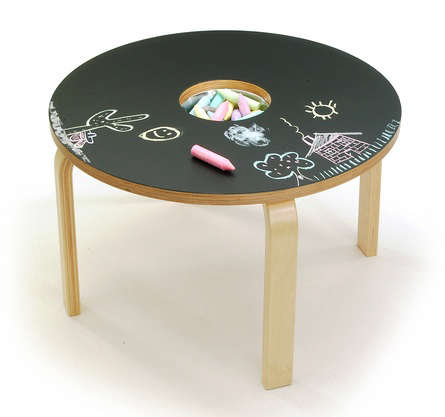
The Woody Chalkboard Table is the kind of children’s furniture that quietly solves several household problems at once. It gives kids a place to draw, build, snack, invent tiny kingdoms, and occasionally cover everything in chalk dust like a miniature Renaissance workshop. At the same time, it gives parents something far more precious: a dedicated creative zone that does not involve the dining table, the hallway wall, or the side of the refrigerator.
Designed by Eric Pfeiffer for Offi & Co., the Woody Chalkboard Table is a round kids’ activity table with a writable black chalkboard surface, birch plywood construction, and a clever bowl in the center for chalk and eraser storage. Its clean, modern shape makes it look more like intentional design furniture than “something plastic that escaped from a preschool supply closet.” That balanceplayful for children, handsome enough for grown-up roomsis exactly why this table continues to attract attention from parents, designers, and anyone trying to make a playroom look less like a toy tornado touched down at 3 p.m.
What Is the Woody Chalkboard Table?
The Woody Chalkboard Table is a children’s chalkboard activity table built for drawing, writing, crafts, and open-ended play. The most recognizable feature is its black chalkboard tabletop, which allows children to draw directly on the surface with regular chalk. Instead of needing paper every five minutes, kids can sketch a dragon, erase it, draw a moon base, erase that, and then create something that might be a cat, a spaceship, or both. Art critics call this “mixed media.” Parents call it “Tuesday.”
The table is commonly listed with a 30-inch diameter and an 18-inch height, a size that works well for many preschool and early elementary play spaces. Its circular design helps children gather around the surface without fighting over “the good side,” because there is no bad side. The center bowl keeps chalk, erasers, small toys, or craft bits within easy reach, making the table feel organized even when the creative process looks suspiciously like chaos wearing socks.
Key Features of the Woody Chalkboard Table
1. Writable Chalkboard Surface
The star of the Woody Chalkboard Table is the chalkboard top. A writable tabletop turns ordinary furniture into an interactive surface. Kids can practice letters, doodle, play tic-tac-toe, label pretend restaurant menus, or draw roads for toy cars. Unlike a standard table, this one invites participation. It says, “Go ahead, draw on me,” which is the opposite of what most furniture says after you have paid for it.
Because the surface is designed for chalk, it can be wiped clean and reused again and again. This makes the table useful for families who want to reduce paper waste or simply avoid the mysterious pile of half-used coloring sheets that somehow appears beside every children’s art station.
2. Birch Plywood Construction
The Woody Chalkboard Table is made with birch ply, a material often appreciated for its layered edge, strength, and warm natural appearance. The wood grain may vary from piece to piece, which gives each table a slightly individual look. That variation is not a defect; it is part of the charm of using real wood materials. Think of it as furniture with fingerprints, only less sticky.
Birch plywood also pairs beautifully with modern interiors. It is light enough visually to fit in a nursery, playroom, homeschool corner, or living room, but it still feels more substantial than many brightly colored children’s furniture pieces. For parents who prefer calm, Scandinavian-inspired design, the Woody Chalkboard Table checks the “cute but not cartoonish” box.
3. Center Bowl for Chalk and Small Supplies
The center bowl is one of those design details that seems simple until you live with it. Children’s art supplies have a way of migrating. Chalk ends up under the couch. Erasers vanish into toy bins. Tiny figures appear in cereal bowls. The built-in bowl gives kids a natural place to drop supplies when they are done.
Of course, the bowl may also become a garage for toy cars, a soup pot for pretend cooking, or a nest for plastic dinosaurs. That is not a failure of design. That is childhood using the furniture correctly.
4. Compact Round Shape
At about 30 inches across, the table is compact enough for many small rooms but still large enough for shared play. The round shape softens the look of a space and avoids sharp visual corners. It also makes collaboration easier. Two or three children can gather around the surface to draw together, play simple games, or negotiate the extremely complex politics of who gets the blue chalk.
The 18-inch height places the table in the child-sized furniture category. Pairing it with appropriately sized chairs is important. A chair that is too tall can make the table feel cramped, while a chair that is too short can leave kids reaching upward like tiny accountants at an adult conference table.
Why Parents Like It
It Creates a Defined Creative Zone
One of the biggest advantages of the Woody Chalkboard Table is that it gives kids a specific place to create. Young children often do better when an activity has a clear home. Books go on the shelf. Blocks go in the bin. Chalk drawings go on the chalkboard tablenot on the wall, not on the floor, and definitely not on the dog, who never asked to become a mural.
A defined creative area can also make cleanup easier. Instead of setting up art materials across the kitchen, parents can keep chalk, erasers, and a small cloth right at the table. When playtime ends, the surface can be wiped down and reset for the next masterpiece.
It Encourages Open-Ended Play
Open-ended play is valuable because it does not come with only one correct answer. A chalkboard table can be a writing desk, art station, map-making surface, pretend café counter, math practice board, or game table. Children can use it differently depending on their age, mood, and imagination.
For toddlers and preschoolers, drawing big shapes helps build hand strength and coordination. For older children, the surface can support spelling practice, number games, storytelling, and collaborative projects. A table that adapts to different kinds of play tends to stay useful longer than furniture designed for one narrow purpose.
It Looks Good in Real Homes
Parents often face a design dilemma: children need furniture that fits their bodies and activities, but adults still have to look at that furniture every day. The Woody Chalkboard Table solves this nicely. Its birch edges, black surface, and clean circular form make it attractive enough for shared family spaces.
It does not scream “temporary toy zone.” It whispers, “Yes, children live here, and somehow the room still has taste.” That is a rare sentence in family design.
Things to Consider Before Buying
Chairs May Not Be Included
Many listings for the Woody Chalkboard Table sell the table by itself, without chairs. Before buying, check exactly what is included. If you already have child-sized chairs, measure seat height and comfort. If not, look for chairs designed to pair with an 18-inch table.
Chalk Dust Is Real
Chalk is charming, nostalgic, and wonderfully low-tech. It is also dusty. For most families, this is manageable with regular wiping, low-dust chalk, and a small cleaning cloth nearby. However, if a child has asthma, allergies, or strong sensitivity to dust, parents may want to be more careful. Choose non-toxic, low-dust chalk, clean the surface frequently, and avoid letting children clap erasers together like tiny old-school professors.
It Is Best for Dry Creative Play
The Woody Chalkboard Table is wonderful for chalk drawing, puzzles, blocks, books, and pretend play. It is less ideal for very wet paint projects, glue explosions, or glitter operations of unknown origin. For messy crafts, use a protective mat or move the project to a surface designed for heavy cleanup.
Natural Wood Can Vary
Because the table uses birch ply, the wood finish may vary in color and grain. This is normal for wood-based furniture. If you expect every edge to look exactly like a product photo, real wood may surprise you. The good news is that variation usually makes the piece look warmer and more natural in person.
How to Use a Woody Chalkboard Table in Different Rooms
In a Playroom
In a playroom, the Woody Chalkboard Table can become the center of activity. Place it near shelves with art supplies, puzzles, and building toys. Keep chalk in the center bowl and store extra materials nearby in labeled bins. A washable rug underneath can help define the zone and catch chalk crumbs, because chalk crumbs are apparently part of the creative ecosystem.
In a Bedroom
In a child’s bedroom, the table can serve as a quiet drawing corner. Pair it with one small chair, a book basket, and a wall shelf for supplies. This setup works especially well for children who enjoy independent play. It gives them a small personal studio without needing an entire room.
In a Living Room
If your home does not have a separate playroom, the Woody Chalkboard Table can fit into a living room more gracefully than many kids’ tables. The black-and-birch design blends with modern, minimalist, Scandinavian, and eclectic interiors. Add a small basket for chalk and a nearby storage cube for toys, and the table becomes part of the room rather than a visual emergency.
In a Homeschool or Learning Corner
For families who homeschool or do after-school learning activities, the table can support handwriting practice, counting games, spelling drills, and quick sketches. Because mistakes erase easily, kids may feel less pressure than they do on paper. A chalkboard surface turns correction into play: erase, try again, laugh at the backwards letter, repeat.
Cleaning and Maintenance Tips
Maintaining a Woody Chalkboard Table is simple, but consistency helps. Wipe the surface with a dry eraser or soft cloth after each drawing session. For deeper cleaning, use a lightly damp cloth and dry the surface afterward. Avoid soaking the tabletop, especially near wood edges, because wood and water have a complicated relationship best described as “please do not introduce them too enthusiastically.”
Use regular chalk or low-dust chalk rather than oil pastels, permanent markers, crayons, or chalk markers unless the manufacturer specifically says those products are safe for the surface. Some markers can stain porous or matte finishes. When in doubt, test in a small hidden area or stay with traditional chalk.
Keep the center bowl clean by emptying broken chalk pieces occasionally. Tiny chalk nubs may look harmless, but they can become choking hazards for very young children. If toddlers use the table, supervise play and choose larger chalk pieces that are easier to handle.
Woody Chalkboard Table vs. Regular Kids’ Table
A regular kids’ table is useful for snacks, puzzles, and crafts. The Woody Chalkboard Table does those things too, but it adds a built-in creative surface. That difference matters. A standard table requires supplies to become interesting. A chalkboard table is already an invitation.
Compared with plastic tables, the Woody Chalkboard Table feels more design-forward and durable. Compared with a full art easel, it takes up less vertical space and supports seated activities. Compared with a DIY chalkboard tabletop, it offers a polished, purpose-built look. The tradeoff is price: designer children’s furniture usually costs more than basic playroom furniture. For families who value aesthetics, material quality, and multi-use function, the investment may make sense.
Who Is the Woody Chalkboard Table Best For?
The Woody Chalkboard Table is best for families who want a stylish, compact, interactive table for young children. It suits kids who enjoy drawing, pretend play, puzzles, building toys, and hands-on activities. It is also a strong fit for parents who care about interior design and want children’s furniture that blends into the home rather than visually shouting from across the room.
It may not be ideal for families who need a large homework desk for older children, a waterproof craft table for paint-heavy projects, or a full dining table for multiple kids. It is also not the best choice if chalk dust is a major concern in the household. Like all furniture, it shines when used for the right job.
Design Analysis: Why the Table Works
The success of the Woody Chalkboard Table comes from the way it combines form and function. The round shape supports shared use. The chalkboard surface encourages creativity. The center bowl solves a storage problem without adding extra parts. The birch plywood edge adds warmth and visual texture. Nothing feels overdesigned, yet every detail has a purpose.
Good children’s furniture should respect children without annoying adults. That sounds simple, but many products miss the mark. Some are too flimsy. Some are too bright. Some are so themed that a child outgrows them emotionally before outgrowing them physically. The Woody Chalkboard Table avoids those traps by staying simple. It does not depend on cartoon graphics, trendy colors, or complicated features. It gives kids a surface, a tool, and permission to create.
Practical Buying Tips
Before purchasing a Woody Chalkboard Table, measure your space. A 30-inch round table needs room not only for the tabletop but also for chairs and movement around it. Check whether chairs are included. Review return policies, especially if buying from an online retailer. Confirm the current finish, dimensions, shipping time, and whether the product is in stock.
Parents should also think about the child’s age and habits. A child who loves drawing may use the table daily. A child who prefers climbing furniture like a mountain goat in pajamas will need closer supervision. For younger children, inspect the table regularly for loose parts, worn edges, or damaged surfaces. Safety is not a one-time checkbox; it is a habit.
Creative Activity Ideas for the Woody Chalkboard Table
Story Map Drawing
Ask your child to draw a map for a story. The table can become a forest, castle, city, zoo, or outer-space route. Then use small toys as characters and act out the adventure. This encourages storytelling, sequencing, and imaginative thinking.
Letter of the Day
Write one big letter on the table and invite your child to draw things that start with that letter. For “B,” they might draw a bear, banana, boat, or something that looks like a potato but is confidently declared to be a butterfly.
Restaurant Menu
Turn the table into a pretend café. Kids can write or draw menu items, take orders, and serve imaginary soup. The center bowl can hold chalk “ingredients.” This game supports language, social play, and early writing.
Shape Hunt
Draw circles, squares, triangles, and rectangles on the tabletop. Ask your child to find objects in the room that match each shape. This makes early geometry feel like a game instead of a worksheet wearing a frown.
Collaborative Mural
Invite siblings or friends to draw one shared scene. One child draws the sun, another adds houses, another adds dinosaurs because dinosaurs improve almost every landscape. Collaborative drawing builds communication and compromise, even if the final artwork makes no architectural sense.
Real-Life Experiences With a Woody Chalkboard Table
Living with a chalkboard table is different from simply admiring one online. In real life, the Woody Chalkboard Table becomes part furniture, part art supply, part social hub, and part evidence board for whatever your child was thinking at 7:42 a.m. One morning it may hold a careful alphabet practice session. By lunch, it may become a racetrack. By evening, it may feature a chalk portrait of the family in which everyone has six fingers and the cat is larger than the house.
One of the best experiences is watching children return to the table without being asked. Because the surface is always ready, there is less setup friction. You do not need to pull out paper, markers, tape, and a protective tablecloth just to let a child draw for ten minutes. The table sits there quietly, waiting. Kids notice that. They wander over, pick up chalk, and begin. Sometimes the most successful children’s products are the ones that reduce the number of steps between “I have an idea” and “I made something.”
Another practical benefit is how the table supports short attention spans. Children do not always want a full art session. Sometimes they want to draw one spiral, erase it, and leave dramatically. A chalkboard table allows that. It does not demand commitment. It welcomes quick creativity, which is exactly how many young kids naturally work.
Parents may also find that the table becomes a gentle teaching tool. You can write a morning message, draw a simple schedule, or leave a tiny puzzle: “Can you draw three circles?” “Can you write your name?” “Can you make a monster with triangle teeth?” These prompts feel playful because they appear on the table, not on a worksheet. The difference matters. A chalkboard surface makes learning feel temporary and forgiving. Mistakes disappear with a wipe.
Of course, the experience is not perfectly tidy. Chalk dust will happen. Broken chalk will happen. Someone may put crackers in the center bowl. Someone else may decide the bowl is a volcano. A damp cloth nearby solves most problems, and the rest become family stories. The key is to set simple rules early: chalk stays on the table, chalk goes back in the bowl, and we do not eat chalk even if it is shaped like a very boring breadstick.
The Woody Chalkboard Table also works nicely during playdates. A round table naturally invites kids to gather without assigning a “front.” Children can sit around it and work on a shared drawing or separate sections. This can reduce competition and encourage parallel play. Even children who do not know each other well can connect through drawing. One child makes a line, another adds wheels, and suddenly the line is a train. That kind of low-pressure interaction is where the table earns its keep.
For adults, the experience is partly emotional. There is something satisfying about giving children furniture that is made for their scale but not visually disposable. The Woody Chalkboard Table says that children’s creativity deserves a real place in the home. Not a corner of the counter. Not a wobbly tray. A real table. That message may be subtle, but children absorb it. Their work has a place. Their ideas have a place. Their chalk dragon with roller skates has a place, too.
Over time, the table can become a small archive of phases. First come scribbles, then circles, then faces, then letters, then elaborate scenes with labels and arrows. Because the drawings erase, nothing is permanentand that is part of the beauty. The value is not in preserving every mark. The value is in giving children a surface where trying again is normal. Draw, erase, repeat. That is creativity in its most practical form.
Conclusion
The Woody Chalkboard Table is more than a cute children’s table. It is a smart, design-friendly activity piece that encourages drawing, writing, pretend play, and collaboration. With its birch plywood construction, black chalkboard surface, center storage bowl, and compact round shape, it offers a thoughtful blend of function and style.
For families who want a kids’ table that looks good in the home and genuinely invites creative use, the Woody Chalkboard Table is easy to love. It may not eliminate mess entirelybecause children are wonderfully committed to mess as a life philosophybut it does give that mess a charming, reusable, and well-designed place to happen.