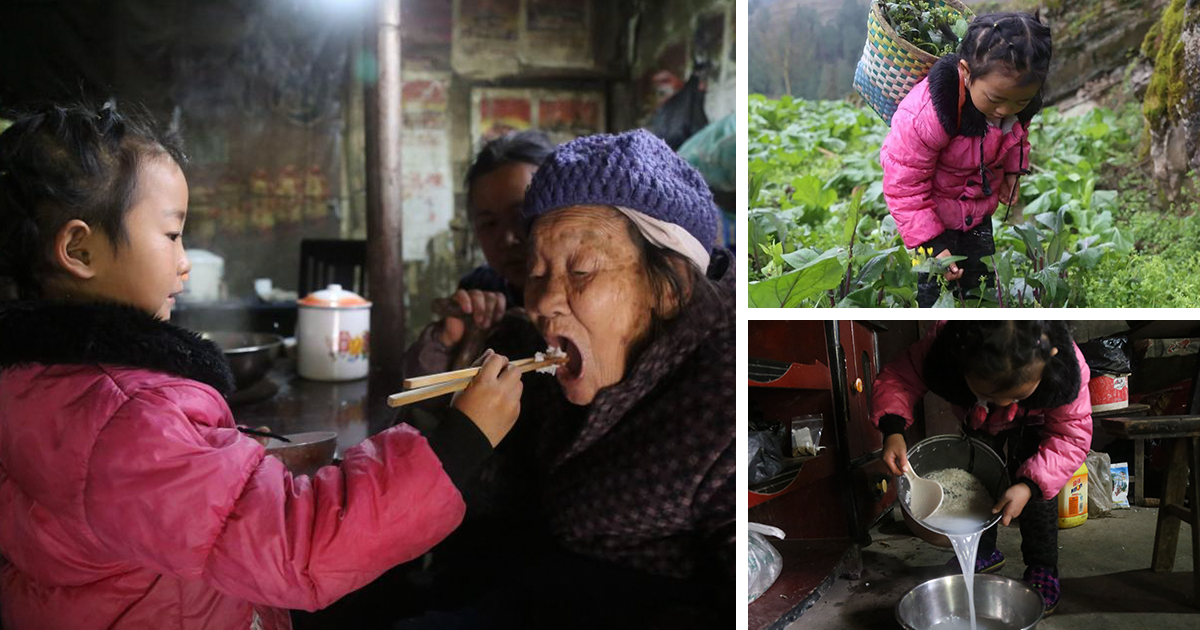
Most five-year-olds are busy mastering shoelaces, negotiating snack diplomacy, and asking why the sky is blue for the seventeenth time before breakfast. Anna Wang, according to public reports from rural southwest China, was doing something heartbreakingly different: caring for her sick grandmother and 92-year-old great-grandmother after her father was imprisoned and her mother left the family.
The story of this 5-year-old girl becoming the sole carer of her grandmas spread online because it is almost impossible to read without pausing. It has all the ingredients of a viral human-interest story: a tiny child, a remote mountain village, elderly relatives who could barely move, and photographs of a little girl standing on a stool to cook meals she was too small to reach. But beneath the emotional shock is a bigger question that deserves more than a quick share: What happens when a child becomes the adult in the room?
This is not simply a tale about bravery. It is a story about family abandonment, poverty, rural isolation, kinship care, elder care, and the invisible weight carried by children who should still be protected by adults. Anna’s reported devotion to her grandmothers is moving, but the real lesson is not “what a strong little girl.” The deeper lesson is: no child should have to be that strong just to keep a household alive.
The Reported Story Of Anna Wang
Public reports identified the child as Wang Anna, a five-year-old living in a mountainous area near Zunyi in Guizhou province, southwest China. She reportedly lived with her ill grandmother and her 92-year-old great-grandmother. Her father was said to have been sent to prison when she was still a baby, and her mother later remarried and left the family behind.
That left Anna in a household where the adults were either absent or physically unable to provide daily care. Her grandmother reportedly suffered from a severe form of arthritis that made movement painful and difficult, while her great-grandmother was elderly and needed help with basic tasks. So Anna did what children often do in crisis: she adapted.
She cooked. She cleaned. She gathered vegetables. She helped her relatives eat. She assisted them when they needed to move around the home or use the toilet. In some accounts, a neighbor allowed her to pick vegetables from a farm when food was short. That detail may sound small, but in a household like Anna’s, a basket of vegetables can be the difference between dinner and a very long night.
One of the most unforgettable images from the story is the tiny girl standing on a stool to reach the stove. It is a picture that says more than any statistic could. A stove is an adult object. A stool is a child’s solution. Put them together, and you get a portrait of childhood stretched far beyond its natural shape.
Why This Story Hit So Many People So Hard
Stories like Anna’s spread because they break our internal rules about childhood. We expect a five-year-old to need help brushing hair, buttoning a coat, or pouring cereal without turning the kitchen into a milk-themed splash park. We do not expect a five-year-old to become a household manager, nurse, cook, and emotional anchor.
That contrast is what makes the story so powerful. Anna’s daily routine was not a cute example of helping grandma bake cookies. It was not a wholesome “kids learn responsibility” moment. It was a role reversal. Adults needed care, and the child became the caregiver.
There is a huge difference between a child helping out and a child carrying the survival of a family. Many children set the table, fold towels, feed a pet, or proudly sweep the same pile of dust into three different corners of the room. Those small chores can build confidence. But when a child must manage meals, hygiene, mobility support, and emotional responsibility for vulnerable adults, the burden becomes developmentally inappropriate.
Child Caregiving Is More Common Than Many People Realize
Anna’s situation was unusually extreme because of her age and the intensity of care required. Still, child caregiving is not rare. Across many countries, children and teenagers help family members with chronic illness, disability, aging-related needs, mental health challenges, or substance-related problems. In the United States, researchers and advocacy groups have warned that millions of minors may be providing some level of unpaid care within their households.
Young caregivers may help with cooking, cleaning, medication reminders, translation at medical appointments, bathing assistance, sibling care, grocery shopping, emotional support, or simply watching over a family member who cannot safely be left alone. Some do this for a grandparent. Others care for a parent, sibling, aunt, uncle, or family friend.
The problem is that young caregivers often remain invisible. Teachers may see a tired child and assume laziness. Doctors may speak only to the adult patient and never ask who is helping at home. Neighbors may admire the child’s maturity without realizing maturity can sometimes be a mask worn by children who ran out of choices.
When Love Becomes Too Heavy For A Child
It is important to say something clearly: Anna’s love for her grandmothers should not be dismissed. Children are capable of deep affection, loyalty, and empathy. A child who brings water to a sick grandparent or holds an elderly hand is not pretending to care. That love is real.
But love does not make an adult burden safe for a child. A five-year-old can love fiercely and still need protection. A child can be brave and still be overwhelmed. A child can smile for a camera and still be missing school, play, rest, and a sense of security.
This is where many online reactions go wrong. People see a child like Anna and say, “She is an angel,” “She is stronger than adults,” or “Children today should learn from her.” Those comments come from admiration, but they can accidentally romanticize hardship. The goal should not be to turn suffering into a motivational poster. The goal should be to ask why the adults, systems, and community supports around a child failed so badly that she had to become the safety net.
The Hidden Cost Of Parentification
Psychologists often use the term “parentification” to describe situations where a child takes on adult-like responsibilities in a family. Parentification can be emotional, such as when a child becomes a parent’s counselor, or instrumental, such as when a child handles practical care tasks far beyond their age.
Not all responsibility is harmful. A child who helps wash vegetables or brings a blanket to grandma may feel proud and connected. The danger begins when the child’s needs disappear behind everyone else’s needs. If a child cannot attend school regularly, play freely, sleep safely, ask for comfort, or make age-appropriate mistakes, the caregiving role has crossed a serious line.
A parentified child may look impressively capable from the outside. They may be organized, quiet, polite, and strangely adult in the way they speak. But inside, they may carry anxiety, guilt, fear, loneliness, or the belief that love must be earned through usefulness. Childhood should not be a job interview for survival.
Kinship Care: A Better Alternative When Adults Step In
Kinship care happens when children live with relatives or close family connections instead of unrelated foster placements. In many cases, kinship care helps children maintain familiar bonds, culture, language, and identity during family crisis. Grandparents, aunts, uncles, older siblings, and close family friends can provide crucial stability when parents cannot safely care for a child.
But Anna’s story shows the painful difference between kinship care and kinship collapse. In a healthy kinship care arrangement, adults care for the child. In Anna’s reported situation, the child was left caring for older relatives. The family bond remained, but the caregiving structure was upside down.
That distinction matters. Grandparents often become heroes in family emergencies, especially when parents are absent, incarcerated, ill, or struggling. Yet older relatives may need support themselves. If a grandmother is too sick to cook, bathe, or move safely, she cannot also be expected to protect a preschool child without outside help. Compassion for grandfamilies must include practical support: food, medical care, legal assistance, transportation, school access, respite care, and regular welfare checks.
Abandonment Is Not Just An Emotional Wound
When people hear the word “abandonment,” they often think first of sadness. That is understandable. Being left behind by a parent can create deep emotional pain, especially for a young child who may not have the words to explain the loss.
But abandonment is also practical. Who buys food? Who takes the child to a doctor? Who ensures the child goes to school? Who keeps dangerous tools, hot stoves, and heavy household responsibilities away from tiny hands? Who notices when the child is sick, frightened, or exhausted?
In Anna’s case, the absence of parents reportedly created a chain reaction. Her grandmothers needed care, but so did she. The household had love, but love alone cannot replace adult capacity, income, transportation, medical treatment, or child protection. A family may have warm hearts and still lack the resources needed to survive safely.
Why Poverty Makes Caregiving Crises Worse
Poverty does not cause every caregiving crisis, but it turns small emergencies into disasters. A family with money can hire help, arrange transportation, buy medicine, pay for childcare, install safety equipment, and call professionals when elder care becomes too complex. A poor family may have none of those options.
In a remote village, distance adds another wall. The nearest clinic may be far away. Social workers may not visit often. School may be difficult to reach. Neighbors may want to help but have limited resources themselves. When poverty and isolation meet illness, the pressure often falls on whoever is physically present. Sometimes that person is a child.
This is why stories like Anna’s should not be treated as isolated oddities. They reveal what happens when a family’s private crisis becomes public only after it has already reached an extreme point. Ideally, support arrives long before a five-year-old is standing on a stool over a stove.
The Role Of Community: Small Help Can Be Life-Changing
One of the few hopeful details in Anna’s story is the neighbor who reportedly allowed her to pick vegetables. That act did not solve everything, but it mattered. Community support often begins in small, practical ways: a meal, a ride, a phone call, a school contact, a bag of groceries, a safe adult checking in.
Still, communities should not be asked to replace child protection systems or healthcare systems. A kind neighbor can help a family eat today. A functioning safety net can ask why a child is the one responsible for securing food in the first place.
The best community response combines compassion with action. Admire the child, yes, but also call the appropriate services. Praise the child’s heart, but protect the child’s body and future. Offer help, but do not quietly normalize the idea that children can simply “step up” when adults disappear.
What A Child In Anna’s Position Really Needs
A child in a caregiving crisis needs more than applause. She needs a safe adult who is legally and practically responsible for her welfare. She needs regular meals, medical checkups, school enrollment, emotional support, and protection from dangerous tasks. She needs time to play, because play is not a luxury for children; it is part of how their brains learn, heal, and grow.
She also needs adults to avoid turning her story into entertainment. Viral attention can bring help, but it can also flatten a child into a symbol. Anna is not merely “the brave little caregiver.” She is a child with fears, preferences, moods, humor, and a right to privacy. She may be strong, but she should not be required to perform strength for the internet.
Lessons For Families, Schools, And Neighbors
For Families
If illness or disability makes daily life difficult, families should try to identify adult backup before a crisis becomes desperate. That may include relatives, community groups, local agencies, faith organizations, medical social workers, or elder-care programs. Children can help in small ways, but they should never become the emergency plan.
For Schools
Teachers and school counselors are often the first adults outside the home to notice signs of hidden caregiving. A child may be frequently absent, unusually tired, anxious about getting home, unable to complete homework, or overly focused on adult problems. Instead of asking, “Why are you not trying?” schools can ask, “What responsibilities are waiting for you after class?”
For Neighbors
Neighbors do not need perfect words to help. They need attention and courage. If a child appears to be caring for vulnerable adults without safe supervision, the answer is not gossip. The answer is to connect the family with real help and, when necessary, alert child welfare or emergency services.
Experience-Based Reflections: What Stories Like Anna’s Teach Us
Anyone who has spent time around caregiving families knows that love and exhaustion often sit at the same table. A grandmother may insist she is “fine” while quietly skipping meals because cooking hurts. A child may say, “I can do it,” because children often want to be helpful, not because the task is appropriate. A neighbor may suspect something is wrong but hesitate, worried about interfering. These moments are where caregiving crises either deepen or begin to change.
One experience many families share is the slow creep of responsibility. Caregiving rarely begins with a dramatic announcement. It starts with one small task. A child brings a cup of tea. Then the child helps with dinner. Then the child reminds someone to take medicine. Then the child stays home from school “just this once.” Before anyone names the problem, the child has become essential to the household. That is the danger of gradual overload: it can look normal because yesterday was only slightly easier than today.
Another common experience is the way adults praise children for coping. A parent, grandparent, or neighbor may say, “You are so mature,” “You are the little man of the house,” or “You are grandma’s helper.” Those words may feel loving, but they can trap a child in a role. Children often chase approval. If being useful earns affection, they may hide fear, pain, or resentment. They may learn to smile while carrying emotional weight that would make many adults want to lie down on the kitchen floor and negotiate with the ceiling.
Families in crisis also teach us that practical help beats vague sympathy. “Let me know if you need anything” is kind, but it puts the work back on the overwhelmed person. Better help sounds specific: “I can bring dinner on Tuesday,” “I can drive you to the clinic,” “I can sit with grandma for one hour,” or “I can call the school counselor with you.” In households like Anna’s, small concrete actions can create breathing room.
There is also an emotional lesson. Children who care for adults may feel proud and resentful at the same time. They may love the person they care for and still wish someone else would take over. They may feel guilty for wanting to play. Adults must make space for those mixed feelings. A child should never be made to believe that needing childhood is selfish.
Finally, stories like Anna’s remind us that society often notices children only after they become extraordinary. But children should not need to become extraordinary to deserve safety. A quiet child missing school deserves attention. A hungry child deserves attention. A child who knows too much about medical routines, unpaid bills, or adult sadness deserves attention. The goal is not to celebrate children for surviving impossible situations. The goal is to build families and communities where survival does not depend on a five-year-old’s tiny shoulders.
Conclusion
The story of the 5-year-old girl who became the sole carer of her grandmas is heartbreaking because it shows both the beauty of a child’s love and the failure of the world around her. Anna Wang’s reported devotion to her grandmother and great-grandmother moved people across the internet, but the most responsible response is not only admiration. It is concern, reflection, and action.
Children can be compassionate. They can help. They can bring joy into the hardest rooms. But they are not substitutes for parents, healthcare workers, social services, or adult caregivers. A child’s kindness should be nurtured, not exploited by circumstance.
Anna’s story matters because it forces readers to look beyond the viral headline. It asks us to notice young caregivers, support grandfamilies, strengthen safety nets, and stop mistaking childhood sacrifice for a feel-good ending. The true happy ending is not a child learning to cook for bedridden elders. The true happy ending is a child being allowed to be a child again.
Note: This article is written for web publication in original language and structure, based on publicly reported information about Anna Wang and broader research on child caregiving, kinship care, child abandonment, and family support systems. No source links or content-reference markers have been inserted into the article body.