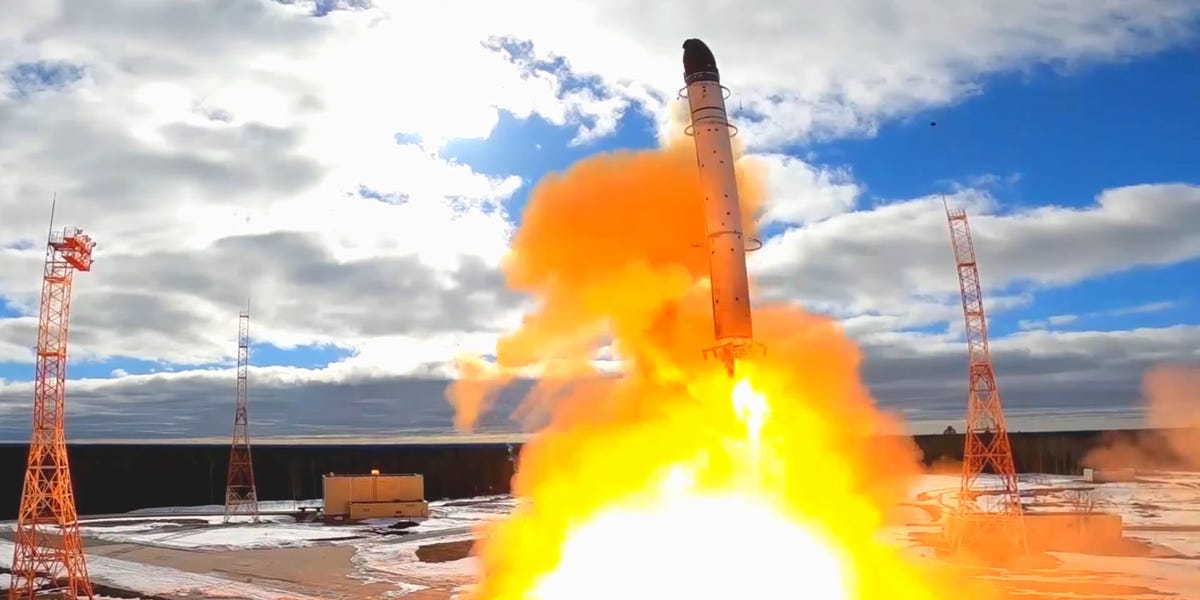
Russia’s RS-28 Sarmat has the kind of nickname that makes editors reach for dramatic fonts: “Satan II,” “doomsday missile,” “the world’s most powerful ICBM.” Subtle, it is not. But behind the headline thunder is a more complicated story about nuclear modernization, engineering difficulty, arms-control erosion, and political messaging.
The RS-28 Sarmat is a heavy, silo-based, liquid-fueled intercontinental ballistic missile designed to replace Russia’s aging Soviet-era R-36M2 Voevoda, known in the West as the SS-18 “Satan.” In plain English: Sarmat is not a battlefield missile. It is a strategic nuclear delivery system built for the gravest possible scenario: deterring nuclear war by threatening catastrophic retaliation. That is why the phrase “doomsday missile” keeps following it around like a very gloomy marketing intern.
In 2026, the missile returned to global headlines after Russian officials claimed another successful test and said the system would enter combat service by the end of the year. At the same time, independent analysts continue to point out that the Sarmat program has suffered years of delays, limited confirmed flight testing, and at least one major reported test failure. So the most accurate view is this: Sarmat is real, dangerous, and strategically significant, but its operational maturity is still a subject of debate.
What Is the RS-28 Sarmat?
The RS-28 Sarmat is a super-heavy intercontinental ballistic missile, or ICBM. It is launched from hardened underground silos, uses liquid fuel, and is designed to carry multiple nuclear warheads over intercontinental distances. Public technical estimates often describe it as roughly 35 meters long, about 3 meters in diameter, and more than 200 metric tons at launch. That makes it less like a “missile” in the casual sense and more like a skyscraper with engines, guidance systems, and geopolitical anxiety bolted on.
Its mission is to replace the Voevoda, a Soviet-era heavy ICBM that has been one of the most powerful weapons in Russia’s strategic arsenal. The old Voevoda was produced in Ukraine during the Soviet period, which created obvious maintenance and supply-chain complications after the collapse of the USSR and especially after Russia’s war in Ukraine. Sarmat is Moscow’s attempt to keep a heavy land-based nuclear option alive using a Russian-produced system.
Why Is It Called a “Doomsday Missile”?
The phrase “doomsday missile” is not a formal military classification. It is a media shortcut for a weapon designed to deliver nuclear warheads across continents. The label sticks because Sarmat is associated with extremely large payload capacity, multiple independently targetable warheads, and countermeasures intended to complicate missile defense.
Russian officials have described the missile as capable of defeating current and future missile defense systems. They have also claimed it can fly unusual routes, including trajectories that could approach targets from directions less covered by traditional early-warning architecture. Analysts treat some of these claims with caution, but the broader concept is clear: Sarmat is meant to make Russia’s nuclear deterrent harder to neutralize.
Key Capabilities: What Makes Sarmat Different?
1. It Is a Heavy ICBM
Sarmat belongs to the heavy ICBM category, meaning it is designed to carry a large payload. That payload may include multiple nuclear warheads, penetration aids, decoys, and possibly hypersonic glide vehicles such as Avangard. The point is not simply distance; the point is survivable nuclear delivery after a crisis has gone catastrophically wrong.
2. It Can Carry Multiple Warheads
Instead of carrying a single warhead, Sarmat is widely reported to be capable of carrying multiple independently targetable reentry vehicles, commonly called MIRVs. MIRVs allow one missile to release several warheads toward different targets. That capability is central to why heavy ICBMs are strategically destabilizing in the eyes of many arms-control experts: one missile can represent many warheads.
3. It Is Designed to Challenge Missile Defense
Missile defense is not a magic force field. It is a complex system of radars, sensors, interceptors, decision timelines, and probabilities. Heavy ICBMs complicate that picture by carrying decoys, using multiple warheads, and potentially varying flight paths. Sarmat’s public image has been built around that theme: fewer assumptions for defenders, more uncertainty for everyone else. Wonderful for deterrence theorists; terrible for sleep quality.
4. It Supports Russia’s Nuclear Modernization
Sarmat is part of a broader Russian effort to modernize its nuclear triad: land-based missiles, submarine-launched missiles, and nuclear-capable bombers. It sits alongside systems such as the Yars ICBM, Avangard hypersonic glide vehicle, Poseidon underwater nuclear-capable drone, and Burevestnik nuclear-powered cruise missile. Whether every system performs as advertised is another question, but together they reflect Moscow’s desire to preserve strategic parity with the United States.
The Development Timeline: Big Ambitions, Big Delays
Russia has talked about Sarmat for years. President Vladimir Putin dramatically highlighted it in 2018 during a presentation of advanced strategic weapons. The missile’s first known full flight test took place in April 2022, when Russia said it launched from Plesetsk and sent practice warheads to the Kura test range in Kamchatka.
After that, the story became messier. Russian officials claimed progress and even announced in 2023 that the missile had been placed on combat duty. Yet outside analysts noted that a single successful flight test is not a typical foundation for large-scale deployment confidence. In 2024, satellite imagery and expert analysis indicated a serious Sarmat-related failure at Plesetsk, reportedly leaving a large crater and damaging the launch area. That episode cast doubt on how close the system really was to reliable operational service.
In 2026, Russian officials again announced a successful test and said deployment would follow by year’s end. The key takeaway is not that Sarmat is imaginary. It is not. The takeaway is that “announced,” “tested,” “deployed,” and “fully reliable” are not the same word wearing different hats.
How Dangerous Is the RS-28 Sarmat?
Any nuclear-armed ICBM is dangerous by definition. Sarmat is especially concerning because it is designed to carry a large number of warheads and to preserve Russia’s ability to retaliate even under extreme conditions. In deterrence theory, that survivability is supposed to prevent nuclear war. In human terms, it also means civilization has built machines whose main job is to make the end of civilization too horrible to contemplate. The logic is cold, and the stakes are hot.
Still, it is important not to confuse “dangerous” with “likely to be used.” Strategic nuclear weapons are primarily political and deterrent tools. Their value lies in the threat of use, not routine battlefield employment. Russia’s repeated public references to Sarmat are therefore not just military updates; they are strategic messaging aimed at Washington, NATO, Ukraine’s supporters, and domestic audiences.
What Does Sarmat Mean for the United States and NATO?
For the United States and NATO, Sarmat reinforces an uncomfortable reality: Russia remains a peer nuclear power even when its conventional military performance is uneven. The missile does not suddenly make Russia “more nuclear” than it already was, but it could eventually replace aging systems with a new heavy missile that preserves or improves payload flexibility.
The bigger concern is arms-control breakdown. For decades, the United States and Russia limited strategic nuclear forces through treaties, verification, inspections, and data exchanges. Those systems did not make the world safe, but they made it less blind. As formal constraints weaken, weapons like Sarmat become symbols of a more uncertain nuclear era.
What Sarmat Does Not Mean
First, Sarmat does not make Russia invincible. Nuclear deterrence is not a superhero cape. The United States also maintains a powerful nuclear triad, including submarine-launched ballistic missiles, strategic bombers, and land-based ICBMs. Mutual vulnerability remains the grim foundation of strategic stability.
Second, Sarmat does not make missile defense irrelevant everywhere. Missile defense systems are usually designed for limited attacks from smaller arsenals, not for stopping a massive nuclear exchange between superpowers. Sarmat’s advertised ability to overwhelm defenses is dramatic, but it mostly confirms what experts already know: no current defense system can reliably shield a country from a large-scale Russian nuclear strike.
Third, Sarmat does not prove that every Russian weapons claim is accurate. Moscow has strong incentives to exaggerate performance, especially during wartime. Western audiences should neither dismiss the missile as propaganda nor accept every boast as engineering fact. The wise approach is boring but useful: verify, compare, and wait for evidence.
Why Russia Keeps Talking About It
Sarmat is a weapon, but it is also a message. Russia uses nuclear signaling to remind adversaries that escalation has limits. During the war in Ukraine, Russian leaders repeatedly referenced nuclear capabilities to discourage deeper Western involvement. Sarmat fits that pattern perfectly: it is visually dramatic, technically intimidating, and easy to describe in terrifying headlines.
There is also a domestic angle. Advanced weapons help the Kremlin project technological strength and national resilience. When a government presents a giant missile as proof of destiny, it is not only speaking to foreign defense ministries. It is also speaking to its own citizens.
Experience Notes: How to Read Sarmat News Without Losing Your Mind
Reading about the RS-28 Sarmat can feel like being handed a weather forecast for the apocalypse. One headline says the missile can hit anywhere on Earth. Another says it exploded in testing. A third says it is already deployed. A fourth says it will be deployed later. At that point, the average reader may reasonably ask whether this is military analysis or a very expensive guessing game.
The best experience-based approach is to separate three things: capability, reliability, and messaging. Capability asks what the missile is designed to do. Reliability asks whether it can do that repeatedly under real operational conditions. Messaging asks why officials are talking about it now. Most alarming headlines mix all three into one spicy stew.
For example, when Russian officials say Sarmat is the most powerful missile in the world, that is a capability claim and a political message. When analysts point to past test failures, that is a reliability question. Both can be true at the same time. A system can be extremely dangerous in design and still troubled in development. Anyone who has owned a printer knows that advanced technology and reliable performance are not always close relatives.
Another useful habit is to look for verbs. “Tested” is not the same as “deployed.” “Deployed” is not the same as “fielded in large numbers.” “Capable of carrying” is not the same as “currently loaded with.” “Reportedly” is doing a lot of work in nuclear weapons coverage, and readers should respect that little word. It often means the difference between verified fact and plausible but unconfirmed claim.
Readers should also avoid the Hollywood version of nuclear strategy. Sarmat is not a button in a villain’s office. It is part of a command-and-control system, a deterrence posture, a treaty environment, and a long competition between offensive missiles and defensive systems. The real story is less cinematic than a movie countdown clock, but much more important.
Finally, the healthiest way to process Sarmat news is to resist both panic and complacency. Panic makes every test sound like the end of the world by Tuesday. Complacency dismisses nuclear signaling as empty theater. The truth lives between those extremes. Sarmat matters because it reflects Russia’s commitment to maintaining a powerful nuclear arsenal, but it also reveals the friction of building huge, complex weapons under pressure. The missile is frightening; the analysis does not need to be frantic.
Conclusion
The RS-28 Sarmat is one of the most consequential weapons in Russia’s nuclear modernization program. It is designed to replace the Voevoda, carry multiple warheads, complicate missile defense, and send a strategic message far beyond its silos. Its nickname may be melodramatic, but the stakes are not.
At the same time, the Sarmat story should be read with caution. Russian officials present it as a world-beating deterrent, while independent experts highlight development delays, test failures, and uncertainty about its actual deployment status. The missile is not just a machine; it is a symbol of an era in which nuclear arms control is weaker, great-power rivalry is sharper, and strategic weapons are once again being used as public theater.
The bottom line: Sarmat is real enough to matter, uncertain enough to question, and powerful enough that nobody should cheer its arrival. In nuclear strategy, the best missile is the one that never has to fly.