Somewhere between an Edo-period print shop and a modern group chat, a confused man is asking whether a butterfly is a pigeon, Doge is contemplating life in gloriously awkward fragments, and a calm little dog is sitting inside a burning room. This is the wonderfully strange territory of “Memes of the Floating World,” an art project that reimagines familiar internet memes through Japanese print styles.
The series is more ambitious than simply placing a vintage texture over a popular reaction image. Each composition translates the characters, clothing, settings, gestures, and visual punch lines of digital culture into an ukiyo-e-inspired world populated by warriors, supernatural creatures, dramatic waves, patterned robes, hand-painted details, and suspiciously meme-aware cats.
The result is a collection of 11 pictures that feels both ancient and unmistakably online. It is thoughtful art history wearing a comedy mustacheand somehow, the mustache looks historically appropriate.
When the Floating World Meets the Infinite Scroll
Ukiyo-e is commonly translated as “pictures of the floating world.” The genre flourished in Japan during the Edo period and became closely associated with woodblock prints depicting kabuki actors, courtesans, landscapes, travelers, folklore, famous places, and scenes from everyday urban entertainment.
Internet memes occupy a different kind of floating world. They move rapidly between platforms, change meaning as people remix them, and sometimes disappear before returning years later with a new caption and inexplicable sunglasses. Although centuries separate ukiyo-e prints from reaction images, both depend on recognizable visual symbols, shared cultural knowledge, repetition, and variation.
That connection makes these Japanese-style meme recreations feel surprisingly natural. A successful meme communicates a situation almost instantly. A raised eyebrow, a burning room, an accusatory hand, or a strangely philosophical dog can carry an entire emotional argument. Traditional prints also used expressive poses, theatrical faces, costumes, scenery, and familiar characters to communicate stories efficiently.
In other words, the printing block and the repost button may be distant relatives.
How “Memes of the Floating World” Began
The project began with a personal gift. The artist created a Japanese print-style version of the “Woman Yelling at a Cat” meme as a Christmas present for his wife, who loved the original image. What could have remained a one-time joke instead became the starting point for an ongoing series.
The concept was also connected to the artist’s childhood. Original ukiyo-e prints from his grandmother’s collection hung in the family home, encouraging a long-term fascination with Japanese art and culture. That background helps explain why the finished works feel more carefully constructed than the average online parody.
The artist has also identified contemporary Japanese creators Takashi Murakami and Yoshitomo Nara among his influences. Both artists are known for mixing accessible imagery with deeper cultural, emotional, and art-historical ideas. That spirit is visible here: popular images are not treated as disposable jokes but as raw material worthy of patient transformation.
The project’s full title, “Memes of the Floating World,” is therefore more than a clever pun. It creates a fictional universe in which internet folklore, Japanese legends, dead memes, living memes, monsters, warriors, and domesticated animals with strong opinions all belong to the same visual tradition.
Highlights From the 11 Japanese Print-Style Memes
1. Woman Yelling at a Cat
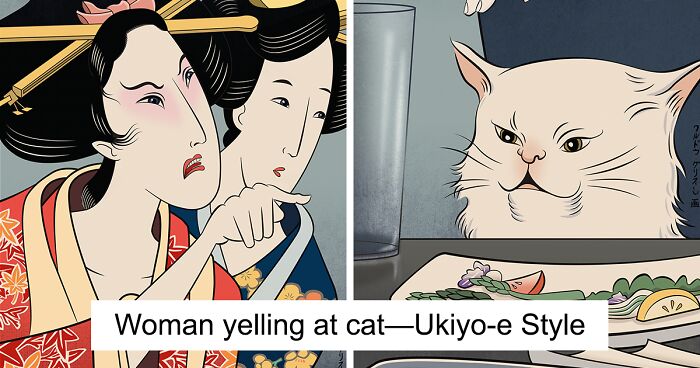
The meme that launched the project is an ideal candidate for a theatrical reinterpretation. Its original humor comes from contrast: an emotional human confrontation appears beside a deeply unimpressed cat sitting at a table.
In the Japanese print-style version, the familiar figures become characters in a dramatic historical scene. Flowing garments, strong outlines, carefully arranged poses, and period-inspired surroundings replace the television still and dinner-table photograph. Yet the emotional equation remains unchanged. One person is furious, another is attempting damage control, and the cat would apparently like everyone to stop interrupting supper.
This transformation demonstrates one of the series’ greatest strengths. The composition changes completely, but the meme remains recognizable within seconds.
2. Longcat and Tacgnol
Longcat belongs to an earlier era of internet humor, when a single unusually long white cat could become a global celebrity without needing a podcast, an energy drink, or a carefully managed personal brand.
The recreation treats Longcat and its dark counterpart, Tacgnol, like enormous mythological beings locked in an epic confrontation. Their exaggerated bodies fit naturally into the vertical energy of Japanese fantasy imagery. What began as an absurd photograph becomes a cosmic battle between elongated feline forces.
The joke works because the artwork gives a ridiculous meme the visual importance of a legendary conflict. It is the internet equivalent of commissioning a palace mural to commemorate two cats arguing over a cardboard box.
3. Doge
Doge is one of the internet’s most durable characters. The Shiba Inu’s sideways expression has been paired with intentionally fragmented phrases expressing surprise, admiration, confusion, and mild existential concern.
In the print-inspired version, Doge appears less like a household pet and more like an animal spirit observing human foolishness from a safe distance. Traditional patterns, restrained colors, and graphic outlines give the character an almost noble presence.
The contrast is delicious. Doge looks as though it possesses centuries of wisdom, yet the imaginary internal dialogue is probably still something like “much art,” “very history,” and “such robe.”
4. This Is Fine
The “This Is Fine” meme shows a small dog calmly sitting in a room consumed by flames. It has become a visual summary of denial, helplessness, forced optimism, workplace chaos, political anxiety, and any Monday morning when the printer begins making a noise previously heard only from injured farm machinery.
Translated into a Japanese print style, the flames become sweeping decorative forms, while the dog’s stillness grows even more striking. Traditional Japanese art frequently used stylized natural forces to create rhythm and movement. Here, that visual language intensifies the central joke: the entire environment is in violent motion, but the character refuses to acknowledge the emergency.
The image feels timeless because pretending everything is fine while circumstances visibly collapse is not merely an internet habit. It may be one of humanity’s oldest hobbies.
5. Retired Memes Reborn as Yōkai
Several works in the series imagine outdated or “dead” memes returning as yōkai. In Japanese folklore and visual culture, yōkai can include monsters, spirits, supernatural animals, possessed objects, tricksters, and other mysterious beings. Their personalities range from playful to dangerous.
Turning forgotten memes into supernatural creatures is a particularly smart idea. Memes rarely die completely. They linger in old folders, archived discussion boards, forgotten social accounts, and the memories of people who spent too much time online in 2012. At any moment, one may return with a new caption.
Portraying them as yōkai gives that cycle a mythological explanation. A dead meme does not vanish; it waits in the digital forest until someone accidentally summons it.
6. Dabbing With Demons
Dabbing was once so widespread that athletes, children, celebrities, teachers, and probably several confused grandparents performed it. The pose eventually became less fashionable, which makes its appearance among Japanese demons especially entertaining.
The print turns a short-lived dance gesture into part of a supernatural gathering. Demonic figures strike the unmistakable pose with complete seriousness, as though an ancient scroll has predicted that the fate of the world depends on placing one’s face near a bent elbow.
This piece captures the series’ playful attitude toward time. Historical imagery and temporary internet trends are treated as equally available ingredients. One carries centuries of artistic tradition; the other once appeared repeatedly in school photographs. Together, they create something strangely memorable.
7. Is This a Pigeon?
The confused anime character pointing toward a butterfly and asking whether it is a pigeon became a flexible template for misidentification. People use it whenever someone labels an object, idea, problem, or emotion incorrectly.
Reframed in a Japanese print style, the gesture becomes more formal and theatrical. The character’s confusion is preserved, but the scene now resembles an illustrated encounter between a traveler and a mysterious creature.
It is also a reminder that a meme’s identity often depends less on photographic detail than on pose and composition. Remove the original animation style, change the clothes, rebuild the background, and the joke still survives because the pointing gesture and mistaken conclusion remain intact.
8. Are Ya Winning, Son?
“Are Ya Winning, Son?” became popular because its simple scene can express affection, misunderstanding, generational distance, loneliness, or awkward parental support. A father enters a room and attempts to connect with his child through a question about gaming.
The Japanese-style recreation shifts the setting into a historical domestic environment while keeping the emotional structure recognizable. That new context makes the generational gap feel almost universal. Technology may change, but parents have probably always entered rooms at inconvenient moments and asked questions that were only approximately related to what their children were doing.
9. The Minimalist “OK” Reaction
The “OK” reaction image is especially suited to a monochrome ink treatment. Its power comes from resignation rather than action. The face does not celebrate, protest, or panic. It simply accepts whatever bizarre information has just entered the conversation.
Rendered with expressive black marks and generous empty space, the reaction gains the economy of an ink drawing. A few well-placed lines communicate an entire mood: acknowledgment without enthusiasm, consent without joy, and the emotional energy of someone clicking “accept” on terms and conditions they absolutely did not read.
Why These Works Are More Than Vintage Filters
It would be easy to create a shallow imitation of Japanese printmaking by adding faded paper, a red stamp, and a wave in the background. These pieces take a more involved approach.
According to the documented process, individual works can require several weeks of concept development, research, sketching, and completion. The artist combines traditional ink and paint with found materials such as vintage paper and cloth, then integrates digital techniques where needed.
That mixed-media method matters. The objective is not to claim that the pieces were produced by an Edo-period workshop. Instead, the artist borrows visual principles from historical prints while openly using contemporary tools. The physical materials provide texture and irregularity; digital methods allow the composition to be refined and prepared for modern reproduction.
Recognizable Silhouettes
A meme must remain identifiable after its setting and characters have been transformed. The artist therefore preserves essential silhouettes, gestures, spatial relationships, and facial expressions. The accusing woman still points. The cat remains unimpressed. The confused man still encounters the alleged pigeon.
Period-Inspired Costumes and Props
Modern clothing and furniture are replaced with robes, armor, domestic interiors, screens, scrolls, lanterns, landscapes, and other historically inspired details. These substitutions are not random decorations. They help establish a consistent fictional world.
Bold Lines and Controlled Color
Ukiyo-e prints are often recognized for strong contours, areas of relatively flat color, asymmetrical compositions, cropped forms, and carefully organized patterns. The meme recreations use similar qualities to turn messy online imagery into deliberate illustrations.
Folklore as a Creative Bridge
Yōkai, legendary animals, demons, and supernatural transformations make it possible to translate the internet’s stranger creatures into a Japanese-inspired visual vocabulary. Longcat can become a towering spirit. An abandoned reaction face can return as a monster. A popular dog can acquire the dignity of a legendary guardian while still thinking in broken adjectives.
Why Japanese Print Memes Work So Well
The humor depends on tension between familiarity and surprise. Viewers know the original meme, but they have never seen it staged this way. Recognition arrives first, followed by the pleasure of discovering how each element has been translated.
The project also exposes the folk-art quality of internet culture. Memes rarely belong to a single stable version. They are copied, captioned, altered, localized, combined with other images, and redistributed through communities. Traditional printmaking also allowed designs to circulate as multiples rather than existing only as unique objects hidden in private collections.
This does not make memes identical to historical prints, but it creates a meaningful point of comparison. Both can function as popular visual communication. Both reward audiences who recognize recurring characters and symbols. Both can preserve everyday humor alongside larger social anxieties.
A burning-room dog, for example, is funny because it is absurd. It is also useful because it expresses a recognizable psychological response to crisis. “Woman Yelling at a Cat” is chaotic nonsense, yet it provides a compact structure for conflict between outrage and indifference. Doge speaks badly but feels deeply.
By giving these characters elaborate artistic treatment, the project asks viewers to reconsider what counts as culturally valuable. Today’s disposable joke may become tomorrow’s archived folkloreor at least tomorrow’s coffee mug.
A Creator’s Experience: Turning a Quick Joke Into Slow Art
The most interesting part of recreating a meme in a Japanese print style is the difference in speed. A meme is usually consumed in seconds. The viewer sees it, understands it, laughs, and scrolls onward. Creating the reinterpretation can take weeks.
My starting point is not simply asking which meme is popular. Popularity changes too quickly. I look for an image with a strong visual structure: a memorable pose, a clear relationship between characters, or a joke that can survive without its original photograph. If the humor disappears as soon as the clothing changes, the concept may not be strong enough.
The first successful experiment was personal. Recreating “Woman Yelling at a Cat” as a Christmas gift gave the project an emotional reason to exist before it became a public series. That mattered because the work required far more effort than expected. Once the modern setting was removed, every element needed a replacement. What should the figures wear? Where should the cat sit? How could the pointing gesture remain dramatic without looking pasted into the scene?
Research became part of the creative process rather than a separate academic chore. I studied print compositions, clothing shapes, decorative patterns, folklore, animals, architecture, dramatic gestures, and the treatment of natural forces. The goal was not to copy one historical print. It was to understand enough of the visual language to build a convincing fictional scene.
Sketching often reveals whether the joke will survive. A recognizable meme has a hidden skeleton. In “Woman Yelling at a Cat,” that skeleton is the diagonal energy of the pointing figure against the cat’s stubborn stillness. In “This Is Fine,” it is the calm character surrounded by obvious danger. With Doge, the expression itself carries most of the meaning.
Once that structure works, details can be added through ink, paint, vintage paper, cloth, and digital finishing. Physical materials introduce imperfections that are difficult to manufacture convincingly on a screen. Paper fibers, uneven edges, brush pressure, and small color variations give the image a tactile presence. Digital tools then help assemble, adjust, and prepare the final artwork without erasing those handmade qualities.
One of the biggest challenges is restraint. A Japanese-inspired setting offers countless opportunities for patterns, waves, clouds, creatures, text panels, costumes, and dramatic scenery. Adding everything would bury the meme under a decorative avalanche. The final image still has to deliver its joke immediately.
Another challenge is balancing respect with playfulness. The comedy should come from the meeting of two visual cultures, not from treating Japanese art as an exotic costume. Specific research, thoughtful composition, and acknowledgment of the project’s mixed-media nature are essential. These works are contemporary tributes and remixes, not historical ukiyo-e prints.
The most rewarding moments occur when viewers recognize both sides of the combination. Some arrive because they love Japanese art. Others come for Doge, Longcat, reaction faces, or demons performing dance moves. When both groups find something to enjoy, the image has done its job.
The experience has also changed how I think about “dead” memes. Online culture moves so quickly that an image can feel ancient after only a few years. Recasting forgotten memes as supernatural beings gives them another life. They become digital ghostsfamiliar, slightly embarrassing, and fully capable of returning when nobody expects them.
Ultimately, this project has taught me that humor does not need to be careless and detailed art does not need to be solemn. A piece can involve research, traditional materials, multiple revisions, and weeks of work while still ending with a confused person pointing at a butterfly. Serious craftsmanship and ridiculous subject matter are not enemies. In the right composition, they make excellent roommates.
Conclusion: A Beautifully Absurd Cultural Remix
“I Recreate Favorite Memes in Japanese Print Styles” succeeds because it does more than make old art look funny. The series identifies a genuine connection between two forms of popular visual culture and builds an imaginative world around it.
Ukiyo-e-inspired linework, theatrical poses, patterned clothing, folklore, dramatic landscapes, and supernatural creatures give familiar memes a new narrative scale. Meanwhile, the memes prevent the artwork from becoming stiff or reverential. A noble-looking composition may still contain a judgmental cat. An intimidating demon may still be dabbing.
The 11 pictures celebrate the strange afterlife of online images. Memes are copied, transformed, forgotten, rediscovered, and transformed again. By slowing that process down and rebuilding each joke through research and mixed media, the artist turns temporary digital humor into something that feels collectible, reflective, and delightfully weird.
Perhaps that is the final lesson of the floating world: everything passes, but a sufficiently determined cat meme may pass several thousand times.