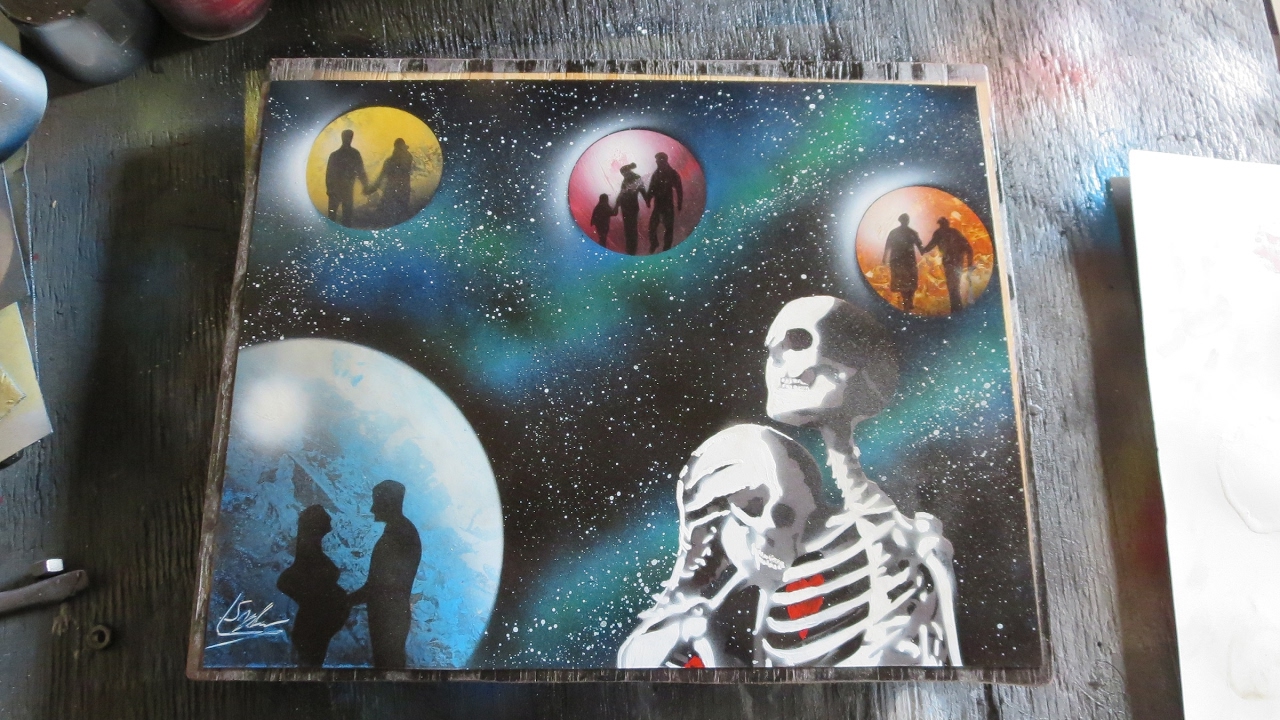
Some artworks arrive politely. Others kick open the door, leave a fog of color in the room, and refuse to explain themselves like respectable adults. Spray paint art often belongs to the second group, and that is part of the fun. It is quick, physical, unpredictable, and strangely intimate for a medium that starts with a hiss.
That is why “Timeless Timelines” by Levon Snyder is such an interesting title for a spray paint piece. The phrase sounds like a paradox on purpose. A timeline suggests sequence, deadlines, and the relentless little treadmill of before and after. “Timeless,” meanwhile, shrugs at clocks and says, “Cute concept. I’ll be over here in eternity.” Put those words together and you get a title that feels emotionally loaded before you even talk about technique.
And with Snyder, emotion matters. Public descriptions tied to the work point to a period of grief, memory, and mental overload. That context changes everything. Suddenly, this is not just another cool aerosol painting with dramatic atmosphere. It becomes a work about what happens when time stops making sensewhen loss makes yesterday feel too close and two years feel like two minutes and two centuries at the same time.
Who Is Levon Snyder, and Why Does This Piece Stand Out?
Levon Snyder has presented himself publicly as a spray painter, artist, tinkerer, and all-around maker. That maker energy matters. Some artists build careers around staying inside one lane; Snyder’s public work suggests somebody who likes crossing lanes with snacks in the passenger seat. His online posts connect him to original spray paint scenes, playful fan-driven projects, and pop-culture paintings that wear their enthusiasm proudly. There is a refreshing lack of fake mystery in that kind of practice. He seems interested in making things because making things is fun, weird, and sometimes necessary.
That broader body of work makes “Timeless Timelines” feel even more compelling. When an artist who can clearly enjoy spectacle, fandom, and visual punch shifts into a more reflective register, the result carries extra weight. It tells you this piece was not made just to look impressive in a thumbnail. It was made because something needed to come out.
In a digital culture that rewards bright, fast, scroll-stopping images, personal work can still cut through when it has emotional pressure behind it. Snyder’s title does exactly that. It sounds poetic without trying too hard. Better yet, it sounds lived-in. It does not read like a committee-tested gallery caption. It reads like somebody trying to name the feeling of carrying memory through time when time itself has gone crooked.
Why “Timeless Timelines” Is Such a Strong Title
Let’s give the title the appreciation it deserves, because it is doing real heavy lifting here. “Timeless Timelines” works because it holds two truths at once. Time is measurable, but grief does not behave. Memory is chronological, but emotion is not. A person can remember events in order and still feel them out of order. That tension is exactly what the phrase captures.
It also fits the logic of spray paint art. Aerosol painting is a medium of rapid decisions and layered revisions. Artists build atmosphere quickly, cover, reveal, scrape, mask, and improvise. It is both immediate and cumulative. In other words, it behaves a little like memory. One layer does not erase the layer beneath it. It changes how the layer beneath is seen.
That is why the title feels more than clever. It feels structurally right. A good title should not just decorate an artwork; it should echo the artwork’s logic. “Timeless Timelines” suggests loops, echoes, recurring thoughts, and a personal history that refuses to sit quietly in the past. It is the kind of phrase that makes you pause, then reread, then mutter, “Okay, that’s annoyingly good.”
Spray Paint as a Medium: Fast, Messy, Honest
The medium matches the mood
Spray paint has always carried a built-in tension between control and chaos. You can guide it, but you never fully domesticate it. It blooms fast, catches edges, creates soft atmospheres, and can jump from silky gradients to aggressive texture in a heartbeat. That makes it ideal for artwork about memory, time, and emotionsubjects that rarely arrive in neat little rectangles.
There is also something psychologically direct about aerosol painting. Traditional brushwork can feel meditative and deliberate. Spray paint feels bodily. Your arm moves differently. Your distance from the surface matters. Pressure, angle, cap choice, layering, and timing all show up instantly. The result often looks less like a polished diary entry and more like a live transmission from the nervous system.
Speed can create sincerity
That speed is not a shortcut. It is part of the language. In the best spray paint art, quickness creates sincerity. The image forms with momentum, and that momentum becomes part of the feeling. You do not merely see the painting; you feel the pace at which it was wrestled into existence. For a piece like “Timeless Timelines,” that matters. Work rooted in grief or mental noise often benefits from a medium that can move as fast as thought and still leave visible evidence of the struggle.
And yes, spray paint also has swagger. It is hard for aerosol art to look shy. Even quiet spray paint pieces tend to have a certain cinematic confidence. That contrastbig visual presence paired with vulnerable emotional contentcan be especially effective. It lets an artist say something deeply personal without whispering.
From Wall Culture to Gallery Language
Part of what makes Snyder’s work interesting in a broader art conversation is that spray paint art carries an enormous cultural history. Graffiti and wall-based expression existed long before the modern spray can, but aerosol transformed the visual speed and scale of public art. Over time, what many people dismissed as vandalism also became one of the most influential visual languages in modern culture.
That history matters because it helps explain why works like “Timeless Timelines” can feel both raw and sophisticated at the same time. Aerosol painting comes with street-level immediacy, but it also comes with decades of artistic evolutionmovement from trains and walls to canvas, from underground identity to museum legitimacy, from ephemeral gesture to collectible object.
In plain English: the medium grew up without losing its attitude. That is a rare trick.
So when viewers respond strongly to a spray paint piece on canvas or board, they are not just responding to color. They are responding to a whole lineage of speed, risk, scale, rebellion, experimentation, and adaptation. Snyder’s work taps into that lineage even when the subject turns inward. That makes the piece feel larger than a personal exercise. It sits at the intersection of individual grief and a medium built for public impact.
Grief, Memory, and the Strange Shape of Time
The emotional frame around “Timeless Timelines” gives the piece its center of gravity. When someone talks about losing multiple loved ones in a short span, the phrase “timeline” stops sounding neutral. Loss rearranges time. Dates remain on calendars, but emotional reality goes off-road.
Anyone who has been through bereavement knows the experience can feel deeply nonverbal. You remember details you do not want, forget details you do want, and move through ordinary days carrying extraordinary internal weather. That is one reason visual art can become such a meaningful outlet. It does not require grief to explain itself in complete sentences. It allows color, space, motion, layering, and symbol to do part of the talking.
That makes Levon Snyder’s Timeless Timelines more than a title attached to a painting. It reads like a short thesis on mourning. Not mourning as a neat sequence of stages. Mourning as repetition, interruption, collision, and echo. Mourning as a timeline that refuses to stay linear.
And honestly, that is what gives the work its likely staying power. Not the fact that it is spray paint. Not the fact that it is dramatic. Not even the fact that it emerged from pain. It is memorable because it names a truth that many people recognize instantly: time can move forward while the heart keeps circling.
What Makes Snyder’s Style Appealing Online
Another reason this piece deserves attention is that Snyder’s public art presence appears approachable rather than overly polished. That may sound like a small thing, but it matters in online art culture, where some creators market themselves so aggressively that the art starts to feel like an accessory to the algorithm.
Snyder’s publicly visible projects suggest range. He has shared spray-paint work tied to fantasy, pop culture, and recognizable fan favorites, which tells us he is comfortable with bold visual hooks and broad audience appeal. That makes “Timeless Timelines” even more interesting, because it points to another side of the practice: not just spectacle, but reflection; not just visual fun, but emotional processing.
This balance is powerful. Artists who can make accessible work without becoming shallow usually build stronger connections with audiences over time. They give people an entry point first, then a reason to stay. In Snyder’s case, the entry point might be the sheer energy of aerosol painting. The reason to stay is the sense that beneath the color and technique, there is actual life happening.
That is the sweet spot for contemporary art on the internet. Viewers do not only want polished images. They want a pulse.
Why “Timeless Timelines” Feels Contemporary
This piece feels contemporary not because it chases trends, but because it reflects how people actually experience life right now. Modern life is overloaded with timelines: social media timelines, life timelines, career timelines, trauma timelines, family timelines, healing timelines, and the extremely rude timeline of aging. We are constantly told to move on, level up, post the update, and optimize the next chapter.
“Timeless Timelines” quietly resists that pressure. Its title suggests that human experience cannot always be sorted into orderly progress bars. Some emotions linger. Some moments return. Some losses flatten time altogether. That idea feels especially relevant in an era when people are publicly discussing burnout, grief, memory, and mental strain with more honesty than previous generations were often allowed.
Spray paint is an excellent medium for that conversation because it looks immediate and lived. It does not arrive wearing a tuxedo and pretending not to sweat. It arrives with velocity. And sometimes velocity is exactly what truth looks like.
Extended Reflection: The Experience Around a Work Like “Timeless Timelines”
There is a particular experience that comes with encountering a piece like “Timeless Timelines”, even when you first meet it through a screen. You do not necessarily begin with analysis. You begin with atmosphere. Spray paint does that well. It creates mood before logic has time to button its shirt.
You imagine the sound first: that sharp aerosol hiss, the quick stop, the shake of the can, the return pass. Then you imagine the physical rhythm of making. Spray paint art is not passive. It is full of reaching, angling, covering, revealing, stepping back, leaning in, and deciding in real time whether a mark should stay or disappear under the next layer. That physical intensity matters because a title like “Timeless Timelines” is not just intellectual. It feels bodily. It feels like something made while carrying weight.
And that is probably why work like this resonates. Most people know what it means to be caught between moving on and looking back. You can be in the middle of an ordinary daybuying groceries, answering emails, pretending to understand your passwordsand suddenly memory cuts across the moment like a bright stripe of color on a dark surface. That is how grief behaves. That is how love behaves too, if we are being honest. Neither one respects scheduling.
There is also something moving about the choice to use spray paint for a personal meditation on time. Aerosol is often associated with walls, rebellion, spectacle, and public space. Using that visual language for something inward creates an interesting emotional contrast. The medium says, “Look at me.” The theme says, “Please understand me.” When those two instincts meet successfully, the result can be deeply memorable.
Another part of the experience is accessibility. Spray paint art often feels less locked behind elite art-world manners than some other forms. Viewers do not need a graduate seminar and three suspiciously expensive tote bags to respond to it. They can feel it immediately. They can connect to color, tension, movement, and title before they know a single thing about art history. That does not make the work simple. It makes it open.
And openness matters. Especially with a piece linked to loss. The most affecting art about grief usually does not trap the viewer inside somebody else’s biography. It leaves room for the viewer’s own memories to arrive. A title like “Timeless Timelines” invites exactly that. It gives people language for feelings they may not have named yet. Maybe that is the real success of the work. Not that it explains pain, but that it recognizes the shape of it.
By the time you step away from a piece like this, you may not remember every technical choice. You may not even remember every visual detail. But you remember the sensation of being briefly pinned between past and present. You remember the feeling that time can stretch, fold, and repeat. You remember that art made from pressure can sometimes give pressure a place to go. That is not a small achievement. That is the kind of thing people mean when they say a work stays with them.
Conclusion
Levon Snyder’s “Timeless Timelines” works because it brings together three things that do not always coexist gracefully: a bold medium, a vulnerable subject, and a title that actually earns its drama. The piece sits at the crossroads of aerosol technique, online-era accessibility, and very old human questions about memory, grief, and the weird elasticity of time.
It also reminds us that spray paint art is not limited to spectacle. Yes, it can be loud. Yes, it can be flashy. Yes, it can absolutely make a wall look cooler than the wall ever deserved. But it can also carry thought, contradiction, tenderness, and mourning. In the right hands, spray paint does not flatten emotion. It amplifies it.
That is what makes “Timeless Timelines” worth writing about. It is not simply a neat title attached to a visually striking medium. It is a compact idea with emotional reach. It suggests that our lives are built from layers, that our losses do not leave on schedule, and that art can turn that messy truth into something vivid enough to share. Not tidy. Not finished. But shared. And sometimes that is the most honest kind of timeless there is.