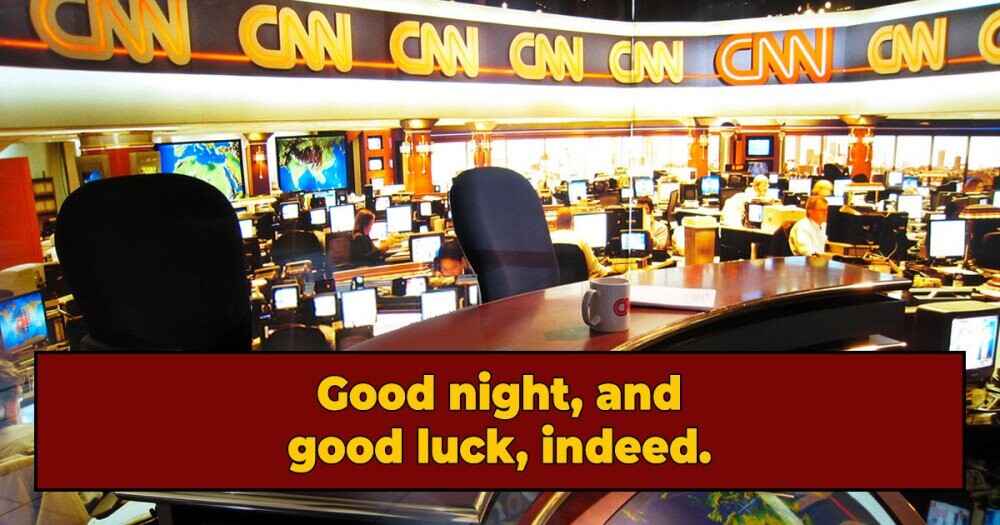
Some television networks keep blooper reels. Some keep archival footage of presidents, hurricanes, wars, elections, and celebrities pretending they “don’t read the comments.” CNN, however, has long been associated with something much stranger: a so-called “doomsday video” reportedly created to air when the end of the world is confirmed.
Yes, that sounds like the plot of a late-night comedy sketch written after too much coffee and one suspiciously dramatic thunderstorm. But the story is real. The video is commonly known as the Turner Doomsday Video, named after CNN founder Ted Turner, the media entrepreneur who launched the Cable News Network in 1980 and helped invent the modern 24-hour news cycle. The clip is not an explosive montage, not a presidential warning, and not a Hollywood-style farewell full of swelling violins and heroic astronauts. It is much simplerand somehow creepier for that reason.
The video reportedly shows military band members performing the hymn “Nearer, My God, to Thee” outside CNN’s original Atlanta headquarters. It lasts about a minute. It looks grainy, formal, and deeply analog, like something recorded for a world of boxy televisions, rotary phones, and Cold War nightmares. Its purpose, according to the long-running legend and later reporting, was to serve as CNN’s final sign-off if humanity ever reached the point where there was nothing left to report except, well, the end.
What Is CNN’s Doomsday Video?
CNN’s doomsday video is an archival clip reportedly commissioned at Ted Turner’s direction around the time CNN was launched. Internally, it became associated with the title “Turner Doomsday Video.” The concept was both dramatic and perfectly on-brand for Turner: CNN would be a network that never signed off. Unlike traditional television stations that ended the broadcast day with a national anthem or a test pattern, CNN was designed to run constantly, covering news all day and all night.
Turner’s grand promise was that CNN would remain on air until the world ended. If that day ever arrived, the network would not simply cut to static. It would have one final piece of programming ready: a solemn performance of “Nearer, My God, to Thee.” In other words, while most companies have fire drills, CNN allegedly had an apocalypse outro.
The video’s power comes from its restraint. It does not explain what happened. It does not name a disaster. It does not say whether the crisis is nuclear war, asteroid impact, plague, climate catastrophe, alien accountants, or the complete collapse of Wi-Fi. Instead, it presents a quiet musical farewell. That lack of specificity makes it oddly universal. The viewer fills in the blank with whatever end-of-the-world scenario keeps them awake at 2:17 a.m.
How Ted Turner’s Big Promise Became Broadcast Folklore
To understand the doomsday tape, you have to understand Ted Turner. He was not a “let’s run this through six committees” kind of executive. Turner was bold, loud, competitive, impulsive, and visionary. Before CNN, television news largely belonged to the big broadcast networks and their scheduled evening programs. Viewers waited for the news. Turner asked a simple but radical question: what if the news was always on?
When CNN debuted on June 1, 1980, many industry observers doubted it would survive. Critics mocked it as the “Chicken Noodle Network,” a joke aimed at its initials and early low-budget appearance. But Turner’s idea changed television. CNN made breaking news feel immediate, global, and continuous. Later, events such as the Challenger disaster, the fall of the Berlin Wall, the Gulf War, and countless live crises helped prove the value of always-on reporting.
The doomsday video fits that same ambitious mindset. It is eccentric, but it is not random. Turner imagined CNN not merely as a channel but as a permanent witness. If history was happening, CNN would be there. If the final page of history was being written, CNN would still be there, camera rolling, lights on, band ready.
What The Video Actually Shows
The clip itself is visually simple. A military band stands outside a red-brick building associated with CNN’s early Atlanta presence. The musicians perform “Nearer, My God, to Thee,” a Christian hymn often linked in popular memory to the sinking of the Titanic, though historical accounts differ about exactly what the Titanic band played in its final moments.
That musical choice matters. The hymn carries associations of mortality, surrender, and solemn dignity. It is not the national anthem. It is not a triumphant march. It is not “Don’t Stop Believin’,” although one could argue that would have made the apocalypse slightly more karaoke-friendly. Instead, the hymn creates the mood of a final ritual.
The footage is reportedly standard-definition and in a 4:3 aspect ratio, which gives it a preserved-in-amber quality. To modern viewers used to high-resolution livestreams and vertical video, it feels like a message from another media universe. That retro texture makes the whole thing more unsettling. It does not look like a slick hoax. It looks like something a serious organization filed away and hoped never to use.
How The Public Finally Saw It
For decades, CNN’s end-of-the-world video lived mostly as an internal legend and media curiosity. The New Yorker wrote about Turner’s secret sign-off tape in 1988, presenting it not as internet lore but as part of Turner’s larger anxiety about nuclear war and the future of humanity. Years later, in 2015, the story exploded online when writer and former CNN intern Michael Ballaban published the video after saying he had encountered it during his internship years earlier.
The internet reacted exactly as the internet tends to react when handed something bizarre, real, and slightly haunted: with fascination, jokes, existential dread, and a few people undoubtedly asking whether there was a 4K remaster. News and culture sites covered the clip. Viewers shared it as a strange relic from early cable television. The phrase “CNN doomsday video” became a perfect search-engine magnet because it combines three irresistible ingredients: a famous network, secret media lore, and the end of everything.
The clip resurfaced again in public discussion after Ted Turner’s death in 2026, when many people revisited his role in creating CNN and reshaping television news. In that context, the doomsday video became more than a weird artifact. It became a symbol of Turner’s personality: theatrical, anxious, grand, and determined to make television feel as large as history itself.
Is The Doomsday Video An Official Emergency Broadcast?
No. That distinction is important. CNN’s doomsday video is not the same thing as the Emergency Alert System, the national public warning infrastructure used in the United States to distribute urgent information through broadcasters, cable systems, satellite providers, and other channels. Real emergency alerts exist to warn people about immediate danger and provide instructions. They are functional, regulated, and designed to save lives.
The Turner Doomsday Video is different. It is not a civil defense script. It does not tell viewers where to shelter, what to avoid, or whether canned beans are now the official currency. It is a symbolic sign-off tape. It belongs to the world of broadcasting culture, not public safety protocol.
That difference actually makes the video more interesting. Emergency alerts are about action: listen, move, shelter, evacuate, prepare. The CNN doomsday tape is about finality. It imagines the moment after usefulness has run out, when reporting can no longer change the outcome and the broadcaster’s role becomes ceremonial. That is a chilling idea for a news organization, because news is built on the assumption that information still matters.
Why The Video Feels So Creepy
The doomsday video is creepy because it is calm. Modern disaster entertainment usually screams at us. Buildings explode. Sirens wail. News anchors shout over graphics the color of hot sauce. The CNN clip does none of that. Its horror is polite. It stands upright, plays a hymn, and quietly closes the door.
It also feels eerie because it was made by a real news network, not a filmmaker. This was not a prop created for a dystopian movie. It emerged from the mindset of a broadcaster living through an era shaped by nuclear anxiety. During the Cold War, the possibility of sudden global catastrophe was not abstract. It was in politics, schools, movies, public-service announcements, and everyday imagination. Turner’s tape captured that anxiety in one strange minute.
There is also something haunting about the phrase “last surviving employee,” often repeated in discussions of the video. It turns the clip into a tiny workplace horror story. Somewhere in the imagined final minutes of civilization, one exhausted CNN staffer is still at the controls, checking the archive, cueing the tape, and presumably wondering whether the break room still has coffee. It is absurd. It is tragic. It is exactly the kind of darkly comic image that makes the story stick.
The Bigger Meaning: CNN, The 24-Hour News Cycle, And The End Of News
The CNN doomsday video is not just a curiosity. It also reveals something about the identity of 24-hour news. CNN was built on the promise that news does not stop. There is always another update, another live shot, another expert panel, another “developing story” banner. The doomsday tape asks the uncomfortable question underneath that promise: what happens when there is no next update?
In the streaming era, the idea of nonstop media feels normal. Our phones deliver alerts before we have finished brushing our teeth. Social platforms turn every earthquake, verdict, celebrity breakup, sports trade, and suspicious raccoon sighting into a rolling feed. But when CNN launched, continuous news was a radical experiment. Turner’s doomsday video sits at the extreme edge of that experiment. It imagines news coverage extending all the way to the final possible moment.
That is why the tape remains fascinating. It is funny in a bleak way, but it is also profound. News organizations exist because people want to know what is happening. The doomsday video imagines a moment when everyone knows what is happening, and the knowledge changes nothing. That is the darkest possible punchline to the 24-hour news cycle.
Why People Still Search For CNN’s Doomsday Video
People search for CNN’s doomsday video because it has the perfect shape of a modern internet mystery. It is short, strange, verifiable, and easy to describe in one irresistible sentence: CNN has a video ready for the end of the world. That sentence practically clicks itself.
The story also appeals to our love of hidden rooms inside familiar institutions. We like discovering that famous companies have secret archives, old contingency plans, forgotten tapes, and strange rituals. It reminds us that even huge organizations are built by human beings with fears, jokes, habits, and dramatic impulses. Somewhere beneath the polished surface of corporate media, there was a file with a title that sounded like it belonged in a bunker.
The video also survives because it is oddly tasteful. A lesser version of this idea would have been ridiculous. Imagine a final CNN montage with spinning globes, explosions, celebrity farewell cameos, and a lower-third reading “WORLD ENDS: PANEL REACTS.” Instead, Turner’s version is restrained enough to remain powerful. It is one minute of music. That simplicity gives it dignity.
Experiences Related To CNN’s Doomsday Video
Watching CNN’s doomsday video today is a surprisingly personal experience, even for viewers who were not alive when CNN launched or when Cold War fears shaped American culture. At first, the clip can seem almost underwhelming. A band plays. The camera holds. Nothing flashes. Nobody explains anything. Then the meaning catches up with the image, and the simplicity becomes the point. You are not watching a disaster. You are watching a prepared goodbye.
The experience is especially strange because modern audiences are trained to expect constant interpretation. If a major event happens, we expect live blogs, push notifications, maps, timelines, explainers, reaction videos, podcasts, and at least one person on social media confidently wrong within four minutes. The doomsday video offers none of that. It feels like the anti-internet: no comments, no updates, no argument, no algorithmic recommendations. Just a solemn performance and the implication that the conversation is over.
That silence makes viewers think about how much emotional weight we place on media during crisis. When something frightening happens, people often turn on the news not only for facts but for companionship. A live broadcast creates the feeling that someone is awake with us, watching the same storm, war, election, fire, or emergency. CNN’s doomsday tape pushes that relationship to its absolute limit. It imagines the broadcaster staying with the audience until there is no audience left.
There is also an unexpectedly human quality to the story. Ted Turner was a billionaire media mogul, but the tape reveals a very ordinary fear: the fear that humanity might destroy itself and that there may be no time for final words. The video is not really about ratings or branding. It is about the need to mark an ending with something meaningful. People have done that for centuries with bells, hymns, poems, prayers, letters, and songs. Turner happened to do it with a cable news archive.
For writers, journalists, broadcasters, and ordinary news consumers, the tape can feel like a reminder of media’s strange responsibility. News is often noisy, flawed, competitive, and exhausting. Yet at its best, it records reality while reality is still happening. The doomsday video turns that mission into a dark fable. It says: keep the signal alive, even when the story is too big to survive.
Of course, there is humor in the experience too, because the human brain is mercifully ridiculous. It is hard not to imagine the final CNN control room: one producer, one blinking monitor, one stale vending-machine snack, and one last decision about whether the apocalypse deserves breaking-news music. That blend of solemnity and absurdity is exactly why the doomsday video continues to fascinate. It is terrifying, yes, but it is also weirdly funny in the way only real life can be.
Conclusion
CNN’s doomsday video remains one of the strangest and most memorable artifacts in television history. It is not a government warning, not a movie prop, and not merely an internet myth. It is a symbolic final sign-off tied to Ted Turner’s audacious vision for CNN: a network that would keep broadcasting as long as there was still a world to cover.
The clip’s continued fascination comes from the contrast between its tiny runtime and enormous premise. In about a minute, it captures Cold War anxiety, media ambition, religious imagery, institutional weirdness, and the dark comedy of a news network preparing for the one story that would make all future programming unnecessary. For a video supposedly meant for the end of everything, it has had a remarkably long afterlife.
Note: This article is written for informational and editorial publication purposes. It summarizes publicly reported accounts of CNN’s Turner Doomsday Video and related media history without reproducing source links inside the article body.