Note: This article is written from publicly available defense reporting and official program information, focusing on high-level technology, safety, modernization, and strategic analysis rather than operational instructions.
When a Howitzer Gun Decides It Also Wants to Be Air Defense
The phrase “howitzer gun” usually brings to mind heavy artillery, long-range fire support, and a very loud reminder that physics has no indoor voice. But the U.S. Army’s M109A7 Paladin has stepped into a much stranger conversation: using cannon artillery to help shoot down missile-like aerial threats. Yes, the same family of self-propelled howitzers traditionally built to support armored brigades on land has been connected to experiments involving hypervelocity projectiles and networked air defense.
To be clear, the M109A7 Paladin is not suddenly replacing Patriot batteries, Aegis ships, or dedicated missile defense systems. Nobody is asking a tracked howitzer to put on sunglasses and become the entire air defense department. The real story is more interesting: the Army and its partners are exploring whether existing artillery platforms, paired with fast guided projectiles and modern sensor networks, can add another layer to defense against cruise missiles, drones, and other fast-moving threats.
That matters because modern battlefields are increasingly crowded with missiles, unmanned aircraft, loitering munitions, rockets, and precision-guided weapons. Intercepting every threat with expensive missiles can become financially painful very quickly. A cannon-launched projectile, if reliable and accurate enough, may offer a lower-cost way to help protect bases, formations, and important infrastructure. In plain English: instead of swatting every mosquito with a diamond hammer, the military wants more practical flyswatters.
What Is the Army M109A7 Paladin?
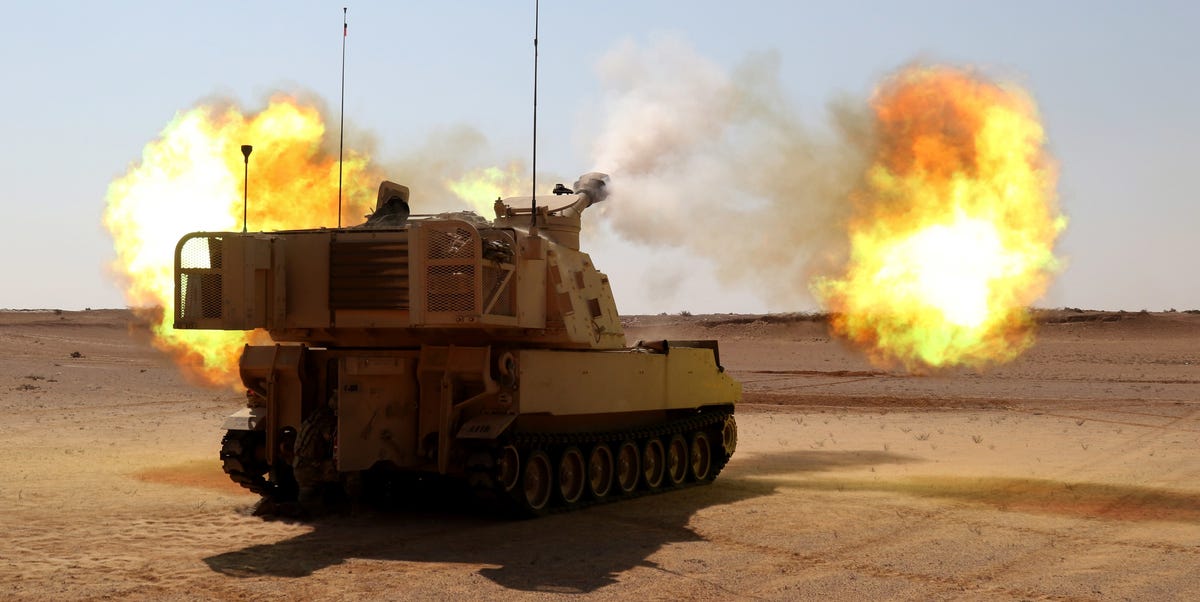
The M109A7 Paladin is the latest major U.S. Army version of the long-running M109 self-propelled howitzer family. It is a tracked, armored 155mm artillery system built to move with armored brigade combat teams and provide indirect fire support. Unlike a towed howitzer, the Paladin carries its cannon, crew protection, mobility systems, digital controls, and onboard power in one vehicle. It looks a bit like a tank to casual observers, but it is not designed for tank-style direct combat. Its job is artillery: firing from protected positions, moving quickly, and supporting maneuver forces.
The M109A7 grew from the Paladin Integrated Management program, which modernized the older M109A6. The upgrade retained familiar artillery elements while improving the vehicle’s chassis, electrical power, cooling, reliability, survivability, and compatibility with other Army armored systems. One important idea behind the M109A7 is growth potential. Modern battlefields demand more electronics, better networking, improved power management, and faster connection to command-and-control systems. The M109A7 was built with those future upgrades in mind.
BAE Systems produces the M109A7 for the Army, along with the M992A3 ammunition carrier that supports it. Recent production contracts show that the Paladin remains a serious part of Army artillery modernization, even as the service experiments with longer-range fires, new projectiles, robotic systems, and integrated air defense concepts.
So, Did a Paladin Really Shoot Down a Missile?
The headline sounds like something a bored defense engineer might pitch after drinking too much coffee: “What if the howitzer could shoot down a cruise missile?” But in a 2020 Advanced Battle Management System demonstration, a Paladin-based 155mm howitzer fired a hypervelocity projectile at a BQM-167 target drone acting as a cruise missile surrogate. The event took place at White Sands Missile Range in New Mexico and was widely reported as a notable demonstration of networked command, sensors, and cannon-launched intercept capability.
The important phrase here is “surrogate.” The target was not an actual hostile missile. It was a drone designed to represent the flight characteristics of a cruise missile for testing. Still, the demonstration was significant because it showed that artillery could be connected into a broader detection-and-engagement network. The howitzer was not acting alone like a cowboy cannon in a Western movie. It depended on the larger system: sensors detecting the target, command-and-control networks sharing information, and a specialized projectile designed for extreme speed and precision.
This is why the story is bigger than one shot. The real breakthrough is not simply “a big gun hit a flying object.” The larger point is that old categories are blurring. Artillery is no longer only about firing shells at ground targets. Air defense is no longer only about dedicated missile launchers. The future battlefield may use any suitable sensor, any connected command node, and any available shooter that can solve the problem in time.
The Hypervelocity Projectile: Small Object, Big Personality
The star of the missile-defense experiment was not just the howitzer gun itself. It was the hypervelocity projectile, often described as a fast, guided round that can be fired from existing cannon systems. The concept has been associated with both Army artillery and Navy guns, giving it an unusual cross-service flavor. Think of it as a highly ambitious shell with a résumé that refuses to fit on one page.
A hypervelocity projectile is designed to travel much faster than traditional artillery rounds and maneuver with greater precision. In air-defense roles, speed matters because the target is moving quickly and the engagement window is short. A slow response is not helpful when a cruise missile is closing in. A fast projectile gives the defensive system a better chance to reach the target in time.
The cost argument is equally important. Advanced interceptor missiles are extremely capable, but they can also be expensive. If a cannon-launched projectile can defeat certain threats at a lower cost per shot, it could help rebalance the economics of defense. That does not mean it works against everything, everywhere, all the time. It means it may become one useful tool in a layered defensive toolbox.
Why Shooting Down Missiles With Artillery Matters
1. The Cost Curve Is Getting Ugly
Modern militaries face a math problem that no one enjoys. Cheap drones, massed rockets, and cruise missiles can force defenders to spend expensive interceptors. When the defensive shot costs far more than the incoming threat, the attacker may gain an economic advantage. Cannon-based air defense could help reduce that imbalance for some targets.
2. Existing Platforms Can Gain New Missions
The M109A7 Paladin already exists in the Army inventory. If existing artillery platforms can be adapted for additional defensive missions through new ammunition, software, sensors, and network integration, the Army can expand capability without building every tool from scratch. That is modernization with a practical haircut.
3. Layered Defense Needs More Layers
No single system can handle every aerial threat. A layered defense may include long-range sensors, fighter aircraft, missile interceptors, electronic warfare, short-range air defense, directed-energy systems, and cannon-based options. The Paladin concept fits into this broader idea: more ways to respond, more flexibility, and fewer single points of failure.
4. Networked Warfare Is the Real Engine
The Paladin’s missile-defense demonstration was tied to the Advanced Battle Management System and the wider Joint All-Domain Command and Control vision. That may sound like a defense acronym convention, but the idea is simple: connect sensors and shooters across land, air, sea, space, and cyber domains so commanders can respond faster. The projectile matters. The cannon matters. But the network is what helps turn information into action.
M109A7 vs. Traditional Missile Defense Systems
The M109A7 Paladin should not be misunderstood as a direct competitor to high-end missile defense systems. Patriot, Aegis, NASAMS, and other dedicated air-defense platforms are built around specialized radars, interceptors, and command systems. They are designed from the ground up for aerial threats. The Paladin is first and foremost an artillery vehicle.
The potential value of the M109A7 in this role is supplemental. It could provide another defensive option in certain scenarios, especially against selected lower-altitude or cruise-missile-like threats if connected to the right sensors and loaded with suitable projectiles. In other words, the Paladin is not becoming Superman. It is becoming that surprisingly useful person in a group project who says, “Actually, I can help with that too.”
This distinction matters for readers and policymakers. Cannon-based missile defense is promising, but it is not magic. It depends on detection, tracking, fire-control quality, projectile performance, weather, target behavior, logistics, and command decisions. The demonstration proved potential, not unlimited capability.
How the M109A7 Fits Into Army Modernization
The Army has been modernizing artillery because long-range precision fires have become central to modern conflict. Lessons from recent wars show that artillery must move quickly, survive counterfire, connect digitally, and fire accurately. The M109A7 improves on older Paladin models by offering better automotive systems, greater electrical capacity, updated controls, and improved sustainability.
Its companion M992A3 ammunition carrier is also part of the system. Artillery is not just about the cannon; it is about ammunition flow, maintenance, crew endurance, targeting data, and the ability to keep operating under pressure. The Paladin family remains relevant because it combines mobility, protection, and a mature logistics base.
At the same time, the Army is exploring future cannon systems, longer barrels, extended-range ammunition, and multi-domain artillery concepts. The idea of using cannon artillery against aerial threats fits naturally into this modernization environment. It is not a random science fair project. It is part of a larger push to make every platform more connected, flexible, and useful.
Real-World Examples and Strategic Context
The 2020 White Sands demonstration is the best-known example linked to the Paladin missile-defense headline. During that event, a Paladin-based howitzer and Navy gun concepts were associated with hypervelocity projectile testing against cruise-missile-like drones. The test highlighted several trends that continue to shape U.S. defense planning.
First, cruise missiles remain a serious concern because they can fly at lower altitudes and challenge traditional detection networks. Second, drones and missile surrogates are becoming common test targets because they represent the kinds of threats modern forces may face in large numbers. Third, speed in command and control is now almost as important as firepower. A perfect weapon is not useful if the information arrives too late.
Recent conflicts have also shown the value of mobile artillery and the danger of being detected. Self-propelled howitzers must fire, move, reload, and stay connected. The M109A7’s modernization supports those needs. If future versions or related cannon systems can add defensive roles, the Army could gain more value from each platform on the battlefield.
Limitations: The Paladin Is Powerful, Not Magical
Any serious analysis should include a cold shower section, and here it is. Shooting down missile-like targets with a howitzer is technically difficult. The target may be fast, low-flying, maneuvering, or part of a larger attack. The defensive system needs accurate tracking, rapid data sharing, precise fire control, and a projectile capable of reaching the intercept point. A single successful demonstration does not mean every Paladin can instantly perform missile defense in normal field conditions.
There are also capacity questions. A howitzer has limited ammunition onboard, and artillery units already have demanding ground-fire missions. Using them for air defense would require careful planning, specialized rounds, training, and integration with air-defense command networks. Maintenance and logistics would matter too. Fancy ammunition is still ammunition, and it needs to be stored, moved, handled, and supplied.
That said, every major military innovation begins somewhere between “that sounds impossible” and “wait, it actually worked?” The Paladin missile-defense demonstration belongs in that space. It does not solve every problem, but it points toward a more flexible future.
What This Means for the Future of Howitzer Guns
The M109A7 Paladin’s possible air-defense role shows how the meaning of “howitzer gun” is changing. For more than a century, artillery has been the backbone of land warfare because it delivers heavy firepower at distance. Now, with guided shells, digital networks, precision navigation, and advanced sensors, artillery is becoming smarter and more adaptable.
Future howitzers may not be judged only by range and explosive effect. They may also be judged by how well they connect to networks, how quickly they receive targeting data, what kinds of projectiles they can fire, and whether they can support multiple missions. A cannon that can fire traditional artillery rounds, precision-guided shells, extended-range munitions, and possibly defensive projectiles becomes more than a weapon. It becomes a platform.
That platform approach is central to modern defense thinking. Rather than inventing a separate vehicle for every task, the military wants flexible systems that can be updated over time. The M109A7’s power, digital architecture, and production continuity make it a useful candidate for experiments that would have seemed outrageous in earlier decades.
Experience-Based Perspective: Watching an Old Weapon Learn New Tricks
Anyone who has followed military technology for a while knows that some of the most interesting breakthroughs do not arrive as shiny new machines. Sometimes they arrive when an older system gets paired with a new brain, a new sensor, or a new type of ammunition. The M109A7 Paladin story feels exactly like that. It is not a Hollywood reveal where a curtain drops and a futuristic laser tank rolls out while dramatic music plays. It is more like watching a trusted workhorse get upgraded with a surprisingly clever toolkit.
The experience of studying systems like the Paladin teaches one big lesson: military hardware lasts a long time when it can adapt. The M109 family has been around for decades because the basic idea remains useful. Armored units need mobile artillery. Soldiers need fire support that can keep up with tracked formations. Commanders need systems that can be maintained, supplied, and trained on at scale. The M109A7 does not throw away that legacy. It modernizes it.
From an observer’s point of view, the missile-defense angle is fascinating because it challenges our neat mental labels. We like simple categories. A howitzer shoots at ground targets. A missile battery shoots at aircraft and missiles. A radar detects things. A command system makes decisions. Modern warfare laughs at those tidy boxes, knocks them off the shelf, and asks everything to work together. The Paladin firing a hypervelocity projectile at a cruise-missile surrogate is a perfect example of that shift.
There is also a practical lesson here about cost. In everyday life, people understand the pain of using an expensive solution for a cheaper problem. You do not rent a crane to hang a picture frame. You do not call a five-star chef to microwave leftovers. Defense planners face a much more serious version of that same problem. If low-cost drones or missiles force defenders to spend high-cost interceptors every time, the defender may win tactically but lose economically. Cannon-based intercepts are attractive because they may help create a more sustainable defensive mix.
Another experience-based takeaway is that demonstrations should be respected but not exaggerated. A successful test is important. It proves that engineers, operators, sensors, and weapons can work together under controlled conditions. But turning a demonstration into a fielded capability takes time. Reliability must improve. Training must be developed. Supply chains must support the ammunition. Commanders must understand when to use the capability and when not to. The gap between “it worked once” and “it is ready everywhere” is where serious engineering lives.
For readers, the best way to understand the M109A7 Paladin is not as a single miracle weapon, but as part of a larger movement toward multi-role, networked defense. The Paladin remains a howitzer. Its core mission is still artillery support. But the fact that it can be discussed in the same sentence as missile defense says a lot about where military technology is heading. The future belongs to systems that can share data, accept upgrades, and perform more than one job when needed.
In a way, the Paladin’s evolution is a reminder that innovation is often less about replacing everything and more about connecting what already exists in smarter ways. The old battlefield question was, “What can this weapon hit?” The new question is, “What can this network see, decide, and engage using the best available tool?” The M109A7 Paladin may not be the final answer to missile defense, but it has earned a place in the conversation. Not bad for a howitzer that already had a pretty loud day job.
Conclusion
The Army M109A7 Paladin’s ability to participate in missile-defense experiments marks an important moment in the evolution of artillery. A self-propelled howitzer designed for ground fire support has shown that, with the right projectile and networked command system, cannon artillery may help defend against certain aerial threats. This does not turn the Paladin into a universal shield, and it does not replace dedicated air-defense systems. But it does suggest a smarter, more flexible future where existing platforms can take on new roles.
The real story is not just the gun. It is the combination of the M109A7 platform, hypervelocity projectile technology, sensor networks, digital command systems, and the military’s urgent need to defeat drones and missiles without losing the cost battle. For the U.S. Army, that combination could make the Paladin more than a modernized howitzer. It could make it part of a broader defensive web built for a faster, more crowded, and more unpredictable battlefield.