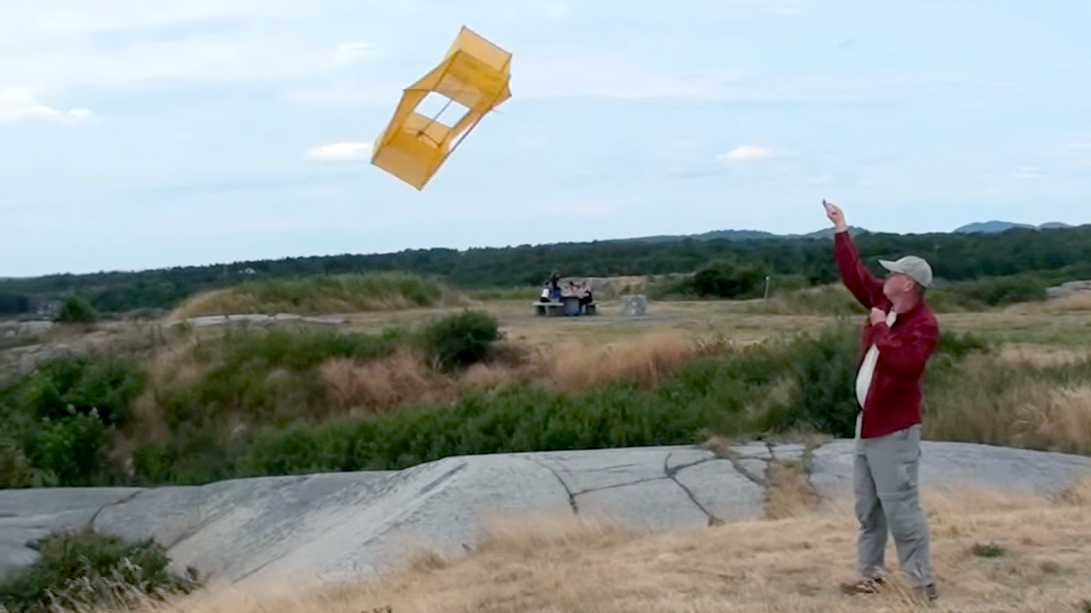
Long before satellite phones, GPS beacons, and pocket-sized emergency radios, stranded crews had a problem that sounds like it escaped from a steampunk novel: how do you send a distress signal from a bobbing life raft in the middle of the ocean when your antenna needs to be very, very tall? The answer, in several real historical cases, was delightfully weird and surprisingly practical: launch the antenna with a kite.
Yes, a kite. Not the kind shaped like a cartoon shark at the beach, although one imagines morale would improve immediately. These were serious radio toolsbox kites, military kites, and survival-kit kites designed to lift long antenna wires into the air when there was no mast, no tower, no ship, and no friendly telephone pole nearby. The result was one of the most fascinating chapters in emergency communications history: kite-supported antennas, the “Gibson Girl” survival radio, and a generation of radio experimenters who treated the sky as part of the circuit.
Why Emergency Radios Once Needed the Sky
Modern emergency transmitters can be compact because they use higher frequencies, efficient electronics, satellites, and standardized rescue networks. Early twentieth-century radio was different. Many distress systems depended on long wavelengths, especially the 500 kHz maritime distress frequency that became famous in the age of ocean liners, lifeboats, and wireless telegraphy.
Long wavelength means long antenna. At 500 kHz, the wavelength is about 600 meters. A full-size antenna for efficient transmission could be wildly impractical for a life raft, aircraft survival kit, or portable field station. Nobody in a rubber dinghy was going to unfold a 500-foot tower while also trying not to become lunch for the North Atlantic.
So engineers did what good hackers have always done: they worked with what the environment gave them. If there was wind, they used a kite. If wind was poor, some kits used a balloon. The antenna wire became the line to the sky, and suddenly a stranded aircrew could turn a crank, send an SOS, and give rescuers a fighting chance to find them.
Marconi, Signal Hill, and the Kite That Helped Prove a Point
The idea of lifting an antenna with a kite did not begin with World War II. One of the most famous radio moments in history involved exactly that kind of improvisation. On December 12, 1901, Guglielmo Marconi and his assistant George Kemp were at Signal Hill in St. John’s, Newfoundland, trying to receive a wireless signal sent from Poldhu, Cornwall. Their receiving antenna was held aloft by a kite, and the signal they expected was the Morse code letter “S”three short clicks.
The experiment has been discussed, debated, celebrated, and re-examined for more than a century, but its symbolism is hard to beat. A wire lifted by wind helped demonstrate that radio was not merely a line-of-sight parlor trick. It could cross oceans. It could connect continents. It could also make every future antenna hobbyist look at a windy field and think, “Hmm, technically…”
That is the soul of historical hacking: not breaking into systems, but breaking out of assumptions. Marconi’s team did not have the perfect fixed antenna at Signal Hill. Weather had already caused problems. The gear was fragile by modern standards. Yet a kite-supported wire became part of a landmark wireless experiment.
Military Radio Antenna Kites: Portable Towers With Tails
Military organizations quickly saw the value of kite-lifted antennas. In the early radio era, field units needed ways to communicate without permanent structures. Masts were heavy, awkward, and not always tall enough. Kites were light, packable, and capable of carrying wire higher than a soldier could easily raise by hand.
U.S. Signal Corps experiments included specially designed antenna-lifting kites. Other military and naval experiments used box kites or modified designs to raise aerial wires for portable wireless sets. These systems were not flawless. Wind changes made antenna height inconsistent. Launching and controlling the kite required patience. Rain, terrain, storms, and operator fatigue could ruin the party faster than a tangled ball of kite string.
Still, the concept solved a real problem. A radio transmitter with a better antenna could reach farther. In emergencies, range is not a luxury; it is the difference between being heard and becoming a footnote. A kite could turn a weak field setup into a workable communications system, especially on lower frequencies where antenna height and length mattered.
The “Gibson Girl” Survival Radio: Beautifully Odd, Seriously Useful
The most memorable example of kite-launched emergency antennas is the World War II survival transmitter commonly nicknamed the “Gibson Girl.” Officially, the American system was the SCR-578, built around the BC-778 transmitter. The nickname came from its curved, hourglass-shaped case, which reminded people of the fashionable illustrations by Charles Dana Gibson. In other words, even emergency radio equipment was apparently not immune to branding.
The shape was not just for looks. A survivor in a life raft could grip the radio between the knees while turning a hand crank. That crank powered the transmitter. No dependable battery was required, which was important because survival equipment might sit unused for months, then suddenly become the most important object in the universe.
The Gibson Girl could send automatic distress signals, including SOS, and could also be keyed manually for Morse code. Its accessories included a long antenna wire and devices to lift that wire: a folding box kite or a balloon system. The idea was elegantly practical. The survivor did not need to erect a mast. The sky did the heavy lifting.
Why a Kite and a Balloon?
A kite needs wind. A balloon does not depend on wind in the same way, but it adds its own complications. Survival kits sometimes included both because emergencies are rude and rarely follow the brochure. In steady wind, a kite could pull the antenna wire upward. When wind conditions were wrong, a balloon could raise the wire instead.
The famous SCR-578 survival set was associated with a wire antenna hundreds of feet long, lifted by kite or balloon to improve transmission range. In some references, the antenna is described as 300 feet; in others, complete sets are described with much longer wire. The key point is not the exact numberit is the engineering logic. A longer, higher antenna gave the low-frequency distress transmitter a better chance of being detected by ships, aircraft, or rescue stations.
How Kite Antennas Worked Without Magic
There is no sorcery inside a kite antenna, although it can look magical when a wire climbs into the sky and a radio suddenly behaves better. A radio antenna works by converting electrical energy into electromagnetic waves, or by receiving those waves and converting them back into electrical signals. Size, shape, height, and placement all affect performance.
Low-frequency and medium-frequency radio systems especially benefit from antenna length and height. If the antenna is too short compared with the wavelength, it may radiate poorly. Raising wire into the air helps reduce losses and improves the signal’s ability to travel. In the maritime world, ground-wave propagation over salt water could also be useful, which is one reason ocean-based emergency systems mattered so much.
A kite-supported wire was not always an ideal antenna. It could sway. Its angle could change. Wet line and rough weather could create hazards. But it provided something priceless: a temporary vertical or sloping wire antenna when no other support existed. That is a very hacker-like solutionuse the least glamorous tool in the bag to solve the most urgent problem in the room.
Historical Hackers Were Designers Under Pressure
The phrase “historical hackers” fits these systems because the designers were not merely making gadgets; they were solving ugly problems under brutal constraints. A downed aircrew might be cold, injured, seasick, exhausted, and surrounded by salt water. Any emergency transmitter had to be rugged, obvious, and operable by people who were not radio technicians.
That explains many of the Gibson Girl’s clever features. The case was brightly colored for visibility. The shape made hand-cranking easier in a cramped raft. Instructions were often printed on the equipment. The transmitter could automatically send distress signals, reducing the burden on the operator. The antenna could be lifted without a mast. Each choice acknowledged reality: emergency gear must work when the user is having the worst day of their life.
Modern product designers still talk about “user experience.” The Gibson Girl had user experience too, except its user experience involved waves, wind, fear, and numb fingers. That is a demanding test environment. Your smartphone app crashing is annoying. Your emergency transmitter failing in a life raft is a tragedy.
From Survival Rafts to Amateur Radio Fields
Kite antennas did not vanish when World War II ended. Amateur radio operators, portable radio experimenters, and low-band enthusiasts have continued to use kite-supported wires in special situations. A kite can raise an end-fed wire, help create a temporary vertical antenna, or support experiments on bands where full-size antennas are difficult to manage.
However, modern kite antennas are not toys. They bring safety, legal, and practical issues. In the United States, FAA rules place limits on moored kites, including restrictions near airports, clouds, and certain heights. Power lines are an obvious danger. Storms are another. Wet line, conductive wire, metal parts, crowded areas, and uncontrolled descent can turn a clever radio idea into a bad afternoon with paperwork.
That is why today’s best lesson from historical kite antennas is not “go launch wire into the sky immediately.” It is: understand the environment, respect regulations, keep experiments safe, and appreciate how earlier engineers solved life-or-death problems with simple tools.
What Made the Kite Antenna So Brilliant?
The brilliance of the kite-launched emergency antenna came from its combination of low cost, portability, and physics. It transformed wind into infrastructure. A ship had masts. A shore station had towers. A life raft had nothinguntil the kite went up.
This is also why the story remains appealing to makers and radio historians. It feels mechanical, visible, and understandable. You can see the system doing its job. The line tightens. The kite rises. The wire lifts. The radio signal improves. Compared with today’s invisible satellite networks, it is almost theatrical.
And yet the underlying principle remains modern: communications resilience depends on redundancy. If one system fails, use another. If a tower is unavailable, use a kite. If a battery may fail, use a hand crank. If the operator is not trained, automate the distress message. This layered thinking is exactly what emergency preparedness still values.
Lessons for Modern Emergency Communication
1. Antennas Matter More Than People Think
Many beginners focus on transmitters, receivers, and power output. Historical kite antennas remind us that the antenna can make or break a radio system. A modest transmitter with a useful antenna may outperform a more powerful transmitter connected to a poor radiator.
2. Simplicity Wins in Bad Conditions
Hand-cranked power, automatic SOS, printed instructions, and visual design were not fancy extras. They were survival features. Emergency tools should be understandable when the user is tired, scared, and distracted.
3. The Best Backup Is the One You Can Actually Deploy
A massive tower is wonderful unless you are floating in a raft. A kite is imperfect, but it is portable. Emergency design is often about choosing the imperfect tool that works now.
4. Nature Can Helpor Laugh at You
Kite antennas depend on wind, open space, and weather. That makes them brilliant in one situation and useless in another. Historical kits often included balloons because designers knew nature does not read manuals.
Experience Notes: What Working Around Kite Antennas Teaches You
Spending time with the story of kite-launched emergency antennas changes how you look at both radio and ordinary objects. A kite stops being just a cheerful triangle in the sky and becomes a temporary mast, a wind-powered tool, and a reminder that communications history was built by people willing to try strange ideas because the normal ones were unavailable.
The first experience this topic offers is humility. It is easy to admire modern devices and forget how difficult communication used to be. Today, many people expect a phone to reach the world from a pocket. Earlier operators had to think about wavelength, wire length, weather, ground conditions, and power generation. A distress signal was not a button; it was a chain of physical actions. Launch the kite. Raise the wire. Turn the crank. Keep turning. Hope someone is listening.
The second experience is respect for design under stress. The Gibson Girl survival radio was not elegant in the sleek, minimalist sense. It was elegant because it understood its mission. Its hourglass shape, crank generator, automatic distress keying, bright color, and antenna-lifting accessories all served a purpose. That kind of design feels refreshingly honest. Nothing is there just to impress a marketing department. Every feature earns its place.
The third experience is a renewed appreciation for amateur radio culture. Radio experimenters have long treated antennas as a creative playground. One person sees a fishing pole, another sees an antenna mast. One person sees a kite, another sees a skyhook for a wire radiator. That mindset is useful beyond radio. It encourages problem-solving with available materials, careful testing, and respect for both physics and safety.
The fourth experience is patience. Kite-supported antennas sound simple until you imagine the real conditions. Wind shifts. Lines twist. The antenna angle changes. The operator must manage radio equipment while also managing a flying object. In historical emergency use, all of this might happen in a cramped raft on moving water. The romance of the idea is real, but so is the difficulty. The past becomes more impressive when you stop treating it like a museum label and start imagining the cold hands doing the work.
The fifth experience is the importance of safe curiosity. Kite antennas are fascinating, but modern experiments must respect laws, airspace, weather, and electrical hazards. No historical romance is worth flying conductive wire near power lines or launching anything into unsafe airspace. The best way to honor historical hackers is not to copy every action blindly; it is to copy their careful problem-solving spirit.
Finally, this topic offers a wonderful reminder that technology is not always about adding complexity. Sometimes the breakthrough is beautifully simple: raise the antenna higher. Sometimes the tool that solves the problem is not a microchip, but a kite. That is why emergency antennas launched by kite still capture the imagination. They sit at the intersection of science, survival, improvisation, and just enough absurdity to make history fun.
Conclusion
Emergency antennas launched by kite are more than a quirky footnote in radio history. They reveal how early wireless pioneers, military engineers, and survival-radio designers solved urgent communication problems with creativity and physics. From Marconi’s kite-supported experiments at Signal Hill to the WWII Gibson Girl survival transmitter, these systems show that a good antenna can be as important as the radio itself.
The story also proves that “hacking” did not begin with computers. Historical hackers worked with wire, wind, Morse code, hand cranks, and practical imagination. They built systems for people in desperate situations and turned simple materials into life-saving communication tools. In a world full of satellites and digital networks, the kite antenna remains a charming, serious reminder: sometimes the smartest backup plan is the one that flies.
Note: This article is written for historical and educational purposes. Kite-supported antennas and radio transmissions must be handled safely, legally, and with respect for aviation rules, weather conditions, power-line hazards, and radio licensing requirements.