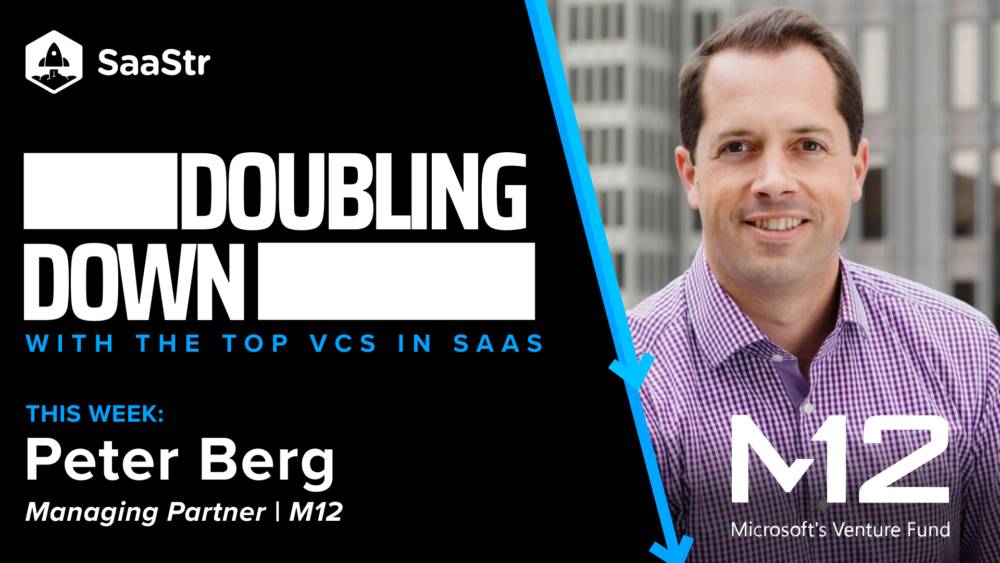
Venture capital has a reputation for being part math, part psychology, and part extremely expensive fortune-telling. In the world of corporate venture capital, the job gets even more interesting: investors must spot the next category-defining startup while also asking how that startup might fit into a much larger technology ecosystem. That is where Peter Berg’s work at M12, Microsoft’s venture fund, becomes such a useful case study.
At the time of the widely shared “Doubling Down” conversation, Peter Berg was a Managing Partner at M12, where he helped lead work around vertical SaaS, applied AI, fintech, retail, commerce, and B2B software. His public career path has since evolved, with his own biography noting that he is now working on something new in agentic commerce and investing with Communitas Capital. Still, his M12 chapter offers a sharp look at how modern corporate venture capital works when it is done with discipline, patience, and a little founder-friendly common sense.
The short version: Berg’s investing philosophy is not about sprinkling money around like confetti at a startup parade. It is about doubling down on conviction, strategic alignment, and real partnership. The long version is more interesting, so let’s open the hood.
Who Is Peter Berg?
Peter Berg is not the classic caricature of a venture capitalist who learned three buzzwords, bought a Patagonia vest, and began asking founders about “moats.” His background is unusually technical and operational. He holds a B.S. in Mathematical and Computational Science and an M.S. in Statistics from Stanford University. That training matters because venture investing, especially in enterprise technology, requires both pattern recognition and a deep respect for uncertainty.
Before joining Microsoft’s venture ecosystem, Berg built and led Visa Ventures, Visa’s global investment group. During that period, he invested in and worked around some of the most recognizable names in fintech and payments, including Stripe, Marqeta, Klarna, Chain, and LoopPay, which later became part of Samsung Pay. He also spent time in strategy and business development at Very Good Security, a payments tokenization company focused on helping businesses protect sensitive data while powering digital commerce.
This combination of statistics, operating experience, fintech investing, and corporate partnership experience gave Berg a practical lens. He understands that a startup is not just a pitch deck with ambition in 48-point font. It is a fragile, fast-moving machine that needs customers, distribution, product clarity, hiring discipline, and sometimes someone at a large enterprise who can actually answer an email.
What Is M12?
M12 is Microsoft’s venture capital fund. It invests in early-stage technology companies that are changing how people and businesses work. Its focus areas have included deep tech and AI, cloud infrastructure, cybersecurity, developer tools, enterprise applications, vertical SaaS, and selected areas such as Web3 and gaming. In plain English, M12 looks for startups building serious technology for serious markets.
What makes M12 different from a traditional VC firm is the Microsoft connection. A standard venture firm can offer capital, board guidance, hiring help, and introductions. M12 can offer those things too, but it can also help founders navigate Microsoft’s technical, commercial, and go-to-market ecosystem. That can mean support with Azure, enterprise sales motion, product partnerships, marketplace opportunities, security guidance, or connections to teams that understand large-scale technology adoption.
M12’s own mission is to accelerate the future of technology through investments, insights, and meaningful partnership with Microsoft. That word “meaningful” is doing important work. Corporate venture capital only becomes powerful when it is more than a logo on a funding announcement. Founders do not need another decorative investor. They need leverage.
Why “Doubling Down” Matters
The phrase “doubling down” can sound reckless, like pushing more chips onto the table after ignoring every warning sign. But in venture capital, doubling down should mean something smarter: increasing commitment when evidence, timing, market direction, and founder quality all point in the same direction.
Berg’s career shows this pattern repeatedly. At Visa Ventures, he did not merely chase fintech because it was fashionable. He focused on infrastructure that could reshape payments, commerce, and financial services. The investment in Chain is a strong example. At the time, blockchain in payments was controversial and widely misunderstood. Yet Chain’s work helped contribute to what became Visa B2B Connect, a blockchain-enabled commercial payments platform for cross-border business transactions.
That is the corporate venture dream scenario: the startup wins, the enterprise learns, the market advances, and the partnership creates something larger than a financial return. No one needs to fire a confetti cannon, but it is absolutely acceptable to nod approvingly at the spreadsheet.
The Strategic Power of Corporate Venture Capital
Corporate venture capital, often called CVC, has a complicated reputation. Done poorly, it can feel slow, political, or overly strategic in a way that suffocates founders. Done well, it can become a superpower. M12’s model aims for the latter.
The best corporate venture investors understand two truths at the same time. First, startups need room to move quickly. Second, large enterprises have resources, customers, infrastructure, and credibility that can help a startup scale faster than it could alone. The trick is to connect those worlds without forcing the startup to become a tiny department inside a giant company.
Berg has emphasized that M12 does not require portfolio companies to work commercially with Microsoft. That matters. A startup should not feel trapped into a forced partnership just because a corporate investor wrote a check. Instead, the value appears when founders can choose to access Microsoft’s resources when those resources help the company grow.
M12’s Investment Focus: AI, Cloud, Cybersecurity, and Vertical SaaS
M12’s strategy has become more tightly aligned with Microsoft’s priorities, especially around AI, cloud infrastructure, cybersecurity, developer tools, and vertical SaaS. This alignment is not surprising. The enterprise software market has shifted from “nice dashboard, would maybe buy someday” to “show me measurable ROI before my procurement team starts breathing fire.”
Artificial intelligence is now central to this shift. Startups are not simply adding AI features for decoration, like parsley on a dinner plate. They are rebuilding workflows in healthcare, finance, security, software development, legal services, logistics, commerce, and customer support. The winners will not be the companies that shout “AI” the loudest. They will be the ones that solve expensive, painful, recurring problems.
M12’s portfolio reflects that thesis. Companies such as Applied Intuition, Arize AI, Aqua, At-Bay, Innovaccer, Typeface, d-Matrix, and WorkBoard illustrate the range of enterprise problems that Microsoft’s venture arm has explored, from AI infrastructure and observability to cybersecurity, healthcare data, enterprise productivity, and generative content platforms.
What Berg’s Career Says About Founder-Market Fit
Venture investors often talk about product-market fit, but founder-market fit can be just as important. Berg’s background suggests a preference for founders who understand the gritty details of the market they are trying to transform. In payments, for example, the real world is full of compliance requirements, fraud risk, bank relationships, legacy rails, global complexity, and edge cases that multiply like rabbits with MBAs.
A founder who has lived inside that complexity has an advantage. They know where the old systems creak. They know why buyers hesitate. They know which workflows are painful enough to justify switching costs. Berg’s investments and career moves suggest respect for that kind of hard-earned insight.
This is especially relevant in vertical SaaS. A vertical SaaS company serves a specific industry, such as healthcare, construction, insurance, logistics, restaurants, legal services, or retail. The software must fit deeply into industry workflows. Generic tools rarely win when the customer’s actual process looks like a haunted filing cabinet with APIs.
The Microsoft Advantage for Startups
For many enterprise startups, distribution is the monster under the bed. Building a strong product is hard enough. Selling that product into large companies can be even harder. Procurement cycles are long, security reviews are detailed, budgets are political, and the phrase “circle back next quarter” can haunt a founder’s dreams.
This is where Microsoft’s ecosystem can matter. Azure, Microsoft Marketplace, enterprise customer relationships, developer communities, security expertise, and technical infrastructure can all become forms of leverage for the right startup. Microsoft for Startups has also expanded access to Azure AI infrastructure, including high-performance GPU virtual machine clusters for eligible startups working on demanding AI models.
For an AI startup, compute access can be the difference between a prototype and a product. GPUs are expensive, scarce, and essential for training and running advanced models. If a startup can access cloud infrastructure, technical expertise, and enterprise pathways earlier, it may move faster from idea to deployment.
Lessons from Visa Ventures and Chain
One of the clearest examples from Berg’s career is Chain. When Visa Ventures invested in Chain, blockchain was still a polarizing idea in financial services. Many people associated it with speculation, complexity, and conference panels where someone inevitably said “paradigm shift” too many times.
But the deeper opportunity was not hype. It was infrastructure. Business-to-business payments, especially cross-border payments, have long suffered from friction, limited transparency, and slow settlement. By working with Chain, Visa explored how blockchain-enabled infrastructure could support a more modern commercial payments network.
The lesson is not “invest in whatever technology is trending.” The lesson is “look for technology that can unlock a real enterprise use case.” That distinction separates thoughtful investors from tourists in the innovation economy.
Why Vertical SaaS Still Has Room to Run
Vertical SaaS remains attractive because many industries still run on outdated software, spreadsheets, email chains, and heroic employees who know exactly which tab in the workbook should never be touched. These markets are not glamorous, but they are full of real problems and high switching pain.
In vertical SaaS, a great company does not merely digitize paperwork. It becomes the operating system for a category. It understands compliance, billing, reporting, collaboration, customer workflows, and industry-specific data. When AI enters the picture, the opportunity expands even further. Industry-specific AI agents can automate complex workflows, surface insights, draft documentation, detect anomalies, and coordinate tasks across teams.
This is why Berg’s focus on vertical SaaS and applied AI fits the moment. The future of AI in business is unlikely to be one giant chatbot that magically does everyone’s job. More likely, it will be many specialized systems embedded into the workflows of specific industries.
What Founders Can Learn from Peter Berg’s M12 Playbook
1. Strategic Fit Is Not the Enemy of Independence
Some founders worry that taking capital from a corporate venture fund will limit their options. That concern is reasonable. However, the best CVC relationships preserve startup independence while creating optionality. Founders should ask: Will this investor help us reach customers, build better technology, or understand the market faster? If the answer is yes, strategic capital can be more than money.
2. Infrastructure Matters More Than Headlines
Startups often get attention for splashy product launches, but durable companies usually win through infrastructure, data, workflow depth, and distribution. Berg’s career in payments and enterprise software highlights the value of building where the real complexity lives.
3. The Best Investors Bring Context
Money is increasingly abundant for the best founders, even in difficult markets. What is scarce is useful context. Investors who understand customer pain, market timing, technical feasibility, and enterprise buying behavior can help founders avoid expensive mistakes.
4. AI Needs a Business Model, Not Just a Demo
A dazzling AI demo can open doors, but customers pay for outcomes. The strongest AI startups will show how they save time, reduce risk, increase revenue, improve accuracy, or unlock capabilities that were previously impossible. Sparkles are nice. ROI pays the invoices.
Experience Notes: What Working Around This Topic Teaches
Looking at Peter Berg’s career and M12’s role in the startup ecosystem offers several practical experiences for founders, operators, and content strategists studying venture capital. The first experience is that “strategic” should never mean vague. In startup conversations, people love to say a partnership is strategic when nobody can explain what will happen next. A truly strategic investor can name the teams, customers, products, integrations, or market insights that may help a startup grow.
The second experience is that corporate venture capital works best when expectations are clear. Founders should not assume that a check from a famous corporate investor automatically means a guaranteed sales channel. It does not. Large companies are complex. They have business units, legal reviews, security teams, budget owners, and product roadmaps. A corporate venture partner can open the right doors, but the startup still has to earn the customer’s trust.
The third experience is that industry knowledge compounds. Berg’s path through fintech, payments, tokenization, B2B commerce, Visa Ventures, VGS, and M12 shows how expertise in one area can become a lens for evaluating new markets. When you understand how money moves, how enterprise buyers think, and how regulated systems behave, you can evaluate software opportunities with sharper judgment.
The fourth experience is that the best startup opportunities often look boring from a distance. Payments infrastructure, healthcare data, cybersecurity, developer tooling, and cloud systems do not always sound exciting at a dinner party unless the dinner party is full of enterprise architects, in which case congratulations on finding your people. But these categories are essential. They hold large budgets, persistent pain points, and deep technical challenges.
The fifth experience is that AI has raised the bar for both founders and investors. A few years ago, adding machine learning to a workflow could feel innovative. Today, buyers expect AI products to be secure, accurate, explainable, integrated, and tied to measurable value. Investors like M12 are looking beyond novelty toward systems that can survive enterprise scrutiny.
Finally, Berg’s story suggests that long-term venture success comes from being useful. Useful to founders. Useful to corporate partners. Useful to customers. Useful when markets are hot and everyone has suddenly become an AI expert. Useful when markets cool and the tourists quietly leave. Doubling down is not about stubbornness. It is about having enough experience to recognize when conviction is deserved.
Conclusion
“Doubling Down: Peter Berg, Managing Partner at M12” is more than a profile title. It captures a broader shift in venture capital: the move from passive capital to active, ecosystem-based partnership. Berg’s work at M12 sits at the intersection of corporate strategy, startup speed, applied AI, fintech experience, and enterprise software execution.
The most important takeaway is simple. Great corporate venture capital is not about a large company trying to look innovative. It is about helping startups become stronger while helping the larger company understand where the future is heading. When that balance works, everyone gets more than a funding announcement. They get momentum.