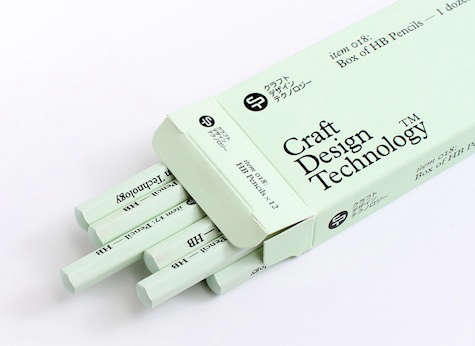
Some stationery whispers. Some stationery shouts. Craft Design Technology Graphite Pencils politely clear their throat, straighten their tiny mint-green jacket, and make your desk look as if it has finally decided to become an adult.
At first glance, these Japanese HB pencils seem simple: a pale green glossy finish, a clean hexagonal body, a white eraser, and a tidy box of three. But that simplicity is exactly the point. Craft Design Technology, often shortened to CDT, has built its reputation on turning ordinary office tools into objects that feel thoughtfully designed without becoming museum pieces that make you afraid to touch them. These pencils are meant to be used, sharpened, erased, dropped into a pencil cup, and pulled out again when your brain needs to turn into handwriting.
In a world of glowing screens, endless notifications, and apps that ask for updates more often than toddlers ask for snacks, a good graphite pencil can feel oddly luxurious. Not because it is expensive, complicated, or rare, but because it does one thing beautifully. The Craft Design Technology Graphite Pencil writes, sketches, edits, plans, and doodles with a quiet confidence that makes the humble pencil feel relevant again.
What Are Craft Design Technology Graphite Pencils?
Craft Design Technology Graphite Pencils are Japanese-made HB wooden pencils designed by Craft Design Technology and manufactured by Camel Pencil. They are typically sold as a boxed set of three unsharpened pencils with erasers. The design features a traditional pale green glossy lacquer, a hexagonal body, clean branding, and a white eraser that sits neatly at the end of the barrel.
The official product description highlights them as high-quality HB black lead pencils with a traditional pale green glossy finish. In practical terms, that means they sit in the sweet spot between everyday writing pencil and design-conscious desk object. They are not a full artist-grade graphite range with every grade from 10H to 12B. Instead, they focus on HB, the all-purpose grade that works well for notes, lists, quick sketches, schoolwork, office use, and planner layouts.
That focus matters. CDT is not trying to win the “most dramatic pencil case” contest. It is trying to make the everyday pencil better: better-looking, better-feeling, and better suited to the kind of workspace where the stapler is not allowed to be ugly just because it has a practical job.
The Brand Idea: Craft, Design, and Technology
The name Craft Design Technology is not random branding confetti. It explains the company’s entire approach. “Craft” refers to Japanese manufacturing knowledge and material skill. “Design” refers to visual balance, proportion, color, and user experience. “Technology” refers to the manufacturing methods and technical expertise behind reliable stationery.
CDT’s philosophy is based on improving standard workplace tools by partnering with established Japanese stationery makers. Instead of reinventing the pencil as a Bluetooth-enabled productivity wandthankfully, no charging cable requiredthe brand refines the classic form. The result is stationery that feels familiar but elevated.
The company’s design language also uses traditional Japanese colors. For daily items such as pencils, CDT uses a pale green tone associated with softness and calm. The color is often described as byakuroku, a light green shade that feels fresh without being loud. On a desk, it lands somewhere between green tea ice cream, spring bud, and “I have excellent taste but do not need to announce it with a marching band.”
Design Details That Make the Pencil Special
1. The Pale Green Glossy Finish
The first thing most people notice is the color. The pale green lacquer is not the school-bus yellow of a standard No. 2 pencil, nor the dark professional green of many European drawing pencils. It is softer, cleaner, and more distinctive. The glossy finish gives the pencil a polished look without making it slippery or flashy.
This matters for more than aesthetics. A pencil is one of the few tools you physically hold for long stretches of thinking time. If it looks pleasant, you are more likely to keep it nearby. If it feels pleasant, you are more likely to use it. Good design does not have to scream. Sometimes it just needs to sit on your desk and quietly improve your mood.
2. The Hexagonal Barrel
The hexagonal shape is classic for a reason. It keeps the pencil from rolling away, gives your fingers natural grip points, and feels stable during longer writing sessions. Round pencils may look sleek, but they also enjoy escaping from desks like tiny wooden athletes. The CDT pencil stays put.
The hexagonal body also supports better control when sketching or shading. You can rotate the pencil slightly as the point wears down, or angle it to create broader strokes. That makes it useful not only for writing but also for quick thumbnails, mind maps, underdrawings, and margin doodles that begin as “just a little idea” and somehow become a full dragon wearing sunglasses.
3. The Built-In White Eraser
The white eraser at the end of the CDT pencil is cleanly integrated into the design. It avoids the traditional metal ferrule, creating a seamless look. For many users, this is one of the pencil’s most charming details. It makes the pencil feel more minimal, more modern, and less like something pulled from a forgotten classroom drawer.
Functionally, an attached eraser is useful for everyday writing. You may still want a separate block eraser for serious drawing or heavy editing, but for quick corrections, planner changes, grocery list upgrades, and “why did I spell calendar like that?” moments, the built-in eraser does the job.
How the HB Graphite Performs
The HB grade is the middle child of graphite pencils: balanced, useful, and unfairly underappreciated until everyone needs it. In the graphite grading system, H pencils are harder and lighter, while B pencils are softer and darker. HB sits near the center, making it one of the most versatile grades for daily writing.
Modern pencil cores are not made of lead, despite the phrase “pencil lead” refusing to retire gracefully. They are usually a mixture of graphite and clay. More clay generally creates a harder, lighter mark. More graphite creates a softer, darker mark. That balance affects how smooth the pencil feels, how dark it writes, how fast it wears down, and how easily it smudges.
Craft Design Technology Graphite Pencils are known for producing a smooth, dark enough line without requiring heavy pressure. That makes them comfortable for note-taking and planning. You do not need to press like you are engraving your homework into a cave wall. A light hand is enough.
Because these are Japanese HB pencils, users may find the mark slightly richer or smoother than some American or European HB pencils. This is not a universal law carved into a sacred pencil tablet, but many stationery fans notice that Japanese HB pencils often lean darker and softer compared with certain Western equivalents.
Best Uses for Craft Design Technology Graphite Pencils
Everyday Writing
For ordinary handwriting, these pencils are excellent. They glide smoothly enough to make lists feel less like chores and more like design exercises. Meeting notes, study notes, phone messages, reading annotations, and daily task lists all benefit from the HB core’s balance of readability and erasability.
Bullet Journaling and Planning
If you use a planner, the CDT pencil is a natural fit. Plans change. Meetings move. Dinner becomes leftovers. A pencil lets you adjust without turning your weekly spread into a crime scene of crossed-out ink. The clean design also pairs nicely with minimal planners and Japanese notebooks.
Sketching and Drafting Ideas
While these are not specialized drawing pencils, they are useful for light sketching. HB is perfect for rough layouts, thumbnail drawings, composition planning, and underdrawings before ink. The line is visible enough to work with but not so heavy that it fights back when erased.
Desk Styling and Gifting
Let us be honest: part of the appeal is visual. A box of Craft Design Technology Graphite Pencils makes a tasteful gift for designers, writers, architects, students, teachers, stationery collectors, and that one friend who says, “I don’t need anything,” while clearly needing better pencils.
How They Compare With Ordinary Pencils
A basic school pencil is designed to be affordable, available, and acceptable. The CDT pencil is designed to make the same basic tool feel more intentional. The difference is not that one writes and the other summons creative lightning. The difference is in the finish, balance, presentation, and small usability details.
Compared with a standard yellow No. 2 pencil, the Craft Design Technology pencil feels more refined. The lacquer is smoother, the color is more distinctive, and the overall design is cleaner. Compared with a dedicated artist pencil such as a full graphite drawing set, it is less specialized but more convenient for daily use.
Think of it as the pencil equivalent of a well-made white T-shirt. It is still a T-shirt. But the cut, fabric, stitching, and fit make you understand why not all basics are equal.
Pros and Cons
Pros
The biggest strength of Craft Design Technology Graphite Pencils is their balance. They are attractive without being silly, practical without being boring, and premium without becoming too precious to sharpen. The HB core works for writing and sketching. The eraser is useful. The box makes them easy to gift. The Japanese manufacturing background adds confidence in quality.
Cons
The main downside is availability. CDT products can be harder to find than mass-market pencils, especially outside specialty stationery shops. The price is also higher than ordinary pencils, so they may not be the best choice for someone who loses pencils at the speed of socks in a dryer. Another limitation is grade selection. If you want a full drawing range with many H and B grades, you will need a different set.
Who Should Buy Craft Design Technology Graphite Pencils?
These pencils are best for people who enjoy everyday tools with thoughtful design. Writers, students, designers, architects, notebook fans, analog planners, and stationery collectors will appreciate them most. They are also a good choice for anyone trying to make a desk feel calmer, more organized, and less like a cable jungle where pens go to disappear.
They may not be ideal for heavy graphite artists who need multiple grades or for buyers who only want the cheapest possible pencil. But for someone who wants one beautiful, reliable HB pencil for everyday work, CDT is easy to recommend.
Care Tips: How to Get the Best Experience
Use a sharp, clean pencil sharpener. A dull blade can chew the wood and break the core, even on good pencils. Since CDT pencils are sold unsharpened, your first sharpening sets the tone. A quality handheld sharpener creates a neat point for writing, while a long-point sharpener can expose more graphite for sketching.
Store them in the box or a pencil case if you carry them around. The glossy finish is attractive, but any pencil can pick up scratches when tossed into a bag with keys, coins, and whatever mysterious crumbs live at the bottom.
For best writing results, pair the pencil with smoother paper such as a quality notebook or planner. On textured drawing paper, the graphite will naturally catch more tooth, creating a slightly rougher feel and a darker deposit. That can be great for sketching but may feel different from writing on smooth paper.
Why a Premium Pencil Still Matters
It is easy to dismiss pencils as outdated. After all, phones can store notes, tablets can draw, and laptops can produce documents at terrifying speed. But pencils still offer something digital tools struggle to match: low-friction thinking.
A pencil does not boot up. It does not ask for a password. It does not show you twelve notifications before letting you write “buy milk.” It simply works. That simplicity is powerful. For brainstorming, editing, planning, learning, and sketching, the graphite pencil remains one of the most efficient tools ever made.
Craft Design Technology understands this. The brand does not bury the pencil under gimmicks. Instead, it respects the object’s original purpose and improves the experience around it. The result is a pencil that feels both old-fashioned and modern, which is harder to achieve than it sounds.
Hands-On Experience: Living With Craft Design Technology Graphite Pencils
Using Craft Design Technology Graphite Pencils for a few days changes the way you think about ordinary stationery. At first, you notice the color. That mint-green finish has an unfair advantage: it looks good next to almost everything. Put it beside a black notebook, and it looks elegant. Put it beside a cream planner, and it looks calm. Put it beside a messy pile of receipts, and the receipts still look guilty, but at least the pencil is trying.
The first sharpening is satisfying. Because the pencils arrive unsharpened, there is a small ritual involved. You choose the sharpener, turn the barrel, watch the pale green shaving curl away, and suddenly the pencil becomes yours. It is a tiny moment, but stationery people understand tiny moments. We are the same group of people who can spend fifteen minutes choosing between two notebooks that are both “basically beige.”
On smooth notebook paper, the CDT pencil writes with a soft, controlled feel. The line is dark enough to read easily but not so dark that it smears everywhere like overdramatic eyeliner. For daily notes, it feels relaxed. You can write quickly without pressing hard, which is helpful during class notes, work calls, reading summaries, or that dangerous moment when you wake up with an idea and need to write it down before your brain replaces it with “sandwich.”
The eraser is surprisingly useful. It will not replace a large drafting eraser for serious art cleanup, but it handles small corrections well. The ferrule-free look also makes the pencil feel more unified. There is no shiny metal band interrupting the design, just a clean white end that says, “Yes, mistakes happen, and yes, we planned for them.”
For sketching, the HB core is best for light structure work: boxes, arrows, thumbnails, quick portraits, room layouts, logo ideas, and rough composition marks. It is not the pencil you grab when you want deep black shadows or dramatic charcoal-like effects. But for early-stage drawing, it behaves beautifully. It gives enough feedback to control the line and enough smoothness to keep the hand moving.
The hexagonal shape becomes more important during longer use. It prevents rolling, gives a stable grip, and makes the pencil easy to rotate as the point dulls. That matters when writing several pages. Small comfort details add up. A pencil that feels good after five minutes may not feel good after fifty. The CDT pencil holds up well because the design is traditional where tradition makes sense.
The real charm, though, is emotional. This pencil makes analog work feel intentional. Writing a to-do list with it feels slightly more civilized. Drafting a paragraph feels less like typing into the void and more like thinking with your hand. Even crossing something out feels pleasant, which is dangerous because you may start adding tasks just for the joy of erasing them later.
After extended use, the best description is this: Craft Design Technology Graphite Pencils do not try to impress you all at once. They win slowly. They sit on your desk, look excellent, sharpen cleanly, write smoothly, erase conveniently, and make you wonder why so many everyday tools are allowed to be ugly. They are not magic pencils. They will not write your essay, finish your sketch, organize your planner, or make Monday behave. But they will make the process feel better, and sometimes that is exactly what a good tool should do.
Final Verdict
Craft Design Technology Graphite Pencils are a strong example of how excellent design can elevate an everyday object. They combine Japanese manufacturing, a smooth HB graphite core, a distinctive pale green finish, and practical details such as a hexagonal barrel and integrated eraser. They are simple, elegant, and genuinely useful.
If you want the cheapest pencil, look elsewhere. If you want a full artist set, choose a range of graphite grades. But if you want a beautifully designed everyday HB pencil that makes writing, planning, and sketching feel more enjoyable, Craft Design Technology Graphite Pencils deserve a place on your desk.