Some photographs document histld landscapes, or make us wonder whether we should finally learn what all those buttons on a camera do. Then there are photographs of newborn Pomeranian puppies wrapped in pastel blanketsand suddenly the entire internet forgets how to behave.
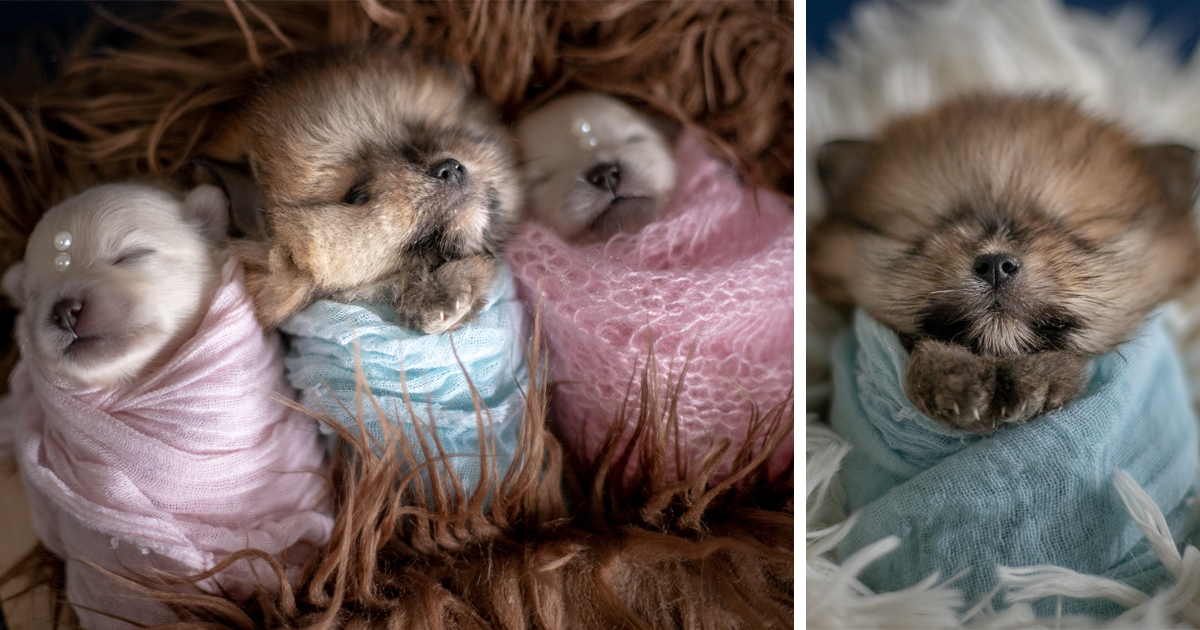
Brazilian photographer Karen Silva created a newborn puppy photoshoot featuring three tiny Pomeranians during the first days of their lives. Instead of producing ordinary kennel portraits, she borrowed the gentle visual language of newborn baby photography: soft fabrics, miniature accessories, dreamy compositions, and sleeping subjects who appeared to have very demanding schedules involving milk, naps, and absolutely no emails.
The resulting images were sweet without feeling chaotic, carefully styled without hiding the puppies’ natural charm, and memorable enough to travel far beyond their original audience. Yet beneath all that fluff is a thoughtful lesson in creative photography, responsible animal handling, and the strange scientific power of cuteness.
The Story Behind the Newborn Puppy Photoshoot
At the time the project was reported in 2020, Silva had spent approximately five years specializing in maternity and newborn photography. The puppy session began after Eloana Santana, owner of the Sant’s Cruz Dog kennel in Brasília, suggested adapting the newborn concept for a litter of Pomeranians.
That background mattered. Silva was not simply placing puppies in a basket and hoping the universe would provide good lighting. She already understood how to create quiet sets, work patiently with fragile subjects, arrange soft materials, and build compositions that feel peaceful rather than cluttered.
The three newborn puppies were photographed while sleeping, wrapped in cozy pastel fabrics and positioned in delicate arrangements inspired by traditional infant portraiture. Reports about the session also noted that the accessories were sanitized and that the puppies’ mother remained present during the shoot. Those details may not be as instantly shareable as a tiny knitted hat, but they are considerably more important.
Why Pomeranians Were Perfect Little Models
Pomeranians are famous for their abundant adult coats, alert expressions, and confident personalities. Newborn Pomeranians, however, look less like glamorous show dogs and more like warm cotton balls with paws. Their small bodies, rounded faces, folded ears, and sleepy expressions naturally match the visual cues people associate with vulnerability and infancy.
The puppies did not need complicated costumes or theatrical scenery. Their size already created an immediate sense of scale, especially when photographed beside tiny pillows, flowers, bows, and layered blankets. Every prop seemed enormous next to them, which made the puppies look even smallerand therefore approximately 900 percent more adorable.
Why the Photographs Feel So Heart-Melting
The success of Silva’s newborn puppy photoshoot was not based on cuteness alone. Adorable subjects certainly helped, but the photographs also used several classic portrait techniques that guided attention toward the puppies and created a consistent emotional atmosphere.
Soft Colors Keep the Mood Calm
Pastel pinks, creams, pale blues, and muted neutrals are common in newborn photography because they feel gentle and visually quiet. These colors do not compete with the subject. Instead, they form a soft background that allows tiny facial details, paws, noses, and fur textures to stand out.
Strong patterns or highly saturated colors might have made the scene feel busy. Silva’s restrained palette created the photographic equivalent of a whisper. Nothing shouted, “Look at me!” except the puppies, who managed to demand attention while unconscious.
Layered Textures Create Warmth
Knitted fabrics, fluffy blankets, smooth wraps, and small cushions made the compositions feel warm and tactile. Viewers can almost imagine how the fabrics would feel, even though they are looking at a flat image on a screen.
Texture also helps separate subjects that share similar colors. A cream-colored puppy placed against a cream background could visually disappear, but layers with different surfaces create enough contrast to define the puppy’s shape without introducing harsh colors.
Close Framing Makes Tiny Details Important
Newborn portraits often focus on details that will change quickly: fingers, toes, eyelashes, cheeks, and expressions. Pet newborn photography works the same way. A close photograph preserves the scale of a puppy’s nose, the softness of barely developed fur, and paws that may soon become several times larger.
By filling the frame with the puppies, Silva transformed ordinary developmental details into the main event. A tucked paw became a storytelling element. A sleepy face became a complete emotional plot. A miniature tongue could probably have launched its own social media account.
The Human Brain Is Practically Defenseless Against This
Researchers studying cuteness often refer to infant-like features such as large heads, round faces, small noses, soft bodies, and relatively large eyes. These characteristics can attract attention and encourage protective or caregiving responses. Studies have also found that viewing cute animal images can produce positive feelings and may temporarily narrow attention toward the adorable subject.
Scientists do not claim that puppy photographs can solve every problem. They cannot repair a broken appliance, submit your taxes, or make a Monday meeting disappear. Still, research helps explain why people pause, smile, share, and occasionally make noises they would deny producing under oath when they encounter a particularly cute animal image. /section>
Adorable Photography Still Requires Serious Animal Care
Newborn puppies are not miniature adult dogs. During their earliest weeks, they have limited ability to regulate body temperature and depend heavily on their mother, littermates, and a properly controlled environment. Veterinary guidance emphasizes warmth, nursing, cleanliness, careful monitoring, and minimal unnecessary disruption.
That means a newborn puppy photoshoot should never prioritize a decorative concept over the animals’ physical needs. A photograph is optional. Feeding, warmth, rest, and access to the mother are not.
Temperature Must Come Before Aesthetics
Veterinary sources explain that neonatal puppies cannot maintain body temperature as effectively as older dogs. Removing them from the warmth of their mother and littermates for extended periods can place unnecessary stress on them. The set therefore needs to be comfortably warm, draft-free, and prepared before a puppy is moved.
Blankets may look charming, but they should never be treated as a substitute for appropriate environmental management. Direct heat sources also require professional caution because overheating and dehydration can be dangerous. A responsible session keeps handling brief and returns each puppy to its mother promptly.
Props Should Be Clean, Soft, and Simple
Every fabric, wrap, cushion, basket liner, and accessory touching a newborn animal should be clean and free from sharp edges, loose fibers, irritating materials, or detachable pieces that could create a hazard. Props should support the puppy’s natural resting position rather than force its body into an unnatural pose.
Sanitation becomes especially important when a photographer works with multiple litters or animals from different homes. Freshly washed fabrics and thoroughly cleaned surfaces reduce avoidable exposure to contaminants. The safest accessory is often the simplest one: a clean blanket with enough texture to look beautiful and enough softness to keep the subject comfortable.
The Mother Dog Should Be Respected
A mother dog may become anxious when unfamiliar people handle her puppies. Even a normally friendly dog can act differently while protecting a litter. Her body language, comfort, and willingness to allow interaction must be monitored throughout the session.
The mother should remain nearby whenever practical, and the breeder or caregiver should control how and when puppies are handled. If she appears distressed, restless, defensive, or eager to retrieve a puppy, the session should stop. There is no photograph important enough to turn a protective mother into an unwilling production assistant.
Animal Behavior Determines the Schedule
Professional pet-photography guidance consistently places animal safety, health, behavior, and comfort ahead of posing. Photographers should understand the individual animal, prepare assistants when needed, watch for stress signals, and avoid forcing cooperation.
With newborn puppies, this usually means working during natural sleep, arranging the scene in advance, and capturing a few frames quickly. The best session may be short, quiet, and deeply uneventful. In pet photography, “nothing dramatic happened” is an excellent behind-the-scenes review. /section>
What Photographers Can Learn From Karen Silva’s Images
Prepare the Set Before Bringing in the Subject
Lighting, backgrounds, camera settings, wraps, and composition should be ready before the puppy enters the scene. This reduces handling time and prevents repeated adjustments around a sensitive newborn.
A photographer can test the setup with a rolled towel or similarly sized object. That may look slightly ridiculous from across the studio, but it is much better than using a living puppy as a light meter.
Choose Gentle, Consistent Lighting
Soft window light or carefully diffused artificial light can produce flattering shadows and visible fur detail without creating an aggressive atmosphere. Harsh direct light may flatten pale fur, create distracting highlights, or make the scene feel less peaceful.
Photography guides commonly recommend natural or diffused light for pet portraits and suggest working near the animal’s eye level when possible. For overhead compositions, the camera should be secured and the photographer should maintain a safe position rather than leaning equipment precariously above the subject.
Use Editing to Support Reality, Not Replace It
Post-production can remove lint, balance color, soften distracting background elements, and refine exposure. It can also be used to create a polished composite when a particular visual idea would be unsafe to capture in one frame.
For example, a photographer could photograph an empty prop separately and combine it with a safely supported puppy portrait. This approach is preferable to placing an animal in an unstable container merely because the final image would look whimsical.
The strongest editing preserves believable fur texture and natural proportions. Newborn puppies are already charming. They do not require enlarged eyes, reshaped faces, or a digital makeover that makes them resemble animated marshmallows.
Why Newborn Pet Photography Matters
Puppies change astonishingly fast. Within weeks, their eyes open, their movement becomes more coordinated, and their personalities begin to emerge. The quiet newborn stage is brief, making photographs from that period meaningful records rather than merely decorative images.
For responsible breeders, well-made portraits can document a litter’s development and help families see how their future companions began life. For pet owners, similar sessions can preserve details that memory tends to blur over time.
Pet photography can also support animal-welfare organizations. Professional images often help rescue groups present adoptable animals as individuals with recognizable expressions and personalities. A thoughtful portrait can encourage someone to stop scrolling long enough to read an adoption profile, volunteer, foster, or donate.
Of course, attractive photographs should never be used to romanticize irresponsible breeding. Anyone considering a puppy should evaluate health practices, living conditions, veterinary care, socialization plans, and the breeder’s willingness to answer detailed questions. A pastel blanket is lovely, but it is not a health certificate.
Experiences and Lessons From Planning a Newborn Puppy Photoshoot
Imagine preparing a session inspired by Silva’s work. The temptation is to begin with props: tiny beds, knitted bonnets, baskets, flowers, bows, and perhaps a miniature newspaper announcing that the puppy market is up three treats. In practice, the most successful experience begins with a conversation rather than a shopping cart.
The photographer first speaks with the breeder, veterinarian, or experienced caregiver about the puppies’ age, health, feeding routine, sleeping pattern, and the mother’s temperament. A session is postponed if a puppy is not nursing well, has difficulty maintaining warmth, seems unusually weak, or is receiving medical care. The goal is to photograph a healthy momentnot manufacture one.
Building a Quiet Working Environment
Before the litter arrives, the studio is warmed and cleared of unnecessary people. Phones are silenced, equipment is positioned securely, and every surface is cleaned. Several identical wraps are prepared so a soiled fabric can be replaced immediately rather than hurriedly cleaned during the session.
The first composition is intentionally simple: one puppy, one neutral wrap, one padded surface, and soft directional light. The caregiver transfers the sleeping puppy to the set while supporting its chest and hindquarters. The photographer takes a few frames, checks focus, and stops rather than repeatedly adjusting the body for microscopic improvements.
This is where experience changes the mood of the room. A beginner may chase perfection, nudging a paw half an inch or rotating the puppy’s head for a cleaner angle. An experienced animal photographer recognizes that the natural position is often the best position. A tiny paw resting in an unexpected place makes the image feel alive rather than manufactured.
Letting the Puppies Set the Pace
Suppose the puppy wakes and begins searching for its mother. That is not a posing problem. It is a clear signal that the puppy should be returned. Feeding and comfort take priority, while another naturally sleeping littermate may be photographedor the entire session may pause.
A productive session might include only a few minutes of actual photography for each puppy. Much of the experience consists of waiting, watching, cleaning, checking warmth, and allowing the mother to settle. This slow pace can feel unusual to photographers accustomed to directing adult clients, but it often produces more authentic results.
The mother dog may also be offered an opportunity to inspect the set and remain close enough to see and smell her puppies. Her handler watches for tension, repeated pacing, fixed staring, lip lifting, or attempts to retrieve a puppy. Any discomfort ends the setup immediately.
Creating Variety Without Constant Repositioning
Instead of moving the puppy repeatedly, the photographer creates visual variety by changing camera position, crop, background layer, or focal length. One safe resting pose can produce a full-body portrait, a close-up of the face, a detail of the paws, and an overhead composition.
This approach is both efficient and creative. It also demonstrates an important lesson: variety does not require elaborate physical manipulation. The camera can move more easily than the subject, and unlike a newborn puppy, the camera is unlikely to become hungry halfway through the process.
When photographing more than one puppy, an assistant and caregiver remain within reach. The animals are placed on a broad, fully supported padded surface rather than balanced inside a raised container. Any decorative basket or bed is stable, lined, and positioned at floor level.
Reviewing the Experience Afterward
After the session, the photographer should evaluate more than image sharpness. Were the puppies away from their mother for the shortest practical time? Did any prop slow the workflow? Was the room warm enough? Did the mother remain relaxed? Were there moments when the team should have stopped sooner?
These questions improve future sessions and prevent the pursuit of a popular photograph from becoming more important than the subject. Successful newborn pet photography is not measured only by shares, comments, or how many people type “I can’t handle this” beneath the pictures. It is also measured by whether the puppies returned to their mother warm, calm, and undisturbed.
The most rewarding part of the experience may arrive months later. The photographer can compare the newborn portraits with images of the same dogs as energetic adolescents or fully grown adults. The once-tiny paws now thunder across the floor, the little noses investigate every grocery bag, and the peaceful sleeping models have developed firm opinions about doorbells.
That contrast reveals the lasting value of the photographs. Silva’s images are charming because they show beautiful puppies, but they are meaningful because they preserve a stage that disappeared almost as soon as the camera shutter closed.
A Small Photoshoot With a Big Emotional Effect
Karen Silva’s newborn Pomeranian portraits succeeded because they combined an irresistible concept with careful visual storytelling. The pastel colors, gentle textures, close framing, and peaceful poses transformed three sleeping puppies into miniature storybook characters.
More importantly, the project offers a reminder that memorable animal photography should be built around patience and respect. Newborn puppies are vulnerable living subjects, not props. Their warmth, health, access to their mother, and freedom from stress must shape every creative decision.
When those priorities are handled correctly, the result can be more than a cute picture. It can preserve a fleeting chapter of an animal’s life, celebrate the connection people feel with dogs, and provide the internet with several urgently needed minutes of emotional softness.
And yes, your heart may melt. Please keep it away from the clean blankets.