When wildfires tear through a landscape, the disaster does not end when the flames go out. For many animals, surviving the fire is only round one. Round two is finding somethinganythingto eat in a world suddenly turned into ash, charcoal, and the sort of crunchy nothingness nobody ordered from nature’s menu.
That is exactly what happened during Australia’s catastrophic 2019–2020 bushfire season, often remembered as the “Black Summer.” Across New South Wales and other parts of the country, fires burned through forests, grasslands, and rocky habitats. Countless animals died, many were injured, and many more were left wandering through damaged ecosystems where food and water had almost disappeared overnight.
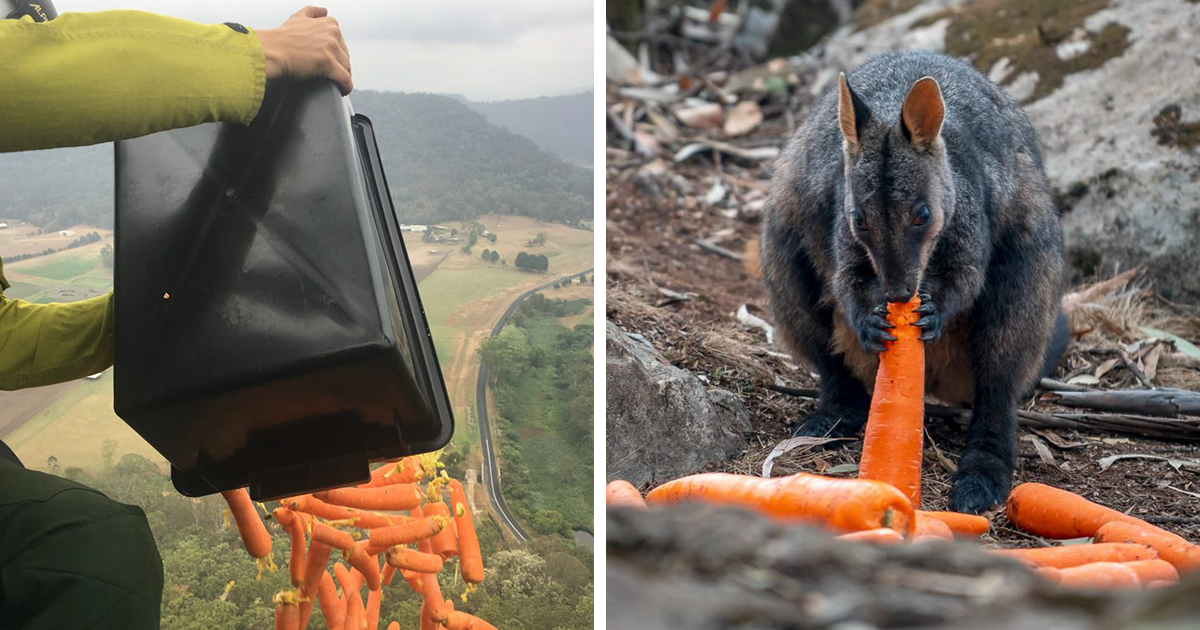
Then came one of the most unusual wildlife rescue scenes of the crisis: aircraft dropping tons of carrots and sweet potatoes from the sky.
It sounds like a cartoon written by a very emotional farmer, but it was real. The operation became widely known as Operation Rock Wallaby, a relief effort designed to help endangered brush-tailed rock-wallabies survive after fires destroyed much of their natural food supply. Helicopters and planes delivered vegetables into remote, rugged areas that people could not easily reach on foot. In other words, dinner arrived by air mail.
Why Animals Were Starving After Surviving the Fires
Australian wildlife has evolved with fire, but not all fires are equal. Some smaller, lower-intensity burns can create space for new growth. The 2019–2020 bushfires, however, were massive, intense, and widespread. In many places, the fires did not simply clear patches of vegetation; they wiped out entire feeding zones.
For animals like the brush-tailed rock-wallaby, the problem was especially dangerous. These wallabies often live in rocky terrain, using cliffs and boulder fields as shelter from predators. That geography can help some individuals survive flames, because they can hide in rocky crevices or retreat into safer pockets. But after the fire passes, they still need leaves, grasses, shoots, and moisture-rich plants. When the surrounding vegetation is burned away, survival becomes a race against hunger, dehydration, and exposure.
The tragedy is that many animals survived the immediate danger only to face a quieter crisis afterward. There were no dramatic flames, no huge smoke columns, no emergency sirensjust empty habitat. For wildlife, an empty habitat can be as deadly as the fire itself.
What Was Operation Rock Wallaby?
Operation Rock Wallaby was an emergency food-drop program led by wildlife and conservation teams in New South Wales. Its goal was simple but urgent: get suitable food to endangered brush-tailed rock-wallabies before starvation weakened already stressed populations.
Teams loaded aircraft with vegetables, mainly carrots and sweet potatoes, then dropped them into known wallaby colonies across fire-affected areas. These were not random snack attacks from the sky. The drops were carefully targeted based on wildlife monitoring, known colony locations, habitat damage, and access challenges.
Brush-tailed rock-wallabies are not backyard pets waiting for someone to ring the dinner bell. They live in steep, rough country, which is wonderful if you are a nimble wallaby and less wonderful if you are a human carrying heavy bags of produce. Helicopters made it possible to reach colonies quickly without disturbing fragile burned landscapes or putting rescuers at unnecessary risk.
Why Carrots and Sweet Potatoes?
Carrots and sweet potatoes were practical choices. They are sturdy, nutrient-rich, relatively easy to transport, and contain moisture, which matters when water sources are limited or contaminated by ash. They also hold up better than softer foods during transport and dropping. Nobody wants to fly into a remote canyon only to deliver vegetable soup by accident.
These foods were chosen as temporary emergency support, not as a permanent replacement for native vegetation. The goal was to keep animals alive long enough for natural food sources to recover. Wildlife feeding programs must be handled carefully because the wrong food, the wrong location, or too much human interference can create new problems. In this case, the drops were part of a targeted conservation response for endangered animals under extreme pressure.
The Brush-Tailed Rock-Wallaby: Small Animal, Big Conservation Problem
The brush-tailed rock-wallaby is a compact, agile marsupial with powerful legs, a long balancing tail, and the general vibe of a parkour athlete who prefers cliffs to sidewalks. Once more widespread, the species has declined because of habitat loss, predation by introduced foxes and cats, competition with other animals, and changes to fire patterns.
By the time the Black Summer fires arrived, many brush-tailed rock-wallaby colonies were already vulnerable. That made the fires especially dangerous. When a population is strong and connected, it may recover more easily from a disaster. When colonies are small and isolated, losing even a few animals can have long-term consequences.
This is why food drops mattered. They were not just a cute story about carrots falling from helicopters. They were part of a serious attempt to prevent endangered colonies from sliding closer to local extinction.
How the Vegetable Drops Worked
From a distance, aerial food drops may sound simple: load vegetables, fly over habitat, release vegetables, become a legend among wallabies. In reality, the process required planning.
Wildlife officers and conservation teams had to identify where surviving colonies were likely to be, determine which habitats had lost the most food, and choose safe drop zones. The drops needed to land close enough for wallabies to find them but not in places where animals would be exposed to predators or forced into unsafe terrain.
The operation also had to consider timing. After a severe fire, animals may be weak, stressed, and reluctant to move far. Food had to arrive before hunger pushed them into riskier areas. Monitoring was also important. Cameras, field checks, and follow-up assessments helped teams understand whether wallabies were using the food and whether the habitat was beginning to recover.
Why the Story Went Viral
The image of aircraft dropping vegetables for hungry animals spread quickly online because it offered something people desperately needed during the bushfire crisis: hope. For weeks, global audiences had seen heartbreaking images of burned forests, injured koalas, exhausted firefighters, and smoke-filled skies. The vegetable drops did not erase that devastation, but they showed action.
There is also something wonderfully strange about the visual. A helicopter flying over blackened wilderness and raining down carrots sounds like a scene from a children’s book with surprisingly good emergency management. It was unusual, memorable, and easy to understand. Animals were hungry. People found a way to feed them. Sometimes the internet loves a story because it is complicated; sometimes it loves a story because it is a carrot with wings.
But beneath the viral appeal was a deeper message: wildlife rescue is not only about saving individual injured animals. It is also about protecting habitat, supporting species recovery, and responding quickly when ecosystems collapse.
The Bigger Wildlife Toll of Australia’s Black Summer
The 2019–2020 Australian bushfires were among the most severe wildlife disasters in modern memory. Scientific estimates later suggested that nearly three billion animals were killed, displaced, or otherwise affected, including mammals, birds, reptiles, and frogs. Koalas received much of the global attention, but the crisis extended far beyond one species.
Reptiles lost shelter and feeding grounds. Birds lost nesting areas. Frogs faced changes to water quality and moisture conditions. Small mammals had to navigate open, burned landscapes where predators could spot them more easily. Even animals that escaped injury were suddenly living in a transformed environment.
That is one of the hardest truths about megafires: they do not create a single emergency. They create layers of emergencies. First comes heat and smoke. Then injury. Then hunger and thirst. Then predation. Then breeding disruption. Then the slow question of whether the habitat can regenerate fast enough to support life again.
Why Feeding Wildlife Is More Complicated Than It Looks
Many people see starving animals and naturally want to help by putting out food. The instinct is kind, but wildlife feeding is not always safe. Feeding the wrong food can make animals sick. Feeding in the wrong place can attract predators, spread disease, or cause animals to gather unnaturally. Long-term feeding can also change wild behavior.
That is why emergency programs like Operation Rock Wallaby are best handled by experts. Conservation teams understand species diets, habitat needs, disease risks, and the importance of keeping wild animals wild. The carrots and sweet potatoes were not a casual picnic. They were a temporary bridge between disaster and recovery.
For everyday people, the most helpful actions are often less dramatic but more effective: support licensed wildlife rescue groups, donate to habitat restoration, keep cats indoors, drive carefully in wildlife zones, plant native vegetation, and follow official advice during emergencies. Not everyone can fly a helicopter full of sweet potatoes, and frankly, most of us should not try.
What This Rescue Effort Teaches About Conservation
The vegetable drops became famous because they were unusual, but their real value lies in what they reveal about modern conservation. Protecting wildlife requires speed, science, cooperation, and creativity.
Government agencies, conservation groups, food suppliers, volunteers, and local communities all played roles in bushfire recovery. Some groups treated injured animals. Others provided food and water stations. Scientists assessed habitat damage. Land managers worked on erosion control and invasive species threats. Donors helped fund care, supplies, and long-term recovery projects.
Operation Rock Wallaby showed that conservation is not always glamorous. Sometimes it is spreadsheets, maps, fuel logistics, muddy boots, camera traps, and thousands of kilograms of root vegetables. Still, when the work helps endangered animals survive, even the humble carrot earns its superhero cape.
How Habitats Recover After Fire
Australian landscapes can be surprisingly resilient. Many native plants can resprout after fire, and some seeds germinate better after heat or smoke exposure. In the months after rain returns, burned areas may begin showing green shoots. For wildlife, that regrowth is everything.
However, recovery depends on fire intensity, drought conditions, soil health, rainfall, invasive species pressure, and whether enough animals remain to rebuild populations. If fires happen too frequently, ecosystems may not have time to recover before the next disaster. That is one reason scientists and land managers pay close attention to changing fire patterns.
Food drops helped wallabies through the immediate shortage, but long-term survival depends on healthy habitat. The best rescue plan is not just feeding animals after a disaster; it is reducing future risks, protecting refuges, restoring native vegetation, and giving wildlife connected landscapes where they can move and adapt.
Specific Examples From the Fire-Affected Areas
In New South Wales, food drops reached multiple wallaby colonies in rugged national parks and conservation areas. Some of these locations were difficult to access because roads were damaged, terrain was steep, or fire conditions had made ground travel unsafe. Helicopters allowed teams to deliver food where it was needed without waiting for perfect access.
Reports from recovery programs later noted that wallabies and other threatened species were observed eating the dropped vegetables. Monitoring also helped confirm survival in some colonies, giving conservationists valuable information about which groups needed continued support.
These examples matter because disaster recovery is not only measured in tons of food delivered. It is measured in whether animals survive, whether breeding continues, whether colonies remain viable, and whether damaged ecosystems can support wildlife again.
Why People Connected Emotionally With the Story
People around the world connected with this story because it combined heartbreak with practical kindness. The fires were overwhelming. The scale of animal suffering was difficult to process. But the image of people loading vegetables into aircraft said, “We can still do something.”
That matters. Environmental crises can make people feel helpless, especially when the numbers are enormous. Millions of hectares burned. Billions of animals affected. Thousands of homes damaged or destroyed. Those numbers are so large that the human brain starts looking for a chair and a snack.
A food drop, however, is understandable. It is concrete. It shows problem-solving. It reminds people that conservation is not only about distant policies or scientific reports; it is also about real animals, real landscapes, and real decisions made under pressure.
Lessons for Future Wildlife Emergencies
The Australian bushfire crisis highlighted the need for better wildlife emergency planning. That includes mapping important habitats, identifying refuge areas, preparing food and water response strategies, training wildlife carers, supporting veterinary networks, and funding long-term ecological monitoring.
Climate change, drought, land-use pressure, and invasive species can all increase stress on wildlife. When a major fire arrives on top of those pressures, vulnerable species may have little margin left. Emergency food drops can help, but they are only one tool in a much larger toolkit.
Future responses will need to combine fast relief with prevention and resilience. That means protecting intact habitats, restoring degraded areas, improving fire management, reducing predator pressure, and making sure conservation programs are funded before disaster strikesnot just after the world sees heartbreaking photos.
Experience-Based Reflections: What This Story Feels Like Up Close
Anyone who has visited a landscape after a severe fire knows the strange silence that follows. A healthy forest is usually noisy in small ways: insects ticking in the grass, birds arguing like tiny feathered lawyers, leaves moving in the wind, animals rustling just out of sight. After a major fire, that soundscape can feel paused. The air smells sharp. The ground crunches. Tree trunks stand black and bare. Even the sunlight seems to arrive differently.
In that kind of place, the idea of animals starving becomes painfully easy to understand. You can look around and wonder, “What would anything eat here?” There may be no soft leaves, no grass, no fruit, no flowers, and no easy shelter. A wallaby that survived the flames might still have to cross exposed ground to search for food. A possum might find its tree hollow gone. Birds may return to a nesting area that no longer exists. Survival becomes a daily negotiation with a damaged world.
That is why the vegetable drops felt so powerful. They were not sentimental fluff. They were a practical response to a practical problem. Hungry animals needed food in places humans could not easily reach, so people used aircraft. It was simple in concept and difficult in execution, which is often the shape of good emergency work.
The story also changes how many people think about helping wildlife. It is tempting to imagine rescue as a dramatic moment: a firefighter carrying a koala, a volunteer bottle-feeding an orphaned joey, a veterinarian bandaging burned paws. Those moments matter deeply. But recovery is also quieter. It may involve delivering water tanks, checking remote cameras, removing invasive weeds, rebuilding habitat corridors, or flying over steep valleys with crates of sweet potatoes.
There is a lesson here for anyone who cares about animals: useful help is not always glamorous. Sometimes it looks like donating to a licensed rescue group instead of trying to handle wildlife yourself. Sometimes it means planting native shrubs that feed birds and insects. Sometimes it means slowing down on rural roads at dusk. Sometimes it means keeping pets away from injured native animals. And sometimes, if you are part of a trained conservation team, it means becoming the reason a hungry wallaby looks up and thinks, “Excellent, the sky has snacks.”
What stays with many people is the combination of sadness and ingenuity. The fires showed how fragile ecosystems can become when extreme weather, drought, and habitat pressure collide. The food drops showed that people are not powerless. We may not be able to undo a disaster overnight, but we can reduce suffering, protect survivors, and give damaged landscapes a better chance to heal.
That is the heart of the story. The planes and helicopters did not solve every problem created by Australia’s fires. They did something smaller and still incredibly meaningful: they bought time. For endangered wallabies standing in burned country with little left to eat, time was everything.
Conclusion
The story of animals surviving Australian fires only to face starvation is heartbreaking, but Operation Rock Wallaby offered a rare moment of hope during one of the most devastating wildlife crises in recent history. By dropping tons of carrots and sweet potatoes into fire-damaged habitats, conservation teams helped endangered brush-tailed rock-wallabies bridge the dangerous gap between immediate survival and natural recovery.
It was an unusual rescue effort, yes. It was also a smart one. The vegetable drops remind us that wildlife protection requires creativity, planning, and compassion backed by science. When landscapes burn, animals need more than sympathy. They need habitat, food, water, safety, and people willing to act quickly.
And if that action happens to involve carrots falling from the sky, well, conservation has had stranger heroes.
Note: This article is written for web publication and is based on real reporting and conservation information about Australia’s 2019–2020 bushfires, wildlife starvation risks, and Operation Rock Wallaby.