Fame is a dangerous drug. It tells wildly talented people, “Sure, you already conquered movies, music, comedy, or television. Why not also conquer spoken-word albums, doomed tech gadgets, cereal-box singles, and animated skateboarding-vet movies?” And that, dear reader, is how pop culture ends up with side projects that feel less like passion and more like someone lost a bet in a velvet-rope lounge.
To be fair, not every celebrity side quest deserves to be launched into the sun. Some are weird but lovable. Some are ambitious experiments that simply arrived before the public was ready. And some are gloriously, unmistakably, hilariously bad. This list is about those projects the ones that made fans blink, critics wince, and casual onlookers ask the eternal question: Who approved this?
From vanity albums and branding stunts to movies nobody asked for and gadgets that should have remained inside a brainstorm session, these 21 celebrity detours show that talent does not always travel well across formats. Sometimes the side hustle becomes a side stumble. Sometimes it becomes a flaming parade float rolling downhill with no brakes. And sometimes, years later, it becomes a cult object people enjoy for all the wrong reasons.
Why Celebrity Side Projects Go So Wrong
The problem is rarely effort. In fact, many of these projects were made with alarming sincerity, serious budgets, and enough confidence to power a small city. The real issue is mismatch. An actor decides that chart-ready pop should be easy. A singer starts treating breakfast cereal like a distribution platform. A beloved movie star thinks fans want a dedicated app, when in reality fans mostly want a normal Instagram account and maybe one good throwback photo.
When side projects flop, they usually flop in one of three ways: they misunderstand the audience, they overestimate the celebrity’s crossover charm, or they confuse novelty with quality. The result is pop-culture clutter fascinating, embarrassing, and impossible to ignore.
The 21 Most Spectacularly Questionable Celebrity Side Quests
1. Joe Pesci’s Vincent LaGuardia Gambini Sings Just for You
Joe Pesci is a tremendous actor, a legitimately capable singer, and one of cinema’s all-time great chaos merchants. So naturally, someone decided he should release a 1998 album in character as Vincent Gambini from My Cousin Vinny. That idea sounds funny for about eight seconds. Then you remember it became a whole album. Instead of charming fans with a playful novelty record, the project mostly landed like an inside joke stretched past the breaking point.
2. Bruce Willis’ The Return of Bruno
Bruce Willis didn’t just record a blues-pop album in the late ’80s. He built an entire faux mythology around a musical alter ego named Bruno. This was not a casual side hustle; it came with a “rockumentary” flavor and full commitment. The wild part is that it had some chart success, which almost makes it more confusing. It wasn’t total career sabotage, but it remains one of the strangest “sure, why not?” pivots of its era.
3. Eddie Murphy’s Serious Music Career Attempt
Eddie Murphy absolutely did not want his music to be treated like a joke, which only made the whole thing more fascinating. “Party All the Time” became a hit, but his broader music ambitions always felt like they were trapped between sincerity and parody. Murphy has the charisma to sell almost anything, yet his albums never escaped the sense that audiences were listening with one eyebrow raised. It is less a forgotten masterpiece than a glittery historical curiosity.
4. Scarlett Johansson’s Tom Waits Cover Album
On paper, Scarlett Johansson recording an atmospheric album of Tom Waits songs sounds artsy, bold, and maybe even cool. In practice, Anywhere I Lay My Head became one of those celebrity music projects people discussed more than they actually enjoyed. Admirable? Sure. A little weird? Definitely. But choosing Tom Waits as the mountain to climb was like deciding your first jog should be up a cliff in dress shoes.
5. Corey Feldman’s Angelic 2 the Core
There are bad albums, and then there are albums that become internet folklore. Corey Feldman’s sprawling double album belongs firmly in the second category. It was earnest, overstuffed, melodramatic, stylistically chaotic, and delivered with the kind of confidence only a true believer can summon. That confidence deserves some respect. The actual listening experience, however, often feels like getting trapped in a neon-colored dream sequence no one remembered to edit.
6. Robert Downey Jr.’s The Futurist
Before he became the polished center of the modern superhero universe, Robert Downey Jr. released a moody singer-songwriter album. It was not a disaster in the flaming-wreckage sense, but it never found a strong enough identity to justify its existence beyond “look, he can do that too.” That is often the death blow for side projects: competence without necessity. The Futurist is the celebrity equivalent of a shrug wearing expensive shoes.
7. William Shatner’s Spoken-Word Music Adventures
William Shatner does not sing so much as dramatically declare while music politely happens nearby. That approach has its fans, and yes, the camp value is enormous. But when people talk about celebrity music detours, Shatner’s name arrives like clockwork because the whole enterprise lives in a permanent fog between performance art, self-parody, and accidental comedy. It is unforgettable, which is not always the same thing as good.
8. Steven Seagal’s Bluesman Reinvention
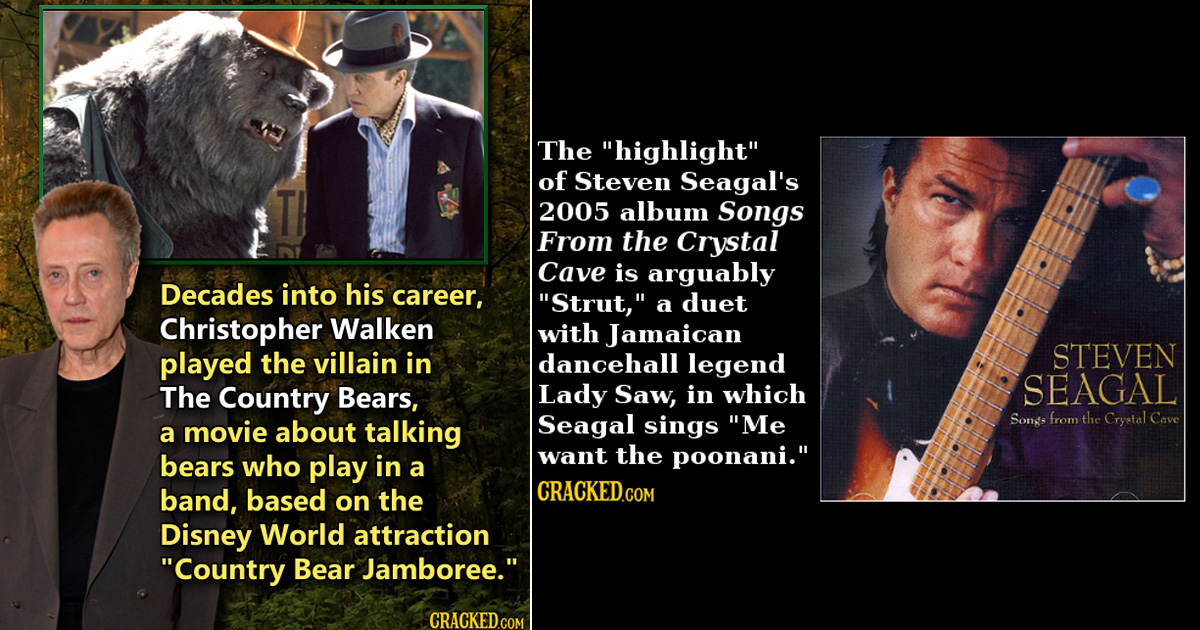
Steven Seagal deciding he should also be a blues-and-roots music guy feels like parody written by a particularly mean late-night writers’ room. Yet it happened. Songs from the Crystal Cave tried to present him as a soulful musician with serious chops, but the vibe was less “weathered master” and more “karaoke night somehow got a budget.” It is one of those projects people discover years later and assume the internet is lying to them.
9. John Travolta Joining The Road to Freedom
Celebrity cameos on concept albums can be fun. Celebrity appearances on a Scientology-linked pop record written around L. Ron Hubbard’s material? That is a much harder sell. John Travolta’s involvement gave the album a big-name glow, but not the kind that translates into lasting musical value. The whole thing feels less like an album and more like a museum exhibit labeled “Please Observe the 1980s From a Safe Distance.”
10. Joaquin Phoenix’s Fake Rap Retirement Era
Joaquin Phoenix is one of the most committed performers of his generation. Unfortunately, that commitment also gave us the I’m Still Here phase, in which he pretended to retire from acting to become a hip-hop artist. The stunt was supposed to blur reality and performance. Mostly, it made everyone uncomfortable. Even Phoenix later spoke about how painful the spectacle became. A bold experiment? Maybe. A fun watch? Not unless you enjoy secondhand embarrassment as a cardio exercise.
11. Jeremy Renner’s Official App
The celebrity app boom gave the world many questionable ideas, but Jeremy Renner’s dedicated app became legendary for all the wrong reasons. It promised exclusive fan engagement and instead became a magnet for trolling, impersonation chaos, and digital nonsense. There is something deeply modern about a celebrity deciding the solution is “more platform” and then learning the internet has other plans. It shut down, naturally, because the trolls won in about five rounds.
12. Will.i.am’s Puls Smart Cuff
Will.i.am has never lacked confidence, and in entertainment that often works in his favor. In consumer tech, confidence without restraint turns into the Puls: a wrist-mounted gadget sold like the future and reviewed like a punishment. The ambition was real. The execution was not. It is the kind of device that makes people nostalgic for the humble, honest uselessness of a lava lamp.
13. Ja Rule and the Fyre Festival Dream
Fyre Festival deserves a permanent seat at the roundtable of catastrophic celebrity side ventures. Ja Rule co-founded a luxury music-festival fantasy that unraveled into one of the most memeified implosions in modern pop culture. It promised paradise and delivered chaos, unfinished infrastructure, and enough online ridicule to power several documentaries. If overhype were an Olympic sport, this project would have brought home gold, silver, and several lawsuits.
14. Jessica Simpson’s Dessert Beauty
Early-2000s celebrity branding produced some truly chaotic beauty ideas, and Jessica Simpson’s edible Dessert Beauty line is one of the era’s purest artifacts. The concept was basically: what if body products could also sound like bakery items and invite confusion? It was peak Y2K excess sugary, sexy, and just a little bit unhinged. Looking back, it feels less like a beauty line and more like a fever dream sponsored by frosting.
15. Heidi Montag’s Superficial
Heidi Montag’s debut album arrived with giant ambition, a reality-TV halo, and enough glossy pop production to make it feel like a lab-designed artifact from the late-aughts fame economy. It flopped at the time and drew heavy skepticism, though later it earned cult appreciation from listeners who enjoy hyperpop before hyperpop had fully learned its name. That revisionism is part of the fun, but in its original moment this was absolutely filed under “celebrity vanity project.”
16. Brie Larson’s Finally Out of P.E.
Before the Oscar and before the superhero franchise machinery, Brie Larson had a teenage pop album. That sentence alone is enough to stop a conversation for a second. The record was not evil, offensive, or especially chaotic; it was simply one more example of an industry trying to build a music career because someone was young, photogenic, and already in the orbit of fame. It feels less like a statement and more like a test balloon that never really left the ground.
17. Johnny Cash’s “Chicken in Black”
When even Johnny Cash later thought a song was a terrible idea, that is usually a clue. “Chicken in Black” is the kind of novelty single that makes you wonder whether everyone in the room misunderstood the assignment at the exact same time. It turned the Man in Black into the center of a bizarre comic premise about brains, chickens, and robbery. There is camp, and then there is whatever this barnyard hallucination was.
18. Sean Connery’s Sir Billi
Imagine ending an iconic screen career by voicing a skateboarding veterinarian in a bafflingly conceived animated film. That is not a hypothetical; that is Sir Billi. Sean Connery deserved a final artistic bow worthy of his stature. Instead, movie history handed him a project that sounds made up even after you verify it. The phrase “career coda” should not be followed by the words “fugitive beaver adventure,” and yet here we are.
19. Aretha Franklin’s Disco Detour on La Diva
Aretha Franklin was too gifted to become bad at music, but even legends can get caught in the wrong trend at the wrong moment. La Diva is often remembered as her disco-era stumble: a project arriving at the tail end of a craze and never quite finding a natural fit between Aretha’s power and the commercial pressure of the moment. It is a reminder that trends can humble absolutely anybody.
20. Usher’s Honey Nut Cheerios Song Rollout
Usher releasing a song through specially marked Honey Nut Cheerios boxes at Walmart sounds like a Mad Lib generated by a sleep-deprived marketing intern. Was it technically a release strategy rather than a full project? Yes. Was it also an absurd celebrity side move that deserves to live in pop-culture trivia forever? Also yes. Nothing says “sexy R&B superstar” quite like a cereal aisle scavenger hunt next to discounted paper towels.
21. Robert De Niro Producing The Adventures of Rocky and Bullwinkle
Robert De Niro has one of the most intimidatingly great résumés in modern film. That is precisely why his involvement in The Adventures of Rocky and Bullwinkle feels so surreal. It is not just that he appeared in it; he also produced it. There is a special kind of disappointment reserved for seeing elite talent spend prestige capital on something that feels like it escaped from a studio memo that should have been deleted.
What These Flops Actually Reveal About Celebrity Culture
The most interesting thing about these projects is not that they failed. Failure is normal. The interesting part is how celebrity culture keeps making the same promise: if an audience loves a person in one lane, it will automatically follow them into every other lane. That logic rarely holds up. People may adore an actor’s intensity, a singer’s charisma, or a comedian’s timing, but that does not mean they want a fragrance, an app, a smartwatch, a spoken-word concept album, or a novelty single hidden under breakfast cereal.
And yet these side projects keep happening because fame creates a false sense of portability. In boardrooms, agents’ offices, brand meetings, and vanity-fueled brainstorms, celebrity gets treated like a universal adapter. It is not. Audiences are much savvier than that. They can smell a genuine passion project. They can also smell a cash grab, an ego trip, or a weirdly overfunded hobby in a trench coat.
The Experience of Watching Celebrity Side Projects Crash and Burn
Part of the reason lists like this are so irresistible is that they recreate a very specific audience experience: the slow-motion realization that a famous person has made a spectacularly odd choice and is somehow completely serious about it. First comes confusion. Then curiosity. Then the tiny, guilty thrill of discovering that yes, this thing exists, and no, it is not a parody cooked up by the internet. That emotional sequence is half the entertainment.
There is also something oddly humanizing about these misfires. When stars succeed too smoothly for too long, they can start to feel bulletproof, overmanaged, or impossibly polished. A weird side project punctures that myth. Suddenly the Oscar winner, chart-topper, or blockbuster kingpin looks like the rest of us on a Tuesday night saying, “I have an idea,” moments before making an extremely avoidable mistake. In that sense, bad celebrity side projects are almost intimate. They reveal taste gaps, blind spots, pet obsessions, and the dangerous magic of having too many yes-people in the room.
Nostalgia makes the experience even richer. A lot of these projects are deeply tied to the aesthetics of their moment: the excess of the late ’80s, the glossy weirdness of the early 2000s, the app delusion of the 2010s, the strange age when brands believed absolutely everything could become a content platform. Revisiting them is like opening a time capsule and discovering it is full of frosted lip gloss, promo CDs, baffling product tie-ins, and secondhand embarrassment preserved in mint condition.
But there is another layer, too: sometimes the audience changes before the project does. What was mocked on arrival can later become camp, and what was once treated like a career-ending embarrassment can evolve into a cult favorite. Heidi Montag’s album is a perfect example of a flop that later found defenders. Even some of the more musical vanity projects now get rediscovered by listeners who appreciate their sincerity, their weirdness, or their refusal to behave like normal pop products. Time can turn a train wreck into an artifact.
That does not make these projects secretly brilliant. Most of them are still messy, misguided, or flat-out ridiculous. But it does explain why people keep coming back to them. A polished, competent release disappears into the feed every week. A celebrity side project that feels wildly overconfident, deeply odd, and slightly cursed? That sticks. It becomes conversation fuel. It becomes trivia. It becomes communal internet folklore.
In the end, the experience of consuming these side projects is less about cruelty than about fascination. We are watching ambition outrun judgment in real time. We are watching fame test its limits. And, if we are being honest, we are watching because disaster has texture. Success is smooth. Failure is detailed. Failure gives us stories, screenshots, awkward performances, impossible packaging decisions, and strange little monuments to the idea that being famous can make almost any idea sound reasonable for far too long.
That is why these projects endure. Not because they were good, and not even because they were universally terrible, but because they captured that rare pop-culture sweet spot where confidence, confusion, and comedy all shook hands. They are bad decisions with excellent shelf life.
Conclusion
Celebrity side projects are the junk drawer of pop culture: full of bizarre objects, half-forgotten experiments, and things that seemed like a great idea until daylight hit them. Some of these ventures were vanity plays. Some were sincere artistic swings. Some were corporate brainstorms that should have been stopped by one brave intern with access to a whiteboard eraser. But together, they tell a bigger story about fame, overreach, and the eternal temptation to confuse recognition with range.
The funniest part is that none of this ever really stops. There will always be another strange album, another cursed product launch, another actor with a tech vision, another superstar partnering with a brand in a way that makes the public say, “I’m sorry, with what?” And honestly, maybe that is for the best. Pop culture would be far less entertaining if celebrities stuck only to the things they were already good at.
So here’s to the glorious misfire: the side project nobody needed, the rollout nobody understood, and the creative detour that somehow became more memorable than a dozen respectable career moves. If greatness is one part talent and one part judgment, these projects are what happens when the second ingredient slips on a banana peel.