Every so often, the art world rediscovers someone who should have been impossible to forget. That is the deliciously strange case with Burt Shonberg, a visionary painter whose work once drifted through Los Angeles coffeehouses, Roger Corman films, psychedelic culture, occult circles, and the kind of conversations that usually begin with, “Wait, how have I never heard of this guy?” His reemergence at the Buckland Museum of Witchcraft and Magick in Cleveland was not just another exhibition. It felt more like a séance with better lighting and stronger wall labels.
The Buckland Museum’s presentation of Beyond the Pleasuredome: The Lost Occult World of Burt Shonberg marked the artist’s first major showing in more than half a century. That alone would be enough to attract attention. But the real hook was deeper: this was a long-overdue public return for an artist who had somehow influenced horror cinema, bohemian Los Angeles, psychedelic aesthetics, and underground mysticism without ever becoming a household name. In other words, Shonberg helped shape a visual language that other people got famous for.
Why Burt Shonberg’s Buckland Museum Show Mattered
The phrase “first showing in 50 years” does heavy lifting, and in this case it earned every ounce of it. Shonberg had only one solo exhibition during his lifetime, back in 1967. After that, his work largely slipped into private collections, legend, rumor, and the occasional sighting behind better-known names. The Buckland Museum exhibition gave that hidden body of work a proper stage. It also placed Shonberg in a setting that made unusual sense.
This was not a generic white-wall gallery trying to make occult art behave politely. The Buckland Museum is devoted to witchcraft, the occult, and related spiritual cultures, so Shonberg’s imagery did not have to explain itself at the door. His paintings, filled with dreamlike landscapes, mythical symbols, altered states, and esoteric suggestion, could breathe there. According to local coverage of the exhibit, the museum’s environment felt less like a neutral container and more like an ecosystem that actually suited the art. That matters. Some art wants a frame. Some art wants a portal.
The exhibition was curated by Brian Chidester, one of Shonberg’s longtime advocates, and accompanied by a catalog devoted entirely to the artist. That catalog was significant in its own right because it pushed Shonberg from cult memory into documented art history. Once an overlooked artist gets a serious catalog, he stops being just “that fascinating forgotten guy your coolest friend talks about” and starts becoming part of the record.
Who Was Burt Shonberg, Exactly?
Burt Shonberg was born in Revere, Massachusetts, in 1933 and studied art in Boston before eventually moving west. Once in California, he became part of a vibrant network of artists, writers, filmmakers, and bohemians orbiting mid-century Los Angeles. He was not a tidy, easy-to-categorize painter. He moved through science fiction, occult imagery, visionary symbolism, psychedelia, and surreal invention with the confidence of someone who had clearly decided that ordinary reality was a little underdressed.
He painted murals for coffeehouses and clubs, including the famously eccentric Café Frankenstein in Laguna Beach, which he helped found. This was not decorative filler art for people sipping espresso and pretending to read Rimbaud. These murals were part of the atmosphere of the place, extensions of the underground culture surrounding them. Shonberg’s art lived in public space before it lived securely in institutions, which may be one reason so much of his legacy scattered so easily.
He also worked around notable figures in film and literature. He was associated with George Clayton Johnson, Hampton Fancher, Forrest J Ackerman, and the artist and occult figure Marjorie Cameron. That circle placed him at the crossroads of Beat culture, science fiction, fringe spirituality, and experimental consciousness. For a modern reader, Shonberg’s biography can sound almost suspiciously cinematic, as if someone built a character by tossing a deck of “1960s California” flashcards into the air. But that strange density of connection is exactly why he fascinates people now.
Burt Shonberg, Psychedelic Art, and the Occult Imagination
Calling Shonberg a psychedelic artist is useful, but incomplete. Yes, he has been described as an early or even foundational figure in psychedelic art. Yes, he participated in research related to LSD and creativity during the early 1960s. Yes, altered consciousness shaped his visual language. But his work was not just a fireworks display of drug-era aesthetics. That would be far too shallow, and frankly a little rude.
What made Shonberg compelling was the way he treated visionary imagery as a serious philosophical and spiritual problem. His paintings often suggest hidden architecture, symbolic beings, sphinxes, dream terrains, and cosmic thresholds. They do not simply scream, “Look at this weird thing!” They ask whether weirdness might actually be the point. His art explored what happens when inner experience, mysticism, fear, revelation, and imagination all borrow the same set of keys.
That is why the Buckland Museum made such poetic sense as a venue. Shonberg’s work did not merely reference occult themes as fashionable props. It came from a world where artists and seekers genuinely treated consciousness, ritual, myth, and hidden knowledge as live material. Seen in that context, his paintings read less like decorative eccentricities and more like transmissions from a larger underground map of postwar American culture.
The Roger Corman Connection That Refuses to Die Quietly
If Shonberg’s name rings a faint bell for film lovers, Roger Corman is probably the reason. Shonberg’s paintings were used in Corman’s Edgar Allan Poe films, including The House of Usher and The Premature Burial. These works contributed to the eerie psychological atmosphere of those movies, giving them an extra layer of feverish visual unease. The paintings did not merely sit in the background like obedient wallpaper. They haunted the frame.
This connection matters because it proves Shonberg was not creating in total obscurity, even during his lifetime. His art was visible, influential, and embedded in cultural works that endured. Yet the artist himself never received the full institutional spotlight that often follows such collaborations. It is one of those maddeningly common art-world stories: the work gets absorbed into the culture while the maker slips into the footnotes.
The Buckland exhibition helped reverse that pattern by placing Shonberg at the center of the story instead of leaving him as an intriguing side note in someone else’s legend. For viewers familiar with Corman’s films, the show offered a chance to reconnect those cinematic fragments to the artist who made them. For everyone else, it served as a reminder that film history is often packed with painters hiding in plain sight.
Why the Rediscovery Took So Long
There are several reasons Shonberg vanished from mainstream recognition for so long. First, his work moved through underground channels rather than stable institutional pipelines. Second, much of it ended up in private hands. Third, he was never a clean fit for standard art history categories. Too mystical for some, too weird for others, too bohemian for the canon, too serious to dismiss as novelty, he occupied an awkward but fertile zone.
There is also the fact that American art history has not always known what to do with figures who connect psychedelia, occultism, horror, outsider symbolism, and subcultural Los Angeles. Shonberg’s world overlaps with all those scenes, but never settles politely into one of them. He belongs to several stories at once. That can delay recognition, especially when institutions prefer neat shelves and legible labels.
Still, the delay may also explain the power of his return. When an artist is rediscovered after decades in the shadows, viewers are not just seeing paintings. They are witnessing a correction. They are watching the timeline get patched. The Buckland Museum exhibition felt important because it did not merely celebrate a forgotten artist; it argued that forgetting him was the mistake.
How the Buckland Museum Changed the Conversation
The Buckland Museum’s role was bigger than hosting a compelling exhibit. It helped shift Shonberg from cult fascination to broader cultural relevance. The museum’s unusual mission made it an unexpectedly strong platform for reassessment. By embracing the occult, paranormal, and magical dimensions of cultural history, Buckland could frame Shonberg without flattening him. That is harder than it sounds.
In a more conventional museum, there might be pressure to translate Shonberg into familiar academic language until all his voltage leaked out. At Buckland, his symbolism, visionary intensity, and mystic undertones were not treated like embarrassing relatives at Thanksgiving. They were treated as central parts of the work. That gave the exhibition both emotional coherence and curatorial honesty.
The show also brought regional and national attention to Cleveland’s museum scene. There was something fitting about this major reintroduction happening outside the usual coastal art capitals. Shonberg had spent decades on the margins of official history, so his comeback landing in a museum devoted to hidden arts felt just right. Not ironic. Not accidental. Right.
The Experience of Encountering Shonberg’s Work
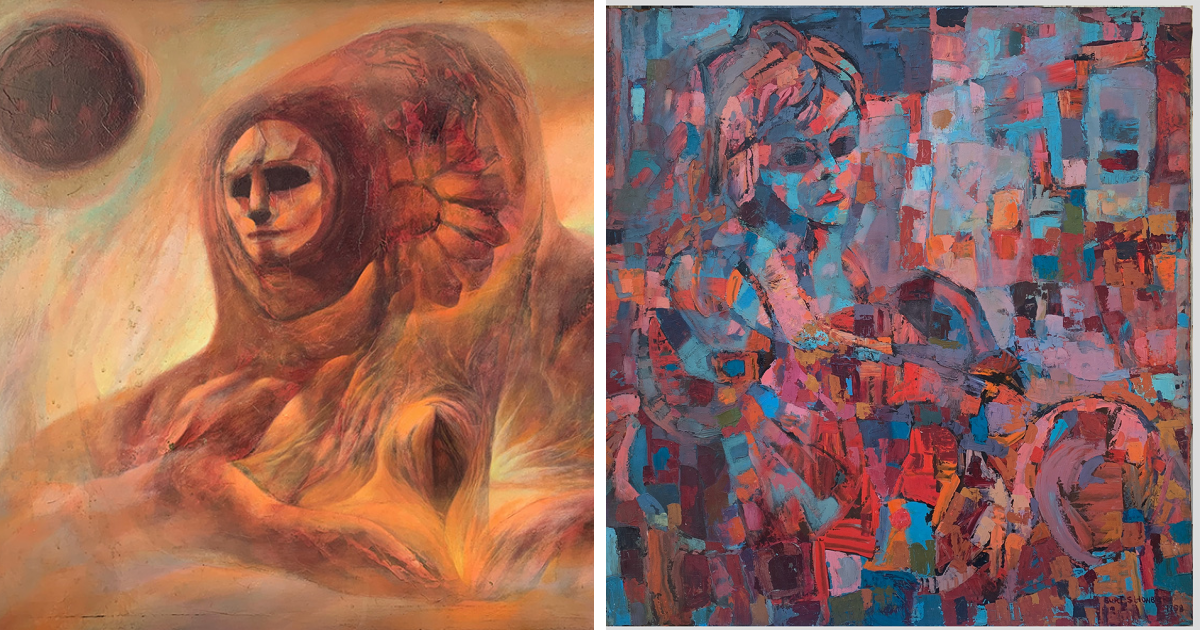
To stand before Shonberg’s paintings, even in reproduction, is to feel the tug of a mind trying to picture what it could not quite explain. The forms can be lush, eerie, luminous, fractured, symbolic, and disorienting all at once. Some works seem to open into interior landscapes. Others feel like mythological portraits seen through an unstable dream. His color often pushes toward revelation, while his imagery hovers between beauty and warning.
One of the most discussed works associated with the Buckland exhibition was Lucifer in the Garden, a painting that reportedly shifted in effect depending on the viewer’s angle and attention. That quality captures a lot of what makes Shonberg memorable. His paintings are not passive. They ask to be experienced rather than merely glanced at. You do not look at them so much as negotiate with them.
And perhaps that is the best reason the Buckland Museum show mattered. It gave viewers a space to slow down and actually have that encounter. Not the quick internet version. Not the myth-summary version. The real thing: color, symbol, atmosphere, and the weird sensation that someone from another artistic timeline has stepped back into the room.
A 500-Word Reflection on the Experience Around This Show
What made Burt Shonberg’s first showing in 50 years at Buckland Museum so compelling was not just the work on the walls, but the feeling surrounding it. This was the kind of exhibition that changed the air in the room before you had even finished reading the title card. Visitors were not simply attending an art show; they were walking into a collision between lost history, occult atmosphere, psychedelic imagination, and museum theater. That combination can go wrong very easily. Here, it seems to have gone gloriously right.
Part of the experience came from contrast. Outside, Cleveland carried on being Cleveland. Inside, Buckland offered an environment where Shonberg’s imagery could unfold with a kind of natural voltage. Reports from the museum emphasized that the building itself already held artifacts, rituals, and stories linked to witchcraft and esoteric traditions. In that context, Shonberg’s paintings did not feel imported. They felt as if they had been waiting there, fashionably late by about five decades.
There is also a very human thrill in seeing an artist receive overdue recognition. You feel it as a visitor. The room carries a slight emotional charge, like everyone knows they are in the presence of a correction. This is not pity for a forgotten painter. It is the sharper feeling that history missed something important and is finally trying to make up for it. That feeling can make even silent galleries buzz.
For people already interested in psychedelic art, the experience was likely one of validation. Shonberg’s work demonstrates that the roots of psychedelic visual culture were deeper, stranger, and more spiritually entangled than the usual posters-and-light-show shorthand suggests. For horror fans, the Roger Corman connection added another layer of pleasure. For museumgoers who came in cold, the show offered the best kind of surprise: the discovery of an artist who feels instantly significant, followed by mild outrage that nobody told you sooner.
Then there is the sensory side. Shonberg’s paintings seem built for slow looking. Shapes emerge in stages. Symbolic hints start murmuring at the edge of perception. Color behaves less like decoration and more like weather. In a standard gallery, viewers might rush past that kind of work. In Buckland’s immersive environment, the art had permission to linger. So did the audience. And once people linger, they start noticing things. Museums love to pretend wall text does all the work, but often it is the room itself that teaches you how to see.
The broader experience around this exhibition was ultimately about recovery: recovering an artist, recovering a subculture, recovering a neglected thread in American visual history. That is what made the show feel bigger than a temporary event. It suggested that Shonberg was not just a fascinating footnote but an important figure whose work still speaks to contemporary audiences interested in mysticism, altered perception, outsider vision, and art that refuses to behave. The Buckland Museum did more than host a comeback. It staged an awakening.
Conclusion
Burt Shonberg’s first showing in 50 years at Buckland Museum was more than a catchy headline. It was a serious cultural moment, one that pulled a visionary artist out of the haze of anecdote and placed him back where he belonged: in front of the public, in conversation with history, and squarely inside the story of American psychedelic and occult art. The exhibition did what the best museum shows do. It gave viewers new work to admire, old assumptions to revise, and one irresistible question to carry home: how many other artists like this are still waiting in the dark?