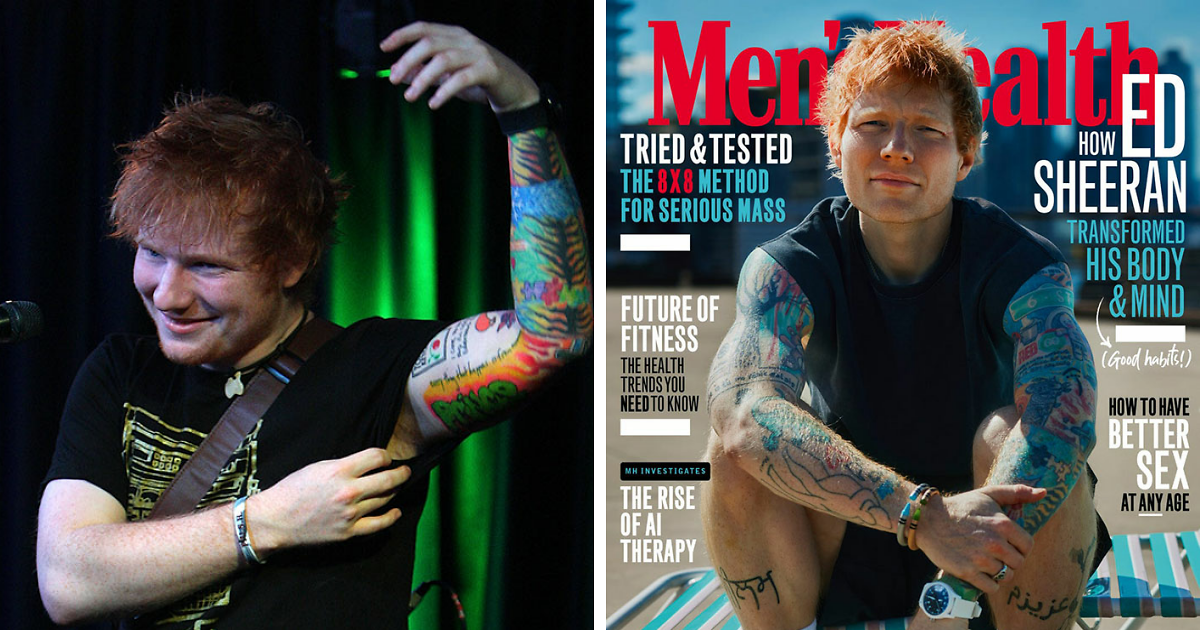
squo;s cardigan-wearing, guitar-strumming everyman. Then he appeared shirtless on the cover of Men’s Health UK, noticeably leaner, stronger, and covered in tattoos that suddenly gave the internet a brand-new group project: having opinions.
For years, Ed Sheeran’s appeal has been built on relatability. He was the guy who looked like he might write a hit song in your friend’s kitchen, then accidentally stay too late because someone opened another bottle of wine. His image was never centered on superhero abs, luxury-gym selfies, or a protein-shake sponsorship that arrives in a fog machine.
That is exactly why his Men’s Health cover created such a loud reaction. The singer revealed a lean, athletic physique after losing roughly 30 pounds over several years, and fans quickly filled social media with praise, shock, jokes, tattoo commentary, and plenty of debates about whether the new look matched the Ed Sheeran they thought they knew. Some reactions focused less on his fitness and more on his dense tattoo collection, with a few commenters making comparisons to Justin Bieber’s heavily tattooed image.
The viral “Worse Than Bieber” framing may be splashy, but it misses the larger story. This was not a pop-star cage match between two tattooed musicians. It was a conversation about identity, public expectations, body image, aging, fatherhood, and what happens when a celebrity known for being comfortably ordinary decides to become visibly healthier.
Sheeran’s transformation is not just about abs. It is about a performer in his thirties realizing that a packed tour schedule, late nights, alcohol, smoking, junk food, and parenting do not always fit neatly inside the same calendar. Turns out the human body does not accept “but I wrote three number-one songs” as a substitute for sleep and recovery.
Ed Sheeran’s Fitness Transformation Was Years in the Making
Ed Sheeran’s body transformation did not appear overnight, even if the magazine cover made it feel like a dramatic before-and-after reveal. He has spoken publicly about changing his habits after years of heavy touring, drinking, smoking, and eating whatever was convenient after performances. Earlier in his career, he had already lost weight after stepping away from a pizza-and-beer-heavy routine and adding more activity to his daily life.
His latest shift appears to be more sustainable than a quick celebrity makeover. Rather than presenting a seven-day juice cleanse or an impossible-to-copy boot camp, Sheeran described a broader overhaul built around consistency. His routine has included running, weight training, reformer Pilates, swimming, yoga, and practical decisions about sleep, recovery, and alcohol.
Fatherhood became a major turning point. Sheeran has said that becoming a dad changed how he viewed his health. He did not want to be exhausted when his daughters needed him, struggle with physical pain while lifting them, or feel like his energy disappeared the moment he left the stage. That motivation is far more relatable than “I needed abs for an action movie role.”
He also connected his wellness efforts to his work. Touring is physically demanding. A two-hour performance involves singing, moving, managing adrenaline, protecting the voice, traveling constantly, sleeping in unfamiliar places, and trying not to eat greasy food at midnight because the hotel menu has once again declared fries a vegetable.
Sheeran reportedly worked with trainers remotely during the pandemic and later brought fitness support on tour. That kind of structure made it easier to turn exercise from a temporary mood into a regular part of his life. The biggest takeaway is not that every person needs a trainer in a tour bus. It is that routines survive better when they are designed around real life instead of fantasy life.
Why the Men’s Health Cover Sparked Such a Big Reaction
Celebrity transformations always attract attention, but Ed Sheeran’s cover felt unusually surprising because his public image has never depended on looking conventionally ripped. His brand has traditionally been built around songwriting, live performance, warmth, humor, and the sense that he might happily join a pub quiz if somebody promised not to ask him to sing “Perfect.”
When a celebrity changes their appearance, fans often feel as though part of the original identity has been replaced. That reaction is not always fair, but it is common. People get attached to the version of a public figure they first encountered. A singer can change a hairstyle, a wardrobe, a sound, or a body, and some fans respond as though a family member rearranged the living room without asking.
With Sheeran, the contrast was especially sharp. The relaxed, slightly rumpled singer-songwriter image was suddenly paired with visible muscle definition and a full spread of tattoos. To many fans, the transformation looked impressive. To others, it felt unfamiliar. The debate was not only about whether he looked good. It was about whether his new visual presentation fit the personality people had assigned to him.
That is where the Bieber comparisons entered the conversation. Justin Bieber’s public image has long included visible tattoos, fashion experimentation, and an athletic body. Sheeran’s tattooed physique prompted some online observers to make lazy comparisons, often as a joke and occasionally as a critique. But comparing two artists simply because both have tattoos is like comparing two pizzas because both contain cheese. Technically possible. Emotionally unnecessary.
The important point is that Sheeran did not become a different musician because he started lifting weights. He still writes emotional songs. He still performs with a guitar. He still has the same voice, the same songwriting instincts, and presumably the same ability to make a stadium audience cry over a chorus they heard while buying nachos.
The Tattoo Debate Was Really About Expectations
The tattoo discussion surrounding Ed Sheeran’s cover says more about public expectations than it does about ink. Tattoos are often treated as visual shortcuts. People see them and attach assumptions: rebellious, stylish, chaotic, serious, unserious, edgy, overdone, artistic, or “my uncle would have opinions.”
Sheeran’s tattoos are not new, but a shirtless magazine cover made them impossible to ignore. When tattoos are partly hidden by T-shirts and jackets, they blend into the background. Put them beside defined shoulders and a polished editorial photograph, and suddenly every design gets its own tiny panel discussion.
Some viewers loved the contrast. The tattoos made Sheeran look more expressive, colorful, and unexpected. Others thought the art clashed with the clean-cut fitness-magazine styling. Neither reaction changes the underlying accomplishment: he built healthier habits and improved his physical capacity in a way that mattered to him.
There is also a cultural double standard hiding underneath the jokes. Men are increasingly encouraged to be fit, lean, muscular, stylish, emotionally available, family-focused, successful, and somehow casual about all of it. The modern ideal is basically a person who can deadlift, make pasta from scratch, attend therapy, answer emails quickly, and never appear to be trying too hard.
Sheeran’s cover became a lightning rod because it exposed that contradiction. Fans say they want celebrities to be healthy and confident. But when a famously relatable artist becomes visibly more disciplined, some people immediately ask whether he has become too polished to relate to anymore.
What Ed Sheeran’s Routine Gets Right About Sustainable Fitness
Sheeran’s approach is more interesting than the final photo because it appears to rely on variety and repetition rather than punishment. Running supports cardiovascular fitness. Strength training can improve muscle strength, physical function, and bone health. Pilates can build body awareness, core control, mobility, and stability. Swimming and yoga add lower-impact movement and recovery options.
That mix matters because boredom is one of the most successful personal trainers in history. It has ended more fitness plans than rain, travel, birthdays, and suspiciously convenient office donuts combined. A routine that includes multiple types of movement can be easier to maintain because it gives people options when their energy, schedule, or joints are not cooperating.
Public health guidance does not require anyone to transform into a magazine-cover model. For most adults, the goal is much more practical: regular movement, aerobic activity, and muscle-strengthening work that can be maintained over time. Even modest activity is better than doing nothing, and consistency usually matters more than intensity for beginners.
That distinction is crucial. A celebrity cover is a snapshot. A healthy lifestyle is a long movie with boring scenes, missed workouts, travel days, rainy mornings, work deadlines, family responsibilities, and the occasional dinner that includes more bread than anyone planned. The best plan is rarely the one that looks most impressive online. It is the one people can still follow when life becomes inconvenient.
Ed Sheeran’s reported shift away from regular late-night drinking also highlights another overlooked part of wellness: recovery. Sleep, hydration, food quality, stress management, and downtime may not create viral photos, but they are often what allow a person to keep exercising without feeling like a discarded phone battery by Wednesday afternoon.
Why Fitness Inspiration Can Become a Problem
There is a positive version of the Ed Sheeran story: a man improves his health, feels stronger, becomes more present for his family, and hopes others feel encouraged to make changes of their own. That is a good story. The problem starts when people turn inspiration into comparison.
A magazine cover is not a baseline for ordinary life. It is a professional production involving styling, lighting, posing, scheduling, wardrobe decisions, and a carefully chosen moment when someone feels and looks their best. That does not erase the work behind Sheeran’s physique. It simply means viewers should not use a finished editorial image as proof that their own body is failing some imaginary test.
Body dissatisfaction can affect men as much as women, especially in a culture that increasingly promotes extreme muscularity as the default standard for masculinity. Social media makes that pressure louder. Scroll long enough, and it can feel as though every other person owns a cold plunge, a home gym, a six-pack, and an extremely confident opinion about creatine.
Healthy fitness goals should focus on energy, strength, mobility, sleep, mood, medical needs, and quality of life. Looking different can be part of the result, but it should not be the only scorecard. A person who can walk farther, play with their children, lift groceries comfortably, sleep better, or feel less anxious has made meaningful progress even if no magazine calls.
Anyone considering a major exercise, diet, or weight-loss change should take their own health history into account. A doctor, registered dietitian, qualified trainer, or physical therapist can help create a plan that fits actual needs rather than internet expectations.
What the Ed Sheeran Fitness Debate Feels Like in Real Life
The most useful part of this story is not the abs, the tattoos, or the internet commentary. It is the familiar feeling underneath it: the moment when someone realizes they are tired of feeling tired.
For many people, that moment does not arrive with a dramatic magazine shoot. It happens while carrying groceries upstairs and needing a break halfway. It happens after struggling to keep up with children at a park. It happens when back pain turns a normal workday into an obstacle course. It happens when a photo appears on a phone and sparks the uncomfortable thought, “I do not feel like myself lately.”
That experience can be emotional because health changes are rarely just about food or exercise. They are about routines, identity, stress, confidence, time, and the stories people tell themselves. Someone who has always seen themselves as “not a gym person” may feel awkward walking into a fitness class. Someone who has spent years eating takeout after work may not know where to begin with cooking. Someone who used to be active may feel embarrassed about starting over.
Ed Sheeran’s story works because it does not begin with perfection. It begins with a person acknowledging that old habits were not serving him anymore. That is a much more realistic starting point than pretending motivation is permanent. Most people do not wake up thrilled to exercise every day. They build systems that make movement easier: a walking partner, a gym bag packed the night before, a simple meal plan, a class they genuinely enjoy, or a rule that says a short workout still counts.
Small wins also matter more than people think. Walking for twenty minutes after dinner may not look dramatic, but it creates momentum. Learning one strength-training movement correctly may not earn applause, but it builds confidence. Going to bed earlier instead of scrolling for another hour can improve recovery more than buying a drawer full of wellness gadgets with names that sound like minor Star Wars villains.
There is also a social side to change. When people improve their health, friends and family sometimes react in unexpected ways. Some are supportive. Some tease. Some feel threatened. Some ask whether the person is “too serious now.” That response often has little to do with the person making changes and more to do with how change makes others reflect on their own routines.
The healthiest response is usually calm and boring: keep doing what helps, avoid turning food or exercise into a personality test, and leave space for joy. A person can train regularly and still enjoy pizza. They can cut back on alcohol without becoming a lecture. They can get stronger without needing to post every workout. They can love their body now and still want to care for it better.
That is the real experience behind the Ed Sheeran debate. It is not about becoming a different person. It is about becoming more capable of living as the person you already are.
The Bottom Line: Ed Sheeran Did Not Betray Relatability
Ed Sheeran’s Men’s Health cover sparked debate because it challenged the version of him people had stored in their heads. The tattoos surprised people. The muscle definition surprised people. The comparisons to Justin Bieber created easy headlines. But the more meaningful story is simple: Sheeran made gradual lifestyle changes because he wanted more energy, better health, stronger performances, and a fuller life with his family.
That is not a betrayal of relatability. It may be the most relatable part of all. Plenty of people reach their thirties and realize that old habits have consequences. Plenty of people want to feel stronger without becoming obsessed. Plenty of people are learning that health is not a punishment for having fun in the past. It is an investment in having more good years ahead.
Editor’s Note: This article discusses a public fitness transformation for entertainment and informational purposes. Individual health, exercise, nutrition, and weight-management needs vary, so personal medical guidance should come from qualified healthcare professionals.