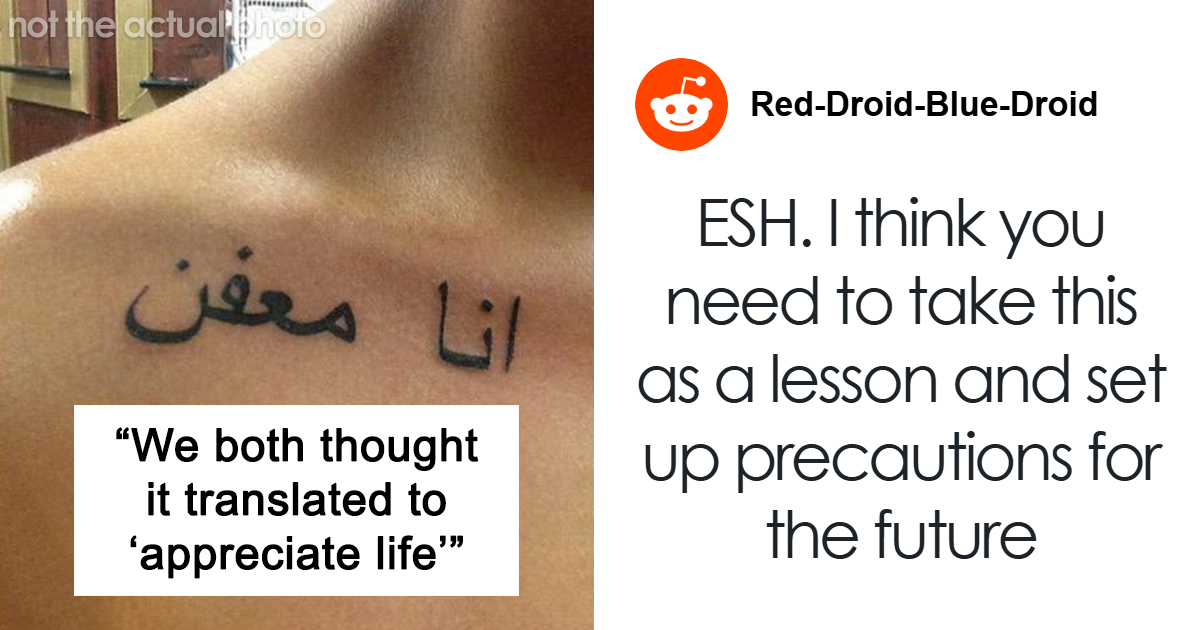
A first tattoo is supposed to become a permanent reminder of something meaningful: a loved one, a personal milestone, a belief, or at least a drawing that does not secretly insult its owner. Unfortunately, one woman’s attempt to get an uplifting Arabic phrase tattooed on her back delivered a very different kind of inspiration.
She believed the elegant script meant “appreciate life.” After the ink had settled into her skin, she discovered that the design came from an old internet meme and reportedly translated to “I’m rotten.” Nothing says personal growth quite like accidentally labeling yourself spoiled produce.
The incident became more complicated when the tattoo artist offered to create a cover-up but wondered whether charging for the additional work would be fair. The resulting debate raised questions about translation, professional responsibility, internet research, tattoo regret, and the surprisingly dangerous practice of treating Pinterest like a multilingual dictionary.
How an Inspirational First Tattoo Became a Permanent Meme
According to the tattoo artist’s account, the client arrived with a reference image containing Arabic writing and an English caption beneath it. The caption claimed that the phrase meant “appreciate life.” Because the translation appeared directly beside the design, both the client and the relatively new artist assumed it was accurate.
The artist copied the requested script and completed the woman’s first tattoo. A few weeks later, however, the client contacted the artist and asked for the photograph of the tattoo to be removed from social media. She had learned that the words did not carry the positive message she expected.
The artist ran the image through translation tools several times and reached the same unpleasant conclusion. The phrase reportedly meant “I’m rotten” and had circulated online as part of a meme years earlier. The original Reddit account described the image as simple Arabic text on a white background with the false inspirational translation underneath it. Its minimalist appearance made it look perfectly at home among motivational graphics, yoga quotes, and photographs of sunsets that insist everything happens for a reason.
The Artist Offered a Cover-Up
Feeling guilty, the tattoo artist immediately offered to collaborate on a cover-up. Four possible designs were reportedly prepared, and the client selected one she liked. That was when the artist began worrying about whether the cover-up should be free.
On one hand, the client had supplied and approved the original design. On the other, the artist felt that a professional should have verified a foreign-language tattoo before placing it permanently on someone’s body. The artist was also concerned that the original offer had sounded like a promise of a complimentary correction.
After receiving extensive online feedback, the artist decided not to charge for the cover-up. There was just one final plot twist: shortly before the appointment, the client canceled. She said the mistaken tattoo had become a charming memory and chose to keep it. The artist later heard that fear of experiencing the pain again may also have influenced the decision. Either way, “I’m rotten” survived.
Why Foreign-Language Tattoos Go Wrong So Easily
Foreign-language tattoos can be beautiful, especially when the language has personal, familial, religious, or cultural significance. The trouble begins when a phrase is selected mainly because the letters look mysterious or decorative.
Languages are not interchangeable collections of stylish symbols. Meaning can change with grammar, spelling, punctuation, dialect, gender, context, and even the way individual letters connect. A machine may provide a technically possible translation that sounds unnatural, comic, or insulting to a native speaker.
Literal Meaning Is Only Part of the Problem
Suppose an online translator confirms that every word is spelled correctly. That still does not guarantee the phrase communicates the intended idea. English expressions such as “break a leg,” “spill the beans,” or “I’m dying” would sound alarming if translated word for word without cultural context.
Arabic creates additional challenges because its letters often change shape depending on their position in a word. The script is written from right to left, and improper software or image editing can reverse letters, disconnect them, or place them in an unnatural order. A phrase can therefore be grammatically wrong even when its individual characters appear attractive.
The safest approach is to consult more than one fluent speaker, preferably including someone familiar with the relevant regional dialect. A professional translator should review longer, culturally sensitive, or deeply personal text. The final stencil should then be checked again after the font and layout have been adjusted.
The Internet Is a Mood Board, Not a Fact-Checking Department
The failed tattoo demonstrates how easily misleading images can be separated from their original context. A joke created for Tumblr, Reddit, or another social platform may later appear on an inspiration board with no indication that it was satire.
Once an image has been reposted enough times, repetition creates the illusion of credibility. Ten accounts sharing the same incorrect translation do not equal ten independent confirmations. They may all be recycling one person’s joke.
A reverse-image search can help locate older versions of a design, discussions about its origin, or photographs of other people who received the same tattoo. Google’s official instructions explain that users can right-click an image in Chrome and search it with Google Lens. Lens can also examine uploaded screenshots and locate visually similar results.
A Five-Minute Tattoo Research Routine
Before approving a permanent design found online, save the image and run it through at least one visual-search tool. Search the exact words in quotation marks, look for earlier posts, and inspect results from native speakers rather than relying only on tattoo galleries.
For foreign text, ask fluent readers to type the phrase independently. Compare their version with the reference image character by character. Then print or display the final stencil in the correct orientation. Five mildly tedious minutes can prevent several years of explaining why your shoulder says “discount refrigerator.”
Who Is Responsible When a Tattoo Translation Is Wrong?
The online debate surrounding this incident divided responsibility among the client, the artist, or both. There is no single universal answer because agreements, professional standards, and tattoo regulations vary by location.
The Client Approved the Design
The strongest argument in the artist’s favor is simple: the client selected the exact image and requested that it be copied. Tattoo artists cannot realistically speak every language or identify every obscure meme ever uploaded to the internet.
Clients also have control over what goes on their bodies. They should check spelling, dates, names, symbols, translations, and placement before the needle starts. Signing a stencil approval should mean more than glancing at it while deciding which snack to buy after the appointment.
The Artist Is Still the Professional
Clients nevertheless visit professional studios because they expect guidance. An experienced artist should recognize high-risk requests, including unfamiliar scripts, copied logos, culturally sensitive symbols, tiny text, and designs that may not age well.
An artist does not need to become a certified translator. However, the artist can pause the appointment, warn the client that the meaning has not been verified, recommend outside confirmation, and document that the client approved the final wording.
Shared Responsibility Is the Most Practical Answer
In this case, the client brought an incorrect reference, while the artist admitted skipping a check that would normally have been performed. That makes the incident less like a villain-versus-victim story and more like two people confidently walking through the same unlocked trapdoor.
A reasonable business response could include a discounted cover-up, credit for the amount paid for the original tattoo, or a correction performed at material cost. Whatever arrangement is offered, the price should be discussed before new artwork is created. Clear communication is cheaper than resentment and considerably cheaper than laser treatment.
How Tattoo Studios Can Prevent Similar Disasters
Professional studios can reduce misunderstandings by using a written approval process. The client should confirm the design, dimensions, orientation, spelling, location, and meaning before tattooing begins.
Foreign-language requests deserve an additional acknowledgment stating that the artist has not independently certified the translation unless a qualified translator was involved. This does not eliminate every disagreement, but it makes expectations visible before anyone reaches for a needle.
Studios should also maintain infection-control procedures, use sterile single-use needles, handle ink properly, and follow applicable licensing rules. Public-health guidance emphasizes the importance of clean facilities, sterilized equipment, safe handling practices, and proper aftercare. Contaminated ink or nonsterile water has been associated with outbreaks of tattoo-related skin infections.
What to Do After Discovering a Tattoo Mistake
The first reaction to a bad tattoo may be panic, anger, or the sudden desire to purchase every long-sleeved shirt in the nearest store. However, an immediate physical correction is rarely the best response.
Let the Tattoo Heal First
A fresh tattoo is an open wound. It can appear darker, redder, puffier, or less precise while healing. Scratching, aggressively washing, or attempting an amateur removal can damage the skin and increase the risk of infection.
Follow the artist’s aftercare instructions, keep the area clean, and avoid unnecessary friction or soaking. Seek medical care when redness spreads, pain becomes worse instead of better, the skin feels unusually hot, drainage develops, red streaks appear, or fever occurs. Allergic reactions can also happen immediately or much later.
Discuss a Correction or Cover-Up
Small spelling errors may occasionally be corrected, depending on the font, spacing, ink density, and location. A cover-up uses a new design to incorporate and conceal the original tattoo. Because the new work must overpower existing pigment, it is usually larger, darker, or more detailed.
Not every tattoo is immediately suitable for a cover-up. An experienced cover-up artist may recommend waiting, fading part of the design with laser sessions, or choosing a concept that works naturally with the original shape.
Consider Professional Laser Removal
Laser treatment breaks tattoo pigment into smaller particles that the body gradually clears. Multiple sessions are usually required, and complete removal is not guaranteed. Results vary according to color, depth, age, location, ink composition, skin tone, and the technology used.
Possible side effects include discomfort, swelling, blistering, changes in skin color, infection, and scarring. The FDA and dermatology organizations advise against unapproved removal creams and do-it-yourself methods, which can burn or injure the skin without reliably removing deep pigment.
Tattoo Regret Is Common, but It Is Not Always Permanent
Tattoos have become a mainstream form of self-expression. A 2023 Pew Research Center survey found that 32% of American adults had at least one tattoo, while 22% had more than one. Most tattooed adults did not regret their ink, although some regretted at least one design.
Regret does not always mean the original decision was foolish. People change careers, beliefs, relationships, identities, and aesthetic preferences. Research on tattoo removal has found that changes in identity and a desire to distance oneself from the past can motivate removal.
Sometimes the healthiest response is correction or removal. Sometimes it is acceptance. The woman in this story reportedly decided that her accidental meme had become a meaningful memory. The phrase was not what she intended, but the experience surrounding it gave the tattoo a new story.
Lessons for Anyone Planning a First Tattoo
Choose an artist whose portfolio demonstrates skill in the style you want. Confirm that the studio follows local health and licensing requirements. Avoid booking while intoxicated, pressured, exhausted, or emotionally overwhelmed.
Keep a proposed design as your phone wallpaper or print it and place it somewhere visible for several weeks. If it becomes annoying before it is on your body, congratulations: you have completed the world’s least expensive tattoo-removal procedure.
Check every name, number, coordinate, quotation, and symbol. For another language, obtain verification from fluent speakers and preserve the approved text in a format that cannot reverse or disconnect characters. Review the stencil while standing naturally and examine it in a mirror.
Finally, speak up. Tattoo artists would rather reposition a stencil five times than discover after the appointment that the date is wrong, the text is backward, or the inspirational quote is actually a complaint about rotten vegetables.
Related Experiences: Five Ways a Dream Tattoo Can Become an Unexpected Story
1. The Name That Looked Different in Script
Imagine someone requesting a parent’s name in an elaborate handwritten font. The digital preview appears graceful, but two connected letters make the name resemble an entirely different word. Everyone sees what they expect to see until a friend points it out after the tattoo heals.
The experience teaches a simple lesson: decorative lettering must remain readable. A design should be shown to someone who does not already know what it is supposed to say. Fresh eyes often notice ambiguities that the client and artist unconsciously correct in their minds.
2. The Coordinates That Led Somewhere Else
Another common concept involves geographic coordinates marking a birthplace, proposal location, or favorite vacation. One switched digit, missing minus sign, or confused latitude direction can move the sentimental destination across an ocean.
The best prevention is to paste the final coordinates into more than one mapping service and verify the location before approving the stencil. Numbers may look less dramatic than Arabic calligraphy, but they are equally capable of betrayal.
3. The Tiny Tattoo That Did Not Stay Tiny-Looking
A client may arrive with a highly detailed design intended to fit into a one-inch space. It photographs beautifully on the day it is completed, but ink naturally settles and softens over time. Tiny gaps can close, delicate lines may blur together, and miniature lettering can become difficult to read.
A responsible artist may recommend enlarging or simplifying the artwork. That advice is not an attempt to ruin a minimalist vision. It is an effort to ensure the tattoo remains recognizable after years of movement, sunlight, and normal skin changes.
4. The Trend That Aged Faster Than the Ink
Internet culture moves at astonishing speed. A symbol that feels clever today can become associated with an embarrassing trend, controversial personality, or forgotten joke next year. Tattoos inspired by memes, viral challenges, celebrity relationships, or fashionable slogans carry an extra layer of cultural risk.
A waiting period helps separate lasting personal meaning from temporary online excitement. The internet will always produce another trend. Your skin does not receive automatic software updates.
5. The Mistake That Became the Favorite Tattoo
Not every imperfect tattoo ends in anger. A crooked line, unusual expression, mistranslated word, or slightly strange animal can become beloved because of the memories attached to it. Friends may turn the mistake into an affectionate joke, and the owner may eventually value the story more than the original design.
That does not mean people should accept unsafe work, unwanted imagery, or serious errors. It means perfection is not the only path to meaning. The woman who kept her accidental “I’m rotten” tattoo apparently transformed a disappointing first experience into a permanent reminder to research carefully, communicate clearly, and perhaps never trust a suspiciously profound meme.