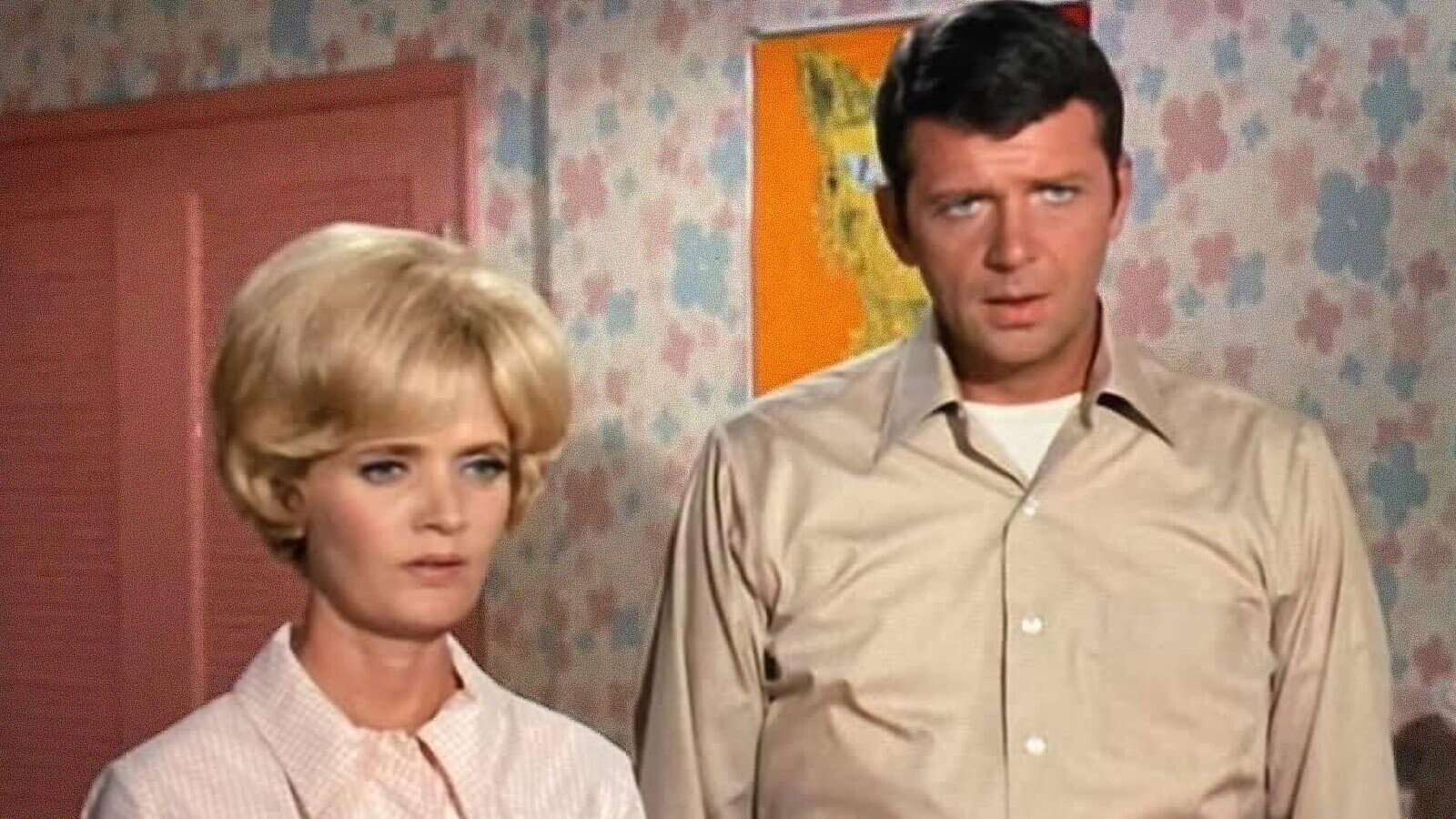
For a show famous for sunshine, shag carpet, and six suspiciously well-groomed children sharing one bathroom, The Brady Bunch has a surprisingly weird unsolved mystery sitting right in the middle of its perfect suburban living room: what happened to Mike and Carol Brady’s first spouses?
The show’s opening theme tells us the important basics. Mike Brady, an architect with three sons, marries Carol Martin, a mother of three daughters. Together, they form one of television’s most recognizable blended families. But the theme song, cheerful little tattletale that it is, skips one major issue: the biological parents who came before. Mike’s first wife is briefly acknowledged as dead. Carol’s first husband? He vanishes so completely that even Alice’s meatloaf gets more emotional closure.
That silence has bothered fans for decades. Was Carol widowed? Divorced? Abandoned? Did Mr. Martin simply walk out for cigarettes and get trapped in a 1970s department-store wallpaper aisle? The official answer is much more interesting: the show never gave one. And because television fans are legally required to fill every blank space with either detective work or nonsense, a darker theory eventually emergedone that Florence Henderson herself jokingly encouraged.
The Confirmed Brady Facts: What the Series Actually Says
The Brady Bunch premiered on ABC in 1969 and ran for five seasons, ending in 1974. Created by Sherwood Schwartz, the sitcom was built around a then-fresh TV concept: a blended family in which two single parents bring three children each into one household. Mike Brady, played by Robert Reed, has sons Greg, Peter, and Bobby. Carol, played by Florence Henderson, has daughters Marcia, Jan, and Cindy. Add housekeeper Alice Nelson, a dog named Tiger, and a suspiciously high tolerance for sibling singing, and you have the Brady formula.
In the pilot episode, “The Honeymoon,” the show gives Mike at least a little backstory. His sons speak about their mother, and Mike comforts Bobby with the idea that his mother would be proud of him. The implication is clear enough: Mike’s first wife has died. What the series does not reveal is her name, how she died, when she died, or why a family dealing with such loss almost never mentions her again.
Carol’s situation is even murkier. At the start of the pilot, she is Carol Martin. Her parents are identified as the Tylers, which makes her full name commonly understood as Carol Ann Tyler Martin Brady: Tyler by birth, Martin by first marriage, Brady by second marriage. That means Carol definitely had a first husband, or at least a first marital surname. Yet the show never shows Mr. Martin, never names him on-screen in the original series, never explains his fate, and never lets Marcia, Jan, or Cindy ask, “Hey, whatever happened to Dad?”
Why Carol’s First Husband Was Never Explained
The missing Mr. Martin was not an accident so much as a network-era compromise. Sherwood Schwartz reportedly intended Carol to be divorced. That would have made The Brady Bunch more openly modern, because divorce and remarriage were becoming more visible in American family life. But late-1960s television was still cautious. A divorced mother on a family sitcom could raise awkward questions: Where is the ex-husband? Does he get weekend custody? Does he pay child support? Why did the marriage end? And most terrifying of all for network executives: would viewers have to hear the word “divorce” while eating a TV dinner?
So the series took the softest possible route. Mike remained a widower. Carol was not officially called a widow, but she also was not clearly identified as divorced. Her first husband became a blank spot in Brady history. The writers avoided custody, grief, remarriage trauma, legal adoption, and anything else that might interrupt the show’s weekly mission of solving household crises in under 26 minutes.
That decision helped keep the series light, but it also created one of classic TV’s strangest gaps. The entire premise depends on two incomplete families becoming one complete family, yet the show refuses to talk about what made those families incomplete in the first place. It is like opening a mystery novel and discovering the detective would rather sing “It’s a Sunshine Day.”
Mike Brady’s First Wife: Dead, But Barely Discussed
Mike’s first wife is the easier case, but only slightly. The boys’ mother is understood to have died before the series begins. The pilot treats that fact tenderly for a moment, especially through Bobby, who is young enough for the loss to feel fresh and confusing. Then, for practical sitcom reasons, the subject largely disappears.
From a storytelling perspective, that silence makes sense. The Brady Bunch was not trying to be a grief drama. Its world runs on misunderstandings, talent shows, school elections, broken vases, and family meetings in the living room. If the boys frequently talked about their late mother, the series would have had to wrestle with real sorrow. Instead, the show chooses harmony over emotional continuity.
But from a fan-theory perspective, that silence is deliciously odd. Three boys lose their mother, move into a newly blended family, and then rarely process that loss on-screen. Carol becomes “Mom” almost instantly. The Brady household operates as if the past has been politely placed in a storage box behind the AstroTurf and never opened again.
Carol Brady’s First Husband: The Mystery Gets Weirder
Carol’s first husband is where the Brady rabbit hole really starts wearing bell-bottoms. The girls become Bradys quickly. They live full-time with Mike and Carol. Their biological father does not call, visit, write, appear, argue, object, or exist in any meaningful way. For a divorced father, that would be remarkably absent. For a dead father, it is strange that the girls almost never mention him. Either way, the original show is aggressively quiet.
Carol does offer one vague emotional clue in the pilot when she reflects that, three years earlier, she thought her world had ended, but now a new life was beginning. That line can be read two ways. It could refer to the death of her husband. It could also refer to a painful divorce. The geniusor the dodgeis that it never says which.
That ambiguity allowed different viewers to project different answers onto Carol’s past. Conservative viewers could imagine she was widowed. More modern viewers could assume she was divorced. The network got plausible deniability. Schwartz kept his intended character background. Everyone wonexcept poor Mr. Martin, who got erased from the family album like a bad prom date.
The Dark Theory: Did Mike and Carol Remove Their First Spouses?
Now we arrive at the theory that turns America’s favorite blended family into a suburban noir. The darker fan interpretation suggests that Mike and Carol did not merely lose their first spouses. They may have arranged for those spouses to disappear so they could be together.
The idea plays like a twisted sitcom version of Strangers on a Train: two people trapped in inconvenient marriages allegedly solve each other’s problems, then wait until suspicion cools before marrying and merging their families. Mike, an architect, would theoretically know structural weak points, slippery staircases, or balcony railings that suddenly become less reliable than Jan’s self-esteem. Carol, with her flawless smile and social grace, could pass through a police interview looking like she was on her way to a PTA bake sale.
To be clear, this is not canon. The original series never suggests Mike or Carol committed crimes. The theory exists because the show leaves an unusually large narrative hole. When a family sitcom refuses to explain two missing spouses, fans will eventually start treating the absence like evidence. That is not fair to the Bradys, but it is very fair to the internet, which was born to ask, “Okay, but what if the nice mom is secretly the villain?”
Florence Henderson’s “Black Widow” Joke
The reason this theory became extra irresistible is Florence Henderson. Years after the series ended, Henderson joked that she had her own dark answer for Carol’s missing first husband. She quipped that Carol had killed him and called herself the original “black widow.” She also joked that she had simply “got rid of him.”
That comment was not a confession, obviously. Florence Henderson was being funny, playful, and fully aware of how absurd the mystery had become. But because she was Carol Bradythe warm, singing, center-square mom of American televisionher joke gave the fan theory a kind of mischievous blessing. If the actress who played Carol could laugh at the idea, fans had permission to imagine the Brady house with a secret basement full of unsolved questions.
That is why the phrase “Carol-endorsed theory” works. Henderson did not seriously endorse murder as Brady canon. She endorsed the fun of the mystery. She understood that the show’s clean surface made the missing-spouse question even more hilarious. The darker the joke, the brighter the Brady kitchen seemed by contrast.
What About A Very Brady Sequel?
The 1996 film A Very Brady Sequel took the missing-husband mystery and turned it into a full comedy plot. In the movie, a man named Roy Martin shows up claiming to be Carol’s long-lost first husband. He says he suffered amnesia and underwent plastic surgery, which is exactly the sort of explanation that sounds ridiculous until you remember this is a Brady parody and not a courtroom deposition.
Of course, the man is not really Roy Martin. He is a con artist trying to steal a valuable artifact from the family. The movie also folds in a joking connection to Gilligan’s Island, another Sherwood Schwartz creation, by suggesting that Carol’s real first husband may have been linked to a professor lost at sea. It is clever, silly, and very much not the same thing as original-series canon.
Still, the sequel matters because it proves the mystery had become part of Brady pop culture. By the 1990s, audiences were expected to understand that Carol’s first husband was a famous unanswered question. The movie did not solve the mystery so much as turn it into a punchline with better lighting.
The More Realistic Answer: TV Avoided Messy Family Details
The most realistic explanation is also the least murderous: The Brady Bunch wanted a blended family without the complicated emotional paperwork of blending a family. Divorce, custody, step-parenting tension, grief, loyalty conflicts, and biological-parent memories were all too heavy for the show’s tone. The series wanted the idea of modern family life, but packaged in a way that felt safe, cheerful, and commercially friendly.
That strategy worked. The Brady children rarely behave like step-siblings. Mike and Carol are not constantly negotiating boundaries. The missing first spouses do not haunt holidays. Nobody argues over whose parent gets called “Mom” or “Dad.” The show turns a complicated family structure into a fantasy of instant unity. In that fantasy, the past has to disappear so the present can smile at the camera.
This is why the first-spouse mystery remains fascinating. It reveals the tension between what The Brady Bunch was selling and what real blended families often experience. Real remarriage can be loving and joyful, but it usually comes with history. The Bradys have history too; the series just keeps it off-screen, probably in the same mysterious place where the toilets are hiding.
Why Fans Still Care About the Brady First Spouses
Fans care because the unanswered question changes how we watch the show. On the surface, The Brady Bunch is a comfort sitcom. Underneath, it is a show built on absence. Mike’s sons had a mother before Carol. Carol’s daughters had a father before Mike. Those people mattered, at least logically, yet the series quickly replaces them with the new family unit.
Modern viewers are more likely to notice that omission. Today, a blended-family sitcom would probably explore grief, divorce, co-parenting, adoption, step-sibling tension, and the children’s mixed emotions. In 1969, the safer choice was to skip the complications and make the family lovable first. That approach gave the show its charm, but it also left behind a mystery big enough to drive a station wagon through.
Experience: Watching the Brady Mystery Through Modern Eyes
Rewatching The Brady Bunch today is a strangely cozy experience. The colors are loud, the lessons are tidy, and the family problems are usually solved before anyone has time to develop a lasting psychological pattern. But once you notice the missing first spouses, the show becomes more interesting. Not darker in a grim waythis is still a universe where a cursed tiki idol can cause family chaosbut more layered.
The first time many viewers revisit the pilot as adults, they are surprised by how much is packed into the setup. Mike and Carol are not just two cute single parents who meet and marry. They are adults with pasts. Their children have already lived through major family disruption. The wedding is not just a romantic beginning; it is also a reset button. Six kids are expected to become one family almost overnight, and the show presents that as sweet, funny, and basically manageable.
That can feel comforting, especially for viewers who grew up with the series in reruns. The Brady house is a place where people choose togetherness. The kids may compete, complain, and occasionally form a singing, and occasionally form a singing group with the confidence of people who have never read YouTube comments, but they ultimately come back to family. The missing spouses make that dream possible because they do not interrupt it.
At the same time, the silence can feel unrealistic. In real blended families, old relationships do not simply vanish. Children remember. Parents carry guilt, grief, frustration, or relief. A new marriage does not erase a former household. Even when everyone wants the new family to work, the past still shows up at birthdays, holidays, school forms, medical records, and quiet moments when a child misses someone who is not there.
That is why the Brady mystery is still fun to discuss. It gives modern audiences a way to talk about how television used to simplify family life. The dark theory is entertaining because it is absurd, but the reason it sticks is more serious: the show leaves too much unsaid. When a story refuses to explain an absence, viewers naturally invent explanations. Some will choose divorce. Some will choose death. Some will choose a Gilligan crossover. And some, with a wicked grin, will choose Carol Brady: suburban black widow, queen of casseroles and cover-ups.
The best way to enjoy the theory is not as a serious accusation against fictional parents, but as a playful reminder that even the cleanest TV families have shadows if you tilt the lamp just right. The Bradys remain lovable. Mike is still steady. Carol is still iconic. Alice still deserves overtime pay. But somewhere behind that famous staircase, there is a locked little door marked “Mr. Martin,” and fans have been happily picking at it for decades.
Conclusion: So, What Really Happened?
The honest answer is that Mike Brady’s first wife died before the series began, while Carol Brady’s first husband was intentionally left unexplained. Sherwood Schwartz wanted Carol to be divorced, but network concerns pushed the show into ambiguity. Later parodies and fan theories had fun with the gap, and Florence Henderson’s black-widow joke gave the whole mystery a deliciously dark sparkle.
So did Carol Brady really kill her first husband? Noat least not in any official Brady canon. But did the show create the perfect conditions for fans to wonder? Absolutely. By refusing to explain Mr. Martin, The Brady Bunch accidentally gave viewers one of classic television’s funniest little mysteries. For a sitcom built on neat endings, that unresolved question may be its most entertaining loose thread.
Note: This article treats the “dark theory” as humorous fan speculation. The confirmed information is that the original series never reveals what happened to Carol Brady’s first husband, while Mike Brady is presented as a widower.