A “flat stomach” is one of those fitness goals that sounds simple until your body raises its hand and says, “Actually, I have genetics, hormones, sleep, stress, posture, digestion, and a full-time job to consider.” The truth is that no single exercise can magically flatten your stomach like a human Photoshop tool. However, the right combination of core training, full-body strength exercises, cardio, mobility work, and consistent healthy habits can help you build a stronger midsection, improve posture, support fat loss, and feel more confident in your body.
So, what exercises can help achieve a flat stomach? The best answer is not 500 crunches while regretting every snack you have ever loved. The smartest plan includes exercises that train your entire core, burn energy through large muscle groups, strengthen your body from head to toe, and improve how you move. A strong stomach is not just about visible abs; it is about stability, balance, better posture, and being able to carry groceries without turning into a folding chair.
First, Can You Target Belly Fat With Ab Exercises?
Let’s clear up the big fitness myth hiding in the room wearing a sweatband: spot reduction does not work the way many people hope. Doing sit-ups can strengthen abdominal muscles, but it will not specifically remove fat only from the belly area. Fat loss happens across the body, and where you lose it first or last depends on factors such as genetics, age, hormones, activity level, sleep, stress, and overall lifestyle.
That does not mean ab exercises are useless. Far from it. Core exercises help tighten and strengthen the muscles underneath, improve posture, support the spine, and make your waistline look and feel more stable. But for a flatter-looking stomach, the winning formula is usually a mix of core work, cardio, strength training, and realistic consistency.
The Best Exercise Categories for a Stronger, Flatter-Looking Stomach
Instead of chasing one miracle move, think of your routine like a fitness team. Core exercises are the captain, cardio is the engine, strength training is the muscle, and mobility work is the friendly coach reminding everyone not to move like a rusty shopping cart.
1. Core Stabilization Exercises
Core stabilization exercises train your abdominal muscles to resist movement, protect your spine, and keep your body steady. These are often more useful than old-school crunch marathons because they target deep core muscles, including the transverse abdominis, obliques, lower back, hips, and pelvic muscles.
Plank
The plank is one of the best core exercises for a reason: it trains your abs, shoulders, glutes, and back at the same time. Start on your forearms and toes, keeping your body in a straight line from head to heels. Pull your belly button gently toward your spine, squeeze your glutes, and avoid letting your hips sag.
Beginners can start with 15 to 20 seconds. As you get stronger, work up to 30 to 60 seconds. Quality matters more than time. A perfect 20-second plank beats a shaky two-minute plank that looks like a bridge during an earthquake.
Side Plank
Side planks target the obliques, the muscles along the sides of your waist. They also improve balance and help build the kind of core strength you use in real life when carrying bags, turning, reaching, or trying not to fall while putting on socks.
Lie on one side, place your elbow under your shoulder, and lift your hips so your body forms a straight line. Hold for 10 to 30 seconds per side. Beginners can bend the lower knee for support.
Dead Bug
The dead bug sounds like something you find near a window, but it is actually a fantastic beginner-friendly core exercise. Lie on your back with your arms reaching toward the ceiling and your knees bent at 90 degrees. Slowly lower one arm and the opposite leg while keeping your lower back gently pressed toward the floor. Return to the start and switch sides.
This move teaches control, protects the spine, and trains deep abdominal muscles without yanking on your neck or lower back.
Bird Dog
Bird dog improves core stability, balance, and coordination. Start on your hands and knees. Extend your right arm forward and your left leg back, keeping your hips level. Pause, return to the start, and switch sides.
The goal is control, not speed. Imagine balancing a glass of water on your lower back. If that imaginary water spills everywhere, slow down.
2. Full-Body Strength Training
If you want a stronger, leaner-looking midsection, do not only train your abs. Full-body strength exercises use large muscle groups, which helps your body burn more energy and build lean muscle. Lean muscle supports a healthy metabolism and improves body composition over time.
Squats
Squats work your legs, glutes, hips, and core. Stand with your feet about shoulder-width apart, push your hips back, bend your knees, and lower as if sitting into a chair. Keep your chest lifted and your knees tracking in the same direction as your toes.
Try 2 to 3 sets of 8 to 12 reps. Bodyweight squats are enough for beginners. Add dumbbells only when your form feels solid.
Lunges
Lunges challenge your balance and force your core to stabilize your body. Step one foot forward, bend both knees, and lower until your front thigh is nearly parallel to the floor. Push through your front heel to return to standing.
Start with reverse lunges if forward lunges feel awkward. They are often easier on the knees and better for learning control.
Push-Ups
Push-ups are secretly core exercises wearing an upper-body costume. They strengthen the chest, shoulders, arms, and abdominal muscles. Keep your body in a straight line, lower with control, and avoid letting your lower back dip.
Beginners can do push-ups from the knees or with hands elevated on a bench, counter, or sturdy chair.
Glute Bridge
Glute bridges strengthen the glutes, hamstrings, and lower back while teaching your core and hips to work together. Lie on your back with knees bent and feet flat. Press through your heels, lift your hips, squeeze your glutes, and lower slowly.
This exercise also helps improve posture, especially for people who sit a lot. Your hips will appreciate the memo.
3. Cardio Exercises That Support Fat Loss
Cardio helps improve heart health, burn calories, and support overall fat loss when paired with healthy eating and strength training. You do not need to punish yourself with workouts you hate. The best cardio is the kind you will actually do consistently.
Brisk Walking
Brisk walking is underrated. It is accessible, joint-friendly, and surprisingly powerful when done regularly. Aim for a pace where you can talk but not sing. If you can belt out a full concert playlist, pick up the pace a little.
A practical goal is 20 to 30 minutes most days of the week. Walking after meals may also help you feel less sluggish and more energized.
Cycling
Cycling, whether outdoors or on a stationary bike, is a strong cardio option for people who want lower-impact movement. It works the legs, raises the heart rate, and can be adjusted from easy to challenging.
Swimming
Swimming trains the entire body while being gentle on the joints. It engages the core because your body must stay aligned in the water. Plus, it has the bonus of making you feel like an athletic dolphin, even if your freestyle looks more like a determined toaster.
Dancing
Dancing burns energy, improves coordination, and makes exercise feel less like a chore. Whether it is Zumba, hip-hop, salsa, or dancing alone in your room like the main character in a music video, movement counts.
4. High-Intensity Interval Training
High-intensity interval training, or HIIT, alternates short bursts of harder effort with recovery periods. HIIT can be useful for improving fitness and supporting fat loss, but it should be used wisely. More is not always better. Doing intense workouts every day can lead to fatigue, soreness, and burnout.
A beginner-friendly HIIT session might look like this:
- 30 seconds of marching or jogging in place
- 30 seconds of rest
- 30 seconds of bodyweight squats
- 30 seconds of rest
- 30 seconds of mountain climbers, slow and controlled
- 30 seconds of rest
- Repeat for 10 to 15 minutes
Keep your form clean. If your body starts moving like a noodle in a windstorm, reduce the intensity.
Best Ab Exercises for a Flat Stomach Routine
The following exercises can be mixed into a balanced weekly plan. They help strengthen the abdominal muscles, improve posture, and build a firmer core.
Mountain Climbers
Mountain climbers combine cardio and core training. Start in a high plank position. Drive one knee toward your chest, return it, and switch sides. Move slowly at first. Fast mountain climbers are only useful if your form stays strong.
Try: 2 to 3 sets of 20 to 30 seconds.
Reverse Crunches
Reverse crunches target the lower abdominal area without requiring a big upper-body crunch. Lie on your back, bring your knees toward your chest, and gently lift your hips off the floor using your abs. Lower with control.
Try: 2 to 3 sets of 10 to 12 reps.
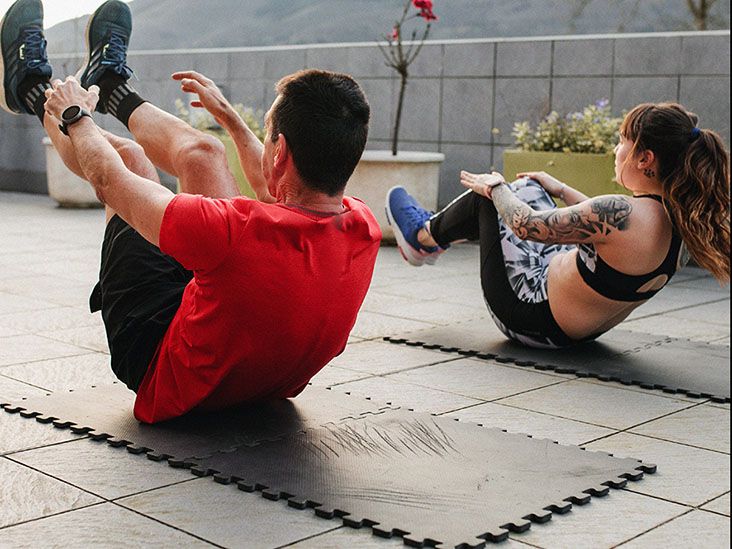
Bicycle Crunches
Bicycle crunches train the rectus abdominis and obliques. Lie on your back, bring your knees up, and rotate your torso so one elbow moves toward the opposite knee. Keep the motion controlled rather than racing through reps.
Try: 2 sets of 10 to 15 reps per side.
Standing Wood Chop
The standing wood chop trains rotation and helps your core work in a more functional way. Use a light dumbbell, medicine ball, or just your hands. Start with your hands near one hip, then rotate diagonally upward across your body. Return slowly and repeat on the other side.
Try: 2 to 3 sets of 8 to 12 reps per side.
Hollow Body Hold
This is more advanced, so start carefully. Lie on your back, press your lower back into the floor, lift your shoulders slightly, and extend your legs. The lower your legs are, the harder it becomes. Bend your knees if needed.
Try: 10 to 20 seconds at a time.
A Simple Weekly Workout Plan for a Stronger Stomach
You do not need to train abs every day. Muscles need recovery to grow stronger. A balanced weekly plan can help you build consistency without turning your life into one long plank.
Beginner Weekly Plan
- Monday: Core workout: plank, dead bug, bird dog, glute bridge
- Tuesday: 30-minute brisk walk
- Wednesday: Full-body strength: squats, push-ups, lunges, bridges
- Thursday: Rest or gentle stretching
- Friday: Core and cardio: mountain climbers, side plank, walking
- Saturday: Fun movement: cycling, swimming, hiking, or dancing
- Sunday: Rest, mobility, or easy walk
Sample 15-Minute Flat Stomach Workout
This quick routine works well at home and requires no equipment:
- Plank: 20 to 30 seconds
- Dead bug: 10 reps per side
- Glute bridge: 12 reps
- Bird dog: 10 reps per side
- Mountain climbers: 20 seconds
- Side plank: 15 seconds per side
Rest for 30 to 60 seconds, then repeat the circuit 2 to 3 times. Keep your breathing steady and your movements controlled.
Common Mistakes to Avoid
Doing Only Crunches
Crunches can be part of a routine, but they should not be the whole routine. A stronger stomach comes from training the entire core and body, not just folding yourself in half repeatedly like laundry.
Ignoring Posture
Poor posture can make the stomach appear more pushed forward. Strengthening the core, glutes, and upper back can help your body stand taller. Sometimes the “flat stomach” improvement people notice comes partly from better alignment, not just fat loss.
Training Too Hard Too Soon
Overtraining can lead to soreness, poor form, and frustration. Start at your current level and progress gradually. Fitness is not a race; it is more like brushing your teeth. Small, consistent actions matter.
Forgetting Recovery
Sleep and recovery are part of the plan. Muscles strengthen during recovery, not during the 47th set of rushed mountain climbers. Give your body time to adapt.
How Long Does It Take to See Results?
Results vary. Some people feel stronger in two to four weeks. Visible changes may take longer depending on body composition, genetics, workout consistency, nutrition, sleep, and stress. Instead of judging progress only by the mirror, track how long you can plank, how your posture feels, how your clothes fit, how much energy you have, and whether daily movement feels easier.
A flat stomach should never come at the cost of health. Extreme restriction, excessive exercise, or chasing unrealistic body standards can backfire physically and mentally. A strong, healthy core is a better goal than trying to force your body into one specific shape.
Helpful Experiences: What Really Works in Real Life
In real life, the people who make the best progress usually are not the ones doing the most dramatic workouts. They are the ones who find a routine they can repeat when life gets messy. And life always gets messy. There are school deadlines, work calls, family plans, rainy days, low-energy days, and those mysterious evenings when the couch develops a gravitational pull stronger than Earth’s.
One useful experience many beginners share is that starting small works better than starting extreme. For example, a person who begins with a 10-minute core routine three times per week often stays more consistent than someone who tries a 60-minute workout every day and quits after one week. A short routine feels doable. Once it becomes normal, it is easier to add more.
Another common lesson is that walking helps more than people expect. Many people think they need complicated gym machines to work toward a flatter stomach, but regular brisk walking can support fat loss, reduce stress, and improve endurance. A 20- to 30-minute walk after dinner can become a simple habit that does not feel like a punishment. It also gets you away from screens, which is basically a modern miracle.
Strength training is another game changer. People often focus only on ab workouts, then wonder why progress is slow. When they add squats, lunges, push-ups, rows, and glute bridges, their whole body becomes stronger. Their posture improves. Their core works harder during everyday movement. They may notice that their stomach looks firmer because their body is better supported.
Many people also learn that form matters more than speed. A slow dead bug with good control can do more for your core than a wild set of bicycle crunches performed like you are trying to escape invisible bees. Controlled movement teaches your deep core muscles to activate properly.
A realistic experience-based tip is to keep a “minimum workout” ready. On busy days, instead of skipping everything, do one round: 20-second plank, 10 dead bugs per side, 10 glute bridges, and a short walk. This keeps the habit alive. You do not need a perfect workout every time; you need enough consistency to keep showing up.
Finally, the biggest lesson is patience. A stronger stomach is built through repeated choices, not one heroic workout. Some weeks will be better than others. That is normal. The goal is to create a routine that supports your body, not one that makes you dread exercise. When workouts feel useful, flexible, and even a little fun, consistency becomes much easier.
Conclusion
The best exercises for a flat stomach are not just ab exercises. A smart plan includes core stabilization moves like planks, dead bugs, bird dogs, and side planks; full-body strength exercises like squats, lunges, push-ups, and glute bridges; and cardio activities like brisk walking, cycling, swimming, or dancing. HIIT can also help when used safely and not overdone.
Remember, the goal is not to punish your body into looking a certain way. The goal is to build a stronger core, improve posture, support overall health, and feel better in daily life. A flat stomach may be part of the result for some people, but strength, energy, confidence, and consistency are the real wins.
Note: This article is for general educational purposes and should not replace personal guidance from a qualified healthcare or fitness professional, especially for anyone with injuries, medical conditions, or new exercise limitations.