Some inventions save time. Others save money. Chindōgu saves you from the dangerous belief that every clever idea deserves a spot in your kitchen drawer. Japan’s playful tradition of “unuseless” invention takes a tiny everyday inconvenience, attacks it with heroic confidence, and produces a solution so awkward that the original problem starts looking pretty reasonable.
That distinction matters. The gadgets below are not ordinary products found in every Japanese home, nor do they represent Japanese technology as a whole. Most belong to the deliberately impractical art of chindōgu, a movement associated with inventor and editor Kenji Kawakami. A proper chindōgu physically exists and appears to solve a recognizable problem, yet it creates enough embarrassment, inconvenience, or absurdity to prevent sensible everyday use.
In other words, these are inventions with one foot in engineering and the other planted firmly on a banana peel. Here are 10 crazy Japanese inventions you probably do not wantalthough at least three may live rent-free in your imagination by the end.
What Makes a Japanese Invention “Crazy”?
Calling something crazy can be lazy unless we define the joke. Chindōgu is not simply a collection of failed products. It is a form of comic design that exposes how easily innovation can become overengineering. The creator identifies a legitimate irritationhot noodles, wet shoes, a runny noseand builds a device that technically responds to it. The catch is that the cure is worse than the complaint.
Traditional chindōgu principles also resist normal commercial logic. The object should exist in physical form, relate to daily life, and contain a rebellious spirit, but it should not become a conventional product created mainly for profit. Humor is present, yet the gadget is funniest when its maker treats it with completely serious design logic.
This is why chindōgu remains more interesting than a random gag gift. Each device asks a useful question: When does convenience stop being convenient? The answer, apparently, is often “right after you attach an umbrella to your shoe.”
The Top 10 Crazy Japanese Inventions You Don’t Want
1. The Toilet Paper Hat for a Runny Nose
Seasonal allergies are miserable. You sneeze, reach for a tissue, discover the box is across the room, and briefly consider replacing your respiratory system. The toilet paper hat eliminates that three-step ordeal by mounting a roll of tissue directly above your head. A loose sheet hangs near your face, ready for action whenever pollen launches another attack.
The design earns points for supply-chain efficiency. Your nose and its paper source are finally in the same department. Unfortunately, you must walk around wearing bathroom hardware like a ceremonial crown. The dangling paper can brush your face, catch on objects, unroll in the wind, or announce your medical situation to everyone within visual range.
Why you do not want it: Carrying a pocket pack of tissues requires less structural engineering and dramatically fewer explanations.
2. Fan-Powered Chopsticks for Cooling Noodles
A steaming bowl of ramen presents a genuine dilemma: wait patiently or burn your mouth with the optimism of a person who has learned nothing from previous noodles. Fan-powered chopsticks propose a third path. A miniature electric fan attaches near the utensils and blows air across each bite as it travels toward your mouth.
On paper, the idea has momentum. In practice, the fan adds weight, noise, batteries, and a small mechanical object near your broth. It may cool one mouthful while the rest of the bowl continues steaming. It can also spray droplets, stir aromas directly into your eyes, and make an ordinary lunch look like a laboratory test involving soup propulsion.
Why you do not want it: Blowing gently on your noodles is free, quiet, washable, and unlikely to require troubleshooting.
3. The Baby Mop Onesie
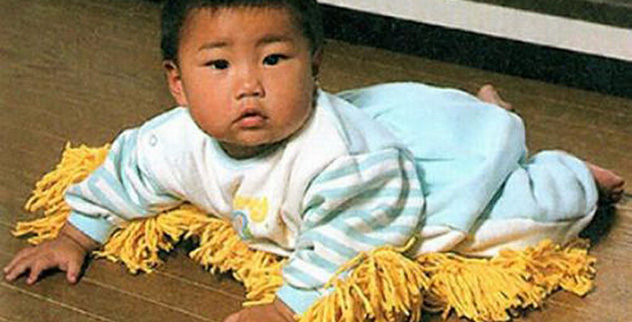
The baby mop may be the most famous example of a solution that sounds efficient for exactly four seconds. Soft mop-like material is attached to the arms, legs, and torso of a crawling infant’s outfit. As the baby explores the floor, the fringe collects dust. Parenting and housekeeping become one adorable, deeply questionable workflow.
The obvious problem is that babies do not clean in organized rows. They reverse unexpectedly, investigate crumbs, drool, stop under furniture, and occasionally decide that movement itself is an insult. The outfit may collect dirt, but it also brings that dirt into close contact with the child. Floors need safe cleaning methods; infants need clean play spaces. Combining the two jobs does not improve either one.
Why you do not want it: Your baby is a family member, not a cordless appliance with snack breaks.
4. The Umbrella Tie
The umbrella tie tries to rescue office workers from carrying a separate umbrella. The concept integrates a compact canopy into neckwear, allowing the user to transform business attire into emergency rain protection. It is the rare accessory that says, “Quarterly earnings at nine, sudden weather event at ten.”
Unfortunately, umbrellas work best when they are wide, stable, centered above the body, and held away from expensive clothing. Ties work best when they lie flat and do not contain support rods. Combining them creates a small canopy close to the face, neck, and shirt. Wind becomes a personal negotiation. Rain may still reach your shoulders, briefcase, and dignity.
Why you do not want it: A normal folding umbrella fits in a bag and does not attempt to strangle your wardrobe during deployment.
5. Tiny Umbrellas for Your Shoes
Wet shoes are uncomfortable, so why protect only your head? Shoe umbrellas attach miniature canopies above your footwear, theoretically keeping rain from landing on the tops of your shoes. Visually, they make every step look as though two tiny café tables are fleeing down the sidewalk.
The umbrellas may block vertical droplets, but rain rarely respects a vertical-only policy. Water splashes from pavement, runs around the edges, blows sideways, and arrives from passing vehicles with cinematic ambition. Meanwhile, the canopies can interfere with your stride, bump into each other, snag on stairs, and turn a crowded sidewalk into a low-altitude aviation zone.
Why you do not want it: Water-resistant shoes handle rain without requiring separate weather systems for each foot.
6. The Butter Stick
Cold butter tears toast. The butter stick responds by packaging butter like a glue stick: twist the base, expose the cylinder, and rub it directly across bread, corn, or another food awaiting a glossy dairy finish. Among strange Japanese inventions, this one comes dangerously close to being useful.
That is also where the trouble begins. Butter changes texture with temperature. Too cold, and the stick drags across the bread like a crayon on carpet. Too warm, and it becomes a slippery tower with poor career prospects. Crumbs cling to the surface, the container requires cleaning, and anyone reaching into the wrong drawer may discover that craft time has taken a savory turn.
Why you do not want it: A butter dish, a knife, and several seconds of patience remain a surprisingly advanced system.
7. The 360-Degree Camera Hat
Before phones made panoramic photography easy, the 360-degree camera hat offered a hardware-heavy alternative. Cameras were positioned around a head-mounted rig so a tourist could capture scenes in multiple directions. Instead of turning around, you could document everything at onceincluding the confused faces of people watching you document everything at once.
The device solves missed angles by adding weight, bulk, film or storage requirements, alignment issues, and the constant risk of hitting a doorway. It also creates the photographic problem of quantity without intention. A memorable picture usually depends on choosing a subject. Recording every direction can produce more evidence but less meaning.
Why you do not want it: Your phone already takes panoramas, and it does not make your head resemble a security system.
8. The Portable Zebra Crossing
The portable zebra crossing is an audacious answer to inconvenient road design. The user carries a roll of striped material, spreads it across the street, and creates an instant crosswalk wherever one seems necessary. It is confidence rendered in black and white.
Of course, painted road markings are not magical shields. A legitimate crosswalk is supported by traffic law, visibility, signals, signs, road design, and driver expectations. A portable striped mat has none of that authority. Deploying one in live traffic would be dangerous, confusing, and possibly illegal. It could also curl, slide, or become a very large piece of road litter.
Why you do not want it: Walk to a designated crossing. The extra minute is less inconvenient than explaining homemade traffic infrastructure to emergency services.
9. The Double-Headed Toothbrush
Brushing takes only a few minutes, but humanity has never stopped asking whether those minutes can be compressed. The double-headed toothbrush uses more than one brush head to clean multiple tooth surfaces at the same time. It promises efficiency through simultaneous scrubbing.
The problem is that mouths are not standardized tunnels. Teeth vary in shape, alignment, sensitivity, and spacing. A rigid multi-head arrangement can feel bulky, trigger gagging, miss the gumline, or apply uneven pressure. More brush heads also mean more places for toothpaste and moisture to collect. The tool may look efficient while delivering less precise control than a conventional toothbrush used with proper technique.
Why you do not want it: Dental care rewards thoroughness, not a speed record set by a brush that resembles kitchen tongs.
10. Onion-Chopping Glasses With Tiny Fans
Onions release irritating compounds when cut, and watery eyes can turn dinner preparation into a low-budget tragedy. Fan-equipped onion glasses attempt to blow the fumes away before they reach your eyes. The wearer receives goggles, miniature fans, and the appearance of a pilot preparing for takeoff over a cutting board.
The concept sounds plausible until airflow becomes involved. A fan may redirect vapors, but it can also push them toward someone else, scatter lightweight ingredients, dry your eyes, move hair into your face, or create extra equipment that must be cleaned after cooking. Batteries near food preparation add another maintenance task to a problem already solved by ventilation, a sharp knife, and basic kitchen technique.
Why you do not want it: Chilling the onion, using a sharp blade, and running a vent fan are less theatrical and more practical.
Why These Weird Japanese Gadgets Are Actually Brilliant
The inventions may be impractical, but the thinking behind them is not foolish. Chindōgu demonstrates that bad solutions can reveal good design principles. Each object begins with observation. Someone notices that tissues are never nearby, noodles are too hot, shoes get wet, or butter refuses to cooperate. That attention to small frustrations is also where useful innovation begins.
The difference appears during evaluation. A successful product reduces total effort. A chindōgu shifts effort into a stranger form. The tissue hat saves one reach but adds public embarrassment. Shoe umbrellas stop a few drops but complicate walking. The noodle fan cools one bite but introduces electronics to lunch. By exaggerating the trade-offs, these inventions teach a memorable rule: never measure convenience by a single step.
They also challenge the assumption that everything creative must be monetized. Modern product culture often rushes from idea to prototype to crowdfunding page before asking whether anyone should own the thing. Chindōgu pauses at the prototype and lets the contradiction remain visible. The object can exist as comedy, commentary, and design exercise without demanding shelf space in millions of homes.
A 500-Word Experience: Spending a Day With “Unuseless” Inventions
The following is a realistic thought experiment based on how these documented inventions are designed to function, not a claim of personal hands-on testing.
Morning: Convenience Immediately Files for Divorce
Imagine beginning the day with the double-headed toothbrush. The first impression would probably be optimism: twice the brush should mean half the work. Then the oversized tool enters your mouth, bumps a cheek, misses an angled molar, and turns two minutes of routine hygiene into a coordination exam. You finish at roughly the usual time, except now you have a more complicated toothbrush to rinse.
Breakfast brings the butter stick. This is the invention most likely to inspire an honest “Wait, that could work.” The first swipe across warm toast might even be satisfying. Then crumbs attach themselves to the butter cylinder, one edge softens faster than the other, and the stick begins leaning like a dairy monument with foundation problems. The knife in the drawer suddenly seems elegant.
The Commute: A Forecast of Public Confusion
Outside, rain begins. You deploy the umbrella tie and attach tiny umbrellas to your shoes. The tie canopy protects a narrow circle around your collar while water reaches your shoulders from both sides. The shoe umbrellas survive three steps before one turns sideways and taps the other. People stare, but not because they are jealous. You are technically addressing the weather while practically losing to it.
At the corner, the portable zebra crossing offers the day’s greatest lesson. Even in an imaginary test, using it on a live road would be unsafe. The responsible experience ends before deployment. You keep the roll packed, walk to the actual crosswalk, and realize that some inconveniences exist because shared systems require predictable rules.
Lunch and Afternoon: Technology Meets Noodles
At lunch, fan-powered chopsticks make their debut. The first bite cools slightly. The second swings under the fan at the wrong angle. The third sends a tiny spot of broth onto the table. Nearby diners become unwilling participants in a demonstration about airflow. You switch the fan off and return to the ancient technology of waiting ten seconds.
Later, the 360-degree camera hat captures everything around you, including unflattering lighting, blank walls, strangers checking whether they are being recorded, and several hundred images you never intended to take. The experience reveals the difference between collecting information and creating a photograph. More coverage is not automatically more meaning.
Evening: The Real Value Appears
By evening, the toilet paper hat feels less like allergy relief and more like performance art. It works in the narrowest technical sense: paper is nearby. Yet every movement reminds you that a pocket tissue accomplishes the same task with almost no social or mechanical cost.
The day would end with an unexpected appreciation for ordinary objects. A toothbrush fits the hand. A knife spreads butter. Crosswalks coordinate strangers. Umbrellas occupy the space above a person instead of above each shoe. Chindōgu makes familiar tools look smarter by showing the thousands of design decisions hidden inside simplicity.
That is the best experience these inventions can provide. You do not need to buy them, and traditional chindōgu was never supposed to become ordinary merchandise. You only need to imagine using them long enough to laugh, notice a design trade-off, and look at everyday life with slightly more curiosity.
Conclusion: Solutions Nobody Asked to Carry
The top crazy Japanese inventions on this list succeed by failing with style. They solve real but minor problems through gadgets that create larger, funnier complications. The toilet paper hat defeats the search for tissues but defeats fashion more decisively. Shoe umbrellas fight rain while fighting your ability to walk. The baby mop combines two responsibilities that should remain respectfully separated.
More importantly, chindōgu should not be mistaken for a catalog of products that defines Japan. It is a specific creative traditionpart design exercise, part anti-consumerist joke, and part celebration of imagination without practical obligation. Its best inventions make us laugh because we recognize the original annoyance and briefly believe the ridiculous solution might work.
Then common sense returns, carrying a normal umbrella.