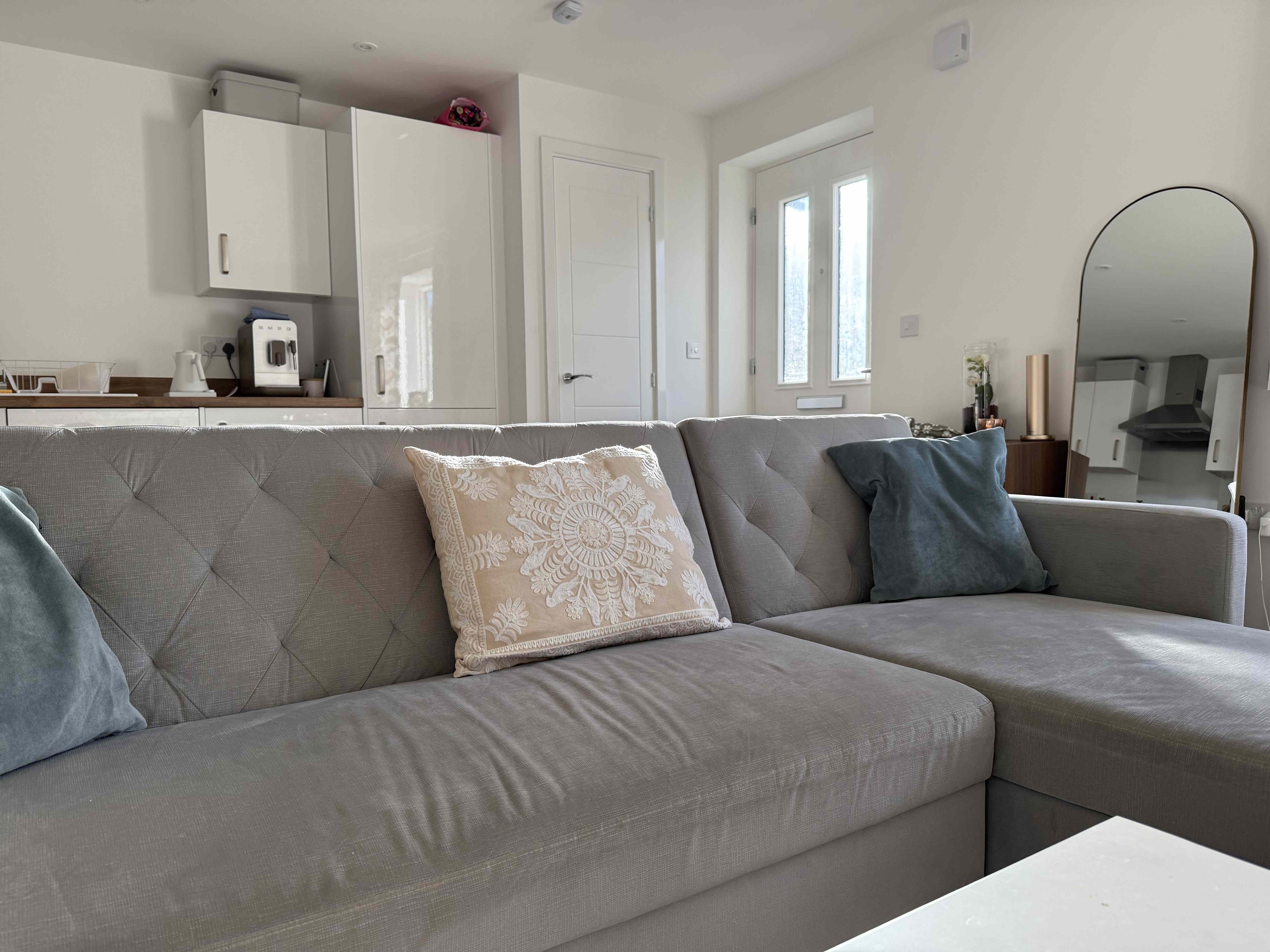
Some people decorate their living rooms with a statement lamp. Others choose a dramatic coffee table, a gallery wall, or a sofa so white it requires guests to sit down with the emotional caution of a museum visitor. For me, the most meaningful piece in my living room is much smaller: a hand-embroidered ivory Suzani-style cushion cover.
Yes, a pillow. The humble couch sidekick. The object most likely to be thrown onto the floor during movie night. But this one is different. It does more than soften the sofa; it softens the distance between where I live now and where my family comes from. It is a piece of South Asian living room decor that quietly says, “Your roots belong here too.”
In a modern apartment filled with warm neutrals, practical furniture, books, candles, and the usual evidence of a person who has convinced herself that one more throw blanket is “for texture,” this cushion brings something deeper: memory, culture, craftsmanship, and a little bit of desi pride without turning the room into a themed restaurant lobby.
Why One Cushion Can Carry So Much Meaning
Decor is often treated as surface-level: colors, shapes, trends, and whether your coffee table books are stacked at a height that suggests you are effortlessly cultured. But home decor can also be emotional architecture. It tells visitors what we value, what we remember, and what we are still learning to claim.
For many South Asian Americans and members of the South Asian diaspora, the home becomes a place where identity is negotiated every day. Outside, there may be pressure to blend in, simplify names, explain food, or reduce a huge, diverse cultural background into a few polite talking points. Inside, however, the home can stretch out. It can hold brass, marble, block prints, embroidered textiles, incense, spice tins, family photographs, festival lights, and the comfortable chaos of culture.
That is why a single cushion can matter. It is not just a soft square with good stitching. It becomes a small, everyday refusal to hide.
The Decor Piece: An Ivory Suzani-Style Cushion Cover
The piece that changed the mood of my living room is an ivory Suzani-style cushion cover inspired by traditional embroidery, handcrafted with a subtle animal and floral motif. Its palette is quiet: cream on cream, warm ivory, soft texture, and detailed stitching that reveals itself slowly. At first glance, it blends beautifully with neutral living room decor. At second glance, it starts telling stories.
That balance is what makes it so special. It does not shout. It does not demand that everything else in the room become jewel-toned, carved, tasseled, and spiritually intense by next Tuesday. It simply rests on the sofa, calm and confident, like an auntie who knows the family gossip but has decided to sip chai instead.
South Asian decor is often flattened into one look: bright colors, “boho” patterns, mandalas, elephants, and enough gold to make a jewelry store nervous. Those things can be beautiful, but they are not the whole story. South Asian design also includes restraint, earthy materials, fine handwork, architectural symmetry, botanical motifs, storytelling textiles, and subtle forms of luxury. This cushion captures that quieter side.
South Asian Living Room Decor Does Not Have to Be Loud to Be Proud
One of the biggest myths about heritage home decor is that cultural expression must be maximalist to count. If your living room does not look ready for a wedding sangeet, does that mean you are doing it wrong? Absolutely not. Culture is not a volume setting.
Some people celebrate South Asian roots with saturated color: saffron, emerald, ruby, indigo, marigold, and hot pink. Others do it through materials: brass trays, carved wood, marble accents, cane furniture, or terracotta vessels. Some prefer scent: sandalwood, jasmine, cardamom, rose, or incense drifting through the room after dinner. And some of us lean toward a softer visual language: embroidered cushions, block-printed napkins, framed textile fragments, or neutral wallpaper with Indian-inspired motifs.
The point is not to perform heritage. The point is to live with it in a way that feels honest.
The Beauty of Handmade Textile Decor
Textiles have always been central to South Asian homes. They appear as shawls, quilts, saris, rugs, cushion covers, bedspreads, curtains, wall hangings, and carefully folded fabrics that nobody is allowed to touch because they are “for guests.” Handmade textiles are especially powerful because they carry evidence of time. A machine can produce perfection. A hand produces presence.
That is what I love about embroidered decor. The stitches create texture and dimension. You can see the care in the surface. Even when the design is minimal, the work feels alive. It connects a modern living room to a long tradition of making beauty useful: cloth that warms, welcomes, protects, decorates, and remembers.
South Asian textile traditions are incredibly diverse. Kantha from Bengal is known for running stitches and layered cloth. Phulkari from Punjab celebrates floral work and dense embroidery. Block printing, ikat, kalamkari, chikankari, mirror work, and woven patterns all carry regional histories and personal meanings. The cushion on my sofa does not try to represent every tradition; that would be impossible and, frankly, too much responsibility for one pillow. Instead, it opens the door to curiosity.
How the Cushion Changed My Living Room
Before adding this piece, my living room looked pleasant but slightly anonymous. It had a beige sofa, a warm rug, pale walls, a small stack of books, and enough candles to suggest I was preparing either for relaxation or a minor power outage. It was nice. But it did not quite feel like mine.
The cushion changed that. Its embroidered details added depth without disturbing the calm palette. The ivory tone worked with the existing neutrals, while the fauna-inspired motif brought in nature, softness, and heritage. Suddenly the room felt less like a rental-friendly Pinterest board and more like a home with a voice.
It also became a conversation starter. Visitors notice it because it is elegant, but when they ask about it, I get to talk about South Asian-inspired design, handmade decor, and the pleasure of finding pieces that reflect more than one part of my identity. That is the dream, really: decor that looks good and gives you an excuse to say something meaningful before everyone starts discussing what to order for dinner.
Blending South Asian Heritage With Modern Interior Design
Modern South Asian home decor works best when it feels layered rather than staged. Instead of buying every “ethnic” accent available and hoping your living room develops a personality through sheer quantity, start with one meaningful item. A cushion, a framed print, a brass bowl, a handwoven throw, or a carved side table can act as an anchor.
From there, build slowly. Pair heritage pieces with clean-lined furniture. Let old and new sit together. A marble tray can work on a Scandinavian coffee table. A block-printed cushion can soften a mid-century chair. A brass diya can sit beside a modern ceramic vase. A framed textile can become art above a console. The contrast is what makes the room feel personal.
1. Choose a Hero Piece
Start with one item that carries emotional weight. It might be a cushion, a rug, a painting, a family heirloom, or a handmade object from a South Asian-owned brand. The goal is not to fill the room instantly. The goal is to create a focal point that feels like you.
2. Repeat Materials, Not Themes
If your hero piece has embroidery, echo texture elsewhere with a woven basket or a linen curtain. If it has brass details, repeat brass in a lamp, tray, or picture frame. This makes the space feel cohesive without becoming costume-y.
3. Mix Neutrals With Heritage Colors
You do not need to choose between beige and bold. Warm neutrals can make saffron, rust, indigo, and emerald feel even richer. A cream sofa with one embroidered cushion can be just as culturally expressive as a room filled with color.
4. Let Scent and Sound Join the Decor
A home is more than what it looks like. Jasmine incense, cardamom tea, old Bollywood songs, ghazals, qawwali, or the sound of family calling from the kitchen can all make a space feel rooted. Living room decor is visual, but belonging is sensory.
Why This Piece Feels Like a Bridge
The most personal homes are rarely pure in style. They are full of bridges: between generations, countries, languages, design eras, and versions of ourselves. My living room is not only South Asian. It is also American, modern, practical, slightly messy, and deeply attached to comfortable seating. That mixture is the point.
The cushion helps me embrace a hybrid identity. It honors South Asian craftsmanship while fitting into a contemporary home. It reminds me of family homes where textiles were everywhere, but it does not force me to copy those spaces exactly. It gives me permission to inherit selectively, lovingly, and with my own taste intact.
That permission matters. Sometimes reconnecting with culture can feel intimidating, especially if you grew up at a distance from certain languages, rituals, or traditions. You may wonder if you are “South Asian enough” to decorate this way. But culture is not a test you pass by owning the correct number of brass objects. It is a relationship. You build it through attention.
Small Decor, Big Identity
There is something powerful about seeing your heritage in the everyday parts of your home. Not only during Diwali. Not only when relatives visit. Not only when you cook a family recipe. But on an ordinary Tuesday, when the room is quiet, the tea is cooling, and the cushion is right there on the sofa reminding you that belonging does not need an occasion.
That is the magic of meaningful living room decor. It can turn a rented apartment into a rooted space. It can make a neutral palette feel personal. It can help you celebrate South Asian roots at home without needing to explain, justify, or overdecorate.
Practical Styling Ideas for a South Asian-Inspired Living Room
If you want to bring South Asian decor into your living room, begin with pieces that feel connected to your story rather than pieces that merely look “global.” Here are a few thoughtful ideas:
Use embroidered pillows as cultural accents
A hand-embroidered pillow is easy to style, easy to move, and easy to mix with existing furniture. Choose motifs that resonate with you: florals, birds, paisley-inspired shapes, geometric borders, or tone-on-tone stitching.
Add brass without overdoing the shine
Brass trays, candle holders, bowls, or small sculptures bring warmth to a living room. To keep the look modern, pair brass with matte ceramics, wood, or stone.
Frame textiles like art
A small textile fragment, vintage scarf, or block-printed cloth can look beautiful in a simple frame. This is especially useful for renters who want cultural wall decor without committing to wallpaper.
Style books and objects together
Display cookbooks, art books, family photos, and small handmade objects on a shelf or coffee table. A masala dabba in the kitchen is practical, but a beautiful spice tin or brass bowl can also become part of the home’s visual story.
Respect the craft
When buying heritage-inspired decor, look for artisan-made pieces, transparent sourcing, or South Asian-founded brands when possible. A meaningful home should not depend on mass-produced objects that strip cultural designs of context.
Experience: Living With a Decor Piece That Feels Like Home
The longer I live with this cushion, the less it feels like an accessory and the more it feels like a quiet companion. It is there when I drink morning tea and pretend I will not check my phone for at least twenty peaceful minutes. It is there when friends come over and someone inevitably moves it to sit more comfortably, then apologizes as if they have offended my ancestors. It is there during late-night movies, family video calls, and those Sunday afternoons when the living room becomes a laundry-folding center with delusions of elegance.
What surprises me most is how naturally it has become part of the room. At first, I worried it might look too precious or too intentional, like I was trying to announce my identity through a single decorative object. But good decor does not announce; it settles. The cushion belongs because I belong. That sounds dramatic for something filled with a pillow insert, but homes have a way of making small objects emotionally large.
It also reminds me that reconnecting with South Asian roots does not have to happen in one grand, cinematic moment. There is no required montage of me lighting diyas, cooking perfect biryani, mastering a language, and suddenly understanding every family joke that flew over my head as a child. Reconnection can happen through tiny choices. Choosing cardamom over vanilla. Playing an old song while cleaning. Learning the name of a textile technique. Asking an elder where a pattern came from. Buying one piece of decor that makes the living room feel less generic and more inherited.
Sometimes I sit on the sofa and think about how many South Asian homes are built through layers: the formal room nobody used unless guests arrived, the embroidered covers protected with plastic, the steel tins full of snacks, the framed gods or wedding portraits, the marigold garlands, the houseplants, the carefully saved shopping bags, the auntie-approved cushion arrangements. My own space is quieter and more edited, but it comes from that same instinct: make the home remember.
This single cushion has also changed the way I shop. I am less interested in buying decor because it is trending and more interested in asking what a piece will mean after the trend leaves. Will it still make sense in five years? Will it remind me of something real? Will it invite conversation? Will it age with the room rather than fight it?
That is the best part of cultural home styling: it turns decorating into a form of self-knowledge. You begin with a pillow and somehow end up thinking about migration, family, memory, craft, and the complicated joy of being from more than one place. Not bad for something that also supports your back during Netflix.
Conclusion: A Home That Holds Your Whole Story
The single piece of living room decor that helps me celebrate my South Asian roots at home is more than an ivory embroidered cushion. It is a bridge between heritage and modern life. It proves that South Asian living room decor can be subtle, stylish, deeply personal, and emotionally rich without feeling forced.
Whether your style is minimalist, maximalist, traditional, modern, or “I bought this because it was on sale and now we are making it work,” the best decor tells the truth about you. For me, that truth includes South Asian roots, handmade beauty, neutral colors, family memory, and a sofa that finally feels like it knows where I come from.