Some airplanes are built to carry passengers, haul cargo, or gently sip fuel across the sky like well-behaved aluminum swans. X-planes are not those airplanes. The X-plane family exists for a much wilder reason: to test ideas so strange, fast, risky, or futuristic that normal aircraft look at them and quietly roll back into the hangar.
Since the 1940s, American experimental aircraft have pushed aviation into places engineers once treated like science fiction. They broke the sound barrier, skimmed the edge of space, flew with wings swept the “wrong” way, used their own bodies as wings, and even became reusable robotic spaceplanes. These machines were not always practical. Some were underpowered. Some were unstable enough to make a coffee cup nervous. Some were designed to fly once and then dramatically retire into the Pacific Ocean.
But that is exactly what makes them legendary. The best X-planes were flying laboratories with attitude. They gave NASA, the U.S. Air Force, the Navy, DARPA, and aerospace companies the data needed to shape fighters, spacecraft, supersonic transports, hypersonic vehicles, and future air travel. Below are nine of the most badass X-planes ever made, ranked not only by speed, but by boldness, influence, and their ability to make aerospace engineers grin like kids who just found the launch button.
1. Bell X-1: The Orange Bullet That Broke the Sound Barrier
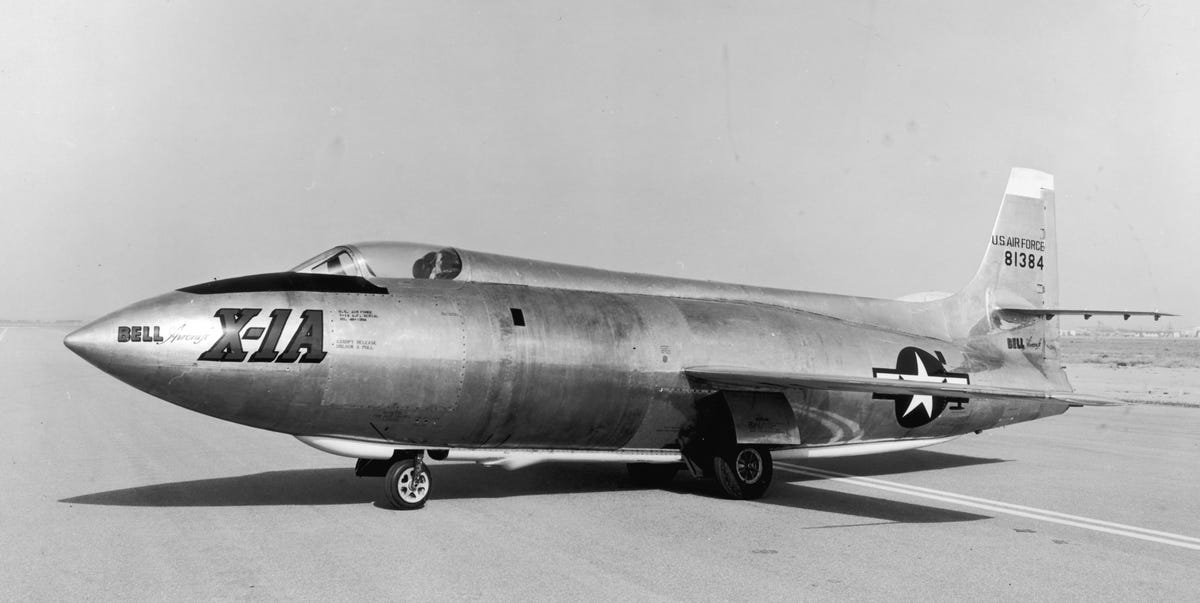
The Bell X-1 deserves the first salute because it did something many people once thought might tear an aircraft apart: it flew faster than sound. On October 14, 1947, U.S. Air Force Captain Chuck Yeager piloted the rocket-powered X-1, nicknamed Glamorous Glennis, past Mach 1 and into history.
The X-1 looked like a giant .50-caliber bullet with wings, which was not an accident. Its shape was inspired by ballistic research, and that blunt, compact fuselage helped it survive the mysterious transonic zone where air behaves like it has had too much coffee. The aircraft was air-launched from a bomber, fired its rocket engine, and gave engineers critical data about shock waves, stability, pressure distribution, and control at high speed.
Why it was badass
The X-1 was not just fast; it was a myth-buster. Before it, the “sound barrier” sounded like an invisible wall guarded by physics dragons. After it, supersonic flight became a design challenge instead of a fantasy. Every modern supersonic fighter owes the X-1 a thank-you note, preferably written at Mach 1.2.
2. Douglas X-3 Stiletto: The Jet That Looked Faster Than It Was
The Douglas X-3 Stiletto may be one of the coolest-looking disappointments in aviation history, which is still an impressive category to win. Built to investigate sustained supersonic flight around Mach 2, the X-3 had a long needle nose, tiny trapezoidal wings, and a fuselage so sleek it looked like it had been designed by a rocket scientist and a fashion editor during a thunderstorm.
Unfortunately, its Westinghouse J34 engines did not provide enough thrust for the aircraft to reach its intended performance in level flight. In plain English, the Stiletto dressed for Mach 2 but showed up with economy-class engines. Yet calling it a failure would be unfair. The X-3 produced valuable research on high-speed stability, low-aspect-ratio wings, titanium use in aircraft structures, flight loads, and inertial coupling, a dangerous phenomenon that later affected high-performance fighters.
Why it was badass
The X-3 proved that even an aircraft that misses its headline goal can still change aviation. Its research influenced later designs, including thinking that helped inform aircraft such as the F-104 Starfighter. It was the aerospace equivalent of a movie with mixed reviews but incredible cinematography.
3. North American X-15: The Rocket Plane That Basically Knocked on Space
If the Bell X-1 broke the sound barrier, the North American X-15 treated the sound barrier like a speed bump in a grocery store parking lot. This rocket-powered research aircraft flew to hypersonic speeds and extreme altitudes, setting records that remain jaw-dropping decades later. The X-15 reached about Mach 6.7 and altitudes above 350,000 feet, high enough that some pilots earned astronaut wings.
The X-15 was carried aloft under the wing of a B-52, dropped like the world’s most terrifying paper airplane, and then ignited its rocket engine. Its flights gathered data on hypersonic heating, high-speed aerodynamics, reaction controls, pilot workload, reentry conditions, and materials that had to survive temperatures hot enough to ruin your picnic and your airframe.
The X-15 program helped bridge the gap between aircraft and spacecraft. Lessons from it fed into Mercury, Gemini, Apollo, and later space shuttle thinking. It was not just an airplane. It was a flying graduate school for going ridiculously fast.
Why it was badass
The X-15 had the swagger of a fighter, the engine of a rocket, and the working environment of a meteor. Pilots wore pressure suits because the aircraft operated in conditions where “outside air” was more of a rumor than a resource.
4. Martin Marietta X-24B: The Flying Brick That Helped the Space Shuttle Land
The X-24B is proof that an aircraft does not need graceful wings to be heroic. This lifting-body research vehicle looked like someone asked a doorstop to reenter the atmosphere. Yet its shape was brilliant: instead of relying on conventional wings, the body itself generated lift.
NASA and the U.S. Air Force used lifting bodies like the X-24B to answer a crucial question: could a vehicle returning from space glide through the atmosphere and land safely on a runway? The answer mattered enormously. A spacecraft that could land like an aircraft would offer more control, more reusability, and more operational flexibility than a capsule splashing down in the ocean.
The X-24B demonstrated that a wingless or nearly wingless vehicle could make accurate runway landings. That research helped support the development of the space shuttle and influenced later reusable spacecraft concepts.
Why it was badass
The X-24B did not win beauty contests, unless the judges were aerodynamicists with clipboards. But it helped prove that spacecraft could return from orbit and land with precision. It was the flying brick that said, “Wings are optional. Physics is not.”
5. Grumman X-29: The Forward-Swept Rebel
The Grumman X-29 looked like it had been assembled by someone who read an airplane manual backward and said, “Perfect.” Its most famous feature was its forward-swept wing design, which made the aircraft appear futuristic, aggressive, and slightly illegal.
Forward-swept wings can offer strong maneuverability and control advantages, especially at high angles of attack. The problem is that they also create nasty structural twisting forces. Earlier aircraft could not handle those loads well, but the X-29 combined advanced composite materials, canards, and a digital fly-by-wire control system to make the idea workable.
The aircraft was intentionally unstable. That sounds terrible until you remember that modern fighters often trade natural stability for maneuverability, using computers to keep everything from becoming a flaming geometry lesson. The X-29 helped prove how digital flight controls and advanced structures could tame extreme configurations.
Why it was badass
The X-29 did not merely test a new wing. It tested whether computers, composites, and audacity could gang up on instability and win. With hundreds of research flights, it became one of the most visually unforgettable NASA X-planes ever flown.
6. Rockwell-MBB X-31: The Jet That Refused to Point Where It Was Going
The X-31 Enhanced Fighter Maneuverability demonstrator was built to explore post-stall control and extreme agility. Translation: it tested whether a fighter-like aircraft could remain controllable even when flying in attitudes that would make a conventional airplane start writing its farewell letter.
The X-31 used thrust-vectoring paddles at the rear of the aircraft to redirect engine exhaust, giving pilots control beyond the limits of traditional aerodynamic surfaces. This allowed dramatic maneuvers at very high angles of attack, including nose-pointing tricks that were deeply relevant to air combat research.
In a dogfight, pointing the nose can matter as much as raw speed. The X-31 helped show how thrust vectoring and advanced flight control systems could let future aircraft maneuver more aggressively, recover more effectively, and remain useful in flight regimes where ordinary jets run out of ideas.
Why it was badass
The X-31 made “flying sideways with confidence” feel like a career goal. It was less about brute force and more about controlled chaos, which is basically the personality profile of every great experimental aircraft.
7. Boeing X-37B: The Robotic Spaceplane Nobody Fully Explains
The Boeing X-37B Orbital Test Vehicle is one of the most mysterious X-planes ever made. Unlike many earlier X-planes that flew over the desert for minutes, the X-37B goes to orbit for months or even years, conducts experiments, and then returns to Earth like a miniature space shuttle with secrets in its luggage.
Operated by the U.S. Space Force, the X-37B is reusable, uncrewed, and designed for long-duration orbital missions. It can carry experiments, test technologies, and return hardware to Earth for inspection. That last part matters: many satellites never come back, but the X-37B can bring payloads home, giving engineers a rare chance to study how materials, systems, and experiments performed after extended time in space.
Its exact missions are often classified, which naturally turns the internet into a popcorn machine of theories. But even without the mystery, the engineering is impressive. A reusable robotic spaceplane that launches on a rocket, operates in orbit, survives reentry, and lands on a runway is objectively a big deal.
Why it was badass
The X-37B combines the cool factor of a spacecraft, the efficiency of reusability, and the dramatic flair of “we cannot tell you everything it does.” That is not just badass. That is movie-villain-hangar badass.
8. NASA X-43A: The Scramjet That Went Nearly Mach 10
The NASA X-43A was tiny, uncrewed, and built for one-way flights, but do not mistake small for timid. This hypersonic research vehicle used a scramjet, or supersonic combustion ramjet, to demonstrate air-breathing propulsion at extraordinary speeds. In 2004, the X-43A reached about Mach 9.6, roughly 7,000 mph, during a record-setting flight over the Pacific.
Unlike a rocket, which carries both fuel and oxidizer, a scramjet uses oxygen from the atmosphere. That makes the technology attractive for future high-speed aircraft and access-to-space concepts, at least in theory. The hard part is that at hypersonic speed, air does not politely enter an engine. It arrives like an angry invisible freight train.
The X-43A was boosted to speed by a Pegasus rocket launched from a B-52, then separated and fired its scramjet. Its powered flight lasted only seconds, but those seconds were enormously valuable. Hypersonic research often advances in tiny windows of data, and the X-43A delivered one of the most famous windows in aviation history.
Why it was badass
The X-43A was basically a flying engine experiment that screamed across the sky faster than a rifle bullet and then sacrificed itself to the ocean. That is commitment. Dramatic, expensive commitment.
9. NASA X-59 Quesst: The Supersonic Jet Trying Not to Be Rude
The X-59 Quesst earns its place because it attacks a different kind of barrier: noise. Traditional supersonic aircraft create sonic booms loud enough to annoy communities, rattle windows, and make regulators reach for the big red “absolutely not” stamp. The X-59 is designed to reshape those shock waves into a quieter sonic thump.
Built by Lockheed Martin for NASA, the X-59 is a long, slender, single-seat experimental aircraft with a needle-like nose and no forward cockpit window in the usual place. Instead, the pilot uses an external vision system. The aircraft is designed to cruise around Mach 1.4 at about 55,000 feet during research flights, but its true mission is not maximum speed. Its mission is social permission.
NASA plans to use the X-59 to collect community response data, helping regulators evaluate whether quiet supersonic flight over land could become acceptable. In 2025, the aircraft completed its first flight, and ongoing testing is expanding its envelope toward future supersonic research.
Why it was badass
The X-59 is not trying to be the loudest beast in the sky. It is trying to be the most persuasive. That is a different flavor of badass: less “wake the neighborhood” and more “change the rules of commercial aviation.”
What Makes an X-Plane Truly Badass?
The most badass X-planes are not always the fastest or the prettiest. They are the aircraft that ask dangerous questions and come back with useful answers. Can an airplane fly faster than sound? Can a pilot survive hypersonic flight? Can a body without normal wings land from space? Can computers control an intentionally unstable aircraft? Can an air-breathing engine work near Mach 10? Can supersonic travel become quiet enough for everyday life?
Each aircraft on this list represents a different kind of courage. The X-1 had historical courage. The X-15 had physical courage. The X-29 had computational courage. The X-43A had propulsion courage. The X-37B has orbital endurance and secrecy. The X-59 has the nerve to suggest that the future of speed may depend not only on power, but on politeness.
That is the real magic of experimental aircraft. They are not built to be perfect products. They are built to take uncertainty into the sky and measure what happens. Sometimes the result is a world record. Sometimes it is a lesson learned the expensive way. Either way, the data moves aviation forward.
Experience Section: How to Feel the X-Plane Legacy Without Wearing a Pressure Suit
You do not need to be a test pilot to experience the thrill of X-planes, although a pressure suit would definitely improve your family photos. For most aviation fans, the X-plane experience begins in museums, documentaries, desert airfields, flight-test history books, and the strange emotional moment when you stand beside a machine that looks too extreme to have been real.
Seeing an X-plane in person changes how you understand aviation. Photographs make the Bell X-1 look iconic, but standing near it gives you a better sense of how compact and purposeful it was. It was not a luxury aircraft. It was a rocket-powered question mark painted orange. The Douglas X-3 Stiletto creates a different reaction. Its long nose and tiny wings make it look impossibly futuristic, even today. You can almost feel the ambition baked into the airframe: the desire to slice through drag, outrun convention, and look spectacular while doing it.
The X-15 inspires something closer to awe. It does not look like an airplane designed for comfort. It looks like a vehicle designed for a pilot who has accepted that the sky is merely a hallway on the way to space. Learning about its flights gives you a deeper respect for test pilots, engineers, ground crews, and chase-plane teams. Every mission required discipline. Every second of data mattered. Every flight carried risk that modern computer simulations can reduce but never fully erase.
If you visit places connected to flight testing, especially around the Mojave Desert and Edwards Air Force Base history, the landscape itself becomes part of the story. Dry lakebeds, huge skies, and distant mountains create the perfect setting for experimental aviation. It is easy to understand why so many boundary-breaking aircraft flew there. The desert offers space, visibility, and a certain cinematic loneliness. It looks like a place where humanity would naturally attempt something unreasonable at high speed.
Watching archival footage is another powerful way to experience these aircraft. The X-15 dropping from its B-52 mothership still feels tense, even when you know the outcome. The X-29 banking through the air with forward-swept wings still looks like CGI before CGI was good. The X-43A separating from its booster and lighting a scramjet for only a brief burst reminds you that breakthroughs often happen in seconds after years of preparation.
For writers, students, engineers, and aviation enthusiasts, X-planes also offer a lesson in creative risk. None of these aircraft existed because someone asked, “What is the safest way to repeat what already works?” They existed because someone asked, “What if we tried the thing that sounds ridiculous, but calculated it carefully first?” That mindset applies far beyond aerospace. Innovation often begins with an uncomfortable question, a prototype that looks odd, and a team willing to learn from failure without treating failure as the final chapter.
The best way to experience the X-plane legacy is to see these machines as more than hardware. They are stories of courage, curiosity, math, metal, fire, and occasionally spectacular weirdness. They remind us that progress rarely arrives in a sensible outfit. Sometimes it shows up with rocket fuel, forward-swept wings, no normal windshield, and a name beginning with X.
Conclusion
The greatest X-planes ever made were not created to be ordinary aircraft. They were built to challenge assumptions, gather data, and drag aviation into the future by the afterburner. From the Bell X-1 breaking the sound barrier to the X-15 touching the edge of space, from the X-29 proving unstable designs could be controlled to the X-43A demonstrating scramjet speed, these experimental aircraft shaped the way engineers think about flight.
Some were elegant. Some were awkward. Some were terrifying. All of them mattered. The X-plane story is really the story of American aerospace refusing to sit still. Every generation gets its own impossible question, and somewhere, in a hangar full of people with calculators and strong coffee, an X-plane is how that question begins to fly.
Note: This article is based on real historical and technical information from reputable aerospace sources, including NASA, the Smithsonian, the U.S. Air Force museum system, DARPA-related program history, Space Force-related public materials, and major U.S. aerospace reporting. No source links are included in the article body to keep the HTML clean for publishing.