After more than three decades on the air, The Simpsons has developed a rare comic superpower: it can turn its own history into material. Not just nostalgia bait, not just a wink at die-hard fans who still know the difference between a Squishee and a Buzz Cola, but full-blown self-cannibalizing comedy. The show now treats its own mythology like Homer treats a buffet line: with deep affection, zero restraint, and a real chance that something weird will spill.
That is exactly why one tiny gag in a newer episode landed so hard. In “Abe League of Their Moe,” a baseball episode built around Grampa, Moe, sports betting, and the general American tradition of monetizing absolutely everything with a pulse, The Simpsons quietly slipped in a callback to one of its strangest ideas in years. More than one Raphael, the sarcastic clerk with the mustache and the permanent retail-worker deadpan, appears at the same time. It is a blink-and-you’ll-cackle moment. But for longtime fans, it also feels like something more unsettling: a reference to the show’s creepiest so-called “deleted” scene.
And yes, “creepiest” is doing honest work here.
The Joke That Should Have Stayed a Joke, But Thankfully Didn’t
To understand why this callback matters, you have to rewind to “Lisa the Boy Scout,” one of the most inventive modern Simpsons episodes. That episode starts like a normal Springfield story, then immediately yanks the steering wheel. Hackers hijack the broadcast and begin airing “buried” scenes that were supposedly hidden because they were too ridiculous, too damaging, or too continuity-shredding to ever let see daylight.
It is one of the smartest framing devices the show has used in years. Instead of pretending canon is sacred, the episode treats canon like an old couch in the garage: still useful, full of stains, and always available for one more reckless experiment. The fake deleted scenes then pile up one after another, each one taking an old fan theory, character mystery, or continuity oddity and pushing it into absurdity.
One scene suggests Martin Prince is not a child at all, but an adult undercover operative with a family and a whole secret life. Another implies that Lenny might be little more than Carl’s personal hallucination. Another toys with the old Homer-in-a-coma idea. All of these are funny in a sharp, meta, “the writers absolutely know what people say online” kind of way.
But one bit is different. One bit doesn’t just play with continuity. It mutates it.
Why Raphael’s “Deleted” Scene Was the Creepiest of the Bunch
Springfield’s Most Overworked Background Character
Raphael has been one of Springfield’s great utility players for years. Need a sarcastic salesman? Raphael. Need a grumpy employee at a random store? Raphael. Need somebody to hand Homer a product while sounding like he has spiritually given up somewhere around 1997? Raphael again. He is one of those background characters who became beloved precisely because the show never overexplained him. The joke was the repetition. Same face, same voice, different jobs, same exhausted contempt for customers.
Then “Lisa the Boy Scout” decided to answer the obvious question in the least reassuring way possible.
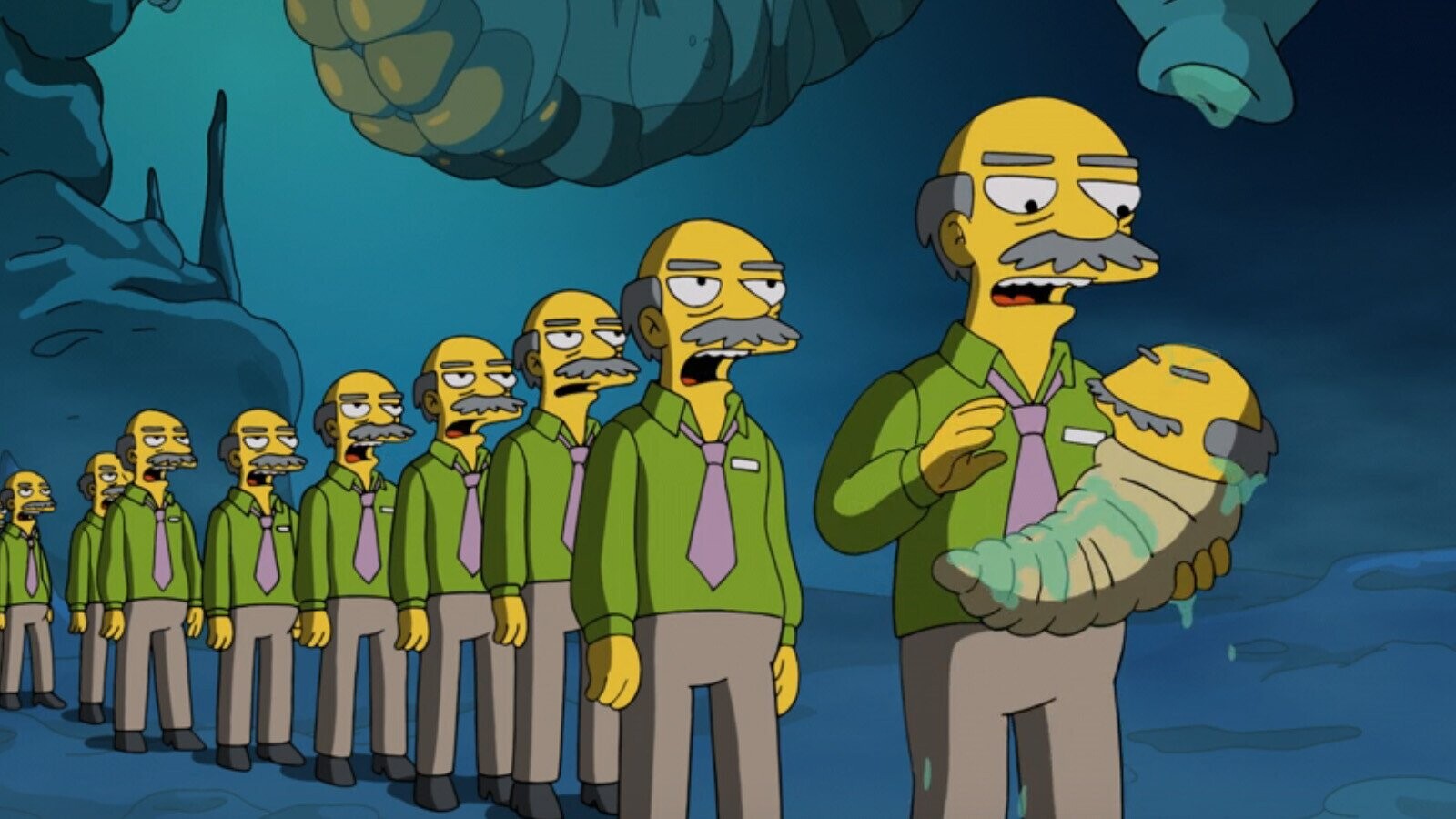
In its most grotesque fake deleted bit, the episode reveals that there isn’t just one Raphael bouncing around Springfield’s service economy. There are many of them, and they originate from a bizarre, subterranean, queen-like source. The gag plays like body horror sneaking into a sitcom wearing a fake mustache. These Raphaels are not just coworkers or cousins or identical brothers with a shared barber. They are more like a retail species.
That is what makes the scene so memorable. The show has done darker jokes before. It has done gorier Halloween material before. It has done existential jokes before. But this one is uniquely unsettling because it takes something mundane and overfamiliar, then gives it an alien origin story. It turns a running background joke into a nightmare explanation.
And because Raphael is such a normal part of Springfield, the reveal feels weirdly invasive. It is like opening the office fridge and discovering the yogurt has a monarchy.
So What Did “Abe League of Their Moe” Actually Confirm?
Now comes the deliciously creepy part. “Abe League of Their Moe” is, on its surface, not a horror story at all. It is a baseball satire. Grampa and Moe bond over the Springfield Isotopes, recruit a star player, and get swept into a world of over-commercialized sports, betting apps, hype culture, and stadium nonsense. It is more crackerjacks than cosmic dread.
But in the middle of all that, the episode shows multiple Raphaels working concessions at the same time.
That alone is enough to make longtime viewers sit up. The show is clearly nodding back to the “Lisa the Boy Scout” revelation. It does not fully restage the queen-monster explanation. It does not drag Homer into a cave and make him watch larval clerks emerge from beneath Springfield. This is still network television, not prestige nightmare fuel. But it does something even sneakier: it validates the premise that there is more than one Raphael in circulation.
That matters because it shifts the old gag from pure one-off weirdness into semi-canon mischief. Not full canon, maybe. The Simpsons treats continuity the way Bart treats school rules: as an interesting suggestion. But the callback is specific enough to say the writers remember that scene, know fans remember that scene, and are happy to let it keep crawling around the edges of the show’s reality.
In other words, Springfield may not officially be powered by a hidden Raphael hive, but the show is no longer pretending the possibility is ridiculous.
Why This Callback Works Better Than a Big, Loud Reference
The Best Modern Simpsons Jokes Don’t Beg for Applause
One reason the joke lands is that it is not overexplained. There is no character turning to camera and saying, “Hey, remember that horrifying fake deleted scene from a few seasons ago?” There is no self-congratulatory flashback montage. The show trusts the image. If you catch it, you catch it. If you don’t, the episode still works as a baseball story.
That light touch is part of what has made modern Simpsons episodes more interesting lately. The series has been at its best when it avoids acting like a museum exhibit of itself. Instead, it treats its own past as a toy box. Sometimes that produces emotional stories. Sometimes it produces ambitious format experiments. And sometimes it gives us the unnerving implication that Springfield’s least paid employee is not a man but a system.
The callback also works because Raphael is the perfect character for this kind of joke. If the show had tried this with Homer, Bart, or Mr. Burns, it would feel too loud, too franchise-conscious, too desperate to be clever. Raphael exists in that sweet spot where fans instantly recognize him, but the character still has enough mystery to support a surreal twist. He is familiar enough to matter and minor enough to mutate.
That is basically the dream setup for a Simpsons joke: beloved, flexible, and just weird enough that the audience will accept one more left turn.
Modern The Simpsons Has Gotten Very Good at Weaponizing Its Own Lore
There was a long stretch where discussions about The Simpsons often sounded like group therapy for people grieving the 1990s. Every conversation eventually drifted toward the “golden era,” as if the show had retired and no one had informed Fox. But episodes like “Lisa the Boy Scout” proved something important: the series still knows how to surprise viewers, especially when it leans into its own impossible longevity.
That is part of the reason the fake-deleted-scenes concept worked so well. A younger show could not have pulled it off. You need decades of baggage, fan theories, character repetition, animation history, and cultural overexposure for a premise like that to sing. The joke is not just that there are hidden scenes. The joke is that a show this old has accumulated enough myth, contradiction, and internet discourse to make fake hidden scenes feel plausible.
That is also why the Raphael callback feels smarter than a standard Easter egg. It is not just pointing at an old moment. It is extending a conversation about how The Simpsons now functions. The show is old enough to parody itself, but still lively enough to do it creatively. That is a hard trick. Plenty of long-running series become trapped by their own legacy. The Simpsons, at its best, turns legacy into a slingshot.
And let’s be honest: the writers probably know there is something deeply funny about fans spending actual brainpower on the metaphysics of a guy who sells novelty goods and insults customers. They are right. That is funny. It is also the kind of gloriously trivial obsession that keeps fandom alive.
Is Raphael’s Monster Origin “Real” Now?
Not exactly. Or maybe exactly enough.
The safest reading is that “Abe League of Their Moe” confirms multiple Raphaels exist, while leaving the more grotesque details from “Lisa the Boy Scout” in the realm of playful maybe. It is a wink, not a notarized affidavit. The show has not issued a formal constitutional amendment declaring Springfield to be ruled by a queen clerk beneath the earth.
But the beauty of The Simpsons is that it does not need to. The joke lives in the uncertainty. Fans now get to enjoy the most entertaining middle ground possible: the clone theory is ridiculous, but no longer entirely dismissible. The body-horror explanation is absurd, but the new episode refused to kill it. The funniest answer remains “probably not,” while the funniest image remains “unless…”
That is richer territory than hard canon. Hard canon is for fantasy franchises with maps, bloodlines, and 700-page lore wikis. Springfield runs on elastic truth. The town survives because its rules bend, wobble, and occasionally fall down the stairs. All the new episode had to do was crack the door open. Our imaginations did the rest.
The Bigger Meaning of This Tiny, Creepy Callback
If you zoom out, the Raphael joke says something flattering about the current state of the series. The Simpsons is still capable of planting a visual bit that sends fans back through years of episodes, arguments, and half-serious theories. That is not nostalgia alone. That is active engagement. It means the show is still making new material that talks to the old material in a way that feels playful instead of desperate.
It also proves that modern The Simpsons understands a fundamental truth about comedy: sometimes the funniest callback is the one that makes the world a little worse. Not catastrophically worse. Just slightly more cursed. Springfield is funnier when it is two degrees more haunted than it needs to be.
And honestly, what better symbol for modern life than discovering the same sarcastic service worker is not one man doing too many jobs, but several identical beings maintaining the illusion of customer support?
That is not just a joke. That is an economy.
The Viewing Experience: Why This Kind of Simpsons Weirdness Sticks With You
For longtime viewers, the real pleasure of a moment like this is not just recognition. It is the sensation of being caught off guard by a show you thought you knew too well to surprise you.
That is a special experience, and The Simpsons does it better than almost any other long-running series because it has spent decades training us to relax around its rhythms. You know the house. You know the school. You know Moe’s Tavern, Krusty Burger, the Kwik-E-Mart, the power plant, and all the side characters orbiting those places like mildly unstable moons. So when the show decides to take one of those comforting little fixtures and make it faintly terrifying, the effect lands harder than a bigger, noisier twist ever could.
Watching the Raphael callback feels a little like hearing a familiar song and suddenly noticing there has been a sinister backup vocal buried in the mix the whole time. The melody is still there. The joke still works. But now the entire thing has a tiny shiver running through it.
That is why fans keep talking about scenes like this. Not because they are the biggest moments in the show’s history, and not because they change the plot in any meaningful way. They don’t. They matter because they change the texture of the world. After a gag like this, you can never quite look at Raphael the same way again. Every future appearance comes with a little bonus suspicion. Is that the same clerk? A different one? One of many? Are there shifts? Rotations? A break room? A brood chamber? Congratulations, the show has turned a disposable background joke into a low-level obsession.
That kind of experience is deeply tied to what it means to grow up with The Simpsons. Many viewers first encountered Springfield as a place of routine. Sunday nights, reruns after school, DVDs stacked on a shelf, quotes repeated until they became family language. Then, over time, the relationship changes. The show becomes less about simple familiarity and more about accumulated layers. You are not just watching a cartoon anymore; you are watching a cartoon that remembers being a cartoon, remembers being a phenomenon, and now occasionally remembers the weird things fans said about it online. That recursive quality can be self-indulgent in the wrong hands. In the right hands, it becomes comic magic.
The best part is that the Raphael joke still feels mischievous rather than precious. It is not homework. It is not lore policing. It is not the show demanding applause because it referenced itself. It is just an image that gets funnier the longer you sit with it. On first viewing, it is a nice gag. On second thought, it is a callback. On third thought, it becomes a tiny existential crisis wrapped in a concession stand uniform.
And that, in a nutshell, is one of the most satisfying experiences The Simpsons can still offer in 2026: the reminder that Springfield remains elastic, mischievous, and just a little bit cursed. Not horror-movie cursed. More like “somebody in this town definitely has an unexplained tunnel under their house” cursed. The show does not need to become dark to be creepy. It only needs to take one harmless background assumption and tug on it until the whole thing starts to wriggle.
For fans, that is catnip. It rewards memory without requiring homework. It turns rewatching into treasure hunting. It makes old episodes feel newly alive because some random joke from years ago might suddenly cast a shadow forward. And most importantly, it creates the exact kind of reaction great comedy loves: laughter followed by a beat of, “Wait… hang on.”
That beat is where the Raphael scene lives. It is funny first, weird second, and unforgettable because it never fully stops being either one.
Conclusion
So yes, The Simpsons really did reference its creepiest “deleted” scene, and it did so with the kind of confidence only a 30-plus-year institution can pull off. The joke was small, but the implications were delightfully large. By showing more than one Raphael at once, “Abe League of Their Moe” brought a deeply cursed old gag back into play and reminded viewers that Springfield’s weirdest corners are still open for business.
More importantly, it showed why the series still matters. Not because every new episode is trying to outrun the past, and not because every callback is sacred fan service, but because the show still knows how to remix its own history into something fresh, funny, and just unsettling enough to linger. In a town full of nuclear leaks, clown trauma, and Mr. Burns, it takes real effort to become one of Springfield’s more disturbing ideas.
Raphael, somehow, has done it by selling snacks and looking mildly annoyed.