At first glance, The Paper Tiger Stool sounds like a punchline from a design school dare. A stool made of cardboard? Sure. And my cereal box is probably a luxury condo. But that knee-jerk skepticism is exactly what makes this piece interesting. It was designed to challenge the old idea that furniture must be heavy, expensive, or built like a medieval castle to deserve respect.
Instead, The Paper Tiger Stool turns humble corrugated board into a surprisingly clever piece of flat-pack furniture. It folds, clicks together without glue, can be printed with graphics or branding, and was created with portability and sustainability in mind. In other words, it is the kind of object that makes you squint, sit down carefully, and then quietly admit, “Okay, that’s smarter than I expected.”
Designed by Anthony Dann, the stool sits at the intersection of product design, temporary architecture, event furniture, and eco-conscious thinking. It is not trying to replace every heirloom dining chair in America. It is doing something more interesting: asking what furniture should look like when it needs to travel well, waste less, communicate visually, and still be useful in the real world.
What Is the Paper Tiger Stool?
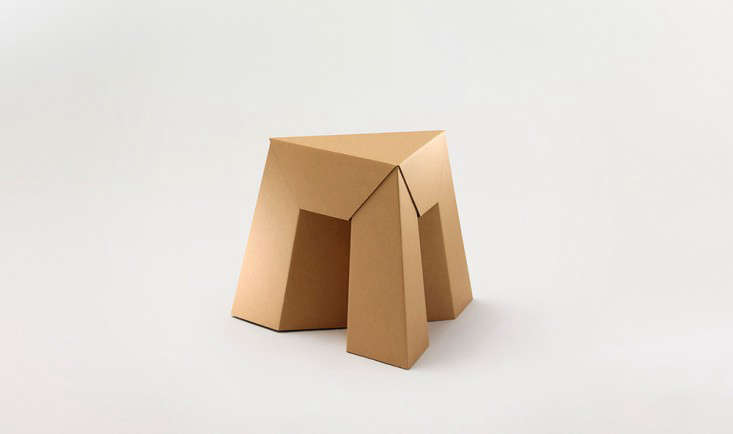
The Paper Tiger Stool is a lightweight cardboard stool designed around folded geometry and seamless assembly. Its form is crisp, angular, and intentional rather than crafty or improvised. This matters. A lot of cardboard furniture looks like it came from an ambitious afternoon with a box cutter and unearned confidence. The Paper Tiger Stool looks designed on purpose.
The stool is part of the broader Paper Tiger range, which includes matching tables and related pieces. According to product information, the stool arrives flat-packed, folds into shape, and clicks together without glue points. Its surfaces are fully printable, and it can be finished with a water-resistant coating. That instantly expands its role from “object you sit on” to “object that can also communicate a brand, decorate a pop-up, or become part of an exhibition environment.”
Its published dimensions make it feel practical rather than merely conceptual: assembled, it measures 60 x 53 x 45 centimeters and weighs just 1.4 kilograms. That is a huge clue to the design’s purpose. This is furniture made for movement. You can transport it easily, store it flat, deploy it quickly, and use it where flexibility matters more than permanence.
And that is the real trick here: the stool does not pretend cardboard is oak. It treats cardboard as cardboard, then pushes that material to do what it does best.
Why a Cardboard Stool Works Better Than Your Brain Thinks It Should
Most people hear the word cardboard stool and imagine disaster. A polite collapse. A dramatic crackling sound. An awkward apology followed by everyone pretending they did not just witness furniture betrayal. But cardboard, when engineered intelligently, has a long design history of proving people wrong.
Corrugated cardboard is stronger than it looks because its internal structure distributes force efficiently. Designers have been exploring that strength for decades, especially when geometry, layering, and folded construction enter the conversation. The Paper Tiger Stool belongs to that lineage, but it speaks a more contemporary language: lighter footprint, faster assembly, easier shipping, better adaptability, and strong visual identity.
Geometry Does the Heavy Lifting
One of the smartest things about the stool is how clearly it communicates its structural logic. This is not a blob-shaped mystery object that somehow survives through magic. The angles, folds, and planes suggest stability. The design makes a visual argument before anyone even sits on it: “Relax, I know what I’m doing.”
That matters in furniture. Good design is not just about surviving weight; it is also about creating trust. The Paper Tiger Stool earns trust through form. Its geometry tells you that the material has been organized, reinforced, and disciplined into usefulness.
Flat-Pack Is Not Just Convenient, It Is Strategic
Flat-pack furniture is often discussed as a lifestyle convenience, but it is also a logistics strategy. Smaller shipping volume can mean more efficient transport, easier storage, and less hassle during setup. For events, exhibitions, and temporary retail spaces, that is gold. Nobody wants to wrestle with bulky seating while a deadline is breathing down their neck.
The Paper Tiger Stool is therefore appealing not only as a design object, but as a system-friendly one. It solves problems upstream and downstream: before use, during setup, and after the event is over. That kind of practical intelligence is exactly why smart temporary furniture often beats traditional furniture in flexible environments.
Printability Changes the Game
This is where the stool becomes more than a seat. Because the surfaces are printable, it can carry graphics, patterns, messaging, or visual branding. Suddenly it is doing double duty as furniture and communication tool. In a gallery, it can become part of the visual language. In a branded activation, it can reinforce identity. In a conference space, it can keep the setup cohesive instead of looking like random folding chairs crashed the party uninvited.
That printable surface also gives the stool a playful edge. It can look minimal and architectural in plain white or raw cardboard, or loud and memorable when dressed in custom graphics. That flexibility makes it attractive to designers who think in environments, not just individual objects.
The Anthony Dann Approach: Temporary Does Not Mean Thoughtless
Anthony Dann designed Paper Tiger products around folded forms, seamless construction, and real-world usability. That combination helps explain why the stool has stayed interesting. It was not created as a gimmick for people who want to say, “Look, I sat on cardboard once.” It was developed as a serious answer to a specific design challenge: how do you make furniture that is lightweight, portable, brandable, and environmentally smarter without making it ugly?
The answer, at least here, is to treat temporary furniture as an actual design category instead of a compromise category. Too often, temporary seating is visually depressing. It looks borrowed, flimsy, or apologetic. The Paper Tiger Stool pushes in the opposite direction. It says temporary objects can still be elegant, graphic, and memorable.
That may be why the stool found a natural home in discussions around sustainability and event design. Earlier coverage also connected the product to a sustainability award, which makes sense. The piece captures a design mindset that has only grown more relevant: use fewer materials, reduce transport burden, make objects easier to recycle, and let one product serve multiple roles.
Why the Paper Tiger Stool Still Feels Relevant
Design trends have a habit of aging like avocados left in a hot car. Yet The Paper Tiger Stool still feels timely because the questions it asks are even more urgent now than when it launched. How much furniture do we really need to ship fully assembled? How often do we overbuild for short-term use? Why are so many “temporary” objects still wasteful, awkward, and visually forgettable?
Today’s design conversations are filled with ideas about circularity, compostability, recycled content, and more efficient material systems. Cardboard furniture keeps returning to that conversation because it occupies a sweet spot between affordability, recyclability, portability, and experimentation. It is also a material that invites innovation without demanding luxury-level budgets.
In that sense, the Paper Tiger Stool feels almost prophetic. It anticipated a world where brands want flexible event infrastructure, where small spaces need lightweight solutions, and where consumers are increasingly skeptical of big, overbuilt stuff that is expensive to move and hard to justify.
Best Use Cases for the Paper Tiger Stool
Not every product needs to work everywhere. In fact, one of the most mature things a design can do is know its lane. The Paper Tiger Stool’s lane is refreshingly clear.
Events and Brand Activations
This may be the stool’s strongest setting. It is easy to ship, quick to assemble, lightweight to reposition, and visually adaptable. If a brand wants seating that doubles as graphic real estate, this stool is practically raising its hand in the front row.
Exhibitions and Pop-Ups
Temporary environments often need furniture that feels integrated, not rented. Because the Paper Tiger Stool can be printed and arranged in multiples, it suits exhibitions, gallery installations, trade shows, and short-term retail experiences where atmosphere matters.
Flexible Offices and Creative Spaces
Paper Tiger’s own positioning points toward meeting rooms and adaptable spaces. That makes sense. In workplaces that shift between presentation mode, workshop mode, and event mode, lightweight recyclable furniture can be surprisingly practical.
Design-Led Educational or Community Settings
Anywhere that values conversation around materials, sustainability, and design thinking could use a piece like this to spark exactly that kind of discussion. It is functional, but it is also educational. People ask questions when they see it. Good objects do that.
Where the Limits Are
Now for the adult part of the conversation: no, this is not the stool for every room, every climate, and every decade-long daily use case. A cardboard stool is still a cardboard stool. Even with smart engineering and optional water-resistant coating, it lives best in contexts where portability, flexibility, and short- to medium-term use matter more than heirloom durability.
That is not a flaw. It is clarity. A wrench is not a bad spoon; it is just a wrench. Likewise, the Paper Tiger Stool is not pretending to be a carved walnut masterpiece. It is aiming for smart, lightweight, visually effective, sustainable seating. Judged on those terms, it makes a lot of sense.
The Broader Design Story Behind It
Part of the charm of The Paper Tiger Stool is that it belongs to a bigger story about paper-based and cardboard-based design. Long before cardboard furniture became social-media novelty content, major designers and museums were already taking the material seriously. That history matters because it frames the stool not as a quirky exception, but as part of an ongoing exploration of how “ordinary” materials can become extraordinary when structure, purpose, and imagination line up.
That design lineage also helps explain why cardboard keeps coming back. It is approachable. It is familiar. It is relatively low-cost. It can be shaped, folded, layered, printed, and rethought endlessly. For designers, that is irresistible. For users, it can be eye-opening. The material you associate with packaging suddenly becomes architecture, seating, sculpture, or branding platform. That reversal is half the fun.
Experience: What the Paper Tiger Stool Feels Like as an Idea and as an Object
Spending time with the idea of the Paper Tiger Stool is almost as interesting as spending time with the object itself. It changes the way you look at furniture, and that is not a small achievement. Most furniture asks for acceptance. This stool asks for reconsideration.
The first experience is disbelief. You see cardboard and your brain starts reading from its ancient script: shipping box, cereal carton, something a cat will eventually claim as personal property. You do not immediately think seat. But then the form steps in. The folds are clean. The shape is deliberate. The planes meet with confidence. It starts to feel less like packaging and more like a solved problem.
Then there is the tactile experience. Even before sitting, you notice how visually light it is. It does not dominate a room the way bulky seating can. It feels mobile, quick, temporary in the best sense of the word. It gives off the energy of an object that can adapt. In a world full of furniture that demands commitment like a possessive boyfriend in a bad romantic comedy, that is refreshing.
There is also something quietly funny about the stool, and I mean that as praise. Good design can be serious without being solemn. The Paper Tiger Stool has just enough mischief in it. It knows that people will underestimate it. It knows that half its job is proving your assumptions wrong. It sits there like a calm overachiever while everyone else in the room is still stuck on the word “cardboard.”
In use, the real pleasure is less about luxury and more about intelligence. You appreciate how little material is doing how much work. You appreciate that it can arrive flat, assemble fast, and then participate in a room without visual chaos. You appreciate that it can carry graphics, meaning it can be part furniture and part storytelling device. And if you are the kind of person who notices supply chains, shipping volume, setup labor, and post-event waste, you appreciate it even more.
There is an emotional layer here too. The stool captures a very contemporary desire: to own or use things that feel lighter on the planet and smarter in execution. Not everything has to be permanent to be valuable. Not everything has to be massive to be trustworthy. The Paper Tiger Stool quietly argues that good design can be temporary, recyclable, and still emotionally satisfying.
It also makes you think differently about space. Because it is so easy to imagine in multiples, the stool feels less like a single heroic object and more like a building block for environments. A dozen of them in a pop-up. A row of them in a talk space. A cluster in a creative workshop. Suddenly you are not just evaluating a seat; you are imagining a whole visual system. That is one reason the design remains compelling. It scales as an idea.
And maybe that is the best experience of all: the Paper Tiger Stool makes design feel open again. It reminds you that material hierarchy is often cultural, not absolute. We have been taught to trust stone, hardwood, metal, and leather because they signal permanence and cost. But intelligence can live in lighter materials too. Beauty can come from restraint. Usefulness can come from a fold. A room can be improved by something that weighs very little and still carries a very clear point of view.
By the time you finish thinking about it, the joke has completely reversed. The stool is no longer the ridiculous idea. The ridiculous idea is how often we assume good furniture must be heavy, overbuilt, and difficult to move in order to count. The Paper Tiger Stool does not solve every design problem, but it does something rarer: it makes a familiar material feel newly possible.
Final Thoughts
The Paper Tiger Stool is a strong example of what happens when sustainable furniture, graphic flexibility, and structural intelligence meet in one product. It turns cardboard into a serious design medium without losing the playful surprise that makes people pay attention in the first place. That is a tough balance to strike.
For anyone interested in Anthony Dann, cardboard furniture, or the future of lightweight flat-pack seating, this stool is more than a novelty. It is a case study in thoughtful design. And unlike most case studies, this one might also hold your coffee while making your event setup look cooler.