The “go-go years” were not a decade-long party with a tidy last call. They were an American investing mood: buy growth, trust the star manager, assume technology would solve tomorrow before lunch, and ask questions only after the ticker tape stopped applauding.
By the late 1960s, that mood had become expensive. The stock market’s fashionable names had been priced for a future so radiant it practically needed sunglasses. When inflation, tighter money, a recession, corporate stress, and plain old disappointment arrived together, the era did not merely cool down. It showed investors what happens when enthusiasm becomes a business model.
What Were the Go-Go Years?
In U.S. market history, the go-go years usually describe the mid-to-late 1960s investment boom. It was an age of glamour stocks, fast-trading mutual funds, aggressive conglomerates, and a new belief that superior growth deserved almost any price. Xerox, Polaroid, IBM, computer companies, aerospace businesses, and acquisition-hungry conglomerates became shorthand for modern America. The enthusiasm was understandable: postwar prosperity had expanded consumer spending, credit, white-collar employment, and confidence in technology. A country that could put people on the moon seemed unlikely to be defeated by a price-to-earnings ratio.
The term also captured behavior. Fund managers who delivered eye-popping returns became celebrities. Their performance was followed with the kind of devotion normally reserved for rock stars, quarterbacks, and anyone who can make a spreadsheet look like a magic trick. Investors poured money into funds after strong results, assuming a hot streak was evidence of permanent genius rather than a moment when the wind happened to be blowing in the right direction.
Research basis:
Why the Boom Felt So Convincing
Every speculative era needs a story that is partly true. The 1960s had several. America was innovating quickly, corporations were growing, the space race reinforced faith in science, and households had more access to financial products than earlier generations. These were not fantasies. The trouble began when valid trends were converted into an assumption that corporate growth would stay fast, margins would stay wide, and exceptional companies could never become ordinary investments.
New Technology Made Old Caution Look Unfashionable
Computers, copying machines, advanced electronics, and communications businesses had real economic promise. The problem was not believing that technology mattered; it was believing that every company with a futuristic narrative deserved a futuristic valuation. A great business can still be a bad purchase when the price assumes flawless execution for decades. Markets have a recurring hobby of discovering this fact with theatrical intensity.
Conglomerates Offered the Illusion of Effortless Growth
Many companies pursued acquisitions across unrelated industries. In theory, a diversified corporate parent could allocate capital cleverly and spread risk. In practice, some combinations looked less like strategy and more like a corporate junk drawer: a little manufacturing here, a dash of finance there, and perhaps a company nobody could explain at a dinner party. Deal-making could boost reported growth, but it could also hide weak operations, rising debt, and accounting choices that looked sturdier from a distance than from inside the building.
Performance Became the Product
Mutual funds were growing quickly, and the industry’s sales pitch increasingly emphasized recent returns. That matters because investors often buy last year’s winners just as the market conditions that created those wins begin to fade. The SEC later described the period as one in which glamour stocks and star managers attracted a cult-like following; stock-fund assets doubled from 1960 to 1965 and doubled again from 1965 to 1970. When the business is selling performance, the temptation is to keep chasing the same narrow group of leaders even after their prices have become fragile.
Research basis:
How the Go-Go Years Began to End
The end was not caused by one villain twirling a mustache beside the New York Stock Exchange. It was a pileup. Valuations had stretched, market leadership had narrowed, inflation was rising, borrowing costs were climbing, and the broader economy was losing momentum. When investors finally stopped paying ever-higher prices for the same growth stories, the losses were severe precisely where confidence had been greatest.
Inflation Changed the Rules of the Game
Inflation is a sneaky editor. It changes the value of future cash flows, raises uncertainty, and makes long-duration growth stories less comfortable. U.S. consumer prices rose 6.1 percent in 1969 and 5.5 percent in 1970, a sharp break from the low-inflation comfort many investors had come to expect. Meanwhile, the fiscal pressures associated with Vietnam War spending and Great Society programs complicated policy choices. Higher rates and inflation did not invent overvaluation, but they made overvaluation much harder to ignore.
Reality Arrived in the Earnings Report
Companies can grow quickly for a while. They cannot grow quickly forever simply because a brochure says “synergy” in a confident font. As economic conditions weakened, highly valued businesses had less room for error. A minor earnings miss, a delayed project, or tighter credit could trigger a sharp repricing. Investors learned that a stock selling at a heroic multiple does not need a catastrophe to fall; it only needs to stop being perfect.
The 1969–1970 Downturn Exposed Concentration Risk
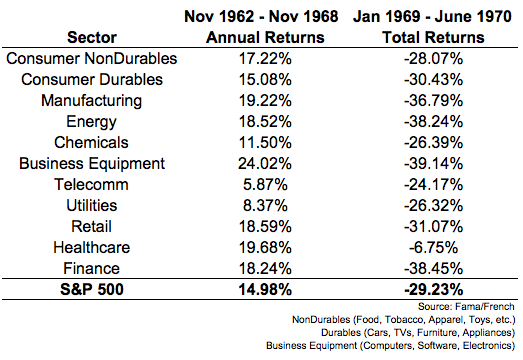
The National Bureau of Economic Research dates the recession from December 1969 to November 1970. Broad market indexes fell, but the glamour-stock damage was often far worse than the headlines suggested. The Dow’s decline did not fully describe what happened to portfolios concentrated in the fashionable growth, technology, and conglomerate names of the period. That distinction is crucial. “The market is down” and “my holdings are down” can be very different sentences, especially when everyone owns the same supposedly invincible stories.
A Plumbing Problem Became an Investor Problem
Wall Street was struggling with operational strain as trading volume grew. Paper certificates, back-office processing, and settlement systems were not built for the speed and scale of the boom. The era’s paperwork crisis was a reminder that markets are not only charts, forecasts, and dramatic television interviews. They are also records, reconciliation, custody, and people trying not to lose a certificate under a stack of lunch menus. When systems strain, confidence can strain with them.
Research basis:
The Pain Did Not End When the First Boom Broke
It is tempting to tell this story as a neat morality play: investors got excited, prices fell, everyone learned a lesson, and then a responsible adult handed out index funds. History is rarely that efficient. The early 1970s brought another wave of economic and market pressure. In 1971, President Nixon ended dollar convertibility into gold and imposed wage and price controls in an attempt to address inflation and a looming gold run. The move marked a major break from the Bretton Woods monetary arrangement, but it did not create a permanent cure for inflation.
Then came the 1973–1974 oil shock. Oil prices rose dramatically after the Arab oil embargo, and the higher cost of energy spread through production, transportation, and household budgets. The result was a miserable combination of weak growth, rising prices, layoffs, and declining confidence: stagflation. The go-go mindset had been built on the assumption that economic progress would keep moving smoothly forward. The 1970s introduced a more awkward realityan economy could stall and get more expensive at the same time. Very rude.
Corporate failures reinforced the change in mood. Penn Central, formed from a major railroad merger in 1968, filed for bankruptcy in 1970; at the time, it was the largest U.S. corporate bankruptcy. The lesson was not that every merger was foolish. It was that size, prestige, and a famous name do not substitute for operational discipline, sound financing, or a business model that works outside the slide deck.
Research basis:
More Than a Market Story
The end of the go-go years also belongs to the broader American transition from the 1960s to the 1970s. The decade carried extraordinary technological ambition and consumer confidence, but it was also marked by the civil rights movement, the Vietnam War, antiwar protest, political violence, and a widening generation gap. The financial mood did not exist in a vacuum. When national optimism became more fractured, the belief that business growth alone could deliver a frictionless future became harder to maintain.
That is why the phrase still has power. It describes a market cycle, but it also describes the moment when a culture stops assuming that tomorrow will automatically be richer, faster, shinier, and easier than today. The end of a boom is not merely a change in prices. It is a change in what people consider believable.
Research basis:
Five Lessons That Still Matter
1. A Powerful Trend Is Not the Same as a Safe Investment
Technology, innovation, and demographic change can reshape the economy. That does not erase the need to ask what a company is worth. Investors should separate the quality of a business from the price paid for its shares. The two are related, but they are not twins.
2. Celebrity Is Not a Risk-Management Strategy
Star managers may be talented, but no one is permanently immune to changing market conditions. A manager’s recent results reveal something about a recent period; they do not provide a notarized guarantee about the next one.
3. Diversification Looks Boring Until It Saves You From Drama
Concentrated bets can make a portfolio exciting. They can also turn a normal correction into a personal weather emergency. Diversification does not eliminate losses, but it reduces the odds that one crowded theme will dictate an investor’s entire financial mood.
4. Liquidity and Infrastructure Matter
Market booms encourage people to focus on upside. Stress reveals the importance of leverage, funding, settlement, operational controls, and the ability to sell when everyone else is also heading for the exit. Financial plumbing is not glamorous, which is exactly why people forget it exists until the ceiling leaks.
5. The Cycle Never Repeats Exactly, but Human Behavior Rhymes Loudly
Every era has its own vocabularyglamour stocks, dot-coms, meme stocks, blank-check companies, artificial intelligence, or whatever phrase makes a group chat sound like a hedge fund. The details change. The temptation to extrapolate a good story forever does not.
A Historically Informed Experience: When the Go-Go Years Ended
Note: The following is a fictional composite, informed by documented conditions of the late 1960s and early 1970s. It is not a verbatim personal account.
In the spring of 1968, a young account executive named Martin felt as though he had discovered the adult version of a secret tunnel at the back of a comic book store. His broker spoke warmly about computers, copying machines, conglomerates, and a fund manager whose name seemed to arrive in conversation with its own spotlight. Martin did not think of himself as reckless. He wore sensible shoes, paid his bills on time, and checked the oil in his car. But his stocks had risen so steadily that caution began to feel like a character flaw. Why settle for a modest return when the future appeared to be running a relay race in your favor?
At the office, colleagues compared funds over coffee. Nobody said “speculation.” They said “growth.” Nobody said “I am buying because everyone else is buying.” They said “the secular opportunity.” The language made ordinary people feel as though they had been invited into a laboratory where tomorrow was being assembled. Martin began saving clippings about the companies he owned. The stack grew taller. It was not research, exactly, but it looked impressively like research when placed beside a lamp.
Then the market began acting differently. First, it was just a bad week. Then a choppy month. Analysts said the weakness was healthy, a word that has comforted investors right up until it has not. Martin’s biggest holdings fell faster than the market averages. The newspaper’s headline numbers seemed almost polite compared with the damage in his account. The stocks that had made him feel ahead of the crowd now made him feel alone inside it. Each sell-off produced a fresh explanation: interest rates, war spending, a recession, profit-taking, temporary nerves. The explanations arrived faster than the recoveries.
By 1970, Martin had learned a lesson no brochure had prepared him for: the price of a stock can fall because the business is weak, but it can also fall because the expectations were absurdly strong. His companies had not all disappeared. Some still made useful products. Some still had clever engineers. But the market had stopped paying for a flawless future that had not happened yet. That shift was brutal because he realized he had not bought shares in businesses alone. He had bought a feelingcertainty with a ticker symbol.
Years later, Martin would not describe the period as a total loss. He still invested, but he stopped treating a rising chart as a personality test. He spread his money across more holdings. He paid attention to debt. He became suspicious of any investment story that could not survive a mildly uncomfortable question. He kept one old clipping in a desk drawer, not as a trophy but as a reminder. The go-go years had not ended because optimism was foolish. They ended because optimism without price discipline eventually runs out of road.
Conclusion: The Party Was Never the Strategy
The end of the go-go years was a hard lesson in market psychology. America’s late-1960s boom rested on real innovation, expanding household participation, and powerful corporate stories. Yet real progress did not justify every price, every acquisition, every fund inflow, or every promise. Inflation, recession, operational strain, and the collapse of crowded expectations exposed the difference between a promising future and a guaranteed one.
For modern readers and investors, the value of this history is not nostalgia. It is perspective. Booms create their own logic, and that logic can feel airtight while prices rise. The end arrives when reality asks the questions enthusiasm kept postponing. The useful habit is not to avoid optimism; it is to bring a calculator, a margin of safety, and perhaps a healthy distrust of anyone who says the rules have been permanently retired.