Some questions sound so simple they almost seem unworthy of a lab bench. Then physics shows up, clears its throat, and turns the whole thing into a grand tour of matter itself. That is exactly what happens when you ask a deceptively innocent question: if you push one end of a solid object, does the other end respond instantly?
At first glance, the answer feels obvious. Solids look rigid. Steel bars look about as flexible as a tax form. So it is tempting to imagine that a push at one end of a rod should be “felt” everywhere at once. But solids are not magic wands, and they are definitely not cosmic express lanes for information. Even the stiffest material has to transmit that push through its internal structure, and that takes time.
This is where a wonderfully simple setup becomes the hero of a surprisingly big story. With a metal rod, a sensor, a trigger, and an oscilloscope, a tabletop experiment can reveal one of the most important truths in solid-state physics: solids are stiff, but they are not infinitely stiff. Disturbances move through them as waves. That single idea opens the door to elasticity, crystal lattices, phonons, heat transport, quantum materials, and even the way we design electronics, buildings, and test advanced alloys.
In other words, a humble experiment does not just answer a clever question. It reminds us that the physics of solids is where “ordinary stuff” becomes deeply extraordinary.
The Question That Sounds Easy Until It Starts a Fight With Reality
When people picture a solid, they usually picture something fixed, stable, and stubborn. A brick stays brick-shaped. A steel spoon does not suddenly flow like maple syrup. A table does not ooze away because it had a long day. That everyday experience is useful, but it can also trick us into thinking solids act like perfectly rigid objects.
They do not. A true perfectly rigid body would pass along a force instantly, and nature does not allow that. Real materials deform, even if the deformation is tiny. When you press on one end of a rod, the atoms near your hand do not send a memo to the far end. They interact with their neighboring atoms, which then interact with the next set, and so on. The effect travels through the material as a mechanical disturbance.
That is why the question matters. It turns “What is a solid?” into “How does a solid actually communicate motion internally?” That is not a toy question. It is the kind of question that sits quietly in the corner until it suddenly becomes the foundation of acoustics, materials science, seismology, and condensed-matter physics.
The Bare-Bones Experiment That Does the Heavy Lifting
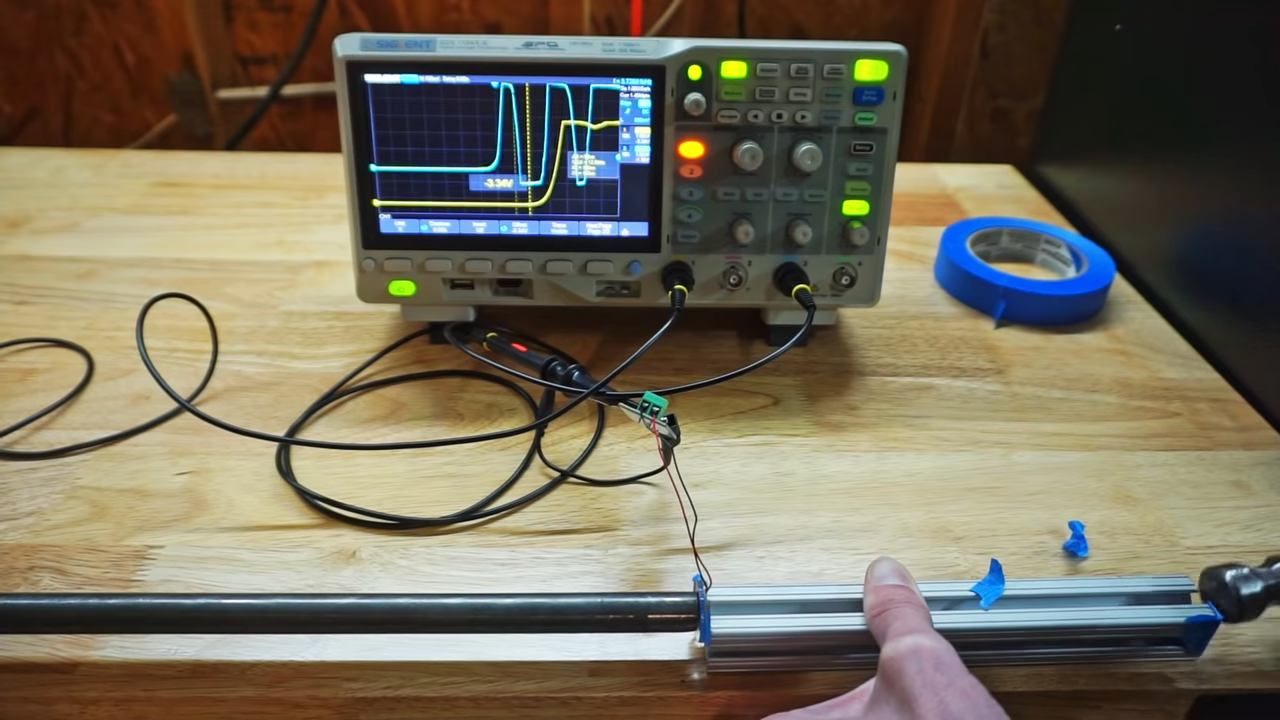
The beauty of this idea is that it does not need a billion-dollar particle accelerator or a room full of foggy equations to get started. A simple metal bar, a contact trigger at one end, a piezoelectric sensor at the other, and an oscilloscope are enough to expose what is really happening.
Here is the basic logic. One end of the rod is struck or triggered so that the exact moment of contact is recorded. At the opposite end, a sensor detects when the mechanical pulse arrives. The oscilloscope compares the two signals. If solids transmitted motion instantly, the traces would line up. But they do not. The receiving end responds only after a measurable delay.
That delay is the whole plot twist. The push moves through the rod at the speed of sound in that material, not at infinite speed and certainly not at the speed of light. For steel, that speed is very fast by human standards, which is why the delay feels invisible in daily life. But “too fast for your eyeballs” is not the same thing as “instant.” Physics is annoyingly precise that way.
What makes the experiment so satisfying is that it takes a thought experiment and pins it down with actual signals on a screen. Suddenly the abstract becomes visible. The rod stops being a cartoon object and becomes what it really is: a medium that carries elastic waves.
Why the Other End Does Not Move Instantly
Solids Are Stiff, Not Magical
A solid keeps its shape because its atoms are packed closely together and held in place by strong interactions. In an introductory picture, those atoms are often represented as masses connected by tiny springs. That image is not perfect, but it is remarkably helpful.
When you push on a solid, you slightly displace the atoms near the point of contact. Those atoms tug or shove on neighboring atoms through interatomic forces. The result is a compression wave that travels through the material. Nothing about this process is instantaneous, because each interaction depends on the previous one. Even in a crystal that looks perfectly orderly at the human scale, the disturbance still has to propagate.
The reason solids feel instantaneous is that many of them are extremely stiff. The delay across a short metal rod can be tiny, often far below what your senses can catch. So your brain says, “Looks immediate to me,” while the oscilloscope rolls its electronic eyes and says, “Absolutely not.”
Young’s Modulus Steps Into the Spotlight
The speed of sound in a solid depends mainly on two things: how stiff the material is and how much inertia its mass provides. In basic terms, the stiffer the material, the faster a disturbance moves. The denser the material, the slower that same disturbance tends to move. For many simple discussions of longitudinal waves in solids, the speed scales with the square root of Young’s modulus divided by density.
That is why sound travels far faster in steel than in air. Air is easy to compress, so it passes along a pressure disturbance sluggishly by comparison. Steel resists compression strongly, which lets the wave move much faster. For a common steel sample, the longitudinal sound speed is on the order of 6 kilometers per second. Impressive? Absolutely. Instant? Not even close.
If you stretched the thought experiment to a rod one light-second long, the far end would not budge one second later because the disturbance would be racing through the material at light speed. It would arrive much later because no ordinary solid comes anywhere near that kind of signal velocity. Matter is sturdy. Matter is not clairvoyant.
Meet the Lattice: Where Solid-State Physics Gets Interesting
Once you accept that solids pass along disturbances through their internal structure, the next question is obvious: what exactly is that internal structure? In many solids, especially crystals, atoms sit in repeating arrangements called lattices. This regular order is what gives crystals many of their mechanical, electrical, optical, and thermal properties.
But a solid is not just a frozen row of atoms standing politely in formation. It is a restless system. The atoms vibrate around their equilibrium positions. Electrons move through or around the structure. Defects interrupt the pattern. Boundaries between grains redirect motion. Suddenly the word “solid” starts sounding less like a dull category and more like a busy city with traffic laws, construction zones, and occasional chaos.
This is why the original question is so fruitful. A push moving through a rod is not merely a force traveling through “stuff.” It is a window into how ordered matter handles energy, momentum, and information.
Phonons: The Tiny Messengers With the Big Job
In modern solid-state physics, collective lattice vibrations are described using the concept of phonons. A phonon is not a tiny marble bouncing down a tunnel. It is a quantized vibrational mode of the lattice, a useful way to describe how atomic motion behaves in a solid.
If that sounds abstract, here is the friendlier version: when atoms in a solid vibrate together in organized ways, physicists treat those patterns almost like particles because doing so makes the physics easier to understand and predict. Phonons matter because they help explain heat flow, sound propagation, thermal conductivity, and important interactions with electrons.
There are different kinds of phonons, and two of the most famous categories are acoustic and optical phonons. Acoustic phonons are the modes most closely tied to ordinary sound-like lattice motion. In these modes, neighboring atoms move largely in step, especially at long wavelengths. Optical phonons, by contrast, involve neighboring atoms in the basis moving against each other. Same lattice, different dance moves.
That distinction is not just textbook decoration. It helps scientists understand why materials absorb light the way they do, how they dissipate heat, and how they behave in advanced electronics and quantum systems.
Not All Solids Read the Same Script
The phrase “physics of solids” can sound like it refers to one neat, well-behaved family. It does not. Solids come in many forms, and their internal order matters enormously.
Crystalline solids, like many metals and minerals, have repeating atomic structure. Amorphous solids, such as ordinary glass and many plastics, do not. They are rigid enough to behave as solids in daily life, but their atoms are not arranged in the same tidy repeating pattern seen in crystals. That difference changes how waves move, how heat spreads, and how the material responds to stress.
This is one reason a simple rod experiment is so revealing. It works beautifully as an entry point, but once you move beyond idealized bars and perfectly uniform samples, the physics becomes richer. A wave may scatter from defects. It may split into different modes. In anisotropic crystals, it may travel at different speeds depending on direction. In disordered materials, the path gets messier, more like navigating a crowded airport than strolling down an empty hallway.
So the real lesson is not just that solids are finite-speed media. It is that every solid carries a physical biography written into its structure.
Why Scientists and Engineers Care So Much
Materials Testing
The same basic idea behind the rod experiment shows up in professional materials testing. High-speed methods such as Kolsky bars, also known as split Hopkinson pressure bars, use stress waves in metal bars to study how materials behave under rapid loading. That matters for manufacturing, transportation safety, protective systems, and extreme-environment engineering.
In other words, the humble question “How fast does a push move through a solid?” grows up and gets a serious job.
Heat Transport in Electronics
In many solids, especially insulators and semiconductors, heat is carried largely by lattice vibrations. That means phonons are central players in thermal management. And thermal management is not some niche concern for people who like spreadsheets and heat sinks. It is one of the biggest practical problems in modern electronics.
As devices get smaller and more powerful, moving heat efficiently becomes essential. If phonons scatter too much, heat gets trapped. If researchers learn how to guide, scatter, or control those vibrations, they can design materials that cool better, waste less energy, and perform more reliably.
Quantum and Functional Materials
Phonons are not just about heat and sound. They also couple to electrons, spins, and other excitations in solids. That coupling can influence superconductivity, magnetism, optical response, and the behavior of quantum materials. In some cutting-edge experiments, special lattice motions such as chiral phonons can even help induce magnetic effects.
So yes, the same general physics that explains why a metal rod is not instantaneously rigid also helps illuminate why certain advanced materials behave in spectacular ways. That is a pretty good return on investment for one thoughtful question.
The Bigger Lesson: Elegant Experiments Are Often the Best Teachers
There is something deeply satisfying about a simple setup answering a complex question. It strips science down to its bones. No fancy jargon can hide. No hand-waving survives. Either the pulse arrives at the other end with a delay, or it does not.
And once the delay appears, the whole conceptual house opens up. Solids are no longer motionless chunks. They are dynamic systems with internal structure, elastic response, vibrational modes, disorder, collective excitations, and finite limits on how fast disturbances can move.
That is one of the quiet glories of physics. A puzzle small enough to fit on a workbench can point straight toward some of the deepest ideas in condensed-matter science. The setup may be simple. The answer is not. And that is exactly why it is worth asking.
Conclusion
The question at the heart of this topic sounds almost playful: does a solid object respond everywhere at once when you push one end? But the answer reaches far beyond a clever lab demo. A solid transmits disturbances through elastic interactions among its atoms, and those disturbances move at a finite speed determined by the material’s properties. That simple fact turns a steel rod into a lesson on stiffness, density, lattices, phonons, heat flow, and the real architecture of matter.
What makes this such a memorable story is not only the science, but the style of science. A stripped-down experiment can expose a profound truth with unusual clarity. It reminds us that the physics of solids is not sealed away in elite journals and intimidating equations. It lives in metal bars, window glass, phone chips, train tracks, and every object that seems still until you ask how it really works.
And once you do ask, solids stop looking simple. They start looking brilliant.
Experiences From Everyday Life That Make the Physics of Solids Feel Real
One reason this topic is so much fun is that the physics of solids is not trapped in a lab. It sneaks into daily life constantly, usually without introducing itself. Tap one end of a long metal railing and listen closely at the other. The sound that reaches your ear through the metal arrives differently from the sound moving through the air. Congratulations, you are now casually flirting with wave propagation in solids.
Anyone who has used a hammer has also had a personal meeting with elastic waves. Strike a nail cleanly and the shock travels through the hammer head and handle into your hand. Miss badly, and the handle practically files a complaint with your wrist. That sting is not random punishment from the universe. It is mechanical energy moving through a solid object with very real timing and structure.
Musicians know this world even better. A guitar string vibrates, but so does the wood of the instrument. A piano sounds rich not just because strings move, but because solid materials guide and shape vibrations beautifully. A cheap instrument and a great one often differ in how well their solid parts manage energy. The wood, braces, bridge, and body are all part of the conversation. Solids are not silent; they are editors.
Sports are full of these lessons too. A baseball bat, tennis racket, or golf club never feels the same across its whole surface. Hit the “sweet spot,” and the energy transfer feels smooth and efficient. Miss it, and the unpleasant buzz reminds you that waves, reflections, and internal vibrations have entered the chat. The object may look simple from the outside, but on impact it becomes a busy landscape of motion.
Even a smartphone offers a modern version of the same story. The solid materials inside it must carry heat away from processors, survive drops, resist bending, and manage microscopic vibrations that affect performance. The phone in your pocket is basically a tiny peace treaty between mechanics, thermodynamics, and materials science. It is less “gadget” and more “carefully negotiated truce among angry atoms.”
Then there is the classic train-track or railroad-rail idea. People often say you can hear a distant vibration through the rail before you hear it through the air. The details depend on the setup, but the intuition points in the right direction: solids can carry mechanical disturbances very efficiently. That does not make them instantaneous. It makes them excellent waveguides under the right conditions.
Perhaps the most valuable experience this topic offers, though, is intellectual rather than tactile. It trains you to distrust appearances in the best possible way. A table looks still. A window looks rigid. A metal beam looks absolute. But physics teaches that underneath that calm exterior is motion, structure, interaction, and limitation. Matter is not frozen; it is organized. Not silent; merely too subtle for casual notice.
That shift in perspective is the real gift. Once you have seen a simple setup answer a complex question about solids, you start seeing the world differently. A staircase creak, a coffee mug ring, a vibrating washing machine, a warm laptop shell, and the clean ping of a spoon against a glass all become tiny demonstrations of deeper principles. The everyday world stops being ordinary. It becomes a field guide to condensed-matter physics.