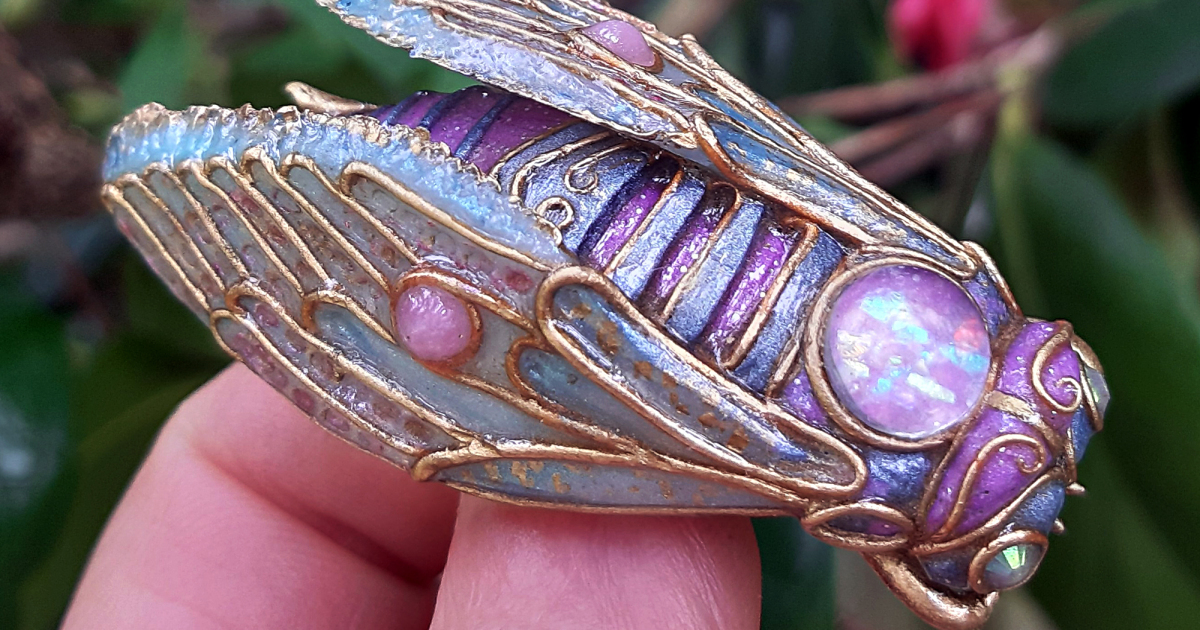
Some people see cicadas and think, “Wow, nature is loud.” I see cicadas and think, “Wow, this would look fantastic in polymer clay.” That may not be the most normal thought I have ever had, but it is definitely one of the most productive. Cicadas are weird in the best possible way: jewel-toned eyes, transparent veined wings, chunky little bodies, and the kind of dramatic life cycle that makes every other insect look like it is just winging it. So I made them. A lot of them. Twelve, to be exact. And yes, they are made from polymer clay, because apparently my hobbies enjoy giving me fingerprints on everything I own.
This project started as a simple craft idea and quickly turned into a full-blown artistic obsession. The more I studied cicadas, the more I realized they are basically nature’s deluxe limited-edition collectibles. Some spend years underground before popping up for a brief, noisy, unforgettable appearance. Others show off green, smoky, amber, black, orange, and red tones that look like they were designed by a very confident art director. That makes them perfect inspiration for handmade insect art, realistic polymer clay sculpture, and quirky home décor that makes visitors say, “Wait… you made these?”
In this piece, I’m sharing the story behind my polymer clay cicadas, what each of the 12 pieces captures, how I approached the sculpting process, and why cicadas make such wildly satisfying subjects for artists and makers. If you love insect art, handmade miniatures, or unusual polymer clay projects, welcome. You are among friends here. Strange, detail-obsessed friends, but friends.
Why Cicadas Make Incredible Polymer Clay Subjects
Cicadas are visually rich, which is artist code for “there is a lot to obsess over.” Their wings are thin and veined like delicate stained glass. Their bodies are sturdy and segmented, which makes them ideal for sculpting in layers. Their heads are broad, their eyes are bold, and their whole look lands somewhere between steampunk gadget and woodland alien. Honestly, if a sci-fi prop designer and a forest had a collaboration meeting, the cicada would probably walk out of it.
From a craft perspective, polymer clay is a great match for that kind of structure. It stays workable while you shape it, which gives you time to refine the body, carve the segmentation, add texture to the thorax, and build wing details without panicking every 30 seconds. Once cured properly, it becomes durable enough for display pieces, ornaments, pins, or mixed-media art. It also plays nicely with sanding, buffing, painting, and selective finishing, which is useful when you want a cicada to look realistic instead of like a gummy bug from another dimension.
What I especially love is that cicadas are both familiar and mysterious. Most people recognize them immediately, but very few people pause to notice just how elegant they are. When you sculpt one by hand, you start paying attention to every tiny design choice nature made: the curve of the abdomen, the angle of the wing, the slight exaggeration of the eyes, the way color pools around veins and joints. It is equal parts art project and quiet nerd spiral, which is pretty much my favorite combination.
The 12 Polymer Clay Cicadas
I designed these twelve pieces as a mini collection rather than twelve copies of the same bug wearing different makeup. Some lean realistic, some are slightly stylized, and a few are unapologetically dramatic because subtlety and I occasionally take breaks from each other.
Pic 1: The Classic Red-Eyed Show-Off
This piece was my love letter to the iconic periodical cicada look: dark body, warm orange accents, and those unforgettable red eyes. I wanted it to feel immediately recognizable, like the cicada equivalent of a celebrity entrance. The wings were kept semi-translucent in appearance with a soft glossy finish, while the body stayed more satin and grounded.
Pic 2: Mossy Forest Cicada
This one leaned greener, with olive and muted bronze tones that made it feel like it had landed on bark and decided it belonged there. I added slightly rougher texture on the thorax so it would photograph well and catch light without looking overly polished.
Pic 3: Amber Wing Experiment
Instead of going fully natural, I warmed up the wing tones and gave the veins an amber cast. The result felt a little magical, as if the cicada had emerged at golden hour and never left. It is one of the pieces that convinced me realism and personality can absolutely share a studio apartment.
Pic 4: Tiny Bark Camouflage Version
This smaller sculpture focused on muted grays, brown highlights, and a tighter silhouette. I made it to look like the kind of cicada you almost miss until it moves or someone points and says, “There. On the trunk. No, the other weird thing.”
Pic 5: The Loud One
If volume could be sculpted, this would be it. I exaggerated the posture slightly, lifting the body and opening the wing stance just enough to suggest motion and noise. It looks like it is about to scream summer directly into the trees.
Pic 6: Shed-Skin Inspired Piece
This was one of the most fun concepts in the series. Instead of focusing on the fully colored adult, I took inspiration from the transition stage and built a paler, softer-looking version with a subtle freshly-emerged vibe. It feels a little ghostly, in the best way.
Pic 7: Metallic Fantasy Cicada
Not realistic. Not apologizing. I used mica-like shimmer and richer jewel tones to create a cicada that looks like it belongs in a cabinet of enchanted curiosities. Every collection needs one piece that whispers, “I was not made for camouflage. I was made for applause.”
Pic 8: Branch-Hugger
This one was posed specifically for photography, clinging to a small display branch. It helped me focus on leg placement, body angle, and the natural way cicadas rest with their wings folded roof-like over the body. It is quieter than some of the others, but very satisfying up close.
Pic 9: Warm Earth Cicada
For this piece, I pushed reddish-browns, clay gold, and smoky black into the mix. It feels more grounded and rustic, like something you would expect to find in late summer near dry wood and warm stone.
Pic 10: Blue-Tinted Art Piece
Real cicadas gave me the structure; imagination gave me the color palette. This sculpture borrowed the anatomy and attitude of a cicada but shifted toward cool tones. The wings stayed delicate, while the body got blue-gray depth and a slightly moodier finish. Think “museum specimen meets indie album cover.”
Pic 11: The Detail Monster
This piece was all about precision: fine wing lines, carefully layered eye color, clean segmentation, and a more anatomical body profile. It took longer than I care to admit, mostly because I kept reworking tiny sections that no sane person would notice. Which, of course, means I noticed them intensely.
Pic 12: The Favorite
Every maker has a favorite, even if we pretend we do not. Mine is the final piece in the collection because it balances everything I was trying to do: believable insect form, rich but controlled color, polished craftsmanship, and just enough personality to feel alive. It looks like a cicada, but also like a memory of one, which is exactly what I wanted.
How I Made the Cicadas From Polymer Clay
1. Building the Body First
I started every cicada with the body shape: head, thorax, and abdomen. Getting that silhouette right matters more than people think. If the proportions are off, the whole piece starts drifting into “mystery beetle with confidence issues.” I used small blended portions of clay rather than one flat color, because natural-looking insects almost never read as a single tone.
2. Conditioning the Clay Like I Meant It
Conditioning polymer clay is not glamorous, but neither is cracking, crumbling, or regretting your life choices halfway through baking. Working the clay until it became smooth and pliable made sculpting easier and helped preserve sharper detail later. For firmer colors, I blended in softer clay sparingly so I could keep control without fighting the material like it owed me rent.
3. Sculpting Texture Without Overdoing It
Cicadas have texture, but not the kind that should be shouted from a rooftop. Too much texture and the sculpture starts looking crusty. Too little and it loses character. I used fine tools to suggest segmentation, wing structure, and the fuller “face” shape while leaving smooth transitions where light could do some of the visual work for me.
4. Wings: My Favorite Headache
The wings were absolutely the fiddliest part. I wanted them to feel thin and intricate without becoming fragile or visually messy. That meant focusing on pattern, spacing, and translucency effects rather than trying to turn every wing into a science diagram. Some got a glossier finish, some were buffed softly, and all of them required the kind of patience usually associated with monks and antique-watch repair.
5. Baking, Cooling, and Finishing
Once sculpted, each piece was baked carefully according to material guidance and thickness. I let them cool fully before handling because warm polymer clay can be deceptive; it looks finished and then says, “Actually, I’m still delicate, thanks.” After curing, I cleaned edges, refined surfaces where needed, and selectively sanded a few sections to get a more professional finish. I skipped unnecessary sealing on most pieces and only added extra surface treatment when I wanted more gloss or a different visual effect.
What These Clay Cicadas Taught Me About Art
This collection reminded me that realism is not about copying every microscopic detail. It is about choosing the details that matter most and making the viewer feel like the piece belongs to the real world, even when it is handmade. A cicada does not need every vein carved at full intensity to feel convincing. It needs the right posture, the right balance, the right eye placement, and enough texture to suggest life.
I also learned that insect art has a sneaky emotional side. These little sculptures are not just about anatomy. They are about time, transformation, patience, and emergence. Cicadas spend years out of sight and then appear all at once, loud and impossible to ignore. That rhythm makes them weirdly moving subjects for art. They are tiny reminders that long quiet periods do not mean nothing is happening. Sometimes something extraordinary is just underground, getting ready.
And yes, I also learned that if you make one clay cicada, you will probably make another. Then another. Then suddenly your desk looks like a fashionable entomology department.
Why “My Cicadas From Polymer Clay” Connects With People
There is something instantly memorable about handmade cicadas. They are unexpected, detailed, and a little eccentric, which is often the sweet spot for art people actually remember. In a world full of generic décor and copy-paste craft trends, polymer clay cicadas feel personal. They invite curiosity. They spark conversation. They make people lean in closer.
That is part of why this project worked so well as a visual series. Each piece had its own personality, but the collection stayed coherent because the subject was strong enough to hold everything together. Whether someone is interested in insect sculpture, polymer clay art, handmade nature décor, or simply unusual creative projects, cicadas offer plenty to admire. They are bold without being flashy, strange without being alienating, and detailed without losing their graphic charm.
Also, let us be honest: “I made twelve cicadas from polymer clay” is an elite sentence. It has mystery. It has confidence. It has just enough chaos to be interesting.
My Experience Making These Polymer Clay Cicadas
By the time I finished the collection, I realized the project had become more than a craft session. It turned into a running conversation between observation and imagination. I would study real cicadas, notice the practical elegance of their shape, and then sit down with clay and ask myself what deserved to stay realistic and what could be pushed a little further. Some days I was patient and methodical, carefully refining the body proportions and wing placement. Other days I was basically negotiating with a tiny insect sculpture at midnight, trying to decide whether the left wing was “artfully asymmetrical” or just crooked. That is the thing about detailed handmade work: it builds character, or at the very least a strong opinion about tweezers.
I also loved how tactile the process felt from beginning to end. Polymer clay rewards attention. The more time I spent conditioning, blending, smoothing, carving, and adjusting, the more the cicadas began to feel intentional instead of merely assembled. Even small choices mattered. A slightly warmer brown changed the mood of the body. A glossier finish made the wings feel lighter. A softer texture on the thorax made one piece look more lifelike, while a sharper finish made another feel more illustrative. None of those decisions were dramatic on their own, but together they gave each cicada its own presence.
There was also a strange joy in making art about an insect people often overlook until it starts making noise. Cicadas are famous, but not always appreciated. Sculpting them made me slow down and really look at them. I started seeing structure where I had once only noticed sound. I paid attention to the red eyes, the vein patterns, the sturdy little legs, the tension between awkwardness and beauty. That shifted the project from novelty to genuine admiration. I was not just making bugs out of clay. I was translating something real into a handmade form that could sit on a shelf and still feel alive.
The funniest part was how people reacted. Nearly everyone had the same first response: surprise. Not because they disliked the cicadas, but because they had never considered them art material. Then they would move closer, notice the details, and suddenly the conversation changed. They wanted to know how the wings were made, whether the colors were natural, how long each one took, and why the eyes looked so vivid. That curiosity made the whole series feel worth it. Good art does not always need to be grand; sometimes it just needs to make someone look twice.
If I make another set, I will probably go even deeper into mixed finishes, layered color effects, and display styling. I would love to create a full shadow-box collection, maybe pairing the cicadas with bark textures, botanical elements, or even a “freshly emerged” scene. For now, though, these twelve pieces feel like a complete chapter. They taught me patience, pushed my technical skills, and gave me a collection that still makes me smile every time I see it. That is a win in any medium. And if nothing else, I now have undeniable proof that cicadas and polymer clay are a surprisingly excellent match.
Conclusion
My cicadas from polymer clay started as a quirky idea and grew into one of the most satisfying handmade collections I have made. The project brought together insect anatomy, creative storytelling, texture work, color layering, and a generous amount of artistic stubbornness. Each piece captured a slightly different mood, from realistic woodland charm to polished fantasy, and together they proved that even the loudest insect in summer can become quiet, detailed, shelf-worthy art.
If you are looking for a unique polymer clay idea, a nature-inspired sculpture challenge, or simply a creative subject that offers endless texture and personality, cicadas are a surprisingly brilliant place to begin. They are dramatic, beautiful, and packed with visual character. In other words, they are exactly the kind of muse an artist hopes to find.