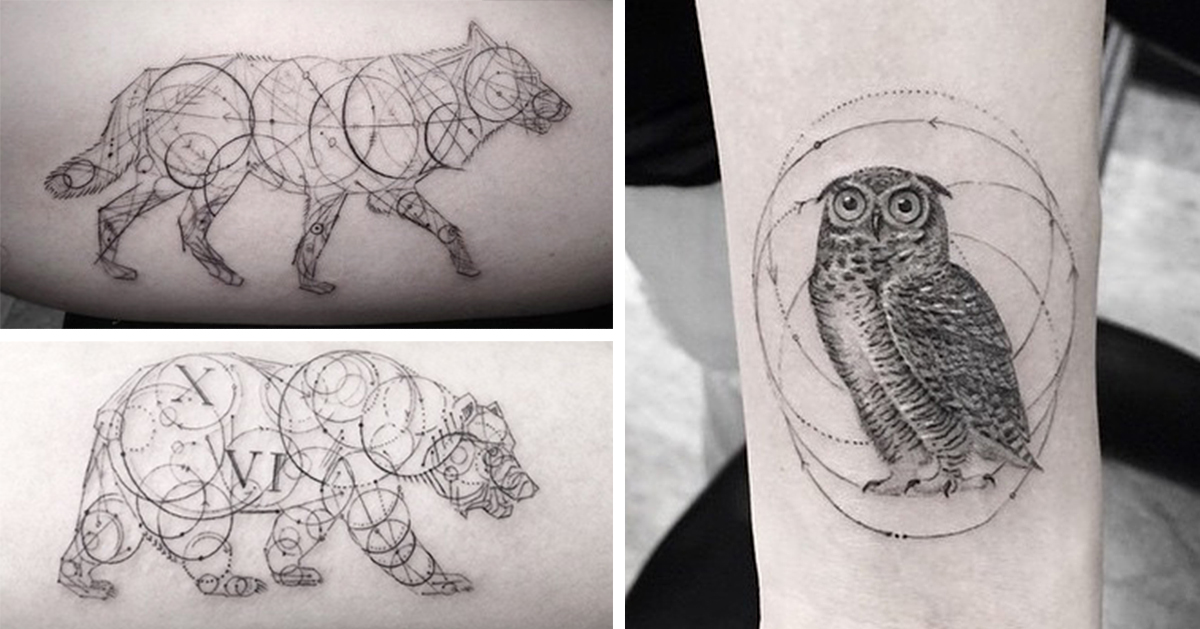
Some tattoo artists make bold work. Some make delicate work. And then there’s Dr. Woo, who somehow makes a tattoo look like it was drawn by a watchmaker, an architect, and a very patient magician working together under a full moon. His geometric tattoos don’t just sit on the skin; they seem to map it, orbit it, and occasionally outsmart it.
That balance is a big reason his work became instantly recognizable. In a field crowded with loud color, oversized flash, and trend-of-the-week chaos, Dr. Woo helped popularize a different visual language: fine lines, black-and-gray shading, meticulous symmetry, and geometric structures that feel both modern and timeless. The result is tattooing that looks refined without feeling cold, artistic without becoming impossible to wear, and intricate without turning into visual soup.
What makes the story even better is that this precision-driven artist didn’t arrive from some polished luxury pipeline. Brian Woo, better known as Dr. Woo, started experimenting with tattoos when he was around 13, long before he became one of the most talked-about names in fine-line tattooing. That early curiosity still shows in his work today. You can feel the restless energy of someone who never stopped studying the possibilities of line, spacing, detail, and design.
Who Is Dr. Woo, Really?
Dr. Woo is the professional name of Los Angeles tattoo artist Brian Woo, a creative whose rise has been tied to skill, timing, and a visual signature that became impossible to ignore. He developed his craft in the orbit of legendary tattooer Mark Mahoney at Shamrock Social Club, one of the most storied shops in Los Angeles. That background matters because it connects him to old-school black-and-gray tattoo traditions even as his own work pushed the style into a newer, more fashion-aware, detail-obsessed direction.
Before he became the tattoo artist celebrities lined up for, Woo was already experimenting with permanence as a teenager. That part of his biography matters because it explains the confidence in his work. His tattoos do not feel hesitant. Even when the lines are whisper-thin, the decisions are decisive. That’s the mark of an artist who has been thinking about skin as a canvas for a very long time.
His reputation grew fast, but not by accident. Dr. Woo’s work landed in a sweet spot between classic tattooing and contemporary image culture. He had the technical discipline of a serious craftsman, but his tattoos also photographed beautifully, which turned out to be rocket fuel in the Instagram era. Fine-line celestial pieces, miniature animals, geometric framing, delicate script, symbolic portraits, and black-and-gray compositions with almost impossible detail made his feed look less like a portfolio and more like an art archive with very cool wrists.
Why His Geometric Tattoos Hit So Hard
Geometric tattoos can go wrong in a hurry. One line is slightly off, one circle is a little wobbly, one spacing decision gets lazy, and suddenly your “sacred symmetry” looks like a stressed-out compass project. Dr. Woo’s geometric work stands out because it understands the unforgiving nature of precision. His circles feel measured. His dot work feels intentional. His spacing breathes. Even when the designs are dense, they rarely look cluttered.
That visual discipline gives his work a distinct mood. His geometric tattoos often feel meditative rather than aggressive. They can be cosmic, spiritual, architectural, botanical, or animal-inspired, but the geometry serves as the skeleton that keeps the composition balanced. A wolf becomes more than a wolf when it is framed by crisp angles and subtle pattern work. A flower becomes more than a flower when it is suspended in a structure of lines, circles, and negative space. A simple symbol becomes richer when geometry turns it into a system rather than a standalone icon.
That is one of Dr. Woo’s greatest strengths: he does not use geometry as decoration alone. He uses it as a way to organize meaning. His tattoos often feel as though organic life and mathematical order are shaking hands. Nature meets design. Emotion meets restraint. Chaos gets dressed up and behaves itself for once.
The Dr. Woo Aesthetic: Fine Line, Black and Gray, and Controlled Drama
If you had to describe the Dr. Woo aesthetic in one sentence, it would be something like this: ultra-fine black-and-gray tattooing with a designer’s eye and a poet’s patience. That sounds dramatic, but the work earns the drama.
His signature style relies heavily on single-needle or slim-needle finesse, allowing for exceptionally thin lines and delicate detail. This makes geometric compositions especially effective in his hands. Sharp shapes, subtle grids, tiny radiating lines, softly shaded planets, miniature wildlife, and pattern-heavy forms all benefit from the kind of precision that his technique makes possible.
Another reason the style works is contrast. Dr. Woo rarely needs loud color to create impact. He uses line weight, spacing, repetition, texture, and negative space to make the design breathe. That gives the work a clean, modern appearance that appeals to people who want tattoos that feel personal and artistic without looking heavy. In other words, his tattoos can whisper and still control the entire room.
Geometric tattoo lovers are often drawn to symmetry, symbolism, and structure, and Dr. Woo’s portfolio delivers all three. There are pieces that feel spiritual, pieces that feel scientific, pieces that feel fashion-forward, and pieces that feel like dream journals written with a ruler. Yet they still look like tattoos, not sterile graphic exercises. That balance is hard to pull off, and it explains why his influence has lasted.
From Tattoo Culture to Pop Culture
It is impossible to talk about Dr. Woo without talking about influence. He did not invent tattooing, obviously, and he did not single-handedly invent fine-line work either. But he became one of the defining artists of a specific era in tattoo culture, one where tattoos moved further into mainstream fashion, celebrity culture, and social media-driven personal branding.
His client list helped amplify that reach. Over the years, celebrities and public figures connected to his work have included names like Drake, Zoë Kravitz, Miley Cyrus, Justin Bieber, Hailey Bieber, Cara Delevingne, Bella Hadid, Emilia Clarke, and others. That kind of visibility could have reduced his work to trend bait, but the tattoos themselves kept the attention from feeling hollow. People were not just booking the artist because he was famous; they were chasing the specific mood and execution that only his hand seemed to offer.
That’s a crucial distinction. Plenty of celebrity tattoo artists are known because celebrities go to them. Dr. Woo became especially influential because other artists, design fans, and tattoo lovers studied the work itself. The geometry, the restraint, the clean black-and-gray detail, and the blending of organic and graphic elements helped shape broader taste. His rise made fine-line tattoos feel less niche and more like a serious visual category with staying power.
Why Geometric Tattoos Feel So Modern
Geometric tattoos have a built-in advantage in contemporary culture: they look good in a world obsessed with clean design. We live in the age of minimalist interiors, elegant logos, balanced layouts, curated shelves, carefully chaotic coffee tables, and phones full of grids. Geometric tattooing naturally fits that visual environment, and Dr. Woo understood that before a lot of people fully realized it.
But his best work does not feel trendy in a disposable way. That is because geometry, at its core, is ancient. Humans have always attached meaning to circles, triangles, patterns, repetition, constellations, and symmetry. Those forms can suggest harmony, ritual, order, infinity, or transformation. So when Dr. Woo builds tattoos from geometric elements, the work feels current, but it also taps into something much older.
That’s why his tattoos can feel deeply personal even when they are visually spare. A small geometric piece can carry a huge emotional charge because it invites interpretation rather than spelling everything out. It has mystery. It trusts the wearer. It also trusts the viewer to lean in, which is always cooler than a tattoo yelling its autobiography from across the parking lot.
Thinking About a Dr. Woo-Inspired Geometric Tattoo?
If Dr. Woo’s work makes you want to sprint toward a tattoo studio, pause just long enough to be strategic. Geometric tattoos reward planning. Placement matters. Scale matters. Skin movement matters. And, perhaps most importantly, artist selection matters. Fine-line geometry is not the kind of style you want done by someone whose circles look emotionally unavailable.
A few principles matter if you want this style to age well and still feel sharp years from now:
- Choose an artist with proven precision. Fine-line geometric tattooing leaves very little room for technical sloppiness.
- Respect placement. Areas with constant friction, stretching, or heavy sun exposure may affect how delicate details heal and settle.
- Keep size realistic. Tiny tattoos can be beautiful, but not every complex idea should be shrunk to the size of a postage stamp.
- Think beyond the trend cycle. The best geometric tattoos feel connected to your aesthetic and story, not just a screenshot folder from midnight.
- Take aftercare seriously. Fine details need good healing habits, patience, and long-term skin care.
This is part of what separates admiration from copycat behavior. A good Dr. Woo-inspired tattoo should not be a carbon copy of his greatest hits. It should borrow the lessons of his work: balance, precision, restraint, symbolism, and thoughtful composition.
The Experience of Living With a Geometric Tattoo
There is a special kind of excitement that comes with a geometric tattoo, especially one influenced by Dr. Woo’s style. It starts before the needle even touches the skin. The design phase feels different from choosing a more literal tattoo because geometry asks bigger questions. You are not just picking an image; you are deciding how order, symbolism, and proportion will live on your body. It’s less “Should I get a cool thing?” and more “How do I want this idea to exist in space?” That sounds lofty, but tattoos have always been part art, part autobiography, and part beautifully irrational commitment.
Then comes the appointment itself, where the experience often feels oddly calm. Fine-line tattooing has a reputation for delicacy, and while pain depends on placement and tolerance, the process can feel more like careful drafting than brute-force punishment. You start to notice how much trust is involved. With geometric work, the artist isn’t just drawing; they’re balancing a composition against the natural curves of your arm, shoulder, ribcage, or leg. Every angle has to cooperate with anatomy. Every line has to feel crisp but alive. Watching that happen can make you appreciate tattooing as a design discipline, not just a rebellious hobby with better lighting than it used to have.
Once the tattoo is finished, the experience changes again. Geometric tattoos have a sneaky quality: they tend to reveal themselves slowly. At first, you notice the overall shape. Then you start seeing the small details a few days later, then a few weeks later, then randomly while brushing your teeth. A line connects to a shadow. A small cluster of dots shifts the balance. A circle frames the image in a way you didn’t fully clock during the stencil stage. Good geometric tattoos keep unfolding visually, which is one reason people become so attached to them.
There is also the social experience. People react differently to geometric fine-line tattoos than they do to louder, more traditional pieces. Instead of saying, “Whoa, that’s huge,” they often lean in and say, “Wait, let me see that.” The tattoo creates curiosity. It invites closer attention. That can feel surprisingly intimate because the tattoo becomes something discovered rather than announced. It is decoration, yes, but it is also conversation, detail, and mood.
Over time, living with a geometric tattoo can feel grounding. Symmetry has a quiet psychological effect. Repetition can feel calming. Circular forms can feel complete. Even abstract pieces often become emotional markers because they are tied to a period of change, a belief system, a memory, or a personal reset. In that sense, the experience of wearing the tattoo becomes bigger than the original design brief. What started as admiration for Dr. Woo’s style can evolve into something more personal: a daily visual reminder of balance, transformation, control, or beauty found in structure.
And perhaps that is the most interesting part. The best geometric tattoos do not stay frozen as “aesthetic choices.” They grow with the wearer. They collect meaning. They absorb seasons of life. They become familiar in the way a favorite ring, jacket, or song becomes familiar, except this one lives on your skin and quietly insists on being part of your story. Not bad for a bunch of lines, dots, and shapes behaving better than most group chats.
Conclusion
Dr. Woo’s geometric tattoos matter because they combine craftsmanship, restraint, and imagination in a way that changed how many people think about modern ink. His story, from teenage experimentation to tattoo-world icon, gives the work extra depth, but the tattoos themselves are what keep people paying attention. They are sharp without being sterile, delicate without being forgettable, and artistic without disappearing into self-seriousness.
In a world where trends rise fast and fade even faster, Dr. Woo’s best geometric work still feels composed, intelligent, and wearable. That is probably why it continues to resonate. The tattoos do not chase attention with noise. They earn it with precision. And in tattooing, as in life, that kind of confidence usually ages pretty well.