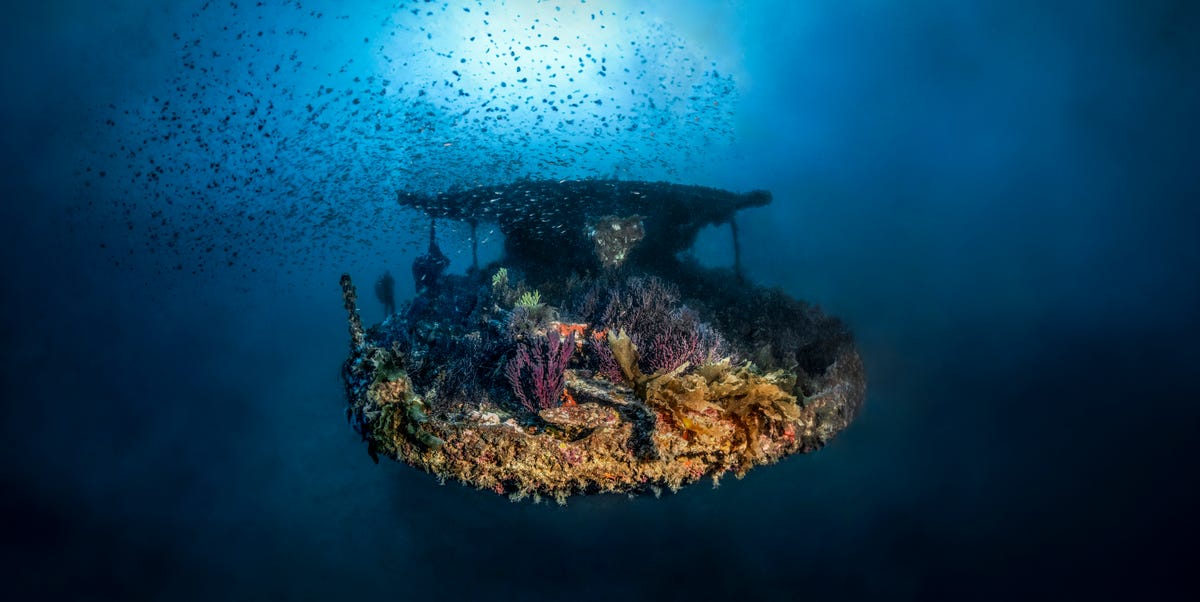
Note: This article is written from verified public information about the Camarat 4 shipwreck, a 16th-century merchant vessel discovered by the French Navy during a seabed survey off southeastern France.
A Routine Military Scan That Turned Into an Archaeological Plot Twist
Most people expect military officers scanning the seafloor to find cables, mines, modern debris, or perhaps the occasional “mystery object” that turns out to be a very dramatic-looking rock. What French Navy specialists found in March 2025 was far more exciting: a 16th-century shipwreck resting more than 1.5 miles beneath the Mediterranean Sea.
The wreck, now called Camarat 4, was discovered off the coast of Ramatuelle, near Saint-Tropez in southeastern France. The name comes from the nearby Cap Camarat area, not from a swashbuckling captain named Camaratalthough, frankly, that would have been convenient for the movie version.
The discovery happened during a military seabed-control operation. Navy specialists were examining the deep ocean floor when sonar detected an unusual shape. After sending down underwater imaging equipment, the team realized the object was not a modern wreck, a submarine part, or a misplaced shipping container. It was a merchant ship, about 98 feet long and 23 feet wide, likely dating back nearly 500 years.
For archaeologists, that is the underwater equivalent of opening a dusty attic box and finding a handwritten Renaissance shopping listexcept this “box” was sitting around 8,200 feet underwater, surrounded by darkness, pressure, cold water, and the sort of silence that makes history feel very serious.
What Exactly Did the Military Officers Find?
Camarat 4 appears to be a 16th-century merchant vessel, probably connected to trade routes between northern Italy and other Mediterranean ports. Its cargo gives researchers the biggest clues. Images from the wreck show hundreds of ceramic objects still scattered across the seabed, including decorated pitchers, plates, and other goods that likely came from Liguria, a historic region in northwestern Italy.
Among the most striking finds are roughly 200 visible glazed ceramic pitchers. Many are decorated with botanical patterns, geometric designs, crosses, and the Christian monogram “IHS,” a symbol associated with Jesus Christ. There are also around 100 ceramic plates, metal bars, anchors, cannons, and cauldrons.
In other words, Camarat 4 was not carrying pirate treasure in the cartoon senseno obvious pile of gold coins guarded by a skeleton with excellent posture. But archaeologically speaking, its cargo is treasure. Everyday objects are often more valuable to historians than royal jewels because they reveal how people actually lived, traded, cooked, worshiped, worked, and moved goods across the sea.
Why the Camarat 4 Shipwreck Is So Important
The Camarat 4 discovery is extraordinary for several reasons. First, it is considered the deepest known shipwreck recorded in waters under French jurisdiction. At more than 2,500 meters below the surface, it lies far beyond the reach of ordinary divers. Even highly trained technical divers cannot casually pop down there after breakfast. This is a realm for specialized underwater drones, remotely operated vehicles, advanced sonar, and teams who understand that one wrong move can turn a priceless artifact into expensive underwater confetti.
Second, the wreck appears to be unusually well preserved. Depth helped protect it. In shallow water, shipwrecks are often damaged by storms, currents, fishing gear, marine life, looters, and earlier salvage attempts. Camarat 4, however, spent centuries in a place where humans could not realistically reach it until modern deep-sea technology arrived.
That means archaeologists may be looking at a site that has remained largely untouched since the ship sank. For researchers, this is a dream scenario. A disturbed wreck can still be useful, but an intact or semi-intact wreck is like a crime scene where no one has moved the furniture. The position of objects, the spread of cargo, the location of anchors, and even empty spaces can help tell the story of what happened.
A Snapshot of 16th-Century Mediterranean Trade
The 1500s were a busy, dangerous, and commercially vibrant period in the Mediterranean. Ships carried ceramics, metals, food, textiles, tools, weapons, religious objects, and luxury items between ports. The Mediterranean was not just a pretty blue backdrop for postcards; it was a superhighway of commerce, politics, migration, conflict, and cultural exchange.
Camarat 4’s cargo suggests that it may have departed from northern Italy or carried goods made in Liguria. The decorated pitchers and plates show the importance of regional ceramic production. These were not disposable containers. They were crafted, decorated, traded, and valued.
The presence of cannons also tells an important story. Merchant ships in the 16th century often needed protection. Pirates, privateers, wartime threats, and rival powers made maritime trade risky. A merchant vessel could be a floating warehouse one day and a defensive platform the next. The cannons on Camarat 4 suggest that its crew understood the old maritime rule: hope for calm seas, but bring something louder than optimism.
What Might Have Caused the Ship to Sink?
Researchers have not yet confirmed why Camarat 4 sank. Several possibilities remain open. It may have been caught in a storm, overloaded, damaged in a conflict, struck by a sudden navigational hazard, or capsized. The empty stern area has raised questions, because ships of that era typically used available space carefully. If part of the ship appears empty, archaeologists must ask whether perishable cargo disappeared, whether some objects are buried under sediment, or whether the wreck broke apart in a particular way.
The seabed itself may hold more answers. Many remains are likely hidden under sand and sediment. Archaeologists are cautious because disturbing the site too aggressively could destroy evidence. Modern underwater archaeology is less about “grab the cool stuff” and more about “document everything, disturb as little as possible, and please do not poke the 500-year-old mystery with a metal claw unless you absolutely must.”
How Underwater Robots Are Helping Solve the Mystery
Because Camarat 4 lies at extreme depth, researchers rely on advanced underwater vehicles. Subsequent missions used remotely operated robots equipped with cameras, lights, and precision tools. These machines can capture detailed imagery, hover over fragile objects, and carefully recover selected artifacts for conservation and study.
One mission gathered tens of thousands of images for photogrammetry, a technique that uses overlapping photographs to build a detailed 3D model. This digital model allows archaeologists to study the wreck without repeatedly disturbing the site. It also preserves a record of the ship as it exists now, which is crucial because deep-sea environments can still change over time.
With a 3D model, experts can measure the wreck, map the cargo, analyze artifact distribution, and share the site with specialists who may never physically visit the location. It is the closest thing archaeology has to teleportation, minus the sci-fi sound effects.
Why Archaeologists Do Not Simply Raise the Whole Ship
When people hear about an ancient shipwreck, they often imagine a dramatic recovery operation: cables, cranes, news helicopters, and a ship rising from the sea like a blockbuster finale. Real archaeology is usually quieterand smarter.
Raising an entire 16th-century wreck from more than 8,000 feet underwater would be extremely difficult, expensive, and risky. More importantly, it might damage the very evidence researchers want to preserve. Wood, ceramics, metal, and organic materials can react badly when removed from the stable environment where they have rested for centuries.
That is why archaeologists often prefer careful documentation, limited sampling, and long-term monitoring. Selected objects may be recovered for conservation and laboratory analysis, but the wreck itself can remain protected in place. The goal is not to empty the ocean like a garage sale. The goal is to understand the past without wrecking the wreck.
The Environmental Side of the Discovery
The Camarat 4 site also reminds us that even the deep sea is not separate from modern life. Reports from the area noted modern debris near the wreck, including pollution such as bottles, cans, nets, and other waste. That contrast is almost painfully symbolic: a 500-year-old ship survives in remarkable condition, only to share the seabed with modern trash.
This adds another layer to the story. The discovery is not just about Renaissance trade or underwater archaeology. It is also about ocean stewardship. Historic wrecks are cultural heritage sites, but they sit within living marine environments affected by pollution, fishing activity, climate change, and expanding seabed exploration.
Protecting shipwrecks therefore means protecting more than old wood and pottery. It means treating the ocean floor as a historical archive and an ecological spacenot an invisible junk drawer beneath the waves.
What Camarat 4 Can Teach Us About the Past
Camarat 4 offers a rare opportunity to study a deep-sea merchant ship from the 16th century with much of its cargo still visible. Researchers may learn more about shipbuilding, trade routes, ceramic production, religious symbolism, cargo organization, and maritime risk in the early modern Mediterranean.
The ceramics alone are a valuable archive. Their shapes, glazes, decorations, and manufacturing techniques can help identify where they were made and how they were traded. The metal bars may reveal information about commercial materials and supply chains. The cannons may help researchers understand how merchant ships balanced trade and defense.
Even the ship’s silence is useful. A wreck does not explain itself in neat paragraphs. It offers clues: a cannon here, a plate there, an anchor partly buried, a cargo pile shifted by impact or time. Archaeologists must read those clues like detectives reading a very soggy, very old book.
Why Accidental Discoveries Matter
Some of the most important archaeological discoveries begin by accident. A farmer digs a field. A construction crew opens a foundation. A fisherman snags a net. In this case, military officers conducting a routine seafloor scan uncovered a ship that had been hidden for five centuries.
Accidental discoveries matter because they expand the map of what we know. Before sonar picked up Camarat 4, the wreck was not part of public history. It existed physically, but not intellectually. No museum label described it. No tourist guide mentioned it. No historian could use its cargo to refine a theory. One unexpected signal changed that.
That is the charm of archaeology: the past is not gone. It is often just misplaced, buried, submerged, or waiting for someone with the right tool to notice that a strange shape on a screen is not just a strange shape.
Lessons and Experiences Inspired by the Camarat 4 Discovery
The story of military officers accidentally discovering a 16th-century shipwreck offers more than a fascinating headline. It also gives us a useful way to think about curiosity, patience, technology, and respect for history. In everyday life, many discoveries happen when people are doing something ordinary with unusual attention. The French Navy team was not on a romantic treasure hunt. They were performing a technical task. Yet because they observed carefully and followed up on an anomaly, they helped uncover a major archaeological site.
That experience translates well beyond the ocean. Writers, researchers, teachers, engineers, students, and business owners often find their best ideas while working through routine tasks. A strange data point, an odd customer question, a forgotten note, or a minor mistake can become the beginning of something meaningful. The key is not to dismiss the unexpected too quickly. Sometimes the “weird thing” is the doorway.
The Camarat 4 story also teaches humility. Modern technology found the ship, but it did not instantly explain it. Sonar, drones, robots, and 3D mapping can reveal the site, yet human expertise is still needed to interpret it. That balance is important. Technology is powerful, but it becomes truly useful when paired with patience, context, and careful judgment.
There is also a lesson in preservation. Many people imagine discovery as possession: find something, take it, display it, own it. Underwater archaeology challenges that instinct. The best choice is often to leave much of the site in place, study it slowly, and protect it for future generations. That mindset applies to cultural heritage everywhere. Not everything valuable needs to be grabbed. Some things are more meaningful when they are respected, documented, and allowed to remain part of their original environment.
Finally, Camarat 4 reminds us that history is not just made by kings, wars, and famous explorers. It is also made by merchants, sailors, ceramic makers, cooks, dockworkers, and unknown crews who loaded ships and crossed dangerous waters. A pitcher on the seafloor may seem small, but it carries the fingerprints of trade, faith, craftsmanship, and daily life. That is why this discovery feels so human. Beneath the military technology and deep-sea drama is a simple truth: five centuries ago, people packed a ship with goods and set sail. They never arrived, but their story did.
Conclusion: A Shipwreck That Turned a Scan Into a Time Machine
The accidental discovery of Camarat 4 proves that the ocean still guards extraordinary secrets. What began as a military seabed survey became one of the most important underwater archaeological finds in French waters: a 16th-century merchant ship, preserved at record depth, carrying ceramics, metal goods, weapons, and clues to Mediterranean trade.
Its story is still unfolding. Researchers are using robots, imaging technology, conservation methods, and archaeological expertise to learn more without damaging the site. The wreck may eventually reveal where it sailed from, where it was going, how it was built, what it carried, and why it sank.
For now, Camarat 4 stands as a reminder that history is not always found in libraries or museums. Sometimes it waits in total darkness, 8,200 feet below the waves, until a sonar screen blinks and someone decides to take a closer look.