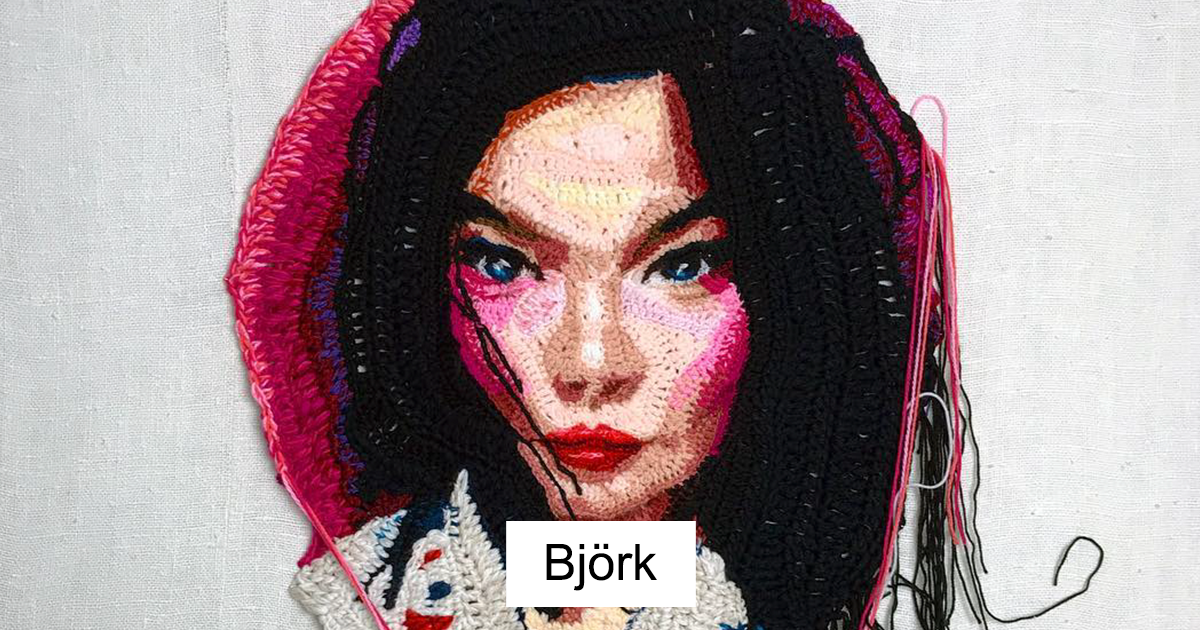
Some people paint with oil, watercolor, or acrylic. I paint with yarn, a crochet hook, and an alarming number of tiny thread ends that somehow migrate into every corner of my home. Crochet portraits may sound unusual at first, but that is exactly what makes them so fascinating. Instead of smooth brushstrokes, the face appears through loops. Instead of blended pigment, emotion is built from texture, color changes, knots, shadows, and patience.
Portrait crochet sits somewhere between fiber art, painting, sculpture, and a very polite form of madness. It asks the artist to think like a painter, calculate like a pattern designer, and stay calm like someone who has not just discovered a mistake 19 rows ago. The result, when everything finally works, is wonderfully human: a face made not only of color and shape, but of time.
This collection of crochet portraits celebrates that handmade magic. Each piece begins as an image, a memory, a mood, or a famous face, then slowly becomes a textured fiber artwork. From expressive eyes to wild hair, from soft cheek shadows to bold outlines, every detail has to be translated into stitches. And yes, yarn has opinions. Very strong opinions.
What Makes Crochet Portraits So Captivating?
A crochet portrait is not simply a picture copied in yarn. It is a translation. The artist has to decide what matters most: the tilt of the head, the contrast around the eyes, the shape of the mouth, the emotional temperature of the face. A photograph can capture a person in a fraction of a second, but crochet stretches that moment into hours, days, or even weeks of work.
That slow process gives crochet portraits their charm. You can see the maker’s hand in every loop. A painted portrait may hide its labor beneath smooth blending, but crochet proudly shows its structure. Stitches become pixels, brushstrokes, and sculptural ridges all at once. The portrait looks different from across the room than it does up close, which makes viewing it feel like a small discovery.
Up close, you see the yarn fibers, color transitions, raised shapes, and tiny imperfections that make the artwork alive. From a distance, those stitches merge into a face. It is a little like watching a magic trick, except the magician is covered in yarn fuzz and probably needs another cup of coffee.
The Art of Turning Yarn Into a Face
Creating a crochet portrait begins with observation. Before choosing a hook or yarn, the artist studies the subject. Where is the strongest shadow? What feature carries the emotion? Is the face calm, dramatic, playful, mysterious, or slightly judging the viewer for not finishing their own craft project?
Once the mood is clear, the technical puzzle begins. Some crochet portraits are made with tapestry crochet or intarsia crochet, where colors change across rows to create an image. Others use freeform crochet, a more improvisational method that allows the artist to build shapes, curves, and textures without following a strict grid. Many portrait artists combine several techniques, because faces are rarely polite enough to fit neatly into one method.
Color Is the First Language
In portrait crochet, yarn color works like paint, but with extra personality. A single skein may contain variations in tone, shine, thickness, or texture. Skin, hair, fabric, and background all need different treatment. A warm beige may work beautifully for one cheek but look completely wrong next to a cooler shadow. A deep brown may define an eye, while a strand of gold, gray, or copper can bring hair to life.
Unlike digital art, crochet cannot instantly blend two colors with a slider. The artist must create the illusion of blending through stitch placement, yarn choice, and contrast. Sometimes a harsh color change creates drama. Sometimes a softer transition creates depth. The trick is knowing when to let the yarn shout and when to ask it, kindly, to use its indoor voice.
Texture Gives the Portrait a Pulse
Texture is where crochet portraits become truly distinctive. A raised stitch can suggest a wrinkle, curl, eyebrow, collar, or shadow. A loose stitch can soften an area, while tight stitches can create sharper definition. Freeform crochet is especially powerful here because it lets the artist build surfaces that feel almost sculptural.
Hair is often the most playful part. Straight hair may be represented with long directional stitches, while curls can be built from spirals, loops, coils, or layered pieces. Beards, hats, scarves, eyelashes, and jewelry become opportunities to add dimension. In a crochet portrait, even silence has texture.
Why Crochet Belongs in Modern Art
For a long time, crochet was often treated as a domestic craft rather than fine art. People associated it with blankets, doilies, baby gifts, and cozy winter projects. Those things are wonderful, of course. A handmade blanket can be a love letter disguised as a rectangle. But crochet can do far more than keep knees warm.
Contemporary fiber artists have pushed crochet into galleries, public installations, fashion, sculpture, political art, and portraiture. Yarn can be bold, conceptual, emotional, humorous, and technically sophisticated. It can tell stories about identity, culture, memory, care, labor, and community. Crochet portraits are part of that larger movement: they show that a hook and yarn can carry the same artistic weight as a brush, camera, or chisel.
There is also something powerful about using a traditionally “soft” material to create strong visual statements. A face made from yarn can feel intimate and approachable, yet still command attention. It invites viewers to come closer, to notice the labor, and to rethink what counts as serious art.
The Challenge of Making 54 Crochet Portraits
One crochet portrait is a project. Fifty-four crochet portraits are a lifestyle choice, possibly a weather system. Each piece requires planning, patience, and problem-solving. No two faces behave the same way. A portrait with dramatic lighting may require sharp contrasts. A softer portrait may need delicate color shifts. A famous face must be recognizable without becoming stiff. A family portrait must feel personal without drowning in detail.
The number 54 also matters because repetition teaches the artist. After several portraits, you begin to understand how yarn behaves when asked to become skin, eyes, shadows, or hair. You learn which colors are secretly too loud, which stitches make a nose look natural, and which techniques make a mouth look expressive instead of accidentally surprised.
Every portrait becomes a lesson. Some teach patience. Some teach color theory. Some teach humility, usually around midnight when the left eye looks perfect and the right eye looks like it has seen the future.
Famous Faces, Personal Faces, and Emotional Recognition
Crochet portraits can feature celebrities, artists, musicians, family members, fictional characters, or anonymous faces. Famous subjects are especially interesting because viewers bring their own memories to the image. A portrait of a beloved singer, actor, or director carries cultural recognition before the first stitch is even noticed.
But personal portraits may be even more moving. A family member, friend, child, or elder translated into yarn becomes more than decoration. It becomes a record of care. Handmade portraiture says, “I spent time looking at you.” In a fast-scroll world, that kind of attention feels rare.
The emotional power of crochet portrait art often comes from this tension between recognition and material. The viewer knows the face, but the method is unexpected. That surprise creates delight. The mind says, “Wait, is that really made of crochet?” Then the eye moves closer, and the answer is yes. Yes, it is. And yes, the artist probably counted a heroic number of stitches.
How a Crochet Portrait Usually Comes Together
1. Choosing the Right Reference
A good reference image has clear lighting, expressive features, and a strong silhouette. The artist does not need every tiny detail, but the main structure must be readable. High contrast is especially helpful because yarn portraits depend on clear value relationships.
2. Simplifying the Image
Faces are complex, and yarn has limits. The artist often reduces the portrait into major color zones, shadow shapes, and key lines. This step is similar to posterizing a photo or sketching a value study. The goal is not to copy every pore. The goal is to preserve identity and emotion.
3. Selecting Yarn and Hook Size
Yarn weight affects detail. Thinner yarn allows finer control but takes longer. Thicker yarn creates bold texture but may simplify facial features. Hook size changes density and flexibility. A tight fabric can hold shape well, while a looser fabric may create a softer, more painterly surface.
4. Building the Face in Layers
Some artists work from a chart, while others build sections intuitively. Background, hair, face, shadows, clothing, and details may be crocheted separately or directly into one surface. Layering helps create dimension, especially when working with eyebrows, lips, hair strands, collars, or accessories.
5. Finishing and Mounting
Finishing is more than weaving in ends, although there are always ends. So many ends. The artist may block the piece, adjust edges, sew sections together, add embroidery, or mount the work on canvas, fabric, wood, or a frame. Presentation matters because fiber art needs support to hang beautifully.
Why Viewers Love Handmade Fiber Portraits
People respond to crochet portraits because they combine familiarity with surprise. Everyone understands a face. Not everyone expects a face to be made from loops of yarn. That combination makes the artwork immediately accessible, even to people who know nothing about crochet.
There is also a deep appreciation for visible labor. In an age of instant images, handmade work reminds us that beauty can be slow. A crochet portrait cannot be rushed without consequences. It demands attention, and that attention becomes part of the finished piece.
Viewers often enjoy spotting the details: the stitch used for an eyelid, the color chosen for a cheekbone, the way hair has been curled or layered. The artwork rewards close looking. It also sparks conversation. Someone will always ask, “How long did this take?” The honest answer is usually, “Long enough to question my choices, but not long enough to stop making more.”
Crochet Portraits and the Rise of Fiber Art Online
Social media has helped crochet artists reach audiences far beyond traditional craft circles. A single portrait can travel quickly online because it is visually surprising and easy to appreciate. People who might scroll past a regular portrait often pause when they realize the image is crocheted.
Online platforms have also helped fiber artists share process videos, detail shots, progress photos, and behind-the-scenes mistakes. This matters because crochet portraiture is not only about the final image. The process itself is part of the appeal. Watching a face slowly emerge from rows, shapes, and color changes feels satisfying, almost cinematic.
For artists, this visibility can be encouraging. It connects makers with other crocheters, collectors, designers, and curious viewers. It also helps break the outdated idea that crochet is limited to traditional patterns. Today, crochet can be wearable art, wall art, public art, portrait art, and, if one is feeling especially brave, a full-sized couch cover shaped like a dragon. The hook has range.
Tips for Beginners Who Want to Try Crochet Portrait Art
If you are new to crochet portraits, start small. A simple face with strong contrast is better than a complicated image with twenty-seven nearly identical shades of beige. Choose a limited palette and focus on the major shapes first. Eyes, hairline, mouth, and shadows usually carry the likeness.
Practice color changes before starting a large portrait. Tapestry crochet, intarsia crochet, and surface crochet each behave differently. Try small swatches to see how your yarn looks when carried, dropped, joined, or layered. The back of your work may look like a spaghetti meeting, and that is normal in the beginning.
Do not be afraid to combine methods. A portrait may use flat crochet for the base, embroidery for fine lines, freeform pieces for hair, and appliqué for accessories. Fiber art is flexible. The best method is the one that helps the portrait speak clearly.
Common Mistakes in Crochet Portraits
One common mistake is using too many colors too soon. More colors do not automatically mean more realism. Sometimes a limited palette creates a stronger portrait because the values are clearer. Another mistake is ignoring contrast. Without contrast, the face can become flat, even if the stitching is beautiful.
Scale is another challenge. If the portrait is too small, important features may become blocky or unclear. If it is too large, the project can become overwhelming. Beginners should choose a size that allows detail without requiring a second lifetime.
Finally, many artists forget to step back. Crochet portraits often look strange up close while they are in progress. The face may not appear until enough sections are complete. Taking photos from a distance can help the artist judge whether the image is reading correctly.
The Beauty of Imperfection
One of the best things about crochet portrait art is that perfection is not the point. The handmade surface gives the work personality. A slightly uneven stitch, a textured edge, or a visible color join can make the piece feel more human. In portraiture, humanity matters more than machine-level smoothness.
In fact, crochet portraits often become more expressive because of their imperfections. A line that is not perfectly straight may suggest movement. A textured shadow may feel warmer than a smooth one. A raised stitch may catch light in a way no flat image can. The quirks are not flaws; they are fingerprints.
Experience Section: What Making Crochet Portraits Has Taught Me
Making crochet portraits has changed the way I look at faces. Before I started translating portraits into yarn, I noticed the obvious things first: eye color, hairstyle, smile, expression. Now I notice the quiet architecture. I see how a shadow under the lower lip can change the mood of a face, how the angle of an eyebrow can add humor or sadness, and how a tiny highlight near the eye can make the whole portrait feel awake.
The first lesson is patience. Crochet portraiture does not reward panic. If a color looks wrong, I have to pause and compare it with the whole composition. If a cheek looks too sharp, I may need to soften the surrounding area rather than blame that one section. The portrait teaches me to solve problems slowly. It also teaches me that pulling out stitches is not failure. It is editing. Painful, yarn-based editing, but editing nonetheless.
The second lesson is that materials have their own voice. I may begin with a plan, but the yarn often suggests a better path. A fuzzy strand might become soft hair. A shiny fiber might work beautifully for a highlight. A rougher texture might add character to clothing or background. The best results usually happen when I stop trying to force the yarn to behave like paint and let it behave like yarn.
The third lesson is emotional. Portraits require attention, and attention is a form of respect. Whether I am making a well-known face or a personal portrait, I spend hours studying the subject. I begin to notice details I would otherwise miss: the asymmetry of a smile, the softness around the eyes, the way personality lives in posture as much as in features. By the time the piece is finished, I feel as if I have had a long, quiet conversation with the person in the image.
There is also a practical lesson: organization saves sanity. Crochet portraits can involve many colors, bobbins, loose ends, and small shaped pieces. Labeling yarn, keeping reference notes, and photographing progress can prevent confusion. Without organization, a portrait session can quickly become a dramatic documentary titled “One Artist Versus Forty-Two Beige Strands.”
Most of all, making crochet portraits has taught me that art does not need to choose between craft and expression. A stitch can be technical and emotional at the same time. A handmade portrait can be playful, serious, nostalgic, modern, decorative, and deeply personal. That is why I keep making them. Every new face is a new puzzle, a new story, and a new chance to prove that yarn can do much more than behave nicely in a basket.
Conclusion
Crochet portraits are a joyful reminder that art can come from unexpected materials. With a hook, yarn, color, texture, and a generous amount of persistence, a flat reference image can become a tactile portrait full of personality. These pieces celebrate not only the subject’s face but also the time and care required to make something by hand.
Whether you are a crochet lover, a fiber art collector, a beginner looking for inspiration, or simply someone who enjoys seeing familiar faces in surprising forms, crochet portrait art offers something memorable. It is warm, clever, expressive, and wonderfully strange in the best possible way. After all, anyone can print a picture. It takes a special kind of artist to look at a face and think, “Yes, this needs yarn.”
Note: This article is written as an original, publication-ready SEO feature inspired by real crochet portrait art, fiber-art practices, and contemporary handmade textile trends. It contains no copied source text, no unnecessary code references, and no external source links.