Buying a car is exciting until someone slides a financing worksheet across the desk and starts talking in monthly-payment riddles. Suddenly, a $34,000 SUV becomes “only $499 a month,” which sounds manageable until you remember that “only” is one of the most dangerous words in personal finance.
Knowing how to calculate auto loan payments gives you a major advantage before you visit a dealership, compare lenders, or fall emotionally attached to a vehicle with heated seats and a suspiciously persuasive salesperson. The goal is not simply to find a payment that fits your month. It is to understand the true cost of borrowing, including interest, taxes, fees, trade-ins, and the length of the loan.
This guide explains how car loan payments work, how to calculate them manually or with an auto loan calculator, and how to compare financing offers without accidentally financing a small moon.
What Is an Auto Loan Payment?
An auto loan payment is the amount you pay each month to repay the money borrowed for a vehicle. Most car loans use amortization, meaning each scheduled payment includes both principal and interest.
At the beginning of the loan, a larger share of your payment typically goes toward interest because the remaining balance is higher. As you continue making payments, more of each payment goes toward reducing the principal balance. This is why paying extra toward principal early in the loan can reduce the amount of interest you pay overall.
Your monthly car payment usually depends on five major factors:
- The total amount financed
- Your annual percentage rate, or APR
- The loan term in months
- Your down payment
- Taxes, dealer fees, registration costs, trade-in value, and optional add-ons
Federal consumer guidance emphasizes looking beyond the monthly payment alone. A lower payment can be created by stretching the loan over more months, but a longer repayment term can increase the total interest paid.
Step 1: Calculate the Total Amount Financed
The amount financed is not always the same as the sticker price. It is the amount you actually borrow after adding applicable costs and subtracting money that reduces the deal.
The Basic Auto Loan Formula
Amount Financed = Vehicle Price + Taxes + Fees + Add-Ons + Negative Equity − Down Payment − Rebates − Trade-In Equity
Here is what each part means:
- Vehicle price: The negotiated selling price of the car, not necessarily the manufacturer’s suggested retail price.
- Taxes: Sales tax can vary by state, county, and city.
- Fees: These may include title, registration, documentation, destination, or lien fees.
- Add-ons: Extended warranties, service contracts, tire protection, paint protection, GAP coverage, and similar products.
- Negative equity: The amount you still owe on your current vehicle beyond its trade-in value.
- Down payment: Cash paid upfront to reduce what you borrow.
- Rebates: Manufacturer incentives that lower the purchase price or amount financed.
- Trade-in equity: Your trade-in value minus the remaining loan payoff amount.
A down payment reduces the amount you need to finance, and it may also help you qualify for better financing terms.
Example: Finding the Amount Financed
Imagine you are buying a vehicle with the following numbers:
- Negotiated vehicle price: $32,000
- Sales tax: $2,240
- Title and registration fees: $500
- Documentation fee: $400
- Manufacturer rebate: $1,500
- Cash down payment: $5,000
- Trade-in value: $3,000
- Remaining trade-in loan balance: $1,000
Your net trade-in equity is $2,000 because the $3,000 trade-in value is reduced by the $1,000 remaining loan balance.
Amount Financed = $32,000 + $2,240 + $500 + $400 − $1,500 − $5,000 − $2,000
Amount Financed = $26,640
That $26,640 is the number that belongs in your auto loan payment calculation. Not the sticker price. Not the payment the salesperson writes on a sticky note. The amount financed.
Step 2: Understand APR and Interest Rate
Your interest rate is the price the lender charges for letting you borrow money. Your APR is broader because it can include the interest rate plus certain lender fees. When comparing loans, APR is often the more useful number because it helps you compare the actual borrowing cost across offers.
The APR you receive may depend on factors such as your credit score, credit history, income, debt obligations, down payment, loan term, loan amount, and whether the vehicle is new or used.
A borrower with strong credit may qualify for a lower APR than a borrower with a thin credit history or higher debt burden. This does not mean you should accept the first rate offered. Shopping multiple lenders can help you see whether a bank, credit union, online lender, or dealership financing program offers the most competitive deal.
Step 3: Convert APR Into a Monthly Interest Rate
Auto loans are generally paid monthly, so you need to convert the annual percentage rate into a monthly rate.
Monthly Interest Rate = APR ÷ 12
For example, if your APR is 6.5%:
6.5% = 0.065
0.065 ÷ 12 = 0.0054167
Your monthly interest rate would be approximately 0.0054167, or 0.54167% per month.
This decimal form is used in the standard auto loan payment formula. It looks slightly intimidating at first, but so did parallel parking, and now you mostly just avoid downtown garages.
Step 4: Use the Auto Loan Payment Formula
The standard formula for calculating a fixed monthly auto loan payment is:
M = P × [r(1 + r)n] ÷ [(1 + r)n − 1]
In this formula:
- M = Monthly payment
- P = Principal, or amount financed
- r = Monthly interest rate
- n = Total number of monthly payments
For a 60-month loan, the total number of payments is 60. For a 72-month loan, the number is 72. You can calculate payments by hand, but an auto loan calculator is usually faster and less likely to make your spreadsheet glare at you.
Example: Monthly Payment on a 60-Month Auto Loan
Using the earlier example:
- Amount financed: $26,640
- APR: 6.5%
- Loan term: 60 months
- Monthly interest rate: 0.065 ÷ 12 = 0.0054167
The estimated monthly payment is approximately $521.24.
Over 60 months, you would pay about $31,274.53 in total. That means the estimated interest cost would be approximately $4,634.53.
This is the part many buyers overlook. The monthly payment is $521.24, but the total vehicle financing cost is more than $31,000. The car may have started at $32,000, but borrowing has its own appetite.
How Loan Term Changes Your Car Payment
Loan term is one of the biggest levers in an auto loan calculation. A longer loan term generally lowers the monthly payment because you are spreading repayment across more months. However, it also gives interest more time to accumulate.
60 Months vs. 72 Months
Using the same $26,640 loan at 6.5% APR:
- 60 months: About $521.24 per month and about $4,634.53 in interest
- 72 months: About $447.82 per month and about $5,602.79 in interest
The 72-month option saves roughly $73 per month, but it costs nearly $1,000 more in interest over the life of the loan. That lower payment can feel comforting, but it may also keep you in debt longer than you expected.
Long loan terms can also increase the chance of owing more than the vehicle is worth, especially during the early years when depreciation can move faster than the loan balance. Consumer advocates commonly warn shoppers to evaluate total borrowing cost and loan length, rather than focusing only on a payment that fits the monthly budget.
How Down Payments Affect Auto Loan Payments
A bigger down payment reduces the amount financed. That can lower your monthly payment, reduce total interest, and potentially make you a more attractive borrower to lenders.
Suppose you increase your down payment by $3,000 on the same loan example. Instead of financing $26,640, you finance $23,640.
At 6.5% APR for 60 months, that lower amount financed would reduce the payment meaningfully and lower the total interest paid. The math is not glamorous, but it is one of the few areas in life where putting money down can make the numbers behave better.
Down payments can be cash, trade-in equity, or a combination of both. However, do not drain your emergency fund simply to make the largest possible down payment. A smaller loan is useful, but so is having money available when your water heater decides to audition for a disaster movie.
Do Not Forget Taxes, Fees, and Add-Ons
One of the biggest mistakes in calculating auto loan payments is using only the vehicle price. Your loan may also include sales tax, registration costs, documentation fees, dealer-installed accessories, service contracts, and other optional products.
Ask for the out-the-door price before focusing on financing. The out-the-door price should reflect the vehicle price plus required taxes and fees, while also showing the impact of rebates, trade-ins, and any optional products.
The Federal Trade Commission advises consumers to know the total cost of the transaction, obtain the charges in writing, and review the contract for fees or add-ons they did not request.
Common Add-Ons That Can Increase Your Loan
- Extended warranties or vehicle service contracts
- GAP coverage
- Paint and fabric protection
- Tire and wheel protection
- VIN etching
- Alarm systems or tracking devices
- Maintenance plans
Some products may be worthwhile in certain situations, but every financed add-on increases the amount borrowed and can create interest charges. A $1,500 add-on does not remain a $1,500 purchase once it rides along for five or six years with your APR.
How Trade-Ins and Negative Equity Change Your Payment
A trade-in can lower the amount financed, but only if you have positive equity. Positive equity means your vehicle is worth more than the remaining loan payoff amount.
For example, if your trade-in is worth $12,000 and you owe $8,000, you have $4,000 in equity. That $4,000 can reduce the new loan amount.
Negative equity is the opposite. If your trade-in is worth $8,000 but you owe $11,000, you have negative equity of $3,000. That unpaid $3,000 may be rolled into the new loan, increasing both your monthly payment and the total cost of borrowing.
Rolling negative equity into another loan can make a new-car deal look easier in the moment, but it increases the amount owed and can make it harder to build equity in the replacement vehicle.
How to Compare Auto Loan Offers
When comparing financing offers, use the same vehicle price, down payment, trade-in information, and loan term whenever possible. Otherwise, one lender may appear cheaper simply because the quote is built on different assumptions.
Compare these numbers side by side:
- Amount financed
- APR
- Loan term
- Monthly payment
- Total of payments
- Total interest paid
- Prepayment penalty, if any
- Required add-ons or lender fees
Here is a simple example using the same $26,640 loan for 60 months:
- Loan A: 6.5% APR, estimated payment of $521, estimated interest of about $4,635
- Loan B: 5.5% APR, estimated payment of about $508.85, estimated interest of about $3,891.30
Loan B saves around $12 per month, which may not sound dramatic. Over five years, however, it saves roughly $743 in interest. Small APR differences can quietly become big money differences, much like one tiny recurring streaming subscription somehow becoming a monthly expense line item with its own zip code.
Use an Auto Loan Calculator Before You Shop
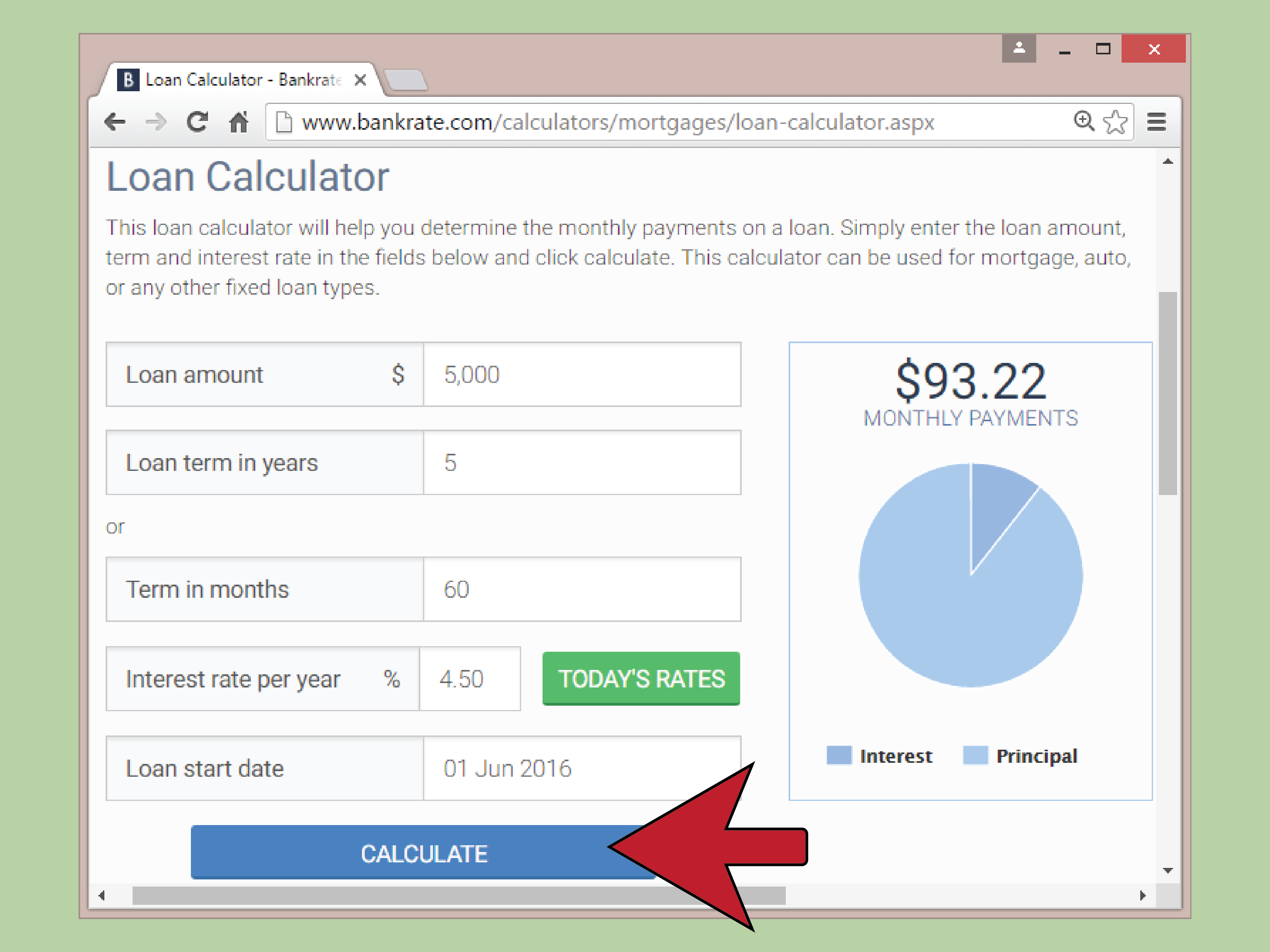
An auto loan calculator can help you test different scenarios before you apply for financing. Start with a realistic estimate of the out-the-door price, then adjust the down payment, APR, and loan term.
Try changing one variable at a time:
- Increase the down payment by $1,000
- Compare a 60-month term with a 72-month term
- Test a lower APR from a credit union or bank
- Remove dealer add-ons from the amount financed
- Use a lower purchase price to see how much vehicle fits your budget
Auto loan calculators from consumer-finance and car-shopping organizations commonly include variables such as vehicle price, down payment, trade-in value, APR, taxes, fees, and loan term because each one can affect the final payment.
How Much Car Payment Can You Afford?
Your lender may approve a payment amount that is much higher than what feels comfortable in real life. Approval is not the same thing as affordability.
When evaluating a car payment, include more than the loan. Budget for insurance, fuel or charging, maintenance, repairs, parking, tolls, and registration costs. Some consumer-finance guidance suggests keeping total transportation expenses within a manageable share of take-home pay, but the correct number depends on your broader expenses, savings goals, debt obligations, and job stability.
A practical approach is to calculate what remains after housing, food, health costs, savings, minimum debt payments, and regular household expenses. Then decide whether the car payment still leaves room for surprises. Because surprise expenses are not rare. They are just very punctual.
Practical Experiences: Lessons From Calculating Auto Loan Payments
People often begin car shopping by asking, “What monthly payment can I get?” That question is understandable, but it can lead to expensive decisions. A better starting question is, “What is the total cost of this vehicle over the next several years?”
One common experience is discovering that a vehicle feels affordable only after the loan term gets stretched. A buyer may see a 48-month payment and decide it is too high. Then the salesperson extends the term to 72 or 84 months, and suddenly the payment appears manageable. The problem is that the car did not become cheaper. The debt simply became longer.
Another lesson is that the purchase price is only the opening scene. Buyers often focus on negotiating the price of the vehicle, then overlook taxes, documentation fees, protection packages, maintenance plans, and financing charges. By the time the contract is complete, the amount financed can be thousands of dollars higher than expected.
Trade-ins can also create confusion. A dealer may offer a generous-looking trade-in number, but that figure should always be compared with the remaining loan payoff. A $15,000 trade-in is not truly worth $15,000 to you if you still owe $13,000 on it. Your real equity is $2,000.
Credit can make a surprisingly large difference, too. Many buyers concentrate on the vehicle model, color, trim, and warranty package but spend little time preparing their credit profile. Yet even a modest APR reduction can save hundreds or thousands of dollars over the loan term. Checking your credit report, correcting errors, lowering revolving balances, and comparing lender offers can be just as valuable as negotiating a lower vehicle price.
It is also wise to separate the car purchase from the financing conversation. First, negotiate the vehicle’s out-the-door price. Then compare financing offers. When everything is discussed at once, it becomes easier for a dealer to move numbers around: raise the vehicle price, extend the loan term, adjust the trade-in allowance, and present a payment that still looks familiar.
Finally, leave room in your budget after buying the vehicle. A car payment may fit nicely on paper, but insurance renewals, tires, maintenance, repairs, parking, and fuel do not care whether your spreadsheet was feeling optimistic that day. The best auto loan is not simply the one with the lowest monthly payment. It is the loan that lets you enjoy the car without turning every unexpected expense into a financial jump scare.
Conclusion
Learning how to calculate auto loan payments puts you back in control of the car-buying process. Start with the out-the-door price, calculate the amount financed, compare APRs, test multiple loan terms, and look closely at the total amount you will repay.
A lower monthly payment can be useful, but it should never be the only thing you compare. The smartest deal is usually the one that balances a manageable payment, a reasonable loan term, a competitive APR, and a total cost that does not make future-you question every decision made in the finance office.