Debt is not usually the word that makes SaaS founders leap out of bed with jazz hands. Equity rounds get the champagne. Product launches get the LinkedIn victory lap. Debt gets a spreadsheet, a nervous CFO, and someone whispering, “What about covenants?” But when used wisely, debt can be one of the most powerful tools a software-as-a-service company has to increase enterprise value, preserve ownership, extend runway, and walk into its next financing or exit conversation looking less like a desperate raccoon in a dumpster fire and more like a disciplined, high-quality business.
The key phrase is used wisely. Debt can maximize value when it funds predictable growth, supports efficient customer acquisition, strengthens the balance sheet, and avoids unnecessary dilution. It can also destroy value when a company borrows to cover weak retention, bloated spending, or a go-to-market engine that eats cash like it has been personally wronged by the bank account.
For SaaS companies, debt is especially interesting because recurring revenue creates visibility. Lenders like visibility. Investors like visibility. Founders like visibility too, mostly because surprise cash crunches are bad for sleep, hairlines, and board meetings. With annual recurring revenue, monthly recurring revenue, retention metrics, customer contracts, gross margin, and CAC payback data, SaaS businesses can show lenders a clearer picture of future cash flow than many traditional businesses can.
Why Debt Can Increase SaaS Company Value
At its simplest, debt helps a SaaS company create value when the return on borrowed capital is higher than the cost of that capital. If a company borrows $2 million and uses it to acquire customers with strong retention, healthy gross margins, and short CAC payback, that debt can produce far more value than it costs. If the same company uses the $2 million to hire randomly, sponsor three conferences nobody attends, and redesign the logo for the eighth time, then the lender has financed a very expensive mood board.
SaaS valuation is often tied to revenue quality, growth rate, retention, margins, and capital efficiency. A company growing efficiently at 30% with improving margins may be more attractive than a company growing 60% while burning cash without control. Debt can help push the company toward the first profile when it is used to invest in repeatable growth channels, customer success, product expansion, and operational discipline.
Debt Preserves Founder and Investor Ownership
The most obvious advantage of debt is that it is typically less dilutive than equity. In an equity round, founders sell a portion of the company. In a debt facility, the company borrows money and repays it with interest, sometimes with warrants or fees attached. Those warrants can still create dilution, but usually far less than a priced equity round.
Imagine a SaaS company with $6 million in ARR, strong retention, and a valuation expectation of 6x ARR, or $36 million. If the company raises $6 million in equity at that valuation, existing shareholders may give up a meaningful stake. If the same company can responsibly borrow $2 million to $3 million and use it to reach $9 million or $10 million ARR before raising equity, the next round may happen at a higher valuation and with less dilution. Debt becomes a bridge to a better negotiating position.
Debt Can Extend Runway Without Signaling Panic
Runway is not just about survival. It is negotiation power. A SaaS company with three months of cash left is not negotiating; it is speed dating capital providers while the building is on fire. A company with 18 to 24 months of runway can choose better timing, better partners, and better terms.
Debt can extend runway when the business has credible revenue, manageable burn, and a clear plan. Venture debt, recurring revenue credit lines, and revenue-based financing can all provide breathing room. The best use is not to postpone hard decisions. The best use is to give a healthy company enough oxygen to hit milestones that change its valuation story.
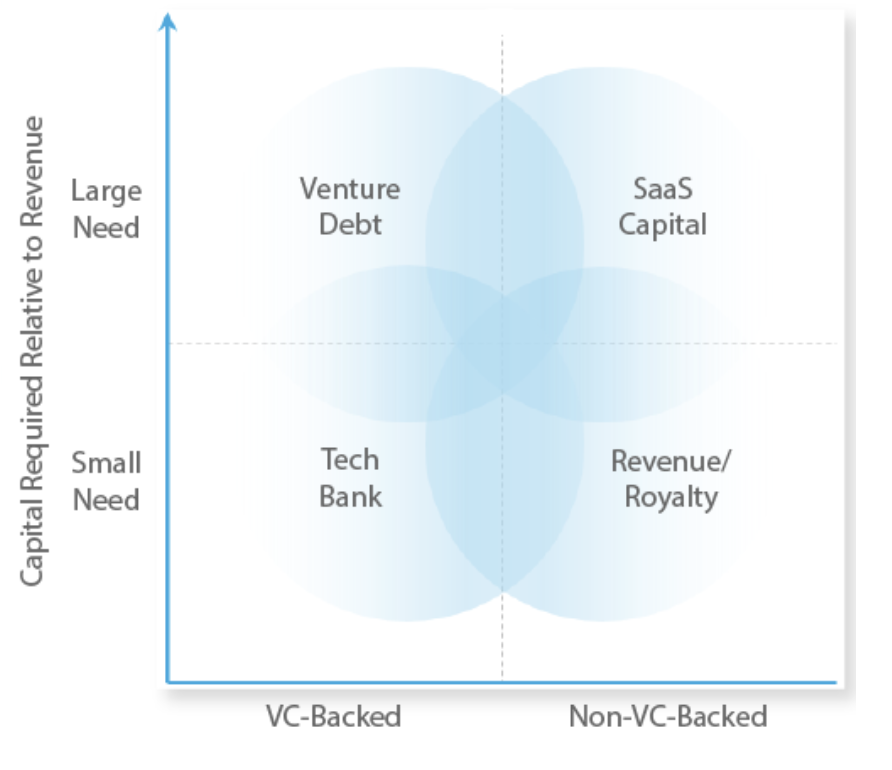
The Main Types of Debt Available to SaaS Companies
Not all debt is the same. Some debt behaves like a flexible tool. Some behaves like a treadmill with legal documents. SaaS founders should understand the major options before signing anything more binding than a coffee shop loyalty card.
Venture Debt
Venture debt is commonly used by venture-backed SaaS companies that have raised institutional equity. It usually comes from banks or specialized venture lenders and is often designed to complement an equity round. The lender is not betting only on current profitability; it is also betting on investor backing, growth potential, and the company’s ability to raise future capital.
Venture debt can be useful after an equity raise because the company is stronger, cash is fresh, and the lender has more confidence. It can extend runway, support hiring, fund product development, or provide insurance against slower fundraising markets. However, it may include covenants, warrants, minimum cash requirements, reporting obligations, and restrictions on additional debt.
ARR-Based or MRR-Based Credit Facilities
Recurring revenue credit facilities are built around the subscription nature of SaaS. Instead of lending primarily against hard assets, lenders evaluate annual recurring revenue, monthly recurring revenue, churn, retention, customer concentration, growth rate, and gross margin. This structure can work well for B2B SaaS companies with predictable revenue and solid customer contracts.
These facilities are often more flexible than a traditional term loan. A company may draw capital as needed instead of taking the full amount on day one. That matters because paying interest on unused money is nobody’s favorite party trick. An ARR-based line can help fund sales capacity, onboarding, implementation, or expansion into a proven market.
Revenue-Based Financing
Revenue-based financing allows a SaaS company to receive capital and repay it as a percentage of revenue until a repayment cap is reached. This can be attractive for bootstrapped or lightly funded SaaS companies that have recurring revenue but do not want to sell equity.
The benefit is flexibility: payments can rise and fall with revenue. The risk is that repayment comes out of cash flow and can reduce the money available for payroll, infrastructure, support, and growth. Revenue-based financing works best when gross margins are strong and customer acquisition is predictable. If margins are thin or churn is high, repayments can become a monthly reminder that optimism is not a financial model.
Traditional Bank Loans and Lines of Credit
Traditional bank debt may be available to more mature SaaS companies with profitability, cash reserves, strong financial controls, and stable customer bases. These loans may offer lower interest rates, but they can also require stronger balance sheets and stricter covenants.
For a SaaS company approaching profitability or already generating positive EBITDA, a bank line can be an efficient way to manage working capital, annual contract timing, receivables, or seasonal cash swings. The company should still avoid borrowing against overly optimistic forecasts. Banks appreciate confidence. They prefer math.
When Debt Makes Sense for a SaaS Company
Debt should not be used because the founder is allergic to dilution. It should be used because the company has a clear, measurable, high-confidence plan to turn borrowed dollars into company value.
The Company Has Product-Market Fit
Debt works best after product-market fit. That means customers are buying, staying, expanding, and recommending the product. The company understands who its best customers are, how much they cost to acquire, how long they stay, and what they are worth over time.
Borrowing before product-market fit can be dangerous because the company is still experimenting. Experiments are necessary, but they are not always debt-friendly. Debt has a repayment schedule. Product discovery has plot twists.
CAC Payback Is Reasonable
Customer acquisition cost payback is one of the most important SaaS finance metrics. It shows how long it takes to recover the cost of acquiring a customer. If a company spends $10,000 to acquire a customer and earns back that amount in gross profit within 12 to 18 months, debt may help accelerate growth. If payback takes 36 months or more, borrowing to acquire customers can create cash pressure.
Debt-funded growth should focus on channels where payback is already proven. For example, if outbound sales to mid-market healthcare companies consistently produces $40,000 annual contracts with strong retention, debt can help hire more reps or fund implementation capacity. But if paid ads are producing low-quality trials and customers churn after two months, debt will not fix the funnel. It will simply make the bad funnel louder.
Retention Is Strong
Lenders and investors care deeply about retention because churn weakens the value of recurring revenue. A SaaS company with high gross retention and net revenue retention above 100% has a stronger case for debt. It shows that customers not only stay, but may expand over time.
Debt used to acquire customers who stay and grow can compound value. Debt used to replace customers who keep leaving is like pouring water into a bucket while refusing to discuss the large raccoon-sized hole in the bottom.
The Company Has Clean Financial Reporting
Debt requires discipline. SaaS companies should have reliable financial statements, clear ARR definitions, cohort reporting, churn analysis, customer concentration data, cash forecasts, and board-level reporting. Lenders will ask for numbers, and “our spreadsheet wizard left last month” is not a strategy.
Clean reporting also improves valuation. Buyers, investors, and lenders all reward confidence. If your revenue recognition, bookings, billings, deferred revenue, and ARR waterfall are easy to understand, you reduce perceived risk. Lower perceived risk can support better financing terms and stronger valuation outcomes.
How to Use Debt to Maximize SaaS Value
Debt should be tied to value-creating milestones. The goal is not to borrow because money is available. The goal is to borrow because the capital helps the company become more valuable than it would have been otherwise.
1. Use Debt to Reach a Better Valuation Milestone
SaaS valuations often improve when companies pass important ARR thresholds. A company at $2 million ARR may be seen as promising but early. A company at $5 million ARR with strong retention may attract a wider set of investors. A company at $10 million ARR with efficient growth may begin to look attractive to growth equity firms or strategic buyers.
Debt can help bridge the gap between milestones. For example, a SaaS company at $4 million ARR with 110% net revenue retention and a 14-month CAC payback might borrow enough to fund sales hiring and customer onboarding for 12 months. If that plan helps the company reach $7 million ARR while maintaining efficiency, the next equity round or acquisition conversation may happen at a materially higher valuation.
2. Fund Expansion Revenue, Not Just New Logos
Expansion revenue is often more efficient than new customer acquisition. Existing customers already trust the product, understand the workflow, and know where the login button lives. That last part is underrated.
Debt can be especially effective when used to build features, customer success programs, integrations, or account management capacity that increases net revenue retention. If borrowed capital helps the company turn $100 of ARR into $115 or $125 over time through upsells and cross-sells, it can create value with lower risk than pure new-logo acquisition.
3. Strengthen the Balance Sheet Before Fundraising
Investors prefer companies that are not fundraising from weakness. A modest debt facility can improve cash runway and reduce pressure before an equity raise. This does not mean hiding problems. It means giving the company time to demonstrate progress.
For example, a SaaS company may use debt to fund six extra months of runway, during which it improves gross margin, reduces churn, launches an enterprise tier, and signs several larger customers. Those improvements can change the fundraising narrative from “we need money soon” to “we are accelerating a model that is working.” Same company, different posture, much better room temperature in the investor meeting.
4. Replace Dilutive Capital for Predictable Needs
Equity should be reserved for high-risk, high-upside activities: new product lines, major market expansion, category creation, or strategic hiring before revenue proof. Debt is often better for predictable needs: financing annual contract timing, expanding a proven sales motion, funding onboarding capacity, or extending runway after an equity raise.
When SaaS companies use expensive equity to fund predictable short-term cash needs, they may give away ownership unnecessarily. Debt can preserve equity for bigger strategic bets.
5. Improve the Rule of 40 Profile
The Rule of 40 combines revenue growth and profitability margin. A SaaS company growing 30% with a 10% EBITDA margin scores 40. A company growing 60% with a negative 30% margin also scores 30, which may be less attractive despite faster growth. Investors increasingly care about efficient growth, not just growth with confetti cannons.
Debt can help improve a company’s Rule of 40 profile if it funds initiatives that increase revenue without permanently increasing burn. But debt can hurt the profile if interest expense and repayments force reactive cuts or reduce flexibility. The best debt plans show how borrowed capital leads to better growth, better margins, or both.
Common Debt Mistakes SaaS Companies Should Avoid
Debt is not evil. Bad debt decisions are evil. They wear nice shoes and arrive with complicated term sheets.
Borrowing Too Late
The worst time to look for debt is when the company urgently needs it. Lenders can smell panic through a PDF. Companies should explore debt options while they still have runway, strong metrics, and choices. Borrowing from strength usually leads to better terms and fewer restrictions.
Ignoring Covenants
Covenants can include minimum cash balances, revenue targets, liquidity requirements, restrictions on additional debt, or reporting obligations. Founders should understand exactly what happens if the company misses a covenant. A slightly cheaper loan with restrictive covenants may be more expensive than it looks if it limits strategic flexibility.
Using Debt to Hide Weak Unit Economics
Debt should not be a disguise for broken unit economics. If churn is high, CAC payback is slow, gross margin is weak, or customer concentration is dangerous, debt may magnify the problem. Fix the business model first. Then use debt to scale what works.
Borrowing More Than the Business Can Support
A healthy SaaS company should model downside scenarios before taking debt. What happens if new bookings are 25% below plan? What happens if two large customers churn? What happens if the next equity round takes six months longer than expected? If the company can still service debt without panic surgery, the facility may be reasonable. If not, the debt is not leverage; it is a trapdoor.
A Practical Example: Debt Done Right
Consider a B2B SaaS company selling compliance software to mid-market financial firms. It has $5 million in ARR, 82% gross margin, 91% gross revenue retention, 116% net revenue retention, and a 15-month CAC payback. The company is burning $150,000 per month but has 16 months of runway. Its sales team has a repeatable motion, but implementation capacity is slowing growth.
Instead of raising a large equity round immediately, the company secures a $2 million ARR-based credit facility. It draws only $1 million at first. The money funds implementation hires, customer success automation, and two experienced account executives. Within 12 months, ARR grows to $7 million, net revenue retention improves, onboarding time drops, and burn remains controlled.
Now the company can raise equity, pursue a strategic acquisition, or continue operating with more options. Debt increased value because it funded a bottleneck in a proven business. It did not fund vanity growth, vague experiments, or a “brand refresh” involving a mascot named Cloudy McSubscription.
Experience Notes: What Operators Learn When Debt Enters the Room
In practice, the most successful SaaS teams treat debt as an operating discipline, not just a financing event. The moment a company prepares for debt, the finance function usually gets sharper. Forecasts become more realistic. Revenue definitions get cleaned up. Leaders stop treating ARR like a magical number that can be stretched, blended, and seasoned to taste. The company learns to explain bookings, billings, recognized revenue, churn, expansion, contraction, and cash conversion in plain English.
One common lesson is that lenders ask the uncomfortable questions early. They want to know whether revenue is concentrated in a few customers, whether contracts are annual or monthly, whether customers can cancel for convenience, whether implementation revenue is recurring or one-time, and whether the company’s pipeline actually converts. This can feel invasive, but it is useful. A good lender’s diligence process often reveals the same issues a future buyer or growth investor will examine later.
Another lesson is that debt changes behavior. That can be good. Monthly reporting, covenant tracking, and cash forecasting force teams to make decisions with more precision. Marketing cannot simply say, “Pipeline is looking exciting.” It must show conversion rates, payback periods, and revenue quality. Sales cannot celebrate bookings that require heroic implementation work and heavy discounting. Product cannot demand five new teams without explaining how the roadmap supports retention, expansion, or new ARR.
Experienced SaaS operators also learn that the best debt facility is not always the largest one. A lender may offer more capital than the company should responsibly use. Founders love optionality, but too much available debt can tempt teams into sloppy spending. The smarter approach is to size the facility around specific milestones: reaching $10 million ARR, extending runway by nine months, funding a proven sales channel, or reducing customer onboarding delays. Clear purpose beats maximum borrowing capacity.
Debt also teaches humility. Forecasts miss. Deals slip. Procurement departments disappear into mysterious caves. A customer who promised expansion in Q2 may return in Q4 with a new CFO and a passion for budget freezes. Good debt planning assumes delays. It includes downside cases, not just the “everything goes right and the dashboard glows green” version. The companies that handle debt well are not pessimistic; they are professionally paranoid.
Finally, debt can improve exit readiness. Acquirers and later-stage investors like businesses that understand capital allocation. If a SaaS company can show that it borrowed responsibly, invested in high-return activities, managed covenants, improved retention, and expanded ARR without chaotic burn, it sends a strong message: this team knows how to operate. That confidence can support better valuation conversations because buyers are not only buying software. They are buying a machine that turns capital into durable recurring revenue.
Conclusion
Debt can help SaaS companies maximize value, but only when it is matched with strong fundamentals. The best candidates have recurring revenue, healthy gross margins, strong retention, efficient customer acquisition, clean reporting, and a clear plan for turning borrowed capital into measurable growth.
Used well, debt can extend runway, reduce dilution, fund proven growth channels, support expansion revenue, and improve a company’s position before fundraising or exit. Used poorly, it can tighten cash flow, trigger covenants, and force painful decisions at exactly the wrong time. In other words, debt is a power tool. It can build a beautiful house, but you should not wave it around while blindfolded.
For SaaS founders, the smartest approach is simple: borrow from strength, use debt for predictable value creation, model downside scenarios, and keep the company’s long-term valuation story at the center of every financing decision. Debt should not be the hero of the SaaS journey. The product, customers, and team still do the heavy lifting. But when the business model is ready, debt can be the quiet financial lever that helps a good SaaS company become a much more valuable one.