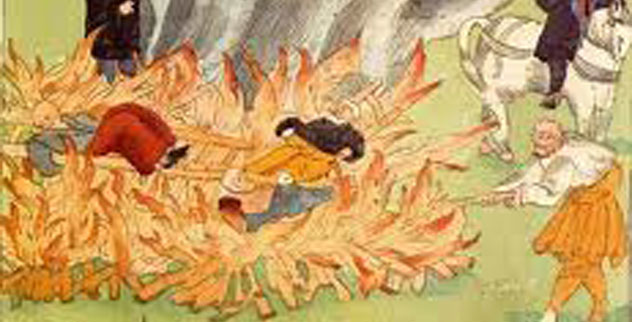
History’s most frightening witch hunts did not begin with bubbling cauldrons, pointy hats, or suspiciously articulate black cats. They began with ordinary communities looking for someone to blame.
A failed harvest, an unexplained illness, a violent storm, or an argument between neighbors could be enough to turn suspicion into an accusation. Once courts, churches, and frightened citizens accepted witchcraft as the explanation, evidence became optional and imagination took over the investigation.
Between roughly 1450 and 1750, about 100,000 people were prosecuted for witchcraft in Europe, with an estimated 40,000 to 60,000 executed. The most intense period stretched from the late sixteenth century into the early seventeenth century, particularly in territories within the Holy Roman Empire. These were not spontaneous bonfires lit by disorganized villagers. Many witch trials were formal legal proceedings conducted by educated officials who believed they were defending society from a genuine supernatural conspiracy.
That combinationfear wearing official robesis what made the most horrifying witch hunts so deadly.
What Turned Suspicion Into a Witch Hunt?
Belief in harmful magic existed in many cultures long before Europe’s major witch-hunting era. People feared curses, poisoned livestock, ruined crops, mysterious infertility, and unexplained death. However, scattered accusations became mass prosecutions only when several dangerous ingredients were mixed together.
Religious Fear and the Devil’s Alleged Conspiracy
By the early modern period, many European theologians no longer viewed witchcraft as a collection of isolated folk practices. They described it as an organized rebellion against Christianity. The imagined witch did not merely spoil milk or irritate the neighbor’s goat. She supposedly signed a pact with Satan, attended secret gatherings, rejected the church, and recruited others.
This theory transformed an unpopular healer or argumentative widow into a member of an invisible criminal network. Once authorities believed a network existed, every accused person was pressured to identify additional members. One accusation could therefore multiply faster than gossip at a family reunion.
War, Disease, Hunger, and Terrible Weather
Witch panics frequently appeared in communities already strained by crop failures, epidemics, political instability, religious conflict, or war. People living without modern medicine or reliable weather forecasting had few satisfying explanations for sudden disasters.
When children became ill, cattle died, or hail destroyed a harvest, blaming an alleged witch gave tragedy a face. Unfortunately, the face usually belonged to a vulnerable neighbor rather than an actual cause.
A Legal System Designed to Produce Confessions
Early modern criminal procedure could make innocence nearly impossible to prove. Authorities searched bodies for supposedly unnatural marks, accepted rumors as supporting evidence, and interpreted nervousness, silence, anger, or confidence as signs of guilt.
Torture made matters worse. A prisoner in unbearable pain might confess to anything, including flying through the night, meeting the Devil, controlling storms, or seeing familiar neighbors at an imaginary gathering. The confession then created new suspects, who were tortured until they supplied still more names.
The system appeared to confirm itself. Accusations produced torture, torture produced confessions, and confessions produced accusations. It was less a search for truth than a bureaucratic machine fueled by terror.
Europe’s Most Horrifying Witch Hunts
The Trier Witch Trials
The witch persecutions centered on Trier, in what is now Germany, became one of Europe’s largest and most destructive witch hunts. Beginning in the late sixteenth century, the panic grew during years of poor weather and agricultural hardship.
Officials claimed that witches were responsible for crop failures and other disasters. Accusations spread across villages and eventually reached respected citizens, government officials, clergy members, and members of wealthy families. Very few defendants escaped once formally accused.
The Trier trials demonstrate an important pattern: witch hunts rarely remained confined to society’s poorest residents. Once the prosecution machine gained momentum, status could provide only temporary protection. A neighbor’s statement, a forced confession, or a political rivalry could pull almost anyone into the investigation.
Würzburg and Bamberg
The German prince-bishoprics of Würzburg and Bamberg experienced devastating witch persecutions during the 1620s and 1630s. These trials unfolded during the Thirty Years’ War, when Central Europe was already suffering from military violence, displacement, disease, hunger, and religious conflict.
Children, laborers, merchants, public officials, and members of prominent families were accused. In Bamberg, authorities maintained a special prison commonly called the “witch house,” where suspects were interrogated and tortured.
The trials became so expansive that no personality type offered safety. Being poor could make someone vulnerable, but wealth could inspire envy. Silence looked secretive. A strong defense looked suspiciously clever. An emotional breakdown suggested guilt, while calmness suggested supernatural assistance. It was the sort of game in which every square on the board said, “Go directly to jail.”
Spain’s Long Regional Persecutions
Witch hunting in Spain varied considerably by region and institution. The Spanish Inquisition is sometimes imagined as the enthusiastic director of every witch trial, but inquisitorial officials could be more skeptical than local secular courts. In several cases, central authorities questioned mass testimony and attempted to restrain local panic.
That did not prevent deadly regional persecutions. In parts of Catalonia, local courts prosecuted alleged witches for generations. Accused women could be suspended by their thumbs or subjected to other forms of torture while court notaries carefully recorded their responses. Regulations supposedly limited torture, but local authorities did not always respect those limits.
The contrast is chilling: officials could produce detailed paperwork, follow recognizable procedures, and still participate in profound injustice. Administrative neatness did not make the suffering less brutal.
The Finnmark Witch Trials
In Norway’s northern Finnmark region, a catastrophic storm on Christmas Eve in 1617 helped create conditions for one of Scandinavia’s deadliest witch panics. Ten boats capsized near Vardø, and 40 men drowned. In communities seeking an explanation for the disaster, witchcraft became the preferred answer.
Across the seventeenth century, 135 people were prosecuted in Finnmark and 91 were executed, most of them women. The population of the region was small, making the concentration of trials especially severe. Finnmark represented only a tiny percentage of Norway’s population but accounted for a striking share of its witchcraft prosecutions.
The trials often expanded when one defendant was forced to name others. Authorities also drew upon stereotypes portraying the distant north as a center of dangerous magic. Geography, prejudice, disaster, and official fear combined into a remarkably lethal formula.
Sweden’s “Great Noise”
Sweden’s most infamous witch panic, known as the Great Noise, began in 1668. Children claimed that witches had transported them to a legendary location called Blockula, where they supposedly attended Satanic gatherings.
Young witnesses delivered dramatic stories involving supernatural journeys, feasts, animals, and demonic ceremonies. Adults treated these tales as evidence, and special commissions investigated the accusations. Children were not merely observers; some became accusers, defendants, or both.
In the village of Torsåker, 71 people were executed in a single day in 1675, most of them women. The panic finally weakened when authorities recognized serious contradictions in the children’s testimony. By then, however, disbelief had arrived rather late to the party.
The Salem Witch Trials: America’s Most Famous Panic
The Salem witch trials began in colonial Massachusetts in 1692 after several young people experienced fits and accused local women of tormenting them through supernatural means. The crisis spread beyond Salem Village into neighboring communities across Essex County.
Religious division, personal disputes, local political conflict, frontier warfare, economic tension, and failed leadership all contributed to the escalation. The trials were not caused by a single spoiled food, mysterious disease, or unusually persuasive teenager. They emerged from a deeply divided society in which supernatural explanations already seemed plausible.
Spectral Evidence and an Invisible Crime
One of Salem’s most dangerous legal practices was the acceptance of spectral evidence. Accusers claimed that a defendant’s spirit or invisible form had attacked them, even when the accused person was physically somewhere else.
That created a defense problem of almost comic impossibility. How could someone prove that an invisible version of herself had not entered another person’s bedroom? The trials turned dreams, visions, gestures, and courtroom reactions into evidence.
English legal precedents helped influence the court’s willingness to consider testimony about supernatural attacks. Yet doubts grew as accusations reached respected members of the community and critics questioned whether the Devil might impersonate an innocent person.
Executions, Imprisonment, and Giles Corey
Nineteen people were hanged during the Salem crisis. Giles Corey, an elderly farmer who refused to enter a plea, was pressed beneath heavy stones until he died. Between 150 and 200 people were imprisoned, including children and elderly residents, and several prisoners died in jail.
Popular artwork frequently shows Salem’s victims being burned, but none of the condemned people in Salem were executed by fire. Hanging was the prescribed method used in colonial New England. Burning was more commonly associated with prosecutions in parts of continental Europe.
By late 1692, official confidence in the proceedings had collapsed. The special court was dissolved, spectral evidence lost credibility, and the remaining cases were handled with greater caution. Later apologies, compensation, legal reversals, memorials, and exonerations acknowledged the injustice, although they could not repair the lives already destroyed.
Witch Hunting Beyond Salem
Salem dominates American memory, but witchcraft accusations appeared in several colonies. Virginia, for example, experienced roughly two dozen known witchcraft proceedings between 1626 and 1730. Many involved defamation suits rather than mass criminal prosecutions.
Grace Sherwood and the Water Test
Grace Sherwood, a farmer and healer in colonial Virginia, was repeatedly accused by neighbors of supernatural wrongdoing. In 1706, officials subjected her to a water test. Sherwood was bound and thrown into the Lynnhaven River. According to the test’s peculiar logic, floating indicated guilt because the water supposedly rejected a witch.
She floated, was jailed, and was ordered to face another proceeding, though historians do not know whether that trial occurred. Sherwood eventually regained her property and lived until about 1740. Virginia formally pardoned her in 2006, three centuries after the ducking and just a touch beyond the ideal customer-service response time.
Virginia’s cases generally produced fewer executions than those in New England. Some defendants were acquitted, while others received fines, public apologies, whippings, or imprisonment. The contrast shows that belief in witchcraft did not automatically create a mass killing. Local laws, judicial restraint, community structure, and the willingness of leaders to resist panic mattered enormously.
Why Women Were Accused More Often
Women made up the majority of people prosecuted for witchcraft in most European regions, although the proportions varied and men were also accused. The stereotype of the witch developed within societies that associated women with moral weakness, disorderly speech, dangerous sexuality, domestic conflict, and susceptibility to demonic influence.
Older women, widows, healers, poor residents, and people dependent on reluctant neighbors could be especially vulnerable. A woman who requested food or assistance might allegedly curse a household after being refused. If illness followed, ordinary guilt and coincidence could be rearranged into a supernatural story.
Not every accused woman was a marginalized herbalist living at the edge of a forest. Some were married, financially secure, socially connected, or respected. Nor should witch trials be reduced to a simple campaign by men against women. Women frequently accused other women, testified against them, searched their bodies, or participated in community disputes.
Still, gender shaped who appeared threatening and how that threat was described. The imagined witch was often a woman who violated expectations: too angry, too independent, too poor, too knowledgeable, too outspoken, or simply too inconvenient.
The Terrifying Logic of Witch-Trial “Evidence”
Witch hunters developed tests that created guilt regardless of the outcome:
- Water tests: Floating could indicate guilt, while sinking created a serious risk of drowning.
- Witch marks: Scars, moles, skin tags, and ordinary anatomical features were interpreted as signs of demonic contact.
- Pricking: Examiners pushed needles into suspected marks, looking for areas that allegedly did not bleed or feel pain.
- Forced watching: Sleep deprivation and prolonged observation could produce confusion, hallucinations, and eventual confession.
- Spectral claims: Dreams and visions allowed accusations that could not be independently tested.
- Torture: Confessions extracted through pain were treated as confirmation rather than evidence of desperation.
These methods reveal the central problem with witch trials: authorities began with the certainty that witches existed and then interpreted every response through that assumption. The accused person was not being investigated to determine guilt. She was being examined to discover which form her presumed guilt had taken.
Witch Hunts Did Not Disappear With the Seventeenth Century
Literal accusations of witchcraft still lead to exclusion, assault, torture, displacement, and murder in some parts of the world. Victims are often women, children, older adults, people with disabilities, or individuals blamed for illness and economic hardship.
Modern cases differ in their cultural and political contexts, so they should not be flattened into a single universal story. Nevertheless, familiar patterns persist: a frightening event, a vulnerable target, a community rumor, an authority unwilling to intervene, and violence presented as protection.
The expression “witch hunt” is also used metaphorically for unfair investigations or public campaigns. It can be a useful description when accusations are unsupported and procedures are designed to guarantee condemnation. However, using the phrase for every criticism, inquiry, or uncomfortable question weakens its meaning. A genuine witch hunt is not merely an investigation someone dislikes. It is a process in which accusation replaces proof and the target has no realistic path to innocence.
Experiencing the History of Horrifying Witch Hunts
Encountering witch-trial history through a textbook is disturbing. Encountering it through original records, memorials, and surviving locations is different. The story stops feeling like a distant Gothic legend and begins to resemble a stack of ordinary administrative decisions made by recognizable human beings.
At Salem’s Witch Trials Memorial, stone benches project from a rough granite wall. Each bears the name of a person executed in 1692. Visitors leave flowers, coins, handwritten notes, and small objects. The design is quiet rather than theatrical. There is no animatronic witch cackling over a plastic cauldron, which is probably for the best.
The silence encourages visitors to consider the victims individually. “Nineteen people were hanged” is a historical fact. Reading nineteen separate names turns the statistic back into human lives. The memorial also incorporates fragments of victims’ final statements, interrupted by the entrance stones as if their words were cut off by the machinery of accusation.
Reading the Testimony
Digital archives provide another intense experience. Original examinations and depositions preserve the language of neighbors describing strange animals, nighttime attacks, damaged livestock, fits, pinching spirits, and invisible threats. At first, the testimony can appear bizarre. After several pages, a more unsettling pattern emerges.
The witnesses were building stories together. One claim supplied vocabulary for the next. Details repeated, expanded, and became accepted conventions. A frightening narrative acquired the appearance of consistency because later witnesses had learned what a convincing witchcraft story was supposed to contain.
The court records also reveal how ordinary the participants sounded. They discussed property, illness, quarrels, church attendance, household work, and neighborhood reputations. There is no clean boundary separating a rational world from a superstitious one. People moved from daily chores to supernatural allegations within the same testimony.
That normality is more frightening than any horror-movie version of Salem. Monsters would be easier to dismiss. The records instead show anxious families, respected magistrates, ministers, children, farmers, and neighbors persuading one another that cruelty was necessary.
Standing Near the Surviving Places
The seventeenth-century house associated with Salem judge Jonathan Corwin survives in the modern city and is commonly known as the Witch House. Its dark timber exterior has become a visual symbol of the trials. Yet the building’s importance lies less in its spooky appearance than in its connection to the legal authority that made prosecution possible.
Walking through such a place can change the questions visitors ask. Instead of wondering whether people genuinely believed in witches, it becomes more useful to ask how belief became policy. Who benefited from prosecution? Who objected? Why were doubts ignored? At what point could a magistrate, minister, juror, or neighbor have interrupted the process?
In Vardø, Norway, the Steilneset Memorial commemorates the 91 people executed during the Finnmark trials. The landscape is beautiful, exposed, and severe. Knowing that storms, isolation, and beliefs about the dangerous north helped shape the panic gives the setting emotional weight. The environment does not explain the executions, but it helps visitors understand how fear could be attached to place.
The Most Uncomfortable Experience
The hardest lesson is recognizing behaviors that have not vanished. Modern people may reject spectral evidence, yet rumors still become “common knowledge.” Repetition still masquerades as confirmation. Groups still reward dramatic accusations. Authorities still protect institutions by sacrificing people with less power.
A meaningful encounter with witch-hunt history therefore involves more than feeling sorry for the dead. It requires noticing the small decisions that allowed persecution to grow: repeating an unverified story, treating suspicion as proof, demanding confession rather than evidence, or remaining silent because another person has become the target.
Visitors often leave memorials asking, “How could they have believed this?” A better and more difficult question is, “What do we believe when fear makes doubt feel disloyal?”
Conclusion: The Real Horror Was Human
The most horrifying witch hunts were not frightening because supernatural witches secretly controlled storms or flew to demonic meetings. They were frightening because communities constructed legal systems in which imaginary crimes produced real prisons, real torture, and real deaths.
Witch trials flourished when uncertainty became intolerable, leaders encouraged fear, institutions rewarded accusations, and vulnerable people were treated as convenient explanations for complex problems. They declined when courts demanded stronger evidence, central authorities restricted torture, skeptical voices gained influence, and officials accepted that unexplained suffering was not proof of supernatural sabotage.
The history remains relevant because the machinery of persecution does not require a belief in magic. It requires only fear, certainty, an expandable enemy, and a process that makes acquittal impossible. Remove the broomsticks and the Devil’s book, and the pattern can still look disturbingly familiar.