Some posts ask for opinions. Some ask for stories. And then there is the internet’s favorite little chaos machine: “Would you rather?” One tiny question, two ridiculous choices, and suddenly strangers are writing mini essays about whether they would rather fight one horse-sized duck or one hundred duck-sized horses. Civilization may never recover, but the comments section will be thriving.
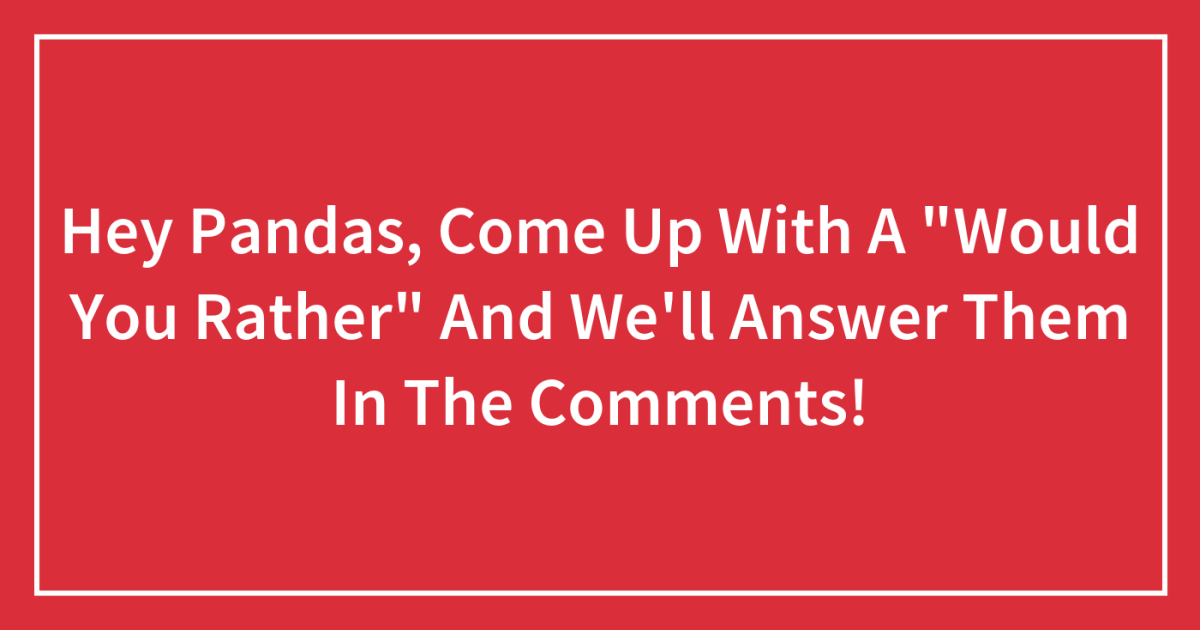
That is exactly why the Hey Pandas, Come Up With A “Would You Rather” And We’ll Answer Them In The Comments! format works so well. It is fast, playful, easy to join, and weirdly revealing. People do not need a long backstory, a PhD, or a ring light. They just need an opinion and the courage to defend it. One person picks “live without music,” another chooses “live without movies,” and suddenly a full debate erupts like it is a congressional hearing hosted by popcorn.
This is more than a throwaway game. A strong would you rather question sparks curiosity, invites personality, and turns passive readers into active participants. It works in comment threads, classrooms, offices, family group chats, road trips, parties, and those awkward moments when everyone is pretending not to look at their phones while definitely looking at their phones.
In this guide, we are diving into why this kind of prompt is so addictive, how to write better ones, what makes people want to answer in the comments, and how to keep the whole thing fun instead of painfully forced. Along the way, you will also get a stack of examples you can steal, remix, and unleash on the internet like a raccoon with Wi-Fi.
Why “Would You Rather” Questions Work So Ridiculously Well
The magic is in the structure. A good would you rather game gives people only two options, which means there is no pressure to come up with a perfect answer from scratch. At the same time, the choices are just open-ended enough to make people explain themselves. That sweet spot matters. If a question is too broad, people scroll past it. If it is too simple, they answer with one word and vanish like a magician who only knows one trick.
“Would you rather” prompts land right in the middle. They are low-pressure but still personal. They are simple but not boring. They invite fast reactions, then quietly tempt people into elaborating. That is why one question can produce jokes, confessions, debates, and surprisingly deep self-analysis in the same comment thread. One minute you are choosing between teleportation and flight. The next minute you are writing 120 words about why airports have emotionally damaged you.
These prompts also create instant equality. Everyone can play. You do not need expert knowledge to answer whether you would rather always be 10 minutes early or 20 minutes late. You just need a functioning brain and perhaps some unresolved issues with time management. That accessibility is a big reason these questions are gold for online communities. They lower the barrier to participation while still giving people room to show humor, values, and personality.
Even better, they generate momentum. One answer inspires another. Someone reads a prompt, answers it, then immediately wants to post their own. The thread starts feeding itself. That is the dream for any comment-driven post: not just attention, but interaction that keeps going after the original question has been asked.
What Makes a Great “Would You Rather” Question?
Not every prompt deserves a standing ovation. Some are brilliant. Some are forgettable. Some make people stare at the screen like, “Why are both of these options bad, and who hurt the author?” If you want better comments, better laughs, and better shareability, the quality of the question matters.
1. Both options should be tempting
The best prompts make people hesitate. If one option is obviously better, the game dies instantly. “Would you rather have a free vacation or stub your toe every day?” is not a question. It is a cry for help. A stronger prompt makes both sides appealing for different reasons. That tension creates discussion.
2. Keep the stakes playful
People love a little drama, but not every comment thread needs to feel like a moral philosophy exam. Light tension works beautifully: comfort versus adventure, fame versus privacy, beach versus mountains, pets versus plants, pancakes versus waffles. The goal is to get people talking, not send them into an existential spiral before lunch.
3. Make it visual
The most memorable prompts paint a picture. “Would you rather live in a treehouse mansion or a luxury underground bunker?” works because people can immediately imagine both options. The more visual the setup, the faster people engage.
4. Let personality leak through
Great conversation starters do more than entertain. They reveal how someone thinks. A person who chooses “read minds” over “be invisible” is not just picking a superpower. They are telling you something about curiosity, trust, and maybe a suspicious level of nosiness.
5. Avoid questions that are too invasive
Online comment threads work best when people feel invited, not cornered. Keep things funny, clever, imaginative, or mildly revealing. A question can be thoughtful without becoming uncomfortable. That difference matters if you want comments, not crickets.
6. Use specificity instead of vagueness
“Would you rather travel or stay home?” is serviceable. “Would you rather spend a month backpacking through Italy or have a dream staycation with unlimited food delivery and zero responsibilities?” is stronger. Specificity adds flavor. Bland prompts get bland responses.
25 “Would You Rather” Prompts Worth Answering in the Comments
Here is the fun part. These prompts are designed for engagement, humor, and personality. Some are silly, some are revealing, and a few are guaranteed to start a debate that could outlive civilization.
- Would you rather always have to sing your thoughts or dance your feelings?
Excellent for comment threads because everyone immediately imagines the social consequences. - Would you rather have unlimited free coffee for life or unlimited free tacos for life?
Food questions are internet catnip. Expect passionate arguments and at least one person declaring coffee a personality trait. - Would you rather be able to time travel to the past once a year or the future once a year?
This one opens the door to humor, regret, curiosity, and somebody trying to win the lottery. - Would you rather live in a giant library or a giant movie theater?
Quiet introverts and loud movie buffs can battle it out respectfully, hopefully. - Would you rather lose your phone for a week or your wallet for a day?
Modern inconvenience is always relatable. - Would you rather have a personal chef or a personal house cleaner?
This question reveals priorities faster than a tax return. - Would you rather never wait in traffic again or never wait in line again?
Simple, relatable, and shockingly divisive. - Would you rather explore the deepest ocean or the farthest reaches of space?
A classic for a reason. It makes people choose between two huge forms of mystery. - Would you rather have the perfect memory or the ability to forget anything embarrassing?
Funny, painful, and deeply human. - Would you rather always be overdressed or always be underdressed?
Social anxiety joins the chat. - Would you rather only listen to one song for a month or only eat one meal for a month?
Ideal for dramatic people, and the internet has many. - Would you rather be famous but constantly misunderstood or unknown but deeply appreciated by the people in your life?
This one can actually produce thoughtful, meaningful comments. - Would you rather have a pet dragon or a pet dolphin?
Logic is optional. Fun is not. - Would you rather have a four-day weekend every week or two long vacations every year?
Comment section productivity drops to zero immediately. - Would you rather be able to speak every language or play every instrument?
Talented people will suffer beautifully deciding this. - Would you rather live where it is always fall or always spring?
Cozy people versus flower people. Pick your side. - Would you rather know how every story ends or never know any spoilers again?
Perfect for readers, streamers, and spoiler-hating goblins. - Would you rather have free flights forever or free hotel stays forever?
Travel lovers will write paragraphs. They cannot help themselves. - Would you rather be hilariously funny or unbelievably persuasive?
One builds a party. The other might accidentally build a cult. - Would you rather do laundry forever or wash dishes forever?
Domestic warfare, but classy. - Would you rather meet your future self or your younger self?
A strong prompt when you want comments with actual emotion. - Would you rather have a house with secret passageways or a house with a rooftop garden?
Whimsy sells. - Would you rather always get the perfect parking spot or never have to pay for snacks again?
Small victories are weirdly powerful. - Would you rather be able to pause time or replay one moment every day?
This one gets creative answers fast. - Would you rather spend one year offline or one year without watching TV and movies?
Nothing wakes up a comment section like a modern lifestyle dilemma.
How to Turn a Simple Prompt Into a Comment Magnet
A lot of people think the question alone does all the work. Not quite. The framing matters almost as much as the prompt itself. If you want people to answer in the comments, invite them like a human being, not like a dull robot with a clipboard.
Instead of posting only the question, set the tone. A line like, “No fence-sitting allowed. Pick one and defend your answer in the comments.” adds energy. So does playful language such as, “Your answer says more about you than your horoscope ever could.” A little humor lowers the pressure and makes people more likely to join in.
You can also improve engagement by giving examples. If you post, “Would you rather have a personal chef or a personal driver? I’m picking chef because I am tired of pretending cereal is dinner,” you signal that funny explanations are welcome. That makes the thread feel alive instead of formal.
Follow-up matters too. The comments section is not a museum. If someone answers, respond. Ask why. Tease their logic a little. Celebrate a creative answer. A thread feels more active when people know they are not tossing their opinions into a digital void.
And here is a quiet superpower: ask prompts that are easy to answer but fun to expand on. That is the sweet spot for comment engagement. You want people to think, “I can answer this in five seconds,” and then accidentally spend five minutes reading everyone else’s responses.
Mistakes That Kill the Fun
Even a playful format can flop if it is handled badly. The first mistake is making one answer obviously superior. People do not want a fake choice. They want a dilemma.
The second mistake is making the question too dark, too personal, or too uncomfortable for a casual public thread. There is a big difference between thought-provoking and mood-destroying. Keep the room breathable.
The third mistake is asking bland questions that have no image, no tension, and no personality. If the prompt sounds like it was assembled in a conference room by exhausted interns, people will scroll past it at the speed of light.
The fourth mistake is forgetting the comments are the real event. The question starts the party, but the answers are where the entertainment lives. If you want your post to perform, build for discussion, not just for a quick tap on the like button.
Why This Format Is Perfect for the “Hey Pandas” Style
The phrase “Hey Pandas” already feels friendly, casual, and community-driven. It sounds like someone walking into a room full of internet friends with a grin and a ridiculous question. That tone is exactly what would you rather questions need.
This style works because it does not pretend to be serious content while still creating real interaction. It blends humor with curiosity. It invites people to perform a little, reveal a little, and laugh at each other in a low-stakes way. That balance is hard to fake and easy to enjoy.
It also gives readers ownership. The best version of the format is not just one question from the author. It is a chain reaction. One person posts a prompt, ten people answer, five people add their own, and before long the entire thread has become a crowd-built game. That kind of participation is internet gold.
Experience Section: What Happens When People Actually Play
Here is the funny thing about a “Would You Rather” in the comments post: people never answer as briefly as they think they will. They arrive with confidence, fully intending to type one line, and then suddenly they are explaining their entire emotional history with camping, elevators, pizza toppings, or fictional superpowers. A simple choice somehow becomes a tiny autobiography.
In real comment threads, the first few answers usually set the mood. If the earliest replies are dry, later readers may stay dry too. But if somebody shows up with a dramatic answer like, “I would absolutely choose the rooftop garden because I once tried to keep a cactus alive and lost, so secret tunnels feel safer,” the whole thread loosens up. People see that personality is welcome. They stop trying to sound correct and start trying to sound human.
Another common experience is the rise of the accidental philosopher. Every playful online prompt eventually attracts someone who turns a silly choice into a full argument about values, identity, freedom, or the meaning of happiness. Oddly enough, that is not a bad thing. It gives the thread texture. The best posts let humor and reflection sit at the same table without flipping it over.
There is also always a rebel. You know the one. The question says choose one, and they respond, “Neither. I reject the premise.” This person appears in every community, every time, like a seasonal allergy. Yet even that can be part of the fun if the tone stays playful. A little disagreement creates movement. A lot of agreement creates a quiet room and a weak post.
Family-friendly prompts often create the warmest exchanges because people bring stories with them. Ask whether readers would rather relive one perfect vacation or instantly plan a brand-new adventure, and the comments start filling with memories. Ask whether they would rather have breakfast for every dinner or dessert for every breakfast, and suddenly half the thread is confessing to midnight pancake behavior. The questions may be silly, but the reactions are real.
Workplace or classroom versions create a different kind of energy. In those settings, the game becomes a safe shortcut to rapport. People learn who is practical, who is chaotic, who is deeply competitive, and who should never be trusted with a group playlist. A single prompt can reveal communication style, humor, comfort level, and creativity without making anyone feel put on the spot. That is why the format sticks. It is playful, but it still tells you something.
Online communities, especially comment-heavy ones, thrive when a post gives people an easy entry point and a reason to stay. “Would You Rather” does both. Readers can jump in fast, then linger to compare answers, argue with strangers about waffles, and discover that a shocking number of people would choose teleportation purely to avoid parking lots. Shared nonsense is still a form of connection. In fact, sometimes it is the best one.
The strongest experiences happen when the host joins the game instead of just posting and disappearing. People respond more when they feel there is a real person on the other side reading, laughing, and replying. A quick follow-up like, “Okay, but how are so many of you choosing dishes over laundry? Please explain yourselves,” can wake a thread right back up. It turns a static post into a living conversation.
And that may be the biggest lesson of all: this format works not because the choices are perfect, but because the participation feels easy, social, and a little mischievous. It gives people permission to be witty, opinionated, nostalgic, strategic, or gloriously unserious. In an internet full of polished posts begging to be admired, a goofy question asking to be answered can feel refreshingly alive.
Conclusion
If you want a post that people do not just read but actually touch, answer, and pass around, the Hey Pandas “Would You Rather” format is a smart bet. It is simple, flexible, funny, and highly shareable. The best prompts are specific, balanced, visual, and easy to answer while still tempting people to explain themselves. That is the formula.
So go ahead. Post the question. Pick your favorite dilemma. Invite the internet to reveal whether it would rather live in a library or a movie theater, wash dishes forever or fold laundry for eternity, and eat tacos or drink coffee for the rest of time. The comments may become chaotic. Beautifully, gloriously chaotic. Which, frankly, is exactly the point.