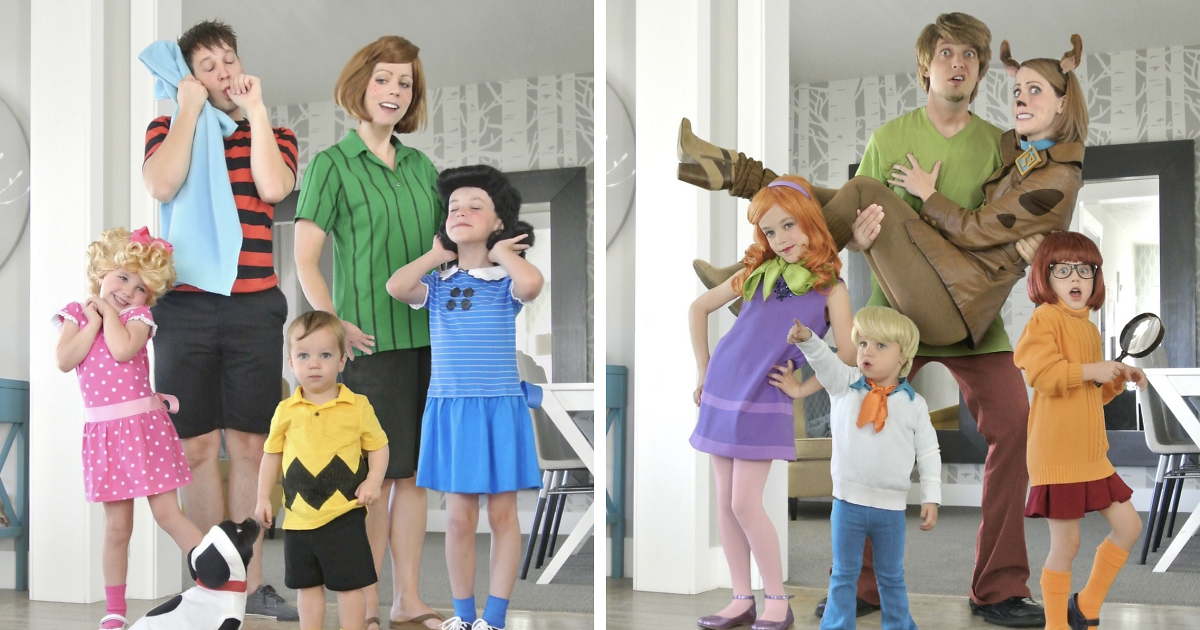
Halloween costumes rarely survive for long. Capes tear, cardboard robot arms collapse, face paint migrates onto the couch, and plastic vampire teeth mysteriously disappear before November. Photographs, however, can preserve the glorious chaos.
An annual Halloween photo tradition turns one evening of costumes and candy into a visual family timeline. Take a similar picture every October, and the collection gradually reveals much more than changing costume preferences. It records growing children, new relationships, beloved pets, different homes, evolving neighborhoods, and the occasional adult who finally admits that wearing an inflatable dinosaur suit was a tactical error.
The eight-picture series below shows how a simple tradition can become a meaningful family archive without requiring professional equipment, elaborate scenery, or the patience of a saint.
Why Halloween Is Perfect for an Annual Photo Tradition
Halloween has always been highly visual. Its modern American form combines older seasonal and religious customs with costumes, neighborhood activities, parties, decorations, storytelling, and trick-or-treating. Historical collections maintained by the Library of Congress, the Smithsonian Institution, and the National Archives include images of costumed children, family celebrations, community parades, decorated homes, and even White House Halloween parties. Those archives show that photographing Halloween is not merely a social-media habit. Americans have been preserving the holiday’s imaginative side in pictures for generations.
Halloween also gives people permission to be ridiculous together. A formal family portrait may create pressure to stand perfectly, smile naturally, and pretend nobody argued in the car. A Halloween portrait has different standards. Crooked wigs, missing gloves, chocolate-covered mouths, and one child refusing to wear the hat are not failures. They are the plot.
That relaxed atmosphere makes an annual Halloween family picture easier to repeat. It can be taken on the porch, beside a familiar tree, in front of the garage, or against a plain wall. The setting does not need to be spectacular. Consistency is what transforms ordinary snapshots into a recognizable photo series.
The Halloween Photo Tradition in 8 Pictures
Picture 1: The Official Costume Lineup
Start with the dependable group portrait. Photograph everyone in full costume from head to toe while the outfits are still intact. Use the same location each year when possible. A front door, brick wall, porch railing, or garden gate can provide a visual reference that makes physical growth and household changes easy to see.
Do not wait for complete cooperation. Take several frames quickly. One can be the smiling picture, another can feature serious character poses, and a third can capture whatever happens after someone yells, “Act scary!” The unplanned frame may become the family favorite.
Costumes have changed dramatically across American history. Early twentieth-century outfits often emphasized disguises and frightening handmade masks, while later decades increasingly reflected movies, television, current events, superheroes, and affordable store-bought characters. An annual costume photograph quietly records that pop-culture history on a household scale.
Picture 2: The Character Portrait
After the group shot, make one close portrait of each person. Ask for an expression or pose that matches the costume rather than requesting a generic smile. A wizard can raise a wand, a detective can inspect a suspicious pumpkin, and a ghost can stare silently into the middle distance as though reconsidering the afterlife.
These individual Halloween photos preserve details that disappear in wider pictures: handmade stitching, dramatic makeup, missing front teeth, tiny props, and proud expressions. They also give shy children more control. Let them decide whether their portrait should be funny, heroic, mysterious, or mildly terrifying.
Picture 3: The Same Pose Every Year
This is the picture that turns a collection of Halloween snapshots into a true tradition. Choose one repeatable pose: sitting on the porch steps, standing beneath a house number, gathering around a carved pumpkin, or holding a small sign displaying the year.
Repetition creates comparison. A toddler who once needed help standing may eventually tower over the same porch railing. A family dog may move from energetic sidekick to gray-faced costume supervisor. Children who once dressed as cartoon characters may later appear as historical figures, elaborate monsters, or teenagers wearing a black shirt and claiming they are “the concept of darkness.”
Family researchers describe rituals as repeated, coordinated, emotionally meaningful activities. The activity does not need to be complicated. Its importance grows through repetition, shared participation, and the meaning a family attaches to it.
Picture 4: The Making-of Moment
Photograph the preparation, not only the finished result. Capture makeup being applied, cardboard being painted, masks being adjusted, and adults searching the house for the accessory that was “definitely right here five minutes ago.”
These behind-the-scenes photographs add context to the polished costume lineup. They show the effort, teamwork, and domestic comedy surrounding the celebration. A homemade costume becomes more meaningful when the archive includes a picture of its construction on the kitchen table.
Keep the camera nearby but avoid directing every moment. Candid Halloween photography works best when people briefly forget they are being photographed. Focus on hands fastening a cape, siblings helping each other, or a parent drawing whiskers on a child who suddenly remembers that faces are extremely ticklish.
Picture 5: The Pumpkin Portrait
Take a separate photo of carved pumpkins, preferably during twilight. The remaining ambient light helps preserve detail in the pumpkin’s exterior while the interior glow remains visible. Photographing in complete darkness can make the carved face bright but leave everything else floating in blackness.
Professional photography guidance from Nikon and Canon recommends stabilizing the camera for darker scenes, using slower shutter speeds for stationary glowing pumpkins, and adding gentle surrounding light when needed. A porch lamp, string lights, or softly diffused illumination can reveal the pumpkin’s shape without overpowering its glow.
Phone users can tap the pumpkin to set focus and exposure, then hold the device steady. On supported phones, a night photography mode may require several seconds to complete the exposure, so leaning against a wall or using a small tripod can improve sharpness.
Picture 6: The Neighborhood Adventure
Include one environmental photograph showing the evening beyond your home. Photograph the group walking toward a decorated house, comparing candy, greeting neighbors, or moving beneath streetlights. This image records the community surrounding the tradition rather than focusing only on costumes.
Trick-or-treating developed in the United States through a mixture of older European customs and evolving American neighborhood celebrations. By the twentieth century, costumed door-to-door visits had become a recognizable part of Halloween culture. A neighborhood photograph therefore captures both a family memory and participation in a much broader tradition.
Nighttime movement can be challenging to photograph. A faster shutter speed helps freeze running children, while a deliberately slower speed can create a ghostly blur when the subject moves through the frame. Adobe and Nikon both describe motion, light trails, and controlled blur as creative tools for spooky seasonal images.
Picture 7: The Candy Inventory
Once everyone returns home, take an overhead picture of the candy spread or a close-up of hands holding favorite treats. This photograph creates a satisfying ending to the evening’s visual story.
It also records small details that change over time: favorite candy brands, decorated buckets, homemade treat bags, handwritten notes from neighbors, and the complex sibling economy in which three fruit chews may or may not equal one miniature chocolate bar.
Photograph the real scene rather than rearranging everything until it resembles an advertisement. Wrinkled costume sleeves, scattered wrappers, tired expressions, and a suspiciously empty candy bucket contribute authenticity.
Picture 8: The End-of-Night Reality
Finish with an honest photograph taken after the excitement has faded. It might show children asleep in costume pieces, boots abandoned near the door, makeup partially removed, or the family gathered on the couch watching a seasonal movie.
This final image often becomes more emotionally valuable than the carefully arranged portrait. It captures the temporary nature of the day. The decorations will come down, the candy will vanish, and the costumes will enter a closet from which some will never return. The photograph preserves the calm after the celebration.
How to Make the Tradition Easy to Repeat
Choose a Simple Anchor
Pick one element that appears every year. It can be a location, pose, bench, pumpkin bucket, handmade sign, or decorative frame. The anchor gives the series visual continuity even when homes, costumes, and participants change.
Take the Essential Picture First
Photograph the main group before anyone begins trick-or-treating. Waiting until later risks missing participants, losing props, smearing makeup, and discovering that someone has traded a costume accessory for candy.
Keep the Session Brief
A family tradition should not feel like a mandatory corporate headshot event. Five relaxed minutes are usually more productive than thirty minutes of repeated instructions. Prepare the location before calling everyone together, check the background for distractions, and take several frames in quick succession.
Let the Tradition Evolve
Do not cancel the annual picture when older children stop trick-or-treating. Let them reinterpret it. Teenagers can choose their own theme, adults can recreate childhood costumes, distant relatives can appear on a tablet screen, and pets can participate when they are comfortable.
Healthy traditions are flexible. The recognizable core remains, but the activity adapts to new schedules, family structures, interests, and abilities. University family resources emphasize that rituals can help establish belonging, identity, predictability, and connection when participants have a voice in shaping them.
Preserving Your Annual Halloween Photo Series
A Halloween photo tradition becomes more valuable when people can actually find the photographs later. Avoid leaving the entire collection buried beneath screenshots, receipts, memes, and seventeen nearly identical pictures of a thumb covering the lens.
Create a folder for each year using a consistent name, such as “Halloween_2026.” Rename important files with basic descriptive information, including the year, names, costume, and location. Metadata and clear filenames help future family members understand what a picture shows instead of confronting a mysterious file called “IMG_8472_final_REALfinal.jpg.”
Keep more than one copy of the collection. Library of Congress guidance recommends organizing important digital photographs, adding descriptions, and maintaining copies on different storage media or in separate locations. The National Archives similarly warns that digital files can be lost and advises families to retain original photographs after digitization.
Consider printing one favorite image each year. A physical album creates a browsable family object that does not require a password, charging cable, or knowledge of which cloud account Uncle Mike used in 2018. For valuable prints, archival guidance recommends photo-safe storage materials and protection from prolonged light exposure, heat, moisture, and damaging adhesives.
Experience Notes: What Families Discover After Years of Halloween Photos
The following experience is an illustrative composite based on the patterns families commonly encounter when they maintain an annual holiday photo ritual.
During the first year, the picture may not feel important. It is simply a quick photograph taken before everyone goes outside. One child is looking at the camera, another is looking at the candy bucket, and an adult is attempting to hide a roll of tape behind a homemade costume. The image gets saved, shared with relatives, and forgotten.
The second year introduces the idea of comparison. Someone notices that the youngest child now reaches the porch railing. The family repeats the location, partly as a joke. The pose is imperfect again, but it begins to look intentional.
By the third or fourth year, the Halloween photo tradition develops its own rules. Everyone knows where to stand. Children begin discussing costumes weeks in advance because they understand that the photograph will become part of the collection. One person suggests recreating an older pose. Another insists that the family dog needs a matching costume, an idea the dog receives with the facial expression of an employee reviewing an unacceptable benefits package.
The practical lessons arrive quickly. The main picture must be taken early, because waiting until after trick-or-treating produces chocolate stains, missing accessories, and expressions usually associated with long airport delays. Batteries need charging. The porch light should be turned on. The photographer should take both horizontal and vertical versions because nobody remembers which one will fit next year’s album layout.
More meaningful changes emerge slowly. The first images focus on costumes. Later, viewers notice the background. A newly painted door appears. A tree grows taller. A stroller disappears from the lineup. A grandparent joins for one year, then becomes especially precious in the pictures that follow. A child once photographed as a tiny firefighter eventually stands in the same spot wearing a graduation sweatshirt or helping a younger sibling adjust a mask.
The tradition also changes the way the family experiences Halloween itself. Costume preparation becomes collaborative because everyone knows the finished creation will be documented. People save small props that would otherwise be discarded. Older children who consider themselves too sophisticated for trick-or-treating may still appear for the annual portrait, sometimes with theatrical reluctance and suspiciously well-planned outfits.
Not every year goes smoothly. Rain may force the photo indoors. A sick family member may join through a video call. Work schedules may require taking the picture on October 30. One year may feature no costumes at all, only tired people holding a sign that says, “We remembered the photo.” These variations do not weaken the tradition. They reveal real life.
After a decade, the collection becomes a compact family history. Looking through it produces laughter about forgotten costume phases, but it can also carry unexpected emotional weight. The viewer sees how quickly children grow, how relationships expand, and how ordinary homes become meaningful stages for repeated experiences.
The most valuable lesson is that a tradition does not become important because it was perfectly planned. It becomes important because people return to it. The camera records costumes, but repetition records commitment. Each year says, in a small and playful way, “We were here together, and this was our Halloween.”
Conclusion: One Night, Eight Pictures, Years of Memories
A successful Halloween photo tradition does not require studio lighting, expensive costumes, or children who suddenly develop flawless posing skills. It needs only a repeatable idea and the willingness to document both the polished moments and the wonderfully messy ones.
Take the official lineup, individual portraits, a repeated pose, behind-the-scenes preparation, glowing pumpkins, neighborhood action, the candy inventory, and the end-of-night reality. Together, those eight pictures tell a complete story. Repeat the sequence each year, organize the files carefully, and print a favorite whenever possible.
Years later, the collection will preserve much more than Halloween outfits. It will show how a family grew, changed, laughed, improvised, and continued gathering in front of the cameraeven when the vampire cape was missing and somebody had already eaten the photography props.