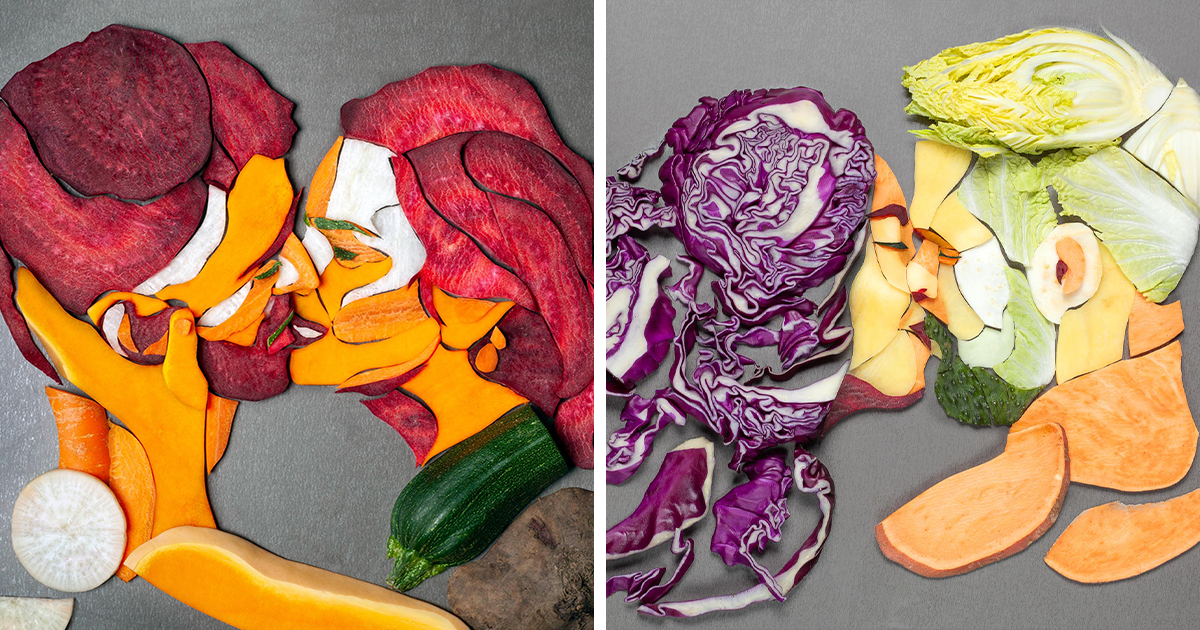
Love is a many-splendored thing. It is also, apparently, a beetroot, a potato, a strip of leek, a slice of pumpkin, and one very emotionally committed cabbage leaf. In my series of vegetable portraits of people kissing, I wanted to explore a simple but oddly powerful idea: what happens when everyday food becomes a love story?
The answer is stranger, sweeter, and more moving than I expected. A kiss is already a tiny sculpture made from timing, trust, closeness, and nerve. Rebuilding that moment from vegetables turns it into something both funny and serious. From far away, you see two people leaning toward each other. Up close, you realize one cheek is a potato, one shadow is red cabbage, and one tender curve might be a shaving of white radish. It is romance, but with a grocery receipt.
This project, often described as a series of “vegetarian love portraits,” began with real couples and real photographs. Some couples shared their own images, while others were photographed specifically for the artwork. From there, each portrait became a puzzle: which vegetable could hold the shape of a jawline, the softness of a mouth, the drama of hair, or the shadow between two faces just before a kiss?
Why Make Portraits of Kissing People Out of Vegetables?
Because love, like food, is one of the basic things that keeps people going. It crosses languages, cultures, ages, identities, and dinner menus. A kiss can be romantic, familial, playful, awkward, brave, or quiet. Vegetables, meanwhile, are humble materials. They sit in bowls, hide in refrigerators, and wait patiently for soup. Bringing the two together creates a funny little collision between the ordinary and the intimate.
There is also a long artistic tradition behind this kind of visual trick. Composite portraitsfaces built from fruits, vegetables, flowers, books, or other objectsare often associated with the Renaissance painter Giuseppe Arcimboldo, whose imaginative heads made from natural and everyday forms still influence artists today. His work proved that a portrait does not need to be made from skin-colored paint to feel human. Sometimes a pear can become a nose, a squash can become a cheek, and a bunch of leaves can suddenly develop personality.
My vegetable kissing portraits continue that playful tradition but move it into a modern, emotional space. Instead of using food only to create a single face, these works build a relationship. The important subject is not just “person one” or “person two.” It is the invisible current between them.
The Creative Process: From Photograph to Edible Portrait
Every portrait started with a reference photo of a couple. That photo gave me the structure: the tilt of the heads, the angle of the shoulders, the place where one face almost disappears behind another. A good kiss portrait depends on small details. Move one line too far, and the kiss becomes a headbutt. Make the mouth too dark, and the romance becomes a dental emergency. Vegetables are not forgiving models.
Before cutting anything, I planned the composition carefully. That part mattered because fresh vegetables change quickly after they are sliced. A beetroot can stain everything like it has strong opinions. A potato can oxidize. A thin piece of radish can curl. A strip of leek can look elegant for ten minutes and then decide to become abstract art without asking permission.
The actual cutting and arranging process often took around five hours for one portrait. Each piece had to be shaped, placed, adjusted, replaced, photographed, and sometimes politely argued with. I had to think like a painter, a collage artist, a food stylist, and a slightly panicked salad chef. When the portrait was finished, I photographed it before the colors faded or the edges dried. After that, the best part: the artwork could be eaten, reused, or returned to everyday life instead of becoming permanent waste.
The Vegetables Became a Color Palette
One of the joys of this project was discovering how expressive vegetables can be. Beetroot gave me deep red shadows and dramatic warmth. Pumpkin and sweet potato created golden skin tones. White radish offered pale highlights. Red cabbage became cool shadows, hair, clothing, or background depth. Leeks and asparagus gave long, elegant lines. Zucchini provided soft green-gray transitions. Potatoes were wonderfully practical, the reliable supporting actors of the vegetable theater.
Using vegetables also made the portraits feel alive. Paint can suggest freshness, but vegetables actually have it. They contain moisture, texture, scent, weight, and fragility. That fragility became part of the meaning. A kiss is temporary. A fresh-cut vegetable portrait is temporary too. You make it, you see it, you photograph it, and then it changes. The clock is always ticking, which gives the whole process a little heartbeat.
10 Vegetable Portraits and What Made Each One Special
1. Gabriele and Gintare
This portrait used potato, beet, cabbage, pumpkin, zucchini, and white radish to create a warm, intimate composition. The contrast between pale vegetables and darker beet tones helped define the faces, while cabbage and zucchini added texture around the figures. It showed how a small number of ingredients can still build a convincing emotional scene.
2. Rolandas and Reinaldas
For this piece, broccoli, red cabbage, red onion, asparagus, leek, potato, celery root, pumpkin, and sweet potato created a richer and more complex arrangement. The variety of greens, purples, oranges, and creams gave the portrait both depth and rhythm. It felt energetic, as if the vegetables were leaning into the kiss along with the couple.
3. Silvestras and Jolita
Beetroot, pumpkin, zucchini, carrot, and white radish formed the core of this portrait. The color choices created a strong visual balance: beetroot for drama, pumpkin and carrot for warmth, radish for light, and zucchini for subtle transition. The result was simple but expressive, proving that a kiss does not need a crowded stage to feel complete.
4. Tamara and Jesse
This portrait brought together leek, asparagus, celery root, beet, potato, sweet potato, pumpkin, white radish, and zucchini. The long green lines helped guide the eye, while the root vegetables created volume in the faces. It felt almost architectural, like the kiss was built from carefully balanced beams, curves, and soft edible shadows.
5. Nina and Viktorija
Leek, Chinese cabbage, beet, sweet potato, potato, celery root, asparagus, white radish, and zucchini gave this image a layered softness. Chinese cabbage is especially useful because its leaves can look delicate and sculptural at the same time. In a portrait of closeness, that kind of texture matters. It can suggest fabric, hair, or the gentle blur of motion.
6. Andrius and Robertas
Broccoli, potato, beet, cabbage, pumpkin, zucchini, and celery root made this portrait earthy and grounded. Broccoli can be tricky because it has such a strong identityno one looks at broccoli and thinks, “Ah yes, the quiet shadow of human romance.” But placed carefully, it becomes texture, weight, and visual noise in the best possible way.
7. Elisabeta and Osvaldas
Sweet potato, Chinese cabbage, red cabbage, cucumber, potato, celery root, and pumpkin created a pleasing mix of warm and cool tones. Cucumber added freshness, while red cabbage offered drama. The portrait showed how color temperature can shape emotion. Warm vegetables brought tenderness; cool vegetables brought contrast and definition.
8. Augustas and Ema
Beet, celery root, cabbage, pumpkin, and potato formed a more restrained palette. This is where the project became less about showing off ingredients and more about control. A limited palette forces every shape to work harder. Each slice must earn its place. No lazy potato allowed.
9. Mother Edita and Daughter Auguste
This piece expanded the idea of kissing beyond romance. Using leek, beet, potato, celery root, pumpkin, and zucchini, it represented affection between mother and daughter. That mattered to the whole series because love is not one narrow category. It can be romantic, familial, protective, tender, silly, and complicated. A kiss can say “I adore you,” “I missed you,” or “Please stop growing up so fast.”
10. Arnas and Tomas
The final portrait closed the series with another celebration of closeness. By the time I reached this piece, the project had become less about proving that vegetables could look like people and more about showing that people could still be recognized through unexpected materials. A true portrait is not just a likeness. It is a feeling that survives translation.
Why the Portraits Work: The Brain Loves a Puzzle
Part of the fun of vegetable portrait art is that the viewer’s brain does half the work. At first, you may see food. Then the shapes snap together and become faces. Then you see the kiss. Then you look again and laugh because the romantic shadow you admired a second ago is absolutely a piece of beet. This back-and-forth creates a satisfying visual puzzle.
That puzzle is also why the portraits feel memorable. They invite viewers to slow down. In a world full of fast images, scrolling thumbs, and photos that disappear after a second, a vegetable portrait asks for attention. You do not just look at it; you inspect it. You wonder how the cheek was made, why the onion works there, and whether the whole thing became dinner afterward.
The Humor Is Part of the Heart
It would be easy to treat a kissing portrait as overly sentimental. Add vegetables, and the mood changes. Suddenly the image has tenderness and a wink. That combination is important. Humor makes the work approachable. It tells viewers, “Yes, this is about love, but nobody here is pretending a cabbage is not a cabbage.”
Food art often works best when it respects both sides of its identity. It should be visually convincing as art, but it should also admit that the material is deliciously absurd. A beetroot can become a shadow, but it remains a beetroot. A potato can become a cheekbone, but it still has potato energy. That honesty keeps the portraits warm instead of pretentious.
Temporary Art, Sustainability, and the Beauty of Not Keeping Everything
One of my favorite things about working with vegetables is that the final object does not need to last forever. Many artworks are designed to be preserved, framed, insured, archived, and guarded from fingerprints. These portraits were different. Their life as physical objects was short, but their meaning was captured through photography.
That temporary nature made the process feel lighter and more responsible. The materials could be eaten or returned to ordinary use. Scraps could become stock, soup, or compost. The project reminded me that creativity does not always require expensive supplies or permanent objects. Sometimes it requires observation, patience, and the courage to look at a celery root and think, “You, my lumpy friend, might be a forehead.”
How to Read a Vegetable Kiss Portrait
When viewing these portraits, start from far away. Let the full image appear first. Notice the couple, the posture, the emotion, and the direction of the kiss. Then move closer and identify the ingredients. This second viewing changes the image. You begin to see the decisions behind it: the beet used for depth, the radish used for light, the cabbage used for motion, the pumpkin used for warmth.
Finally, step back again. The best moment is when the ingredients disappear back into the people. That is the magic trick. The portrait does not work because the vegetables stop being vegetables. It works because they become both things at once.
My Experience Making “10 Vegetable Portraits Of People Kissing That I Made”
Making this series taught me that art materials have personalities. Paint stays where you put it, unless you are unlucky. Vegetables negotiate. A slice of beetroot can bleed into a white radish. A leek can spring back after being flattened. A cabbage leaf can look perfect under the light and then wilt like it just heard bad news. At first, I fought these changes. Later, I learned to use them.
The most difficult part was not cutting the vegetables. It was preserving emotion while changing the language of the image. A photograph of two people kissing contains thousands of subtle signals: the pressure of a hand, the angle of a neck, the softness of closed eyes, the tiny shadow between two faces. When translating that into vegetables, I had to decide which details mattered most. Not everything could be included. The portrait had to be simplified without becoming empty.
I also learned that likeness is less important than gesture. A perfect nose made from potato is impressive, but it means little if the bodies do not feel connected. The strongest portraits were the ones where the heads leaned naturally, where the negative space between the faces felt intentional, and where the colors guided the viewer toward the kiss. The vegetables were the vocabulary, but the gesture was the sentence.
Another surprise was how emotional the process became. These were not anonymous stock-photo kisses. They came from real people, real relationships, and real stories. Before building each portrait, I thought about how the couple met and what kind of energy their photograph carried. Some kisses felt bold. Some felt shy. Some felt playful. Some felt like a private moment accidentally witnessed by a potato.
The kitchen-studio atmosphere was part of the experience too. There is something wonderfully ridiculous about making a serious artwork while surrounded by vegetable peels, cutting boards, knives, towels, and the faint smell of onion. It kept me humble. No matter how poetic the concept became, there was always a stray carrot shaving stuck to something it had no business sticking to.
Time pressure shaped every decision. Once the cutting began, the materials started changing. I could not wander away, make coffee, answer messages, and return three hours later expecting the same portrait. The work demanded attention. In that way, the vegetables behaved like the kiss itself: temporary, vivid, and impossible to pause.
Photographing the finished piece felt like catching a creature before it flew away. The camera transformed the temporary arrangement into a lasting image. Lighting mattered because shiny vegetable surfaces could reflect too much, while pale slices could disappear if the exposure was wrong. The photograph had to honor both the illusion and the ingredients. I wanted viewers to see the kiss first, then the vegetables, then the kiss again.
When each portrait was done, eating or reusing the materials felt like the right ending. It removed the preciousness. The artwork had served its purpose. It had become an image, carried a story, and made people look twice. Then it returned to the world of food. That cycle made the project feel complete rather than wasteful.
What I remember most is the laughter. People reacted with surprise, delight, and sometimes confusion. They would lean in and say, “Wait, is that cabbage?” Yes. Yes, it was. And somehow, it was also love.
Conclusion: Love, Food, and the Art of Looking Twice
“10 Vegetable Portraits Of People Kissing That I Made” is a playful art project, but beneath the humor is a serious belief: love can be found in unexpected forms. It can appear in a photograph, a shared story, a family kiss, a romantic embrace, or a carefully arranged pile of vegetables on a table.
The series celebrates the beauty of temporary materials and the power of observation. It also reminds us that art does not always need rare tools or expensive surfaces. Sometimes it begins with what is already nearby: a pumpkin, a beet, a cabbage leaf, a reference photo, and a little faith that the human heart can recognize itself almost anywhere.
In the end, these portraits are not just about vegetables and kissing. They are about transformation. They turn groceries into gestures, scraps into tenderness, and ordinary food into a visual love letter. Not bad for something that could have been soup.
Note: This HTML article is written for web publication in standard American English, with SEO-friendly headings, natural keyword usage, original phrasing, and no source-link clutter in the body content.