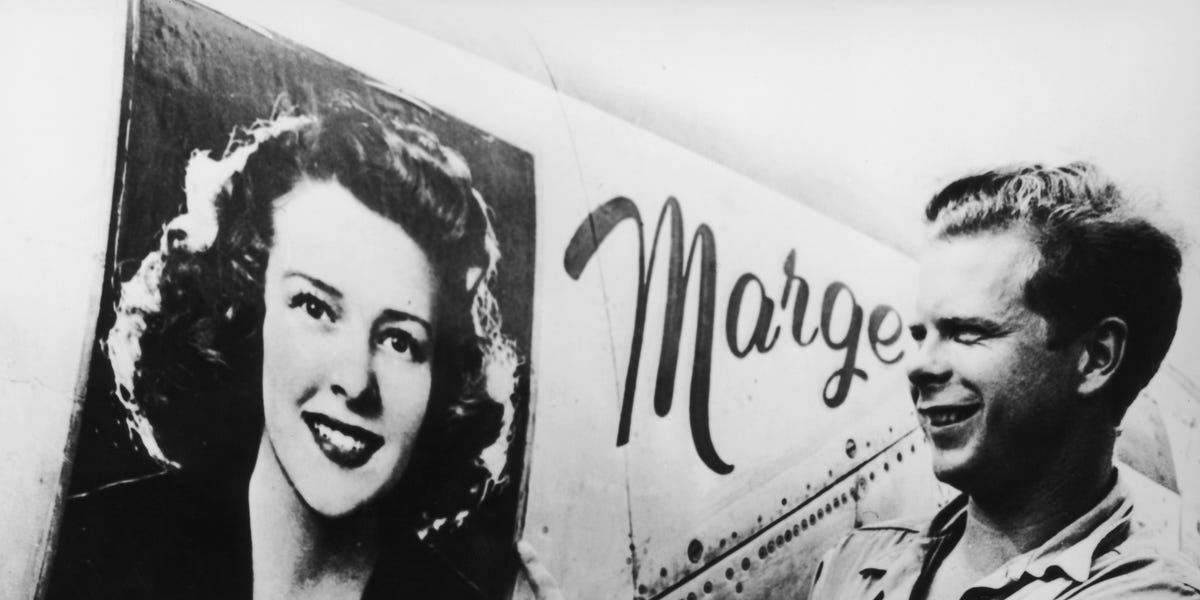
For eight decades, the jungle of Papua New Guinea kept a remarkable World War II secret beneath vines, mud, and trops of a Lockheed P-38 Lightning connected to Major Richard “Dick” Bong, America’s highest-scoring fighter ace. The aircraft was called Marge, after the woman Bong loved, and its nose once carried an enlarged portrait that made the fighter as personal as it was famous.
In May 2024, a small expedition found wreckage from a P-38J, red-painted components, manufacturing details, and the digits “993” on a wingtip. Those numbers matched the end of U.S. Army Air Forces serial number 42-103993. After 80 years, the missing plane of the WWII hero pilot had a location, an identity, and a new chapter.
The Discovery of Richard Bong’s Lost P-38 “Marge”
The search was organized by the Richard I. Bong Veterans Historical Center in Superior, Wisconsin, and Pacific Wrecks, a nonprofit group that documents World War II sites across the Pacific. Expedition leader Justin Taylan had researched the aircraft and its probable crash area for years.
Taylan traveled to Papua New Guinea with Steve Kleiman and Joel Carillet. After reaching Madang and traveling by boat toward the Rai Coast, they met local landowners familiar with aircraft wreckage in the area. The first site they examined belonged to a Japanese aircraft. The next location, deeper in the jungle, was different.
Scattered metal showed the wreck was American. Data plates and parts narrowed it to a P-38J Lightning. The decisive clue appeared on a red-painted wingtip: “993,” matching the last three digits of serial number 42-103993. The aircraft had struck a jungle-covered hillside, leaving both engines embedded in the soil while lighter debris shifted downhill over time. The famous portrait and the word Marge were not found, but the serial and model identifiers established the aircraft’s identity.
Pacific Wrecks conducted a non-invasive survey, documenting rather than stripping the site. That distinction matters. A historic crash site is evidence and cultural heritagenot a free parts counter for someone’s garage. as Richard “Dick” Bong?
Richard Ira Bong was born in Wisconsin in 1920 and entered military aviation before the United States was fully immersed in World War II. He became an exceptionally skilled, aggressive, and occasionally mischievous pilot. His energetic flying attracted attention for reasons that could politely be described as “not entirely listed in the training manual.”
In the Southwest Pacific, Bong became America’s leading fighter ace. Flying P-38 Lightnings, he accumulated 40 confirmed aerial victories, surpassing the 26 credited to World War I ace Eddie Rickenbacker. Bong often closed to short range before firing, a method requiring nerve, judgment, and a complete disregard for comfortable personal space.
He received the Medal of Honor for voluntarily flying dangerous combat missions between October 10 and November 15, 1944, even though he was assigned as a gunnery instructor and was not required to seek combat. During that period, he shot down eight enemy aircraft. General Douglas MacArthur presented the medal in December 1944. o Connected to More Than One Airplane
Some retellings make it sound as though Bong scored all 40 victories in one magical fighter named Marge. The history is more complicated. Wartime pilots flew multiple aircraft, and more than one P-38 carried Marge markings associated with Bong. The newly identified wreck was the first P-38J connected with the name and serial number 42-103993.
That makes the discovery more interesting, not less. The wreck represents a fast-moving combat system involving pilots, mechanics, replacement aircraft, remote airfields, and supply networks operating under extraordinary pressure.
Why the P-38 Lightning Fit the Pacific War
The Lockheed P-38 Lightning had a shape that refused to be boring: two engines, twin tail booms, a central cockpit pod, and concentrated nose-mounted weapons. Its range, speed, heavy firepower, and twin-engine configuration made it valuable across the enormous distances of the Pacific.
P-38 units operated in New Guinea and New Britain, where long flights over mountains, jungle, and ocean punished machines and crews. The fighter could escort bombers, intercept aircraft, attack ground targets, and conduct reconnaissance. Yet it was not flawless. Complex systems, tropical conditions, and mechanical failures could transform a routine assignment into an emergency. Sometimes the enemy was an electrical problem followed by gravity doing its job with irritating consistency. Marge” Crashed in March 1944
Richard Bong was not flying the aircraft when it went down. On March 24, 1944, Second Lieutenant Thomas E. Malone used the P-38J for a weather reconnaissance mission. The fighter developed mechanical and electrical trouble, and Malone bailed out and survived. The airplane continued into the jungle and disappeared from practical reach.
Bong was understandably angry when he learned that his personalized fighter had been lost, though he acknowledged that the airplane had shown electrical problems before the crash. He soon received another P-38 that also became associated with the Marge name and portrait.
Calling the wreck “Bong’s plane” is accurate because it was assigned to him and personalized for him. Saying Bong crashed in it is not. Malone survived the accident, Bong continued flying, and the first Marge remained hidden for the next 80 years. he Jungle Preserved the Mystery
Papua New Guinea was a major battlefield and aviation corridor during World War II. Many wartime crash sites remain undocumented or difficult to reach. Dense vegetation can conceal large wreckage quickly, while heavy rain, corrosion, roots, and shifting soil gradually redistribute debris.
Old reports may identify a broad area rather than a modern coordinate. Witness accounts can contain approximate bearings, outdated place names, or landmarks that no longer exist. “Near the plantation” may sound useful in an archive; in miles of tropical terrain, it resembles directions supplied by a pirate who misplaced the map.
The expedition succeeded because archival research was combined with local knowledge. Historical records suggested the general area, but residents knew where unusual wreckage rested. Technology can narrow a search, but people who live on the land often hold the missing piece.
The Human Story Behind the Name “Marge”
The name came from Marjorie “Marge” Vattendahl, Bong’s girlfriend and later his wife. A wallet-sized photograph of her was enlarged, color-tinted, attached to the aircraft’s nose panel, and protected with varnish. It carried a private reminder of home into a distant war.
Bong and Marge married in February 1945. Their marriage was tragically brief. After returning to the United States, Bong became a test pilot. On August 6, 1945, he died when a P-80 jet he was testing crashed near Burbank, California. He was only 24. His death occurred on the day the atomic bomb was dropped on Hiroshima. fying Marge reconnects several lives: Bong’s combat career, Malone’s survival, Marge Vattendahl’s portrait, the mechanics who kept the fighter airborne, the communities near the crash, and the researchers who refused to let an old report become the final word.
What Happens After a WWII Aircraft Is Found?
Finding a historic aircraft does not automatically mean hauling it out and putting it under museum lights by Tuesday. Land rights, national heritage laws, preservation ethics, environmental conditions, cost, and community wishes all influence what happens next.
Careful documentation may be more responsible than dramatic recovery. Moving fragile wreckage can destroy archaeological context, including the relationship between components, terrain, and impact direction. The Bong Center has also connected Mission: Marge with educational, clean-water, cultural-exchange, and exhibit goals in Papua New Guinea. The wreck exists within living communities, not an empty movie set. his WWII Plane Discovery Matters
The discovery shows how small physical details can settle a large historical question. A few worn digits can identify an aircraft more convincingly than decades of rumor. Red paint can connect corroded metal to wartime photographs. Embedded engines can reveal how a plane met the terrain.
It also proves that World War II remains an active archaeological story. Aircraft, ships, equipment, and human remains are still being located. Families continue to seek answers, while museums and historians continue to revise the record.
Most of all, the find turns a famous statistic into something tangible. Bong’s 40 victories can feel like a number in a book. A broken wingtip in wet jungle soil feels different. It shows that history was made by machines that failed, young people who took risks, loved ones who waited, and communities that inherited the physical remains of a global war.
Field Lessons and Experiences Behind a Jungle Aircraft Search
1. The Search Begins Before Anyone Packs Boots
A jungle expedition may look like machetes and dramatic photographs, but successful searches begin with quiet research. Teams compare aircraft record cards, mission reports, maintenance histories, maps, eyewitness statements, and old photographs. They test competing theories and watch for consistencies such as a serial fragment, painted surface, model-specific component, or reported flight direction.
The experience teaches patience. History rarely provides a clean address. It offers clues created by different people under wartime pressure. The first reward is watching those scattered facts slowly become a probable location.
2. The Jungle Changes Every Assumption
On the ground, distance becomes deceptive. A point that looks close on a digital map may require hours by boat and on foot. Heat, humidity, mud, insects, steep slopes, and sudden rain turn ordinary movement into work. Equipment must stay dry, batteries must be managed, and water must be carried. Even a large aircraft component can vanish beneath leaves and moss.
The practical lesson is humility. The landscape sets the rules. Teams that move carefully, listen to local guides, and adapt to conditions are more likely to reach a site safely and document it properly.
3. Local Knowledge Can Beat Expensive Technology
Satellite imagery, GPS, and archival databases are valuable, but residents may know where old engines, unusual metal, or impact scars have existed for years. In the search for Marge, local landowners helped guide the expedition between known crash sites.
This creates a shared discovery. Researchers bring historical records; communities bring geographic memory. Responsible explorers obtain permission, respect ownership, credit local knowledge, and discuss what preservation will follow.
4. Identification Is Careful Detective Work
The emotional climax may be a few worn digits on corroded metal. First the team identifies an American aircraft, then a P-38, then a P-38J. Finally, “993” aligns the wreck with serial 42-103993. Each step reduces uncertainty.
The team does not declare victory after finding the first shiny object. It photographs details, checks part numbers, compares records, and asks whether another aircraft could fit the evidence. Good field archaeology is detective work conducted while sweating through every available layer of clothing.
5. A Discovery Creates Responsibilities
Finding a WWII aircraft brings excitement and obligations. The site must be protected from looting. Fragile parts should not be moved casually. Laws and customs must be followed, and researchers must consider how much location information to publish.
The deepest experience is emotional. Standing beside an aircraft lost for 80 years compresses time. The machine is damaged but recognizable, silent but full of stories. For descendants, historians, veterans’ groups, and nearby communities, the discovery can become a point of connection rather than merely a headline.
Conclusion
The identification of Richard Bong’s P-38J Marge is a victory for aviation archaeology. A small team, years of research, local guidance, and a few stubborn pieces of metal solved an 80-year mystery in the Papua New Guinea jungle. The find honors Bong, recognizes Thomas Malone as the pilot who survived the crash, and highlights the essential role of local landowners.
It also offers a broader lesson: history does not always vanish. Sometimes it waits beneath roots and rain until people ask the right questions, follow the evidence, and treat the answer with care. The jungle kept Marge hidden for eight decades. It did not erase her story.
Note: The aircraft is accurately described as Richard Bong’s plane because it was assigned to him and carried his personalized Marge artwork. However, Bong was not aboard when it crashed; Second Lieutenant Thomas E. Malone was flying the weather reconnaissance mission and survived by bailing out.