Most narrow city backyards accept their fate quietly. They acquire a barbecue, a patch of exhausted lawn, three plastic chairs, and perhaps a hose that spends its retirement tied in a knot. Earth Inc., a Toronto landscape design firm known for mixing architecture with horticulture, took a less obedient approach.
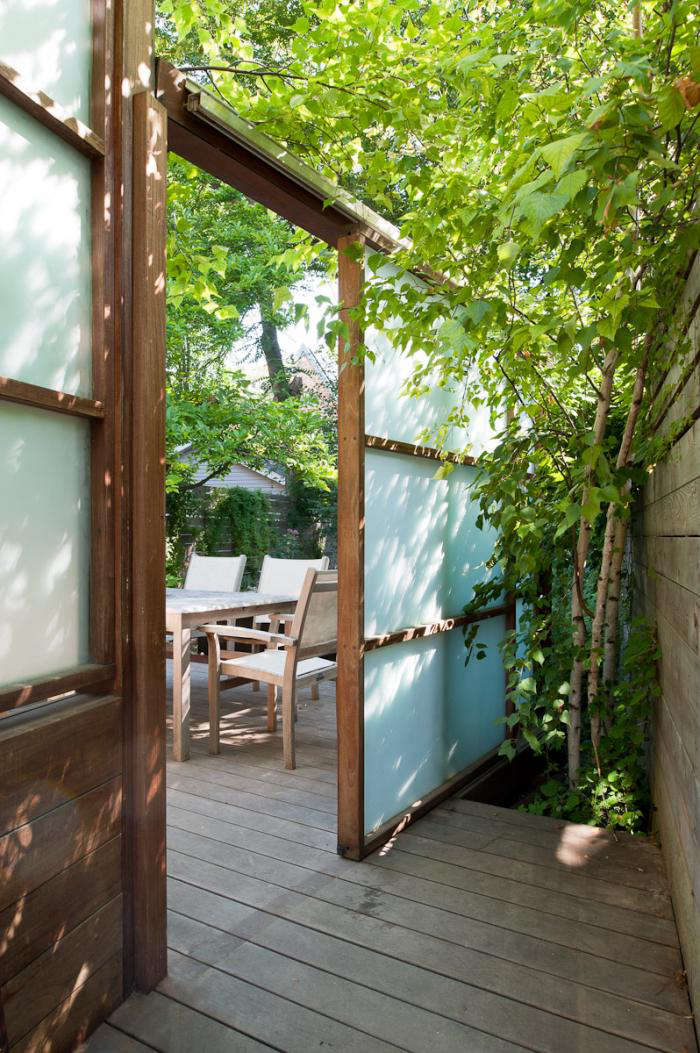
Behind a renovated Victorian home in downtown Toronto, the designers transformed a long, slender construction zone into an unapologetically modern urban garden. The centerpiece is not a lawn, a conventional stone path, or an oversized outdoor kitchen. It is a shallow artificial river running beside a 50-foot industrial steel boardwalk.
The water is only about an inch deep, yet it changes the entire atmosphere of the property. It moves through stones, attracts birds, reflects shifting light, and turns the journey from patio to rear deck into something closer to a woodland walkassuming your woodland happens to have steel grating, poured concrete, and excellent drainage.
This Earth Inc. Toronto garden demonstrates how strong geometry, water, plants, and a touch of controlled unpredictability can make a confined backyard feel mysterious, spacious, and alive.
A Narrow Toronto Backyard With an Unusually Big Idea
The original site measured approximately 18 feet wide and 80 feet deep. A recent renovation had modernized the house but left the backyard looking like a staging area for heavy machinery. Only a small number of plants from the owners’ earlier collection had survived.
Instead of beginning with a list of fashionable materials, landscape designer Kennedy McRae reportedly began by asking how the owners wanted to use the yard. They entertained frequently, but they also wanted a garden that revealed itself gradually. It should not be understandable in one glance.
That request became the guiding principle. The finished landscape contains two primary sitting areas at opposite ends of the property. Between them stretches a linear boardwalk accompanied by a narrow, recirculating stream. Vines soften the fences, shade-tolerant plants fill the ground plane, and the long central route encourages visitors to move through the entire garden.
In other words, Earth Inc. did not attempt to disguise the backyard’s narrow shape. The designers turned that shape into the main event.
How the River Garden Is Organized
The Entertaining Patio
Immediately outside the house, a patio sits several steps below the kitchen. This level change creates a clear transition between indoor and outdoor space while giving the entertaining area a sense of enclosure.
The patio works as the social headquarters of the garden. It accommodates dining and conversation without consuming the entire yard. More importantly, it provides a strong starting point for the view toward the rear of the property.
At the edge of the patio, water enters a concrete trough. From there, it travels beside the boardwalk, pulling the eye away from the house and toward the distant seating area. Even when no one is walking through the garden, the moving water creates a visual journey.
The Industrial Steel Boardwalk
The boardwalk is the project’s connective tissue. Made from industrial steel grating, it appears to float above the planting bed instead of sitting heavily on the soil. Hardy ground cover grows underneath and occasionally pushes through the openings.
This is a clever combination of infrastructure and theater. The grating provides a durable walking surface while allowing glimpses of foliage below. Shadows, leaves, water, and rust continually modify its appearance. A conventional paved path might have divided the planting beds; the elevated steel walkway becomes part of them.
The material also introduces a distinctly urban character. Earth Inc. did not pretend that the garden was located beside an untouched mountain creek. Steel, concrete, fences, and narrow property lines remain visible. Nature is invited in, but the city is not asked to wear a fake mustache and leave through the back gate.
The One-Inch-Deep River
Running beside the boardwalk is a concrete-and-steel water channel filled with rocks. The water remains roughly one inch deep, reaching only partway up the stones. Rather than covering them, it moves through the gaps.
This restraint is essential. A deep pond would have occupied too much physical and visual space. A tall fountain might have overwhelmed the narrow yard or produced more sound than serenity. The shallow stream creates movement without becoming bulky.
At the rear of the property, the channel passes beneath the boardwalk and drains into a concealed or sunken collection basin. A pump returns the water to the trough near the patio, completing the circuit. The result is a recirculating urban stream rather than a feature that continuously consumes fresh water.
The shallow depth also appeals to birds. They can stand on the stones, drink, bathe, and move safely through the channel. What began as a sculptural line becomes a small wildlife resource.
The Destination at the Far End
A second seating area waits at the back of the yard. Its position gives people a reason to use the boardwalk rather than merely admire it from the patio.
This destination-based layout is one of the garden’s most valuable lessons. Small landscapes often place every amenity near the house, leaving the back half underused. By separating the sitting areas, Earth Inc. stretches the experience of the property. The yard feels longer because its full length has a purpose.
Why the Garden Feels Larger Than It Is
A Strong Axis Creates Order
The boardwalk and stream establish a clear line through the backyard. In a narrow landscape, strong geometry can be more effective than a collection of tiny curves. The long axis organizes the garden and prevents it from feeling cluttered.
Because the walkway is relatively narrow and surrounded by planting, it also emphasizes depth. The eye follows the channel toward the far deck, making the space appear more expansive.
The Entire Garden Is Not Revealed at Once
The garden’s plants, level changes, water, and destination seating create a sequence rather than a single view. Visitors notice the patio first, then the beginning of the stream, the steel walkway, foliage pushing through the grating, and finally the rear retreat.
This gradual reveal introduces suspense. It is a useful strategy in any small backyard: make people curious about what lies beyond the first few feet. Even modest changes in elevation, planting density, or path direction can slow down the visual experience.
Contrasting Materials Sharpen the Design
Soft leaves meet rigid steel. Flowing water meets rectangular concrete. Rust-colored surfaces sit beside green foliage. These contrasts keep the limited material palette interesting.
The garden does not rely on dozens of decorative objects. Its personality comes from the interaction between a few carefully selected elements. That simplicity makes the space feel intentional rather than crowded.
Weathering Steel, Concrete, and the Beauty of Change
One of the most memorable details is the way rust from the steel channel stained the porous concrete. The coloration was not necessarily planned with laboratory precision, but it strengthened the design by visually connecting the two materials.
Weathering is often treated as an enemy in residential landscapes. Homeowners are encouraged to keep every surface looking as if it arrived yesterday wrapped in foam. Earth Inc.’s garden takes the opposite position. Rust, plant growth, water marks, and seasonal changes are allowed to become part of the composition.
This does not mean maintenance is optional. There is a meaningful difference between graceful aging and a pump clogged with decomposing leaves. The lesson is that materials should be selected for how they will mature, not merely for how impressive they look on installation day.
Steel and concrete suit this garden because they can tolerate visual change. As they weather, the landscape becomes less like a newly completed project and more like a place with its own history.
Shade-Loving Plants Soften the Architecture
The planting scheme includes ornamental grasses, hostas, ferns, dwarf mock orange, clematis, Virginia creeper, and a spreading ground cover beneath the steel grating. These plants help soften the hard boundaries of an urban lot.
Hostas contribute broad, sculptural foliage, while ferns supply finer texture and movement. Ornamental grasses add vertical rhythm. Vines climb the fencing, reducing the boxed-in feeling created by neighboring properties.
This reliance on foliage is especially effective in shade. A city backyard surrounded by buildings and fences may not receive enough direct sunlight for a flower-heavy design. Leaves can provide color, pattern, scale, and seasonal interest without demanding full sun.
The plants also make the industrial walkway feel more surprising. Steel grating usually belongs in factories, transit systems, and mechanical platforms. Here, leaves emerge through it. The contrast turns ordinary infrastructure into garden poetryadmittedly the sort of poetry that could support a maintenance worker carrying a toolbox.
A Water Feature That Works for People and Birds
Water changes a garden through more than appearance. It introduces sound, reflected light, motion, cooling associations, and habitat. In a dense neighborhood, even a quiet ripple can soften traffic noise and make the backyard feel separated from the surrounding city.
The Earth Inc. stream is particularly bird-friendly because it is shallow and contains exposed stones. Birds can judge the depth, find secure footing, and enter gradually. Moving water is also easier for wildlife to notice than a silent basin.
The feature effectively becomes a narrow bird sanctuary. The owners receive a constantly changing performance without installing a television outside. Birds hop between stones, water moves below the boardwalk, and leaves sway over the channel.
Wildlife value does not require a large natural pond. A carefully maintained shallow feature can still provide drinking and bathing opportunities, particularly when it is surrounded by protective vegetation.
The Engineering Behind the Calm
A peaceful water garden may appear effortless, but the calm depends on competent construction. Pumps must be appropriately sized. Troughs need reliable waterproofing. The channel must direct water toward the collection basin, and the system needs accessible components for cleaning and repair.
Debris is unavoidable. Leaves, seeds, soil, and feathers eventually enter the water. Screens or filters require inspection, while pumps should be checked for reduced flow or unusual noise. A recirculating system also needs periodic examination for leaks.
Cold climates introduce additional concerns. Depending on the equipment and construction, the system may need to be drained, protected, or partially shut down before winter freezes. The exposed materials must tolerate repeated freezing and thawing.
Water quality matters as well. Circulation discourages stagnant conditions, but it does not eliminate every possibility of algae or mosquitoes. Regular cleaning and thoughtful pump operation remain important.
McRae’s practical philosophy was essentially that a water feature must be built robustly enough to avoid becoming irritating. Once maintenance feels like a weekly argument with plumbing, the stream is in danger of being emptied and converted into the world’s most expensive planter.
Design Lessons to Borrow From Earth Inc.
Use the Shape You Have
A long, narrow backyard does not need to imitate a wide suburban lawn. Emphasize its length with a path, channel, planting rhythm, or sequence of destinations.
Create More Than One Place to Sit
Positioning seating at opposite ends encourages movement and makes every portion of the yard useful. One area can support dining, while another offers privacy or quiet reflection.
Keep the Water Feature in Scale
A shallow runnel, narrow rill, wall fountain, or compact basin can produce movement and sound without dominating a small property. Recirculation makes the feature more water-conscious.
Design With Foliage
In shaded urban gardens, leaves often provide more dependable impact than flowers. Combine broad hostas, airy ferns, grasses, vines, and ground covers for layered texture.
Choose Materials That Improve With Age
Weathering steel, stone, brick, and certain concrete finishes can become more expressive over time. Consider staining, corrosion, water marks, and plant contact during the design stage.
Make Maintenance Part of the Plan
Provide access to pumps, filters, drains, and electrical connections. Select plants appropriate to the local climate and available light. A garden should be intriguing to explore, not impossible to service.
What This Toronto Garden Says About Urban Nature
The project succeeds because it avoids the false choice between modern architecture and natural beauty. The garden contains unmistakably manufactured elements, yet it feels alive. Its steel boardwalk is softened by plants. Its concrete trough carries moving water. Its narrow urban boundaries shelter birds.
That balance is increasingly relevant in cities, where outdoor space may be limited to small yards, courtyards, rooftops, and side passages. Urban nature does not always arrive as a meadow or mature forest. Sometimes it appears as a fern beside a fence, a vine climbing steel, or a sparrow bathing in an inch of circulating water.
Earth Inc. demonstrates that small gardens can support both human pleasure and ecological activity. The owners gain places to entertain and relax, while birds receive water, vegetation, and cover. Neither function feels pasted onto the other.
The result is not a miniature imitation of wilderness. It is a collaboration between construction and growthorganized enough to function, loose enough to surprise.
Experiencing the Garden: A Walk Beside the Urban River
Imagine stepping out of the kitchen during a warm Toronto evening. The patio is close enough to the house to feel like an outdoor room, but the change in level immediately alters your perspective. Behind you are countertops, walls, and the familiar negotiations of domestic life. Ahead, water slips into a concrete channel and disappears toward a wall of green.
At first, the steel walkway seems almost too industrial for a garden. Its grid belongs to a subway platform or a fire escape. Then you notice leaves rising through the openings. The plants beneath it turn the hard surface into a floating frame. With each step, the view downward changes.
The stream beside you is barely deep enough to deserve such a dramatic name. Yet depth is not its job. Its job is movement. Water curls around the stones, collecting fragments of sky and foliage. The channel is narrow enough to feel intimate and long enough to pull you forward.
A bird lands several feet ahead. It pauses on a stone, apparently suspicious that the entire landscape may have been designed as an elaborate trap for one small sparrow. After a moment, it steps into the water, splashes enthusiastically, and dismisses you as irrelevant.
The garden changes pace as you move away from the patio. Conversation from the house becomes quieter. Ferns and hostas crowd the edges, while vines soften the fences and obscure neighboring structures. You know you are still in downtown Toronto, but the city no longer occupies the foreground.
Halfway down the boardwalk, the most impressive quality is not any single object. It is the coordination of sensations. The grating feels firm beneath your feet. Water provides a low, continuous sound. Leaves create soft movement at several heights. Rust, concrete, stone, and green foliage form a limited but expressive palette.
Reaching the rear seating area feels more significant than the distance should permit. In ordinary measurements, you have walked only across a backyard. Psychologically, you have traveled from a social patio to a more secluded destination.
Sitting at the far end also reverses the composition. The house becomes the distant focal point, framed by vegetation and the straight line of the boardwalk. The stream now guides the eye back toward the patio. People arriving from the kitchen become part of the landscape before they join you.
As daylight fades, reflections in the water become darker and more abstract. The steel loses some of its visual hardness. The channel continues circulating, giving the garden a pulse after the plants have become silhouettes.
This imagined walk explains why the design remains memorable. The garden is not simply a collection of attractive materials photographed from one perfect angle. It is an experience organized through time. You enter, notice, move, pause, listen, and arrive.
That sequence can be adapted to far more modest projects. A homeowner may not install a 50-foot steel boardwalk, but a narrow path can still lead to a bench. A recirculating basin can introduce water. Vines can soften a fence. Shade plants can replace struggling turf. The essential lesson is to make the journey through a small space matter.
Conclusion: A Small River With a Powerful Current
Earth Inc.’s Toronto river garden is a master class in accepting constraints and turning them into character. The narrow lot becomes a dramatic axis. Shade supports a foliage-rich planting scheme. Industrial materials provide structure, while water and wildlife prevent the composition from feeling cold.
The shallow stream may be only an inch deep, but it performs several jobs at once. It guides the eye, creates sound, reflects light, attracts birds, and makes the walk between two seating areas feel like a genuine journey.
Most importantly, the garden refuses to become predictable. Plants push through steel. Rust colors concrete. Birds interrupt the geometry. Seasonal changes rewrite the view. It is carefully engineered without being completely controlled.
For anyone planning a narrow backyard landscape, the project offers a refreshing message: limited space does not require limited imagination. Sometimes all a city garden needs is a strong path, resilient planting, and a small river determined to run through it.
Note: The experiential section is a creative interpretation based on documented project details and does not claim an in-person visit to the private garden.