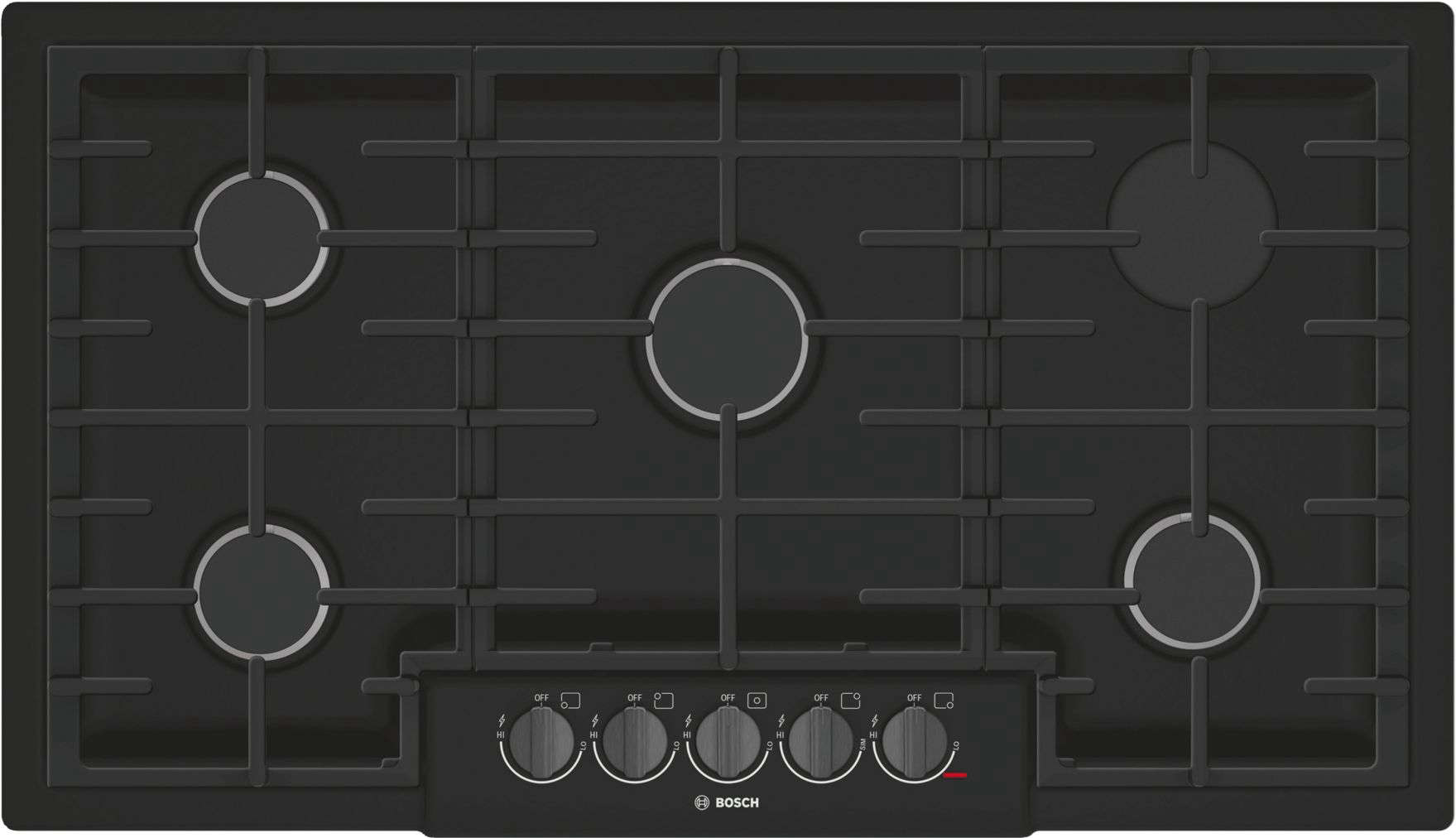
The Bosch 800 Series 36 in. 5 Burner Gas Cooktop is designed for home cooks who want the responsiveness of gas without treating every burner adjustment like an interpretive dance. In its current U.S. configuration, model NGM8659UC combines five sealed burners, a stainless steel surface, continuous cast-iron grates, illuminated controls, and Bosch’s FlameSelect system with nine defined heat levels.
That last feature is the headline attraction. Traditional gas cooktops offer excellent visual feedback, but returning to precisely the same flame can involve squinting at a blue flicker and hoping your sauce remembers what happened last Tuesday. FlameSelect gives the knobs numbered settings, making heat adjustments more repeatable.
This review examines cooking performance, design, cleaning, installation requirements, common owner experiences, and overall value. It focuses on the current NGM8659UC model rather than discontinued Bosch cooktops with nearly identical names and different burner specifications. Bosch currently identifies the unit as a 36-inch-class, five-burner stainless steel cooktop with a 17,000-BTU center burner.
Quick Verdict: Is the Bosch 800 Series Cooktop Worth It?
The Bosch 800 Series 36-inch gas cooktop is a compelling premium choice for cooks who value controlled heat, an uncluttered appearance, and easy movement between burners. Its 17,000-BTU dual-ring center burner handles boiling, searing, and larger cookware, while the low-output OptiSim burner is better suited to melting chocolate, warming butter, and holding delicate sauces.
It is not the most aggressively powerful 36-inch cooktop on the market. Some competitors advertise 19,000- or 20,000-BTU burners, and serious wok enthusiasts may prefer a rangetop with even more concentrated heat. Bosch instead emphasizes balance. This cooktop is built to cover everyday cooking tasks gracefully rather than intimidate your onions into caramelizing out of fear.
The strongest reasons to buy it are FlameSelect, the practical burner assortment, quality grates, LED indicators, and polished low-profile design. The biggest cautions are its premium price, the need for careful installation planning, and the modest spacing that naturally occurs when several oversized pans occupy a five-burner surface.
Design and Build Quality
A Clean, Low-Profile Stainless Steel Surface
The one-piece stainless steel platform has a restrained, modern appearance that fits particularly well in transitional and contemporary kitchens. It looks upscale without attempting to impersonate restaurant equipment. The front-center knobs remain easy to reach, and their symmetrical placement keeps the cooking area visually organized.
Because the burners are sealed, spills are less likely to migrate into the cooktop’s internal components. The shallow surface also has fewer complicated edges than many commercial-style rangetops. Tomato sauce will still find somewhere inconvenient to landtomato sauce has ambitionbut routine cleanup is generally straightforward.
The appliance is approximately 37 inches wide and 21 1/4 inches deep, despite being marketed as a 36-inch cooktop. “Thirty-six inch” describes its installation class, not its exact outside width. The specified countertop opening is approximately 34 15/16 inches wide by 19 1/8 inches deep. Bosch documentation should always be checked before cutting a countertop because measurement conventions and installation revisions can differ.
Continuous Cast-Iron Grates
Heavy, enameled cast-iron grates span the cooking surface, allowing pots to slide from one burner to another without being lifted completely. That is useful when a Dutch oven is full of chili and suddenly weighs approximately the same as a garden shed.
The grates feel stable under stainless steel stockpots, cast-iron skillets, and broad sauté pans. Bosch labels them dishwasher-safe, although their size and weight may make hand-washing more convenient in some kitchens. Before placing them in a dishwasher, confirm that the rack can accommodate them without blocking the spray arms.
Five-Burner Layout and Cooking Performance
The 17,000-BTU Dual-Ring Center Burner
The center burner is the cooktop’s workhorse. On natural gas, it reaches a rated 17,000 BTUs and uses two flame rings to provide a broad heating pattern. It is the best position for rapidly boiling pasta water, preheating a large skillet, stir-frying vegetables, or searing several steaks without making dinner guests wait through an awkward second batch.
The center position also helps accommodate larger cookware without forcing it against a wall or backsplash. Its wide flame pattern works best when the pan base is appropriately sized. Placing a tiny saucepan over the full burner wastes energy and may send heat around the sides rather than into the food.
The OptiSim Burner for Low-Heat Cooking
The 3,400-BTU front-left burner is fitted with Bosch’s OptiSim system. It is intended to maintain a controlled low flame for jobs that punish impatience: melting chocolate, keeping a cream sauce below a boil, warming gravy, or holding rice without welding it to the bottom of the pot.
Low-heat control is often more important than maximum output. Plenty of burners can attack a kettle with enthusiasm. Fewer can keep clarified butter warm without turning it into a tiny kitchen emergency. The OptiSim burner gives the cooktop useful range rather than simply adding another medium-strength flame.
The Supporting Burners
The remaining positions include two 6,000-BTU burners and a 10,300-BTU burner when configured for natural gas. Together, the five burners provide a total rated natural-gas load of 42,700 BTUs. The cooktop is factory-set for natural gas and can be converted to liquid propane using the included conversion kit; rated outputs vary slightly after conversion.
This mix is well suited to coordinated meals. A practical arrangement might place a stockpot on the center burner, vegetables on the 10,300-BTU burner, rice on a 6,000-BTU position, and sauce on the OptiSim burner. The fifth burner remains available for coffee, gravy, or the side dish someone remembered after dinner was already supposed to be ready.
How FlameSelect Changes Gas Cooking
FlameSelect divides the knob’s operating range into nine defined levels. Instead of relying entirely on visual judgment, the cook can select a numbered position and return to it later. Once a household learns that pancakes brown nicely at one setting and tomato sauce settles into a calm simmer at another, recipes become easier to repeat.
This does not turn gas into a temperature-controlled laboratory. Pan material, cookware diameter, food quantity, room conditions, and burner selection still affect results. A numbered flame setting is a repeatable power level, not a guarantee that every skillet will reach the same surface temperature.
Even so, the feature makes a meaningful difference. Gas is often praised for infinite adjustment, but “infinite” is not always convenient when someone else must reproduce the meal. Defined settings create a shared language. “Use level four” is more helpful than “turn the knob until the flame looks medium-ish, but emotionally confident.” Bosch and major U.S. appliance retailers consistently identify the nine-level FlameSelect valves as a defining feature of this model.
Controls, Ignition, and Safety Features
Each stainless-look control knob includes a red LED light line. The illumination indicates that a burner is operating and can also warn of residual heat after the flame is turned off. This is more useful than it may sound. Gas flames can be difficult to see in bright daylight, and cast-iron grates remain hot after cooking ends.
The electronic ignition system uses thermocouple flame monitoring. If a flame is lost, the monitoring system is designed to help control gas flow. Owners should still treat every gas appliance responsibly: investigate unusual odors, keep burner components properly seated, and arrange qualified service when ignition or flame behavior changes.
A healthy flame should generally appear blue rather than persistently yellow or sooty. The U.S. Environmental Protection Agency recommends using an exhaust hood that vents outdoors, keeping gas burners properly adjusted, and operating the hood during cooking. The Consumer Product Safety Commission also warns never to use a gas cooktop or oven to heat a home.
Cleaning and Maintenance
The cooktop’s stainless steel surface is easier to maintain when spills are addressed after the appliance has cooled rather than allowed to become part of the architecture. Remove the grates, lift away loose debris, and wipe the surface with a soft cloth and a cleaner approved for stainless steel.
Abrasive pads can scratch the finish, while excessive liquid around the control openings can cause trouble. Burner caps should be returned to their correct positions after cleaning. A misplaced or tilted cap can create uneven ignition, clicking, or an irregular flame.
The grate system is convenient but heavy. Dishwasher cleaning may save scrubbing time, yet moving several large iron sections between the cooktop and dishwasher is not effortless. Many owners will find that soaking and hand-cleaning the grates is faster for ordinary messes.
Customer reviews commonly praise the model’s appearance, flame control, and cleanability. The less enthusiastic reports tend to mention hard-to-read control markings, ignition timing, or disappointment when the delivered burner arrangement differs from an image or expected configuration. Checking the exact model number and current product diagram before ordering is therefore essential.
Installation Requirements You Should Check First
This is a built-in gas appliance, not a countertop gadget that can be dropped into place between lunch and a video call. Installation requires a compatible countertop opening, an accessible gas connection, proper pressure regulation, a grounded 120-volt three-prong electrical supply, and required clearances from combustible materials.
The electrical specification calls for a 15-amp circuit, 120 volts, and 60 Hz. The included power cord is approximately 40 inches long. Natural gas is the factory configuration, while an LP conversion kit is supplied for installations using propane. Conversion and gas connection work should be performed by a qualified professional in accordance with local codes.
Countertop dimensions deserve special attention during replacements. A previous 36-inch cooktop may not use the same cutout. Stone countertops can be expensive to modify, and finding that out after delivery is an excellent way to turn appliance day into a character-building exercise.
Plan the ventilation at the same time. An externally vented hood is preferable to a recirculating unit for removing combustion products, moisture, grease, and cooking particles. The hood must also be installed according to its manufacturer’s clearance requirements.
Who Should Buy This Bosch Gas Cooktop?
It Is a Strong Match For:
- Home cooks who want more repeatable gas-flame settings.
- Families regularly preparing several dishes at once.
- Kitchens with a properly sized 36-inch cooktop opening.
- People who prefer physical knobs instead of touch controls.
- Cooks who need both a strong center burner and dependable simmering.
- Remodels using coordinated Bosch 800 Series appliances.
Consider Another Option If:
- You need an ultra-high-output burner above 17,000 BTUs.
- You regularly use five oversized pots or skillets simultaneously.
- You prefer the easier-to-wipe glass surface of induction.
- Your kitchen cannot support effective exterior ventilation.
- You want six burners, an integrated griddle, or commercial-style controls.
- Your existing countertop opening would require costly modification.
Pros and Cons
Advantages
- Nine FlameSelect settings improve repeatability.
- Balanced five-burner arrangement for high and low heat.
- Useful 17,000-BTU dual-ring center burner.
- OptiSim burner performs delicate simmering tasks.
- Continuous cast-iron grates support heavy cookware.
- LED indicators improve burner and residual-heat awareness.
- Sealed burners and one-piece stainless steel simplify cleanup.
- LP conversion kit is included.
Disadvantages
- Premium pricing compared with basic five-burner cooktops.
- Maximum output trails certain high-performance competitors.
- Large pans can crowd neighboring burners.
- Cast-iron grates are heavy to lift and wash.
- Stainless steel shows grease, fingerprints, and dried droplets.
- Installation dimensions must be verified carefully.
How It Compares With Other 36-Inch Cooktops
Against mainstream models from GE, KitchenAid, Frigidaire, and Whirlpool, the Bosch typically distinguishes itself through FlameSelect and its illuminated control design. Less expensive cooktops may offer comparable burner counts and even higher headline BTU figures, but they do not always provide defined gas settings or the same low-profile styling.
Compared with premium rangetops from brands such as Thermador, Wolf, or BlueStar, the Bosch is less commercial in appearance and usually less extreme in output. It also occupies less space below the counter than a deep professional rangetop. The result is a practical middle ground: more refined than an entry-level cooktop but less imposing than equipment that looks prepared to cater a steakhouse.
Induction remains the principal alternative. A high-quality induction cooktop can boil quickly, maintain precise low heat, and wipe clean easily. The Bosch gas model counters with visible flame, immediate physical feedback, freedom from magnetic-cookware requirements, and familiar knob controls. The better choice depends on how you cook, not which technology has the more enthusiastic fan club.
Real-World Ownership Experience: What Daily Cooking Feels Like
The following experience-based observations combine common owner feedback with realistic cooking scenarios. They are intended to illustrate daily use rather than claim that every household will have identical results.
The First Week: Learning the Controls
The first noticeable change is that the knobs behave more deliberately than those on a basic gas cooktop. The numbered FlameSelect levels encourage experimentation. During the first few meals, a cook may note that eggs perform well at one level, sautéed onions at another, and a covered soup needs less power than expected. Within several days, frequently used settings become familiar.
The LED light lines quickly prove practical. A glance across the kitchen reveals whether a knob remains active, even when the flame is partly hidden by a large pan. After cooking, the residual-heat indication discourages someone from resting a grocery bag or plastic utensil on a hot grate. The feature is subtle, but it becomes one of those conveniences that feels oddly absent when using another stove.
Cooking a Large Family Dinner
Imagine preparing spaghetti and meatballs for six people. The center burner brings a stockpot toward a boil while the 10,300-BTU burner browns meatballs in a broad skillet. Tomato sauce simmers on one of the 6,000-BTU burners, and the OptiSim position gently warms a butter-and-herb mixture.
The continuous grates make repositioning cookware easy. A heavy sauce pot can slide several inches without being lifted. The cooktop feels spacious with medium cookware, although a 12-inch skillet, large stockpot, and wide Dutch oven can begin negotiating border disputes. Thoughtful pan placement matters more than the five-burner label suggests.
Low-Heat Tasks Show the Cooktop’s Personality
The OptiSim burner is particularly useful during slower meals. Chocolate melts with less risk of scorching, and a cream sauce can remain warm while the main dish finishes. It does not eliminate the need to stir or use appropriate cookware, but it creates a calmer margin for error.
This is where the Bosch feels more sophisticated than a cooktop designed mainly around maximum flame. High heat makes impressive advertising. Controlled low heat saves dinner.
Cleanup After a Messy Meal
After frying, sauce droplets and oil inevitably reach the stainless steel. Once everything cools, the grates lift away and the sealed surface wipes down without requiring access to open burner wells. The process is simple, but the cooktop does not clean itself through good German manners. Stainless steel still rewards prompt wiping.
The grates are the least graceful part of the routine. They are substantial, which is excellent while cooking and less delightful while balancing them over a sink. For minor spills, spot-cleaning is easier than loading every section into a dishwasher.
After the Novelty Wears Off
Several weeks into ownership, FlameSelect stops feeling like a feature demonstration and becomes ordinary muscle memory. The user turns directly to familiar settings instead of studying the flame. That repeatability is the main long-term benefit.
The cooktop is most satisfying for someone who cooks frequently enough to appreciate small improvements in control. An occasional cook may simply see five burners and attractive stainless steel. A person who regularly makes sauces, soups, stir-fries, and multi-pan dinners is more likely to recognize why the Bosch costs more than a basic alternative.
Final Verdict
The Bosch 800 Series 36 in. 5 Burner Gas Cooktop delivers a thoughtful blend of power, simmering control, durable construction, and restrained design. Its 17,000-BTU center burner is capable rather than outrageous, while the OptiSim burner and nine FlameSelect levels give the appliance its real identity.
It is best for buyers who want the tactile familiarity of gas but would appreciate more repeatable control. The continuous grates and illuminated knobs improve daily convenience, while the stainless steel surface gives a remodeled kitchen a clean, premium finish.
The purchase makes less sense for shoppers chasing the highest possible BTU rating, commercial styling, or bargain pricing. It also requires disciplined measurement and professional installation. For the right kitchen, however, the Bosch NGM8659UC is a balanced and highly usable five-burner gas cooktop that makes both weeknight meals and ambitious weekend cooking feel more manageable.
Note: Bosch has sold several similarly named 800 Series 36-inch gas cooktops. This article focuses on the current U.S. model NGM8659UC. Confirm the exact model number, current specifications, countertop cutout, gas type, ventilation requirements, and installation documents before purchasing.