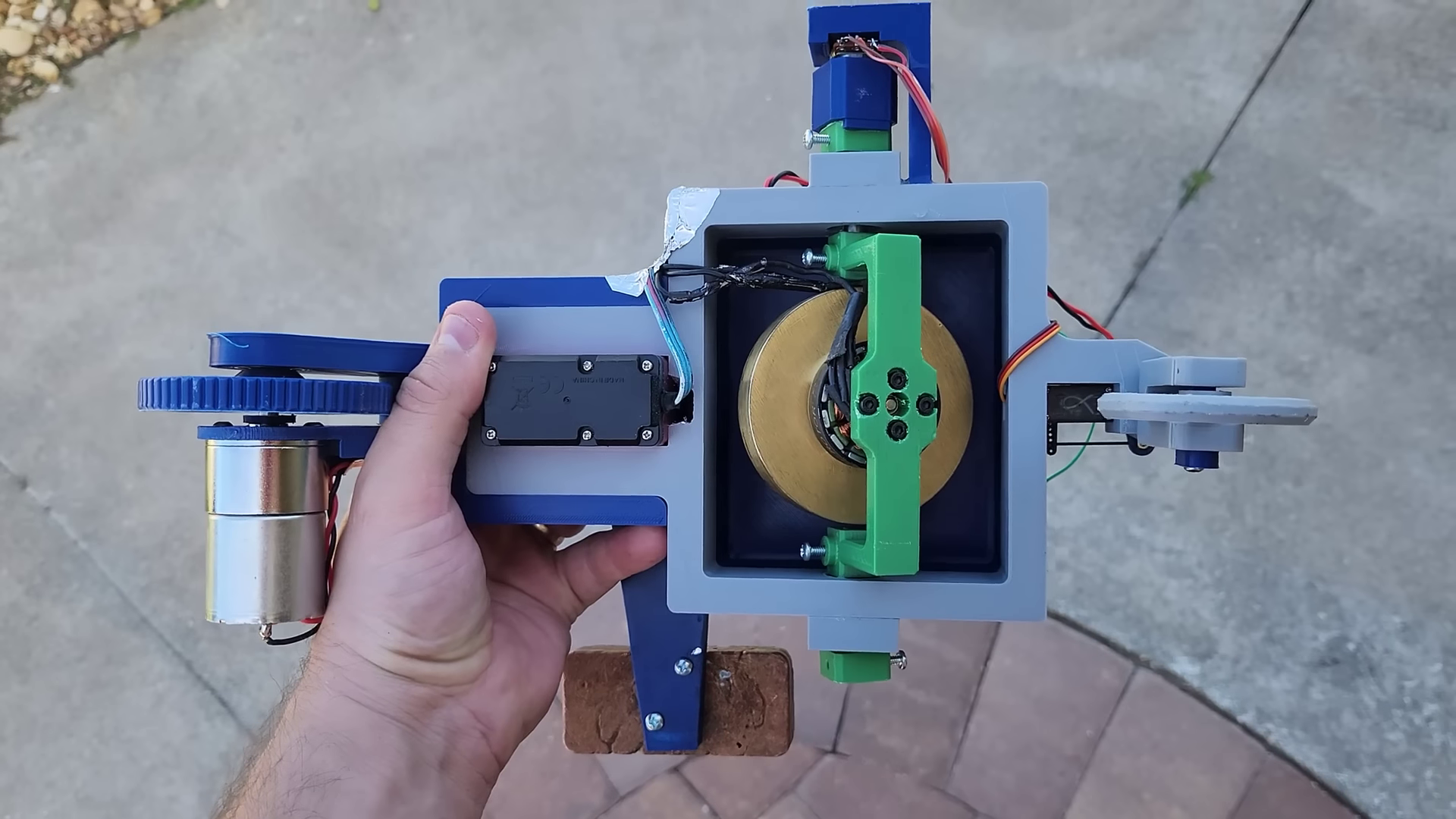
If you’ve ever watched a self-balancing gadget wobble heroically and then face-plant anyway, you’ve already met the
central truth of stabilisation: one trick rarely works forever. Gyros are fantastic at shrugging off quick nudges
(wind gusts, bumps, your cat’s “help”), but they can struggle against a constant bully like gravity. Weight shifting,
on the other hand, is like leaning into a turn on a bicycleslow, deliberate, and surprisingly powerful.
Put the two together and you get something that feels almost unfair: fast correction from gyro stabilisation, plus
long-term “stay upright” authority from moving mass where it matters. This hybrid approach shows up everywhere,
from hobby RC experiments to spacecraft attitude control conceptsbecause physics is consistent, even when our
wiring is not.
Why Gyro Stabilisation Is Great… Until It Isn’t
A spinning rotor resists changes to its orientation. When an external torque tries to tip your platform, the gyro
responds with a precession torquebasically redirecting that “tip energy” into another axis. For short, sharp
disturbances, that’s perfect: the system can dampen roll quickly without needing huge motors or lightning-fast
weight movement.
But gravity isn’t a quick disturbance. Gravity is the coworker who schedules meetings that could have been an email.
It applies a persistent torque if your center of mass is not directly above your support point (or if your bike
keeps leaning because physics has opinions). Over time, a gyro-based system can “run out of useful geometry” as
the rotor’s axis and the external torque line up poorlysometimes discussed in hobby contexts with the language of
gimbal lock, singularities, or simply “the gyro stopped saving me.”
The key limitation: steady-state correction
A gyro is excellent at resisting changes, but it doesn’t magically relocate your center of mass. If your platform
needs a sustained corrective torque to hold a nonzero lean angle, a gyro can end up fighting a losing battle. You
might see slow drift, mounting oscillations, or the classic “it held… and then it didn’t.”
Why Weight Shift Balancing Is Boring… and Brilliant
Weight shifting is the opposite personality. It’s not flashy; it’s practical. By moving mass left/right (or fore/aft),
you can reposition the center of gravity so that gravity itself generates a restoring torque. Instead of constantly
“pushing back” against gravity, you’re changing the geometry so gravity helps you.
This is how humans balance on a bike at low speeds: you steer and you lean, constantly adjusting where your mass
sits relative to the contact patch. A robot can do a similar dance with a sliding weight, a rotating arm, a pendulum
mass, or even a movable battery pack (the most honest mass on any build: it’s already heavy and it already owns your
layout).
Weight shift excels at:
- Steady-state stability (holding a lean angle without “torque debt”)
- Slow disturbances (ramps, uneven floors, steady wind)
- Reducing actuator saturation (less constant fight, more smart posture)
The Hybrid Strategy: Fast Gyro, Slow Mass
When you combine gyro stabilisation with weight shift, you’re essentially splitting the workload by frequency:
- High-frequency corrections (quick bumps, chatter, impulse disturbances) go to the gyro system.
- Low-frequency corrections (drift, sustained lean, gravity bias) go to the weight shift mechanism.
In control-speak, you’re building a two-layer stabiliser: a fast inner loop that damps motion, and a slower outer
loop that re-centers the system so the inner loop doesn’t have to do heroic overtime. In plain-speak, the gyro handles
the “oh no” moments, and the weight shift handles the “let’s not end up in this situation again” moments.
A Concrete Example: The Gyro-Stabilised RC Bike That Learns to Lean
One of the most intuitive demonstrations of this hybrid idea is a gyroscopically stabilised RC bike that also shifts
a weight. The gyro helps the bike resist sudden wobblesespecially useful when the bike is jittering from surface
imperfections or tiny steering overcorrections. But as the bike continues moving, the system can use a weight shift
to keep the roll angle near upright without requiring the gyro to supply a constant corrective effect.
The result is a machine that doesn’t just “fight tipping” moment by moment; it actively repositions itself into a
more stable posture. If you’ve ever tried to keep a bike upright by only spinning a rotor, you’ll appreciate how
much calmer everything becomes when the center of mass is allowed to move too.
Core Building Blocks (and What They Actually Do)
1) The spinning mass: gyro, reaction wheel, or CMG-like behavior
In hobby builds, “gyro stabiliser” can mean a few different hardware realities:
-
Reaction wheel: a flywheel whose speed changes to apply an equal-and-opposite torque to the frame.
Great for impulse correction, but can saturate if you keep demanding torque in one direction. -
Gimballed gyro / CMG-like setup: a spinning rotor whose axis is reoriented with a gimbal to create
strong precession torques. Powerful, but can hit singularities if the geometry lines up badly. -
“Gyro module” damping: sometimes builders use off-the-shelf gyro stabilisation modules that output
control signals for servos or motors; the physics is still angular rate sensing and feedback.
2) The moving mass: slider, pendulum, rotating arm, or shifting ballast
Weight shift doesn’t need to be fancy. The engineering challenge is mostly mechanical:
- Backlash (slop ruins control authority)
- Friction (stiction creates “nothing-nothing-WHOA” motion)
- Speed vs. torque (too slow and you can’t catch drift; too fast and you excite oscillations)
- Mass placement (a small mass far from the pivot can beat a big mass near the pivot)
3) The brain: control loops that don’t fight each other
This is where many builds go from “promising” to “possessed.” If the gyro loop and the weight-shift loop both try to
correct the same error in the same time band, they can amplify oscillations instead of damping them.
A common approach is:
- Inner loop (gyro-based): stabilises angular rate and provides quick damping.
- Outer loop (weight shift): targets roll angle (or lean bias) and slowly nudges the center of mass.
Sensing: IMUs, Drift, and the Art of Not Being Fooled by Your Own Acceleration
Most builds rely on an IMU (inertial measurement unit) containing a gyroscope and accelerometer. The gyro gives you
smooth short-term rate data, but it drifts when integrated. The accelerometer gives you a gravity reference, but it
gets noisy and confused when your robot accelerates (because it can’t tell whether it’s feeling gravity or motion
it’s basically honest but not very insightful).
Complementary filtering: the “peanut butter + jelly” method
A complementary filter is popular because it’s lightweight and effective: trust the gyro for quick changes (high-pass
behavior) and trust the accelerometer for long-term “down is down” correction (low-pass behavior). You get a stable
angle estimate without turning your microcontroller into a tiny space heater.
Kalman filtering: the “I brought spreadsheets to the skateboard park” method
Kalman (including extended Kalman filtering) can improve estimates when you model noise and dynamics carefully. It’s
powerful, but it demands more math discipline and better tuning. Many builders start with a complementary filter,
then upgrade if they hit performance ceilings.
Control Tuning: PID Is Still Relevant (and Still a Little Petty)
PID control shows up constantly in balancing projects because it’s intuitive and works well when tuned properly.
But in hybrid stabilisation, you often have two controllers with different jobs. That means:
- Rate PID (gyro loop): targets angular velocity (fast damping).
- Angle controller (weight shift loop): targets lean angle (slow posture correction).
A practical tuning mindset:
- Get the IMU angle estimate stable before you “tune control.” Bad sensing makes every gain feel wrong.
- Tune the fast loop first so the system stops flopping on small disturbances.
- Add the slow loop gently so it reduces drift without introducing a new oscillation mode.
- Watch for saturation (motors maxing out, servos hitting limits, reaction wheel speed pegging).
Design Tips That Save Hours (and Possibly Furniture)
Put your IMU where the motion is “representative”
Mounting matters. If the IMU sits far from the rotation axis, it experiences extra linear acceleration, which can
contaminate tilt estimates. Many balancing builds work best when the IMU is near the center of rotation or close to
the body’s principal motion axis.
Bias your mechanics toward stability
Hybrid control can’t fix everything. If your bike’s steering geometry is unstable, your rotor bearings are rough,
and your weight slider sticks like it’s held by grudges, the control code is going to look guilty for crimes it
didn’t commit. Smooth mechanics make “easy control” possible.
Use limits intelligently
Weight shift mechanisms have end stops. Reaction wheels have max speed. Gimbals have singularities. If your control
design ignores limits, you’ll get the worst kind of surprise: the kind where the robot behaves perfectly… right up
until it doesn’t, and then it does something memorable.
What This Teaches Us About Robotics (and Why Hackers Love It)
Combining gyro stabilisation with weight shift balancing is a perfect “maker brain” project because it forces you
to blend disciplines:
- Physics (angular momentum, torque, center of mass)
- Controls (loops, bandwidth separation, stability margins)
- Sensing (IMU fusion, drift, vibration management)
- Mechanical design (low friction, rigidity, backlash control)
And it rewards you with a result that feels alive: a machine that looks like it’s “thinking” as it steadies itself,
leans, corrects, and glides back to balance. It’s one of those projects where the final 10% isn’t just polishit’s
the difference between “demo” and “daily driver.”
Hands-On Experiences: What You’ll Notice When You Build (and Debug) This Hybrid System
The first time you run a gyro stabiliser on a balancing platform, you’ll probably grinright up until the grin turns
into the expression of someone watching a shopping cart develop free will. Gyros make the system feel “stiffer”
immediately. Small taps don’t topple it; instead, you get a quick shiver and recovery. That’s the magic of fast
damping. The less magical part is the slow drift you may notice: the platform holds for a moment, then gradually
leans farther than it should, as if it’s reconsidering its life choices.
When you add weight shift, the personality changes again. Now the system doesn’t just resist tippingit starts
“seeking” upright. You’ll see the weight mechanism creep to one side while the frame relaxes back toward center.
If you tune it conservatively, it feels calm and intentional. If you tune it aggressively, it can feel like the
robot is doing interpretive dance: the weight slides, the body overshoots, the gyro loop slaps it back, and suddenly
you’ve invented a vibration generator.
One of the most common real-world surprises is how much mechanical friction and backlash
matter. A weight slider that moves freely on the bench can bind under load once the frame twists. A servo horn that
seems tight can develop tiny slop that becomes a full-on oscillation at speed. You’ll learn to love boring upgrades:
better bearings, stiffer mounts, smoother rails, and linkages that don’t “click” when you reverse direction.
IMU behavior is another rite of passage. You’ll discover that accelerometers are extremely honest about acceleration
including acceleration you caused with your own motors. If your platform jitters, your accelerometer will happily
report nonsense tilt changes, and your controller will faithfully “correct” them. That’s when you start caring about
isolation foam, vibration damping, cable strain relief, and motor balancing. You’ll also start appreciating why
complementary filters are popular: they’re fast, stable, and forgiving when your hardware isn’t perfect yet.
You’ll also feel the limits of your actuators in a very physical way. Reaction wheels can saturate: the wheel speed
climbs until you can’t ask for more correction. Weight shift can hit travel limits: the mass runs out of runway.
Even battery voltage sag becomes visible as “why is the response slower after 90 seconds?” Debugging becomes a game
of identifying whether you’re seeing a control problem, a power problem, or a mechanical problem wearing a control
problem costume.
Finally, you’ll experience the joy of bandwidth separation without needing to call it that. When the
fast gyro loop is tuned to kill quick wobbles, and the slow weight loop is tuned to gently erase drift, the system
starts to feel composed. It stops arguing with itself. It responds to bumps with a quick correction, then quietly
re-centers like nothing happened. That’s the moment you go from “I built a wobbly science project” to “okay, this is
actually a stabilisation system.” And yesat that point you’ll absolutely consider putting it on something slightly
irresponsible, like a bike, a camera rig, or a platform you’ll swear is “totally safe” right before it scoots off
the workbench.