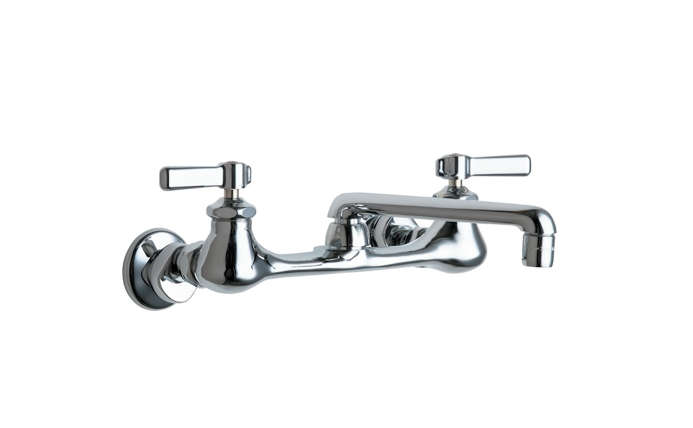
The Chicago Faucets 540-LDABCP wall mounted sink faucet is not trying to win a beauty contest with delicate curves, touch-sensitive controls, or a smartphone app that tells you the water is wet. It is a commercial-grade fixture built for a much more practical mission: delivering dependable hot and cold water in busy spaces where durability, serviceability, and straightforward operation matter.
With cast-brass construction, adjustable wall connections, lever handles, a six-inch swing spout, and rebuildable compression cartridges, the 540-LDABCP is designed for commercial kitchens, utility areas, institutional facilities, workshops, schools, offices, and other demanding environments. Its polished chrome finish gives it a traditional professional appearance, while its exposed design makes inspection and maintenance considerably less mysterious than working on plumbing hidden behind a wall.
This in-depth review explains its specifications, installation considerations, everyday performance, potential drawbacks, maintenance needs, and the real-world experiences facility teams can expect after the novelty of owning a shiny new faucet has worn off.
“`
Chicago Faucets 540-LDABCP at a Glance
The 540-LDABCP is a two-handle, wall-mounted manual faucet from the Chicago Faucets 540 Series. It has an eight-inch body and adjustable inlet arms that accommodate supply centers from 7-1/4 inches to 8-3/4 inches. That adjustability can be valuable when replacing an older commercial faucet whose wall connections are close to eight inches apart but not quite as precise as the original blueprint promised.
| Feature | Specification |
|---|---|
| Model number | 540-LDABCP |
| Installation type | Exposed wall mount |
| Supply-center range | 7-1/4 to 8-3/4 inches |
| Spout | 6-inch S-type swing spout |
| Flow rate | 2.2 gallons per minute |
| Outlet | Pressure-compensating Softflo aerator |
| Handles | Two 2-3/8-inch metal lever handles |
| Cartridges | Right- and left-hand Quaturn compression cartridges |
| Connections | 1/2-inch female NPT inlets |
| Finish | Polished chrome |
| Operating pressure | 20 to 125 PSI |
| Operating temperature | 40°F to 140°F |
| Approximate product weight | 4.46 pounds |
Commercial Construction Without Decorative Drama
Cast-Brass Body
The faucet uses a durable cast-brass body rather than a lightweight shell intended primarily to look attractive in a showroom. Brass is commonly selected for commercial plumbing fixtures because it offers strength, corrosion resistance, and the ability to withstand repeated use.
The manufacturer describes the faucet as an ECAST product, meaning its construction has a weighted-average lead content of no more than 0.25 percent. It is intended for installations where low-lead requirements apply or where reducing lead content is a purchasing priority.
Polished Chrome Finish
Polished chrome is a logical finish for a commercial wall-mounted faucet. It reflects light, looks clean when maintained, and fits easily with stainless-steel sinks and other institutional fixtures. The downside is familiar to anyone who has ever met a fingerprint: chrome readily displays water spots, mineral residue, and smudges.
Fortunately, the finish does not require an elaborate spa treatment. Mild soap, warm water, and a soft cloth are generally sufficient. Abrasive pads, aggressive chemicals, and harsh solvents should stay in the cleaning cabinet unless the goal is to turn polished chrome into “distressed industrial chic.”
Adjustable Wall-Mount Connections
One of the most useful features of the Chicago Faucets 540-LDABCP is its pair of offset supply arms. Although the faucet has a nominal eight-inch body, the arms can be adjusted to fit wall connections spaced from 7-1/4 inches to 8-3/4 inches apart.
This does not eliminate the need for accurate measurements. It simply provides a reasonable correction range for existing plumbing. In older buildings, utility rooms, school kitchens, and renovated commercial spaces, wall stub-outs are not always positioned with laser-guided perfection. Adjustable arms can prevent a slightly imperfect rough-in from becoming a considerably more expensive wall-opening project.
The faucet uses 1/2-inch female NPT inlets and includes slip flanges that cover the wall penetrations. Installers should check thread condition, pipe alignment, shutoff accessibility, and available clearance before removing the existing fixture.
Why Professional Installation Still Makes Sense
The visible faucet body may appear simple, but wall-mounted installations place stress directly on the supply connections. Poor alignment, excessive tightening, damaged threads, or unsupported piping can create leaks or place strain on the plumbing behind the wall.
A qualified plumber can verify that the supplies are secure, seal the threaded joints correctly, align the faucet body, and test the installation under pressure. That is especially important in commercial facilities, where one small leak can become an enthusiastic contributor to the building’s maintenance budget.
Six-Inch S-Type Swing Spout
The six-inch S-type swing spout provides a practical reach for many compact commercial and utility sinks. Because it swivels, users can direct water toward different portions of the basin or move the spout aside when placing a container in the sink.
A six-inch reach is useful, but it is not universally ideal. Before ordering, measure the distance from the finished wall to the center of the sink bowl. A spout that ends too close to the rear wall can make washing awkward and may cause water to strike the sloped side of the basin. A spout extending too far can produce splashing near the front edge.
For a single-bowl sink with conventional proportions, the included spout is often a sensible match. Large compartment sinks, oversized service basins, or specialized workstations may require a longer or differently shaped spout from the broader 540 Series.
Softflo Aerator and 2.2 GPM Performance
The pressure-compensating Softflo aerator delivers a rated flow of 2.2 gallons per minute. Its purpose is to create a controlled, aerated stream that feels full while reducing chaotic splashing compared with an unrestricted outlet.
Pressure compensation helps keep the flow more consistent as building pressure changes within the faucet’s rated operating range. That can be helpful in facilities where pressure fluctuates because several fixtures or pieces of equipment are operating at once.
A 2.2 GPM faucet provides faster filling than many modern low-flow lavatory fittings. That can be convenient for rinsing tools, filling containers, cleaning a sink, or handling general prep work. However, buyers pursuing aggressive water-conservation targets may prefer a lower-flow model.
The current manufacturer specification also states that this fitting is not intended to be sold in California under applicable California Energy Commission requirements. Purchasers should check current state regulations, local plumbing codes, project specifications, and approved-product lists before ordering.
Lever Handles and Quaturn Compression Cartridges
Easy Manual Control
The faucet includes separate hot and cold lever handles with color-coded index buttons. Each handle is approximately 2-3/8 inches long, providing enough leverage for comfortable operation without occupying excessive space.
The metal levers are secured to discourage casual removal and are designed for frequent commercial use. Their shape also makes the faucet easier to operate than small round knobs, especially for users with limited grip strength. The model is listed as meeting ADA-related dimensional and operating requirements when installed appropriately.
Rebuildable Compression Technology
Inside the faucet are separate right-hand and left-hand Quaturn compression cartridges. These cartridges open and close through a 90-degree handle movement and close with the direction of water pressure.
The rebuildable design is a meaningful advantage for maintenance departments. When wear eventually causes dripping or rough operation, technicians may be able to repair the valve using manufacturer replacement parts instead of discarding the entire faucet. Commercial buyers often value this parts-based service strategy because a fixture that can be maintained for years may cost less over its working life than a cheaper unit treated as disposable.
Standards, Certifications, and Warranty
The Chicago Faucets 540-LDABCP is listed as meeting several commonly referenced plumbing and accessibility standards, including ASME A112.18.1/CSA B125.1, ADA ANSI/ICC A117.1, NSF/ANSI/CAN 372 for low lead content, and NSF/ANSI/CAN 61 requirements applicable to drinking-water system components.
The manufacturer also identifies the product as compliant with applicable Buy American Act provisions. Public projects should still confirm the exact domestic-content documentation required by the contract, since “Buy American,” “Build America, Buy America,” and agency-specific procurement rules are related but not always interchangeable.
Published warranty coverage includes a lifetime limited faucet warranty, a five-year limited cartridge warranty, and a one-year limited finish warranty. Warranty terms usually contain exclusions, installation requirements, and restrictions, so buyers should retain invoices, model information, and maintenance records rather than relying on a photograph of the faucet and a confident shrug.
Best Applications for the 540-LDABCP
This wall-mounted commercial sink faucet is especially suitable for locations that prioritize rugged construction and accessible service:
- Commercial kitchen handwashing or preparation sinks
- School, university, and institutional utility areas
- Office breakrooms with exposed wall plumbing
- Workshops and maintenance rooms
- Healthcare support spaces where project specifications permit
- Public facilities requiring durable manual controls
- Renovation projects with approximately eight-inch wall centers
It is less suitable for installations that need a pull-down spray head, electronic activation, temperature limiting built into the faucet, an integral vacuum breaker, a very long spout, or an especially low flow rate.
Advantages and Potential Drawbacks
Notable Advantages
- Durable cast-brass commercial construction
- Adjustable supply arms for imperfect existing rough-ins
- Six-inch swivel spout for flexible basin access
- Pressure-compensating aerated stream
- Rebuildable hot and cold cartridges
- Lever handles with clear temperature indicators
- Exposed components that are relatively easy to inspect
- Broad availability of model-specific service documentation
Points to Consider
- The 2.2 GPM flow rate may not meet every conservation goal or regional rule.
- Polished chrome requires regular wiping to remain spotless.
- The six-inch spout may be short for deep or oversized sinks.
- Wall-mounted threaded connections should be installed carefully.
- Separate hot and cold handles are slower to adjust than a single mixer.
- The traditional commercial appearance may not suit a decorative residential kitchen.
Installation and Maintenance Tips
Before Installation
Measure the wall connections from center to center and confirm they fall within the adjustable range. Inspect the exposed nipples or adapters for corrosion, damaged threads, or movement. Shut off both supplies and relieve pressure before removing the old faucet.
The water lines should be flushed before the new fixture is connected. Construction debris, pipe scale, and sealing-material fragments can damage cartridges or clog the aerator almost immediately.
After Installation
Once the faucet is mounted, remove the outlet or aerator and flush the fixture thoroughly. Reinstall the outlet, operate both handles, check the full swing of the spout, and inspect every joint for leakage.
Do not assume a dry connection at first glance is permanently dry. Recheck it after the faucet has been operated repeatedly and after the lines have remained pressurized.
Routine Care
Clean the chrome with mild soap, warm water, and a soft cloth. Periodically unscrew and rinse the aerator if flow becomes uneven. In areas with hard water, mineral deposits may require more frequent attention.
A persistent drip from the spout usually points toward cartridge wear, damaged internal sealing components, or debris preventing complete closure. Because the faucet uses separate right- and left-hand cartridges, technicians should confirm the correct replacement part before ordering.
Who Should Buy the Chicago Faucets 540-LDABCP?
The ideal buyer is a facility manager, contractor, property owner, or maintenance professional seeking a dependable exposed wall-mount faucet with adjustable centers and replaceable internal components. It is particularly appealing when the existing plumbing is already configured for a two-hole wall-mounted faucet near eight-inch centers.
Residential buyers can also use it in a laundry room, workshop, mudroom, or industrial-style kitchen. However, its strengths are practical rather than luxurious. It will not produce an elegant pull-down spray pattern, remember a preferred temperature, or illuminate the water with colorful LEDs. It will simply turn on, deliver water, and give technicians a reasonable path to repair it laterwhich, in commercial plumbing, is often the more impressive trick.
Real-World Experience With the Chicago Faucets 540-LDABCP
Experiences with a commercial faucet are shaped by the sink, water quality, installation quality, and frequency of use. Even so, several patterns are likely to become apparent once the 540-LDABCP is placed into service.
The Installation Experience
The adjustable supply arms are usually the first feature installers appreciate. A nominal eight-inch rough-in may measure slightly narrow, slightly wide, or subtly uneven after decades of repairs and wall finishes. Being able to adjust from 7-1/4 to 8-3/4 inches gives the installer room to align the body without immediately modifying the plumbing.
That flexibility does not make the faucet foolproof. The arms must be adjusted evenly enough to keep the body level, and the threaded connections need to be sealed without being overtightened. When the piping behind the wall is loose, the exposed faucet can feel unstable no matter how carefully its flanges are positioned. The best experiences begin with solid supply piping and patient alignment rather than the traditional “one more turn should fix it” technique.
The Daily User Experience
In everyday use, the handles feel direct and uncomplicated. Users can identify hot and cold quickly, and the short quarter-turn movement avoids repeated twisting. This is useful in busy work areas where people may operate the faucet dozens or hundreds of times per day.
The aerated 2.2 GPM stream feels substantial. Containers fill at a practical speed, and routine rinsing does not feel painfully slow. When the faucet is paired with an appropriately sized sink, the Softflo outlet keeps the stream controlled. Splashing becomes more noticeable when the basin is shallow, the spout lands near a sloped surface, or water pressure is unusually high.
The swing spout adds convenience because it can be repositioned or moved out of the way. Users should avoid treating it like a grab bar, however. Repeated side loading can loosen the spout joint or accelerate wear. A faucet can survive a hard commercial life, but it still prefers not to be used as gym equipment.
The Cleaning Experience
Chrome looks crisp after wiping, particularly beside stainless steel. It also reveals every dried droplet under bright commercial lighting. In a heavily used room, expecting a mirror finish all day is optimistic. Regular wiping with a soft cloth is more effective than occasional attacks with abrasive cleaners.
Hard-water facilities may notice white mineral buildup around the aerator, spout joint, and handle bases. Cleaning the aerator before deposits become severe helps preserve a straight, even stream. Maintenance teams generally have a better experience when faucet cleaning is included in routine tasks rather than postponed until the outlet resembles a tiny limestone cave.
The Maintenance Experience
The exposed layout is helpful when troubleshooting. A technician can observe the body, supply arms, spout connection, handles, and outlet without opening cabinetry or removing decorative panels. If a leak develops, its general location is often immediately visible.
Rebuildable cartridges also support long-term ownership. Keeping the correct right-hand and left-hand cartridge numbers in the facility’s maintenance system can reduce downtime. For buildings with several Chicago Faucets fixtures, maintaining a small inventory of common cartridges, aerators, index buttons, and seals may be more efficient than ordering parts after a faucet begins dripping.
The most satisfying ownership experience is not necessarily one in which nothing ever wears out. Commercial fixtures operate under demanding conditions, and components eventually require attention. The advantage is having a recognizable design, published repair information, and replaceable parts when that day arrives.
Long-Term Practical Impression
Over time, the 540-LDABCP is likely to be remembered less for dramatic innovation than for predictability. Its operation is obvious, its components are accessible, and its appearance does not depend on current design trends. Those qualities matter in facilities where maintenance staff would rather solve a problem with a cartridge and wrench than replace an entire proprietary electronic assembly.
Its limitations remain equally clear. The faucet is not the best choice where water rules demand a lower flow, where users need an integrated sprayer, or where the sink requires substantially more reach. Selecting the right model and spout configuration before installation is the key to a positive long-term experience.
Final Verdict
The Chicago Faucets 540-LDABCP wall mounted sink faucet is a robust, serviceable option for commercial and institutional sinks with exposed supplies near eight-inch centers. Its cast-brass body, adjustable inlet arms, lever handles, swivel spout, pressure-compensating aerator, and rebuildable cartridges address the practical needs of facilities that expect a faucet to work hard and remain repairable.
It is not ideal for every project. Buyers must confirm spout reach, flow-rate regulations, rough-in dimensions, pressure conditions, and local code requirements. When those details match the installation, the 540-LDABCP offers the kind of straightforward reliability that rarely produces glamorous storiesand frequently prevents unpleasant ones.