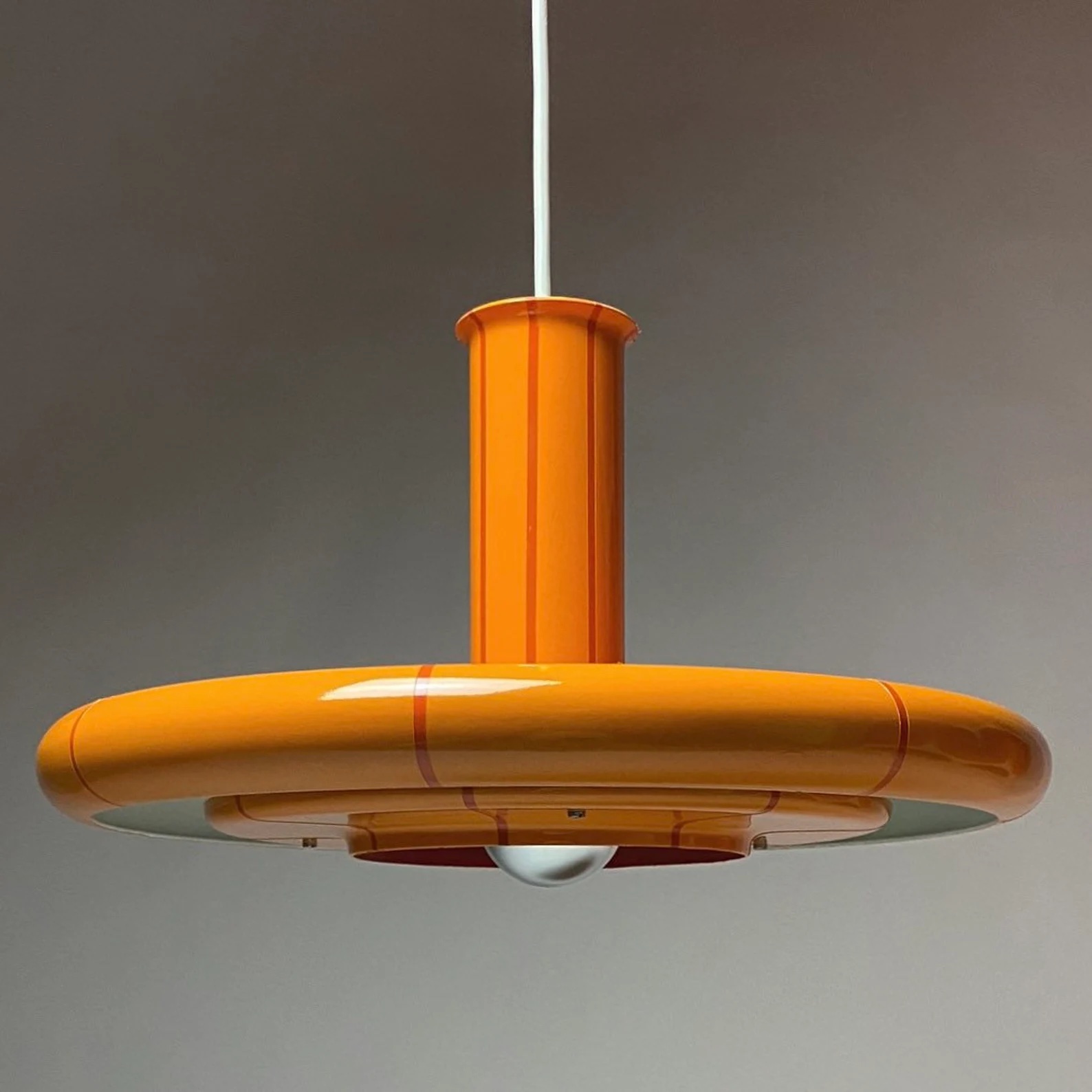
The beautiful two toned orange lacquered Optima ceiling light is the kind of vintage fixture that does not politely enter a room. It arrives, adjusts its imaginary sunglasses, and says, “Yes, the ceiling needed a personality.” Sleek, compact, graphic, and warmly colored, this Danish modern pendant sits at the delightful intersection of 1970s space-age design and everyday practical lighting.
At first glance, the Optima ceiling light looks simple: a shallow saucer-like form, a crisp lacquered finish, and a warm orange color story that feels both retro and surprisingly current. But good design often works that way. The fewer tricks it uses, the more confident it looks. This lamp does not need crystals, tassels, carved dolphins, or twelve remote-control modes. Its magic is in proportion, color, reflection, and restraint.
Collectors usually connect the Optima lighting family with Danish designer Hans Due and the celebrated manufacturer Fog & Mørup, a company deeply associated with mid-century and 1970s Scandinavian lighting. The Optima series is especially loved for its thin, futuristic profile and its ability to produce soft, controlled illumination. In a two toned orange lacquered version, the design gains an extra layer of charm: part modernist object, part glowing citrus planet, part “why is my dining nook suddenly cooler than I am?”
What Makes the Optima Ceiling Light Special?
The Optima ceiling light is not merely a vintage pendant. It is a carefully shaped lighting instrument. Its flattened profile gives it a hovering effect, almost like a small UFO that decided to settle above your breakfast table instead of abducting your toaster. The design feels light and aerodynamic, yet the lacquered metal gives it presence and durability.
The two toned orange finish is particularly striking because it changes how the lamp behaves visually. Orange is a warm, social color. It flatters wood tones, softens white walls, and adds energy without screaming like a neon sign outside a 24-hour taco shop. When used on a lacquered shade, orange becomes even more expressive because the glossy or semi-gloss surface catches highlights and creates depth.
Two-tone construction also gives the fixture dimension. A darker or richer orange exterior can frame the lamp as a sculptural object, while a lighter or brighter interior can help bounce light downward and outward. The result is a pendant that works even when switched off. During the day, it becomes decor. At night, it becomes atmosphere.
A Brief Design Background: Hans Due, Fog & Mørup, and the 1970s Look
Hans Due’s work for Fog & Mørup belongs to a period when Danish lighting design balanced function with futuristic elegance. The 1970s were not shy about shape or color. Designers explored low profiles, rounded silhouettes, lacquered metal, matte chrome, and bold shades such as yellow, brown, red, and orange. It was an era when a lamp could look like an architectural diagram and a spaceship at the same time, which frankly is a wonderful use of civilization.
Fog & Mørup was one of Denmark’s important lighting manufacturers, known for producing refined, modern fixtures that appealed to both domestic and international markets. The company worked with multiple designers and became strongly associated with Danish modern lighting. The Optima family, with its pendant, table, floor, and wall versions, reflects this design culture beautifully. It is efficient, decorative, and quietly clever.
The Optima pendant models are often described as thin, sleek, and space-age in feel. That description is accurate, but it does not tell the whole story. The real appeal is not just that the lamp looks futuristic. It is that it still looks useful. Many “futuristic” objects age badly. They begin as tomorrow and end as “what was everyone wearing in 1974?” The Optima, however, keeps its dignity because the form is pure, the proportions are disciplined, and the light quality matters as much as the silhouette.
The Power of Two Toned Orange Lacquer
Color is where this particular Optima ceiling light becomes especially memorable. White versions of the Optima are crisp and minimal. Brown versions feel earthy and architectural. Yellow versions are sunny and playful. But orange sits in a sweet spot between warmth and confidence. A two toned orange lacquered Optima ceiling light brings color without chaos.
Orange lacquer works well in vintage interiors because it speaks the language of the 1970s without turning the room into a museum set. Pair it with walnut furniture, cream walls, terrazzo, smoked glass, or a low-slung sofa, and it looks period-correct. Place it in a clean contemporary apartment with white oak floors and matte black accents, and it suddenly looks intentional and editorial. Orange is surprisingly flexible when the object wearing it has good lines.
The two-tone effect also helps prevent the lamp from feeling flat. Instead of one solid block of color, the fixture has visual rhythm. The eye reads shadow, highlight, curve, and contrast. In practical terms, that means the light can become a focal point without overwhelming the rest of the room. It says, “Look here,” not “Please ignore all furniture; I am the captain now.”
How the Optima Light Shapes a Room
A ceiling light has more responsibility than most people admit. It is not just there to prevent you from mistaking the cat for a throw pillow. It sets mood, organizes space, and determines whether dinner feels cozy or like a staff meeting in a dentist’s office.
The Optima ceiling light performs best where its shape can be appreciated. Over a small dining table, it creates a centered, intimate zone. In a breakfast nook, it adds cheerful warmth. In a hallway, it becomes a sculptural surprise. In a bedroom, it can replace a generic ceiling fixture with something that feels collected rather than installed by default during a renovation in 1998.
Because the Optima has a low, saucer-like profile, it is especially useful in rooms where a large chandelier would feel too bulky. It brings character without visual heaviness. That makes it a strong choice for apartments, mid-century homes, compact dining areas, reading corners, and rooms with modest ceiling heights.
Best Places to Use It
Dining area: The warm orange tone naturally supports conversation and appetite. Food also tends to look better under warm, well-managed light. Nobody wants their pasta to look like evidence in a science lab.
Entryway: A colorful vintage ceiling light immediately tells guests the home has taste, humor, and possibly excellent snacks.
Home office: Used carefully, an Optima pendant can add personality above a worktable or reading corner without becoming distracting.
Bedroom: If paired with dimmable bulbs and warm color temperature, it can create a soft, cozy glow.
Living room corner: It works beautifully above a small round table, lounge chair, or record cabinet, especially in interiors with other mid-century pieces.
Styling Ideas for a Two Toned Orange Optima Ceiling Light
The easiest styling strategy is to let the lamp be the star, then build a calm supporting cast around it. Since the orange lacquer already brings energy, surrounding it with warm neutrals, natural woods, and simple textures keeps the room balanced.
Pair It with Wood
Walnut, teak, oak, and rosewood all look excellent with orange lacquer. This is one reason the lamp feels so at home in Danish modern interiors. The orange picks up the golden and reddish notes in wood grain, while the clean metal form prevents the room from becoming too rustic.
Use Cream, White, or Soft Gray Walls
A quiet wall color gives the fixture room to breathe. A white wall makes the orange pop. Cream makes it warmer. Soft gray gives it a gallery-like edge. Dark walls can also work, but they create a moodier look that may be better suited to a den, lounge, or dramatic dining room.
Add One or Two Echoes of Orange
To make the lamp feel integrated, repeat orange once or twice elsewhere in the room. A small ceramic vase, a patterned pillow, a book spine, or a piece of art can do the job. The trick is restraint. You want a conversation, not a marching band.
Mix It with Contemporary Furniture
Vintage lighting often looks best when it is not surrounded only by vintage furniture. Pairing the Optima ceiling light with contemporary chairs, a minimalist table, or clean-lined shelving keeps the space fresh. The lamp becomes a curated design piece rather than a time capsule.
What to Check Before Buying a Vintage Optima Ceiling Light
Because these fixtures are vintage, condition matters. A little age is part of the charm. Heavy damage, unsafe wiring, or poor repainting is another story. Before buying a vintage Optima pendant light, study the photos carefully and ask direct questions.
Finish and Lacquer
Look for chips, scratches, dents, uneven repainting, and discoloration. Minor wear can be acceptable, especially on a piece that is several decades old. However, large paint losses or sloppy restoration can reduce both beauty and value. If the lamp has been relacquered, ask whether the color matches the original tone or is a decorative update.
Shape and Structure
The Optima’s thin profile is part of its appeal, so dents can be noticeable. Check the rim, canopy, underside, and any seam areas. A small imperfection may not matter once installed, but a bent shade can affect how the fixture hangs and reflects light.
Wiring and Socket
Vintage electrical pieces should be inspected before use. Wiring may be original, European, or updated by a previous owner. For a home in the United States, it is smart to have the fixture checked by a qualified electrician and rewired if needed. Always use bulbs that match the fixture’s safe wattage rating, and avoid heat buildup. A beautiful lamp should create ambiance, not a small household incident with paperwork.
Authenticity
Ask whether the fixture includes a manufacturer label, catalog reference, seller documentation, or other attribution support. Not every authentic vintage light still has its original sticker, but reputable sellers should be able to explain why they identify the piece as an Optima by Hans Due for Fog & Mørup.
Why Collectors Love the Optima Series
The Optima series appeals to collectors because it checks several important boxes. It has a known designer, a respected manufacturer, a strong period identity, and a form that remains usable today. It is also not so ornate that it requires a very specific room. That flexibility helps it stay desirable.
Another reason collectors pay attention is the range of models. The Optima family included multiple fixture types and sizes, making it possible to build a cohesive lighting story across a space. A pendant above the table, a floor lamp near the sofa, and a table version on a sideboard can create a subtle design rhythm without matching in a stiff, furniture-showroom way.
Color variations also add collectability. While white examples are often easier to find, brighter lacquered versions attract buyers who want something more expressive. A two toned orange version stands out because it feels rarer, warmer, and more decorative. It has personality baked in.
Practical Lighting Tips
To get the best from an Optima ceiling light, choose bulbs carefully. A warm white LED, often around 2700K, usually suits orange lacquer and vintage interiors. Cooler bulbs can make the orange feel harsh and flatten the cozy effect. Dimmable bulbs are ideal if the fixture and wiring support them, because they let the lamp shift from task lighting to dinner-party glow.
Height also matters. Over a dining table, a pendant should generally hang low enough to define the table area but high enough that people can see each other without ducking like they are entering a submarine. In hallways or open walking areas, keep clearance comfortable and code-appropriate. When in doubt, measure twice, install once, and do not rely on “that looks about right” unless you enjoy forehead-based testing.
Finally, think about surrounding light. A single pendant can be beautiful, but a room usually benefits from layered lighting. Combine the Optima with wall sconces, table lamps, or floor lamps to create depth. The ceiling light can be the visual centerpiece while other sources provide softness around the room.
Experience: Living With a Beautiful Two Toned Orange Lacquered Optima Ceiling Light
There is a particular pleasure in living with a vintage light that has character. A beautiful two toned orange lacquered Optima ceiling light does more than illuminate a room; it changes the mood of the daily routine. Morning coffee feels a little more intentional under it. A small dinner table suddenly seems like a designed space rather than simply the place where mail, keys, and one mysterious screw from an unknown appliance gather for weekly meetings.
The first thing people usually notice is the color. Orange has a way of warming the room before the bulb is even switched on. In daylight, the lacquer catches reflections from windows and nearby furniture. It can look bright at noon, honeyed in late afternoon, and deeper in the evening. This shifting quality makes the lamp feel alive, almost like a small design object with its own schedule.
Installing a vintage Optima-style ceiling light also teaches an important lesson: one strong piece can do more for a room than several ordinary accessories. Many people try to fix a dull interior by adding more items: more pillows, more frames, more baskets, more decorative objects that eventually begin to look like a polite garage sale. A distinctive pendant works differently. It gives the eye a focal point. Once the ceiling has something worth looking at, the rest of the room can relax.
In a dining nook, the experience is especially satisfying. The shallow saucer shape directs attention downward, making the table feel like a small stage. Put a bowl of oranges underneath it and, yes, the joke writes itself. But beyond the humor, the effect is genuinely attractive. The orange lacquer repeats the color of fruit, flame, sunset, and warm ceramics. It makes meals feel casual but considered.
In a modern apartment, the lamp can also solve the common problem of bland architecture. Many newer spaces have plain white ceilings, plain white walls, and lighting that appears to have been selected by a committee whose main goal was not being noticed. A two toned orange Optima ceiling light introduces history and playfulness. It suggests that the room was assembled by a person, not generated by a rental listing algorithm.
There is also the tactile satisfaction of vintage design. Even when you are not touching the lamp, you sense the material presence of lacquered metal. It has more soul than a disposable fixture. Small signs of age can make it better, not worse, as long as the piece is structurally sound and electrically safe. A tiny mark on the rim may remind you that the lamp has already lived several lives before arriving in yours.
The best experience comes from treating it with respect but not fear. Use it. Enjoy it. Clean it gently with a soft cloth. Avoid abrasive cleaners that could damage the lacquer. Have the wiring checked. Choose a warm bulb. Let it glow during dinner, reading, quiet mornings, and those evenings when the house needs just enough light to feel civilized.
In the end, the beautiful two toned orange lacquered Optima ceiling light is not just a fixture for collectors. It is for anyone who believes practical objects should have wit, shape, and charm. It proves that a ceiling light can be useful without being boring, vintage without being dusty, and colorful without behaving like it escaped from a carnival. That is a rare balanceand exactly why this little orange saucer continues to win hearts.
Conclusion
The beautiful two toned orange lacquered Optima ceiling light is a standout example of vintage Danish modern lighting: sculptural, functional, warm, and wonderfully distinctive. Its space-age profile gives it architectural clarity, while the orange lacquer brings personality and glow. Whether used above a dining table, in an entryway, or as a statement piece in a modern apartment, it offers the rare combination of collectible design and everyday usefulness.
For buyers, the key is to look closely at condition, authenticity, wiring, and finish. For decorators, the secret is balance: let the lamp shine, surround it with warm woods and calm colors, and repeat the orange sparingly. Done well, this Optima ceiling light can transform a room with one confident gesture. Not bad for something hanging quietly above your head.
Note: This original article synthesizes public information from vintage Danish lighting references, marketplace descriptions, design commentary, and electrical safety guidance.