In space, a missing part is not a small inconvenience. It is not like realizing you forgot batteries for the TV remote or that one bolt from the IKEA bag has mysteriously joined the witness protection program. On a long mission to the Moon, Mars, or deep space, a cracked seal, broken clip, damaged tool, or custom medical need can quickly become a mission-level problem. That is why the successful test of an axial 3D printer aboard Virgin Galactic’s VSS Unity spaceplane deserves more attention than a typical “cool gadget goes to space” headline.
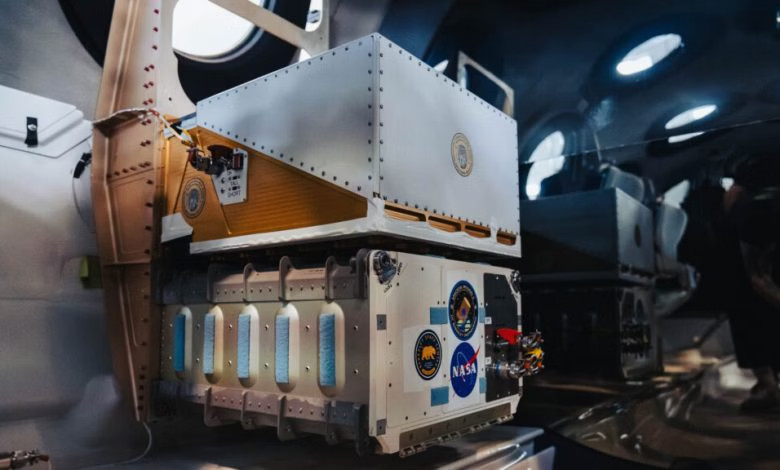
The printer in question is SpaceCAL, a next-generation microgravity 3D printer developed by researchers at the University of California, Berkeley. During the Virgin Galactic 07 mission on June 8, 2024, SpaceCAL spent roughly 140 seconds in suborbital space and autonomously printed and post-processed four small test parts, including space shuttle models and 3DBenchy-style figurines, using a liquid plastic called PEGDA. That is a lot to accomplish in the time it takes most of us to decide whether we want coffee or “just five more minutes.”
But the bigger story is not the tiny printed objects. It is the printing method. SpaceCAL uses computed axial lithography, or CAL, a layerless approach to additive manufacturing. Instead of building an object one thin slice at a time, CAL uses projected light patterns and a rotating vial of photopolymer resin to form a complete object more like a CT scan in reverse. The result is fast, elegant, and potentially powerful enough to change how astronauts make parts, tools, and even medical devices far from Earth.
What Is an Axial 3D Printer?
An axial 3D printer is not a typical desktop machine with a nozzle, filament spool, and the familiar “please do not fail at 97%” energy. SpaceCAL is based on computed axial lithography, a form of volumetric 3D printing. In conventional fused-filament 3D printing, a heated nozzle extrudes plastic layer by layer. In stereolithography, light cures resin layer by layer. CAL takes a different path: it projects many carefully calculated images into a rotating container of light-sensitive material.
As the vial rotates, the light patterns overlap inside the resin. Areas that receive enough light cure into solid material, while the rest remains liquid or gel-like and can be removed. Think of it as sculpting with light, except the chisel is math, the marble is resin, and the studio is briefly floating above Earth.
This matters because layer-by-layer printing can be slow and mechanically complex. It may require support structures, careful build orientation, and a lot of patience. CAL can create certain complex shapes more quickly because it forms the object throughout a volume rather than stacking it from the bottom up. For spaceflight, that speed and simplicity are attractive. Fewer moving parts can mean fewer things to jam, drift, misalign, or throw a tantrum when gravity takes a vacation.
The Virgin Galactic 07 Test: Small Parts, Big Implications
The SpaceCAL experiment flew aboard VSS Unity during Virgin Galactic 07, a suborbital mission that also carried private astronauts and other research payloads. NASA’s Flight Opportunities program supported the UC Berkeley payload, giving the team a chance to test the printer in a real reduced-gravity environment without sending it directly to the International Space Station.
The flight provided approximately three minutes of microgravity. SpaceCAL used that short window to print and finish four test parts. That achievement is important for two reasons. First, the system did not merely start a print; it completed a sequence that included printing and post-processing. Second, it operated autonomously. On a future mission, astronauts will not want to babysit a printer like a nervous parent watching a toddler carry soup. The machine needs to work reliably with minimal crew time.
The parts themselves were test objects, not mission-critical hardware. Still, test objects are how serious engineering earns its passport. A small benchy or shuttle model can reveal whether a process handles shape, curing, accuracy, resin behavior, vibration, timing, and environmental conditions. In aerospace, nobody starts by printing the part that keeps the cabin sealed. You start with controlled experiments, collect data, improve the system, and only then move toward higher-stakes applications.
Why Printing in Microgravity Is Different
On Earth, gravity is always part of the manufacturing environment. It pulls liquid downward, affects bubbles, changes how resins settle, and influences how materials flow. In microgravity, fluids behave differently. Surface tension, capillary action, and tiny trapped bubbles can become much more important. That makes space manufacturing both promising and weirdbasically the perfect combination for engineers.
For CAL, microgravity may open possibilities that are harder to achieve on Earth. Because the method relies on resin or gel material suspended in a rotating volume, the absence of normal gravity can reduce sagging and support-related limits. Researchers have suggested that CAL may make it possible to produce parts in microgravity that are difficult or impossible to print on the ground.
That is why a suborbital flight is valuable even though it lasts only a few minutes. Parabolic aircraft tests can create short bursts of reduced gravity, usually around 20 seconds at a time. A suborbital flight gives a longer continuous window and a more realistic operational environment. It is not the same as months aboard the International Space Station, but it is a practical step between the laboratory and orbital deployment.
How SpaceCAL Builds on Earlier In-Space 3D Printing
SpaceCAL is not the first 3D printer to make headlines beyond Earth. NASA and commercial partners have been testing additive manufacturing in space for years. In 2014, the first 3D printer on the International Space Station produced plastic parts using a fused-filament process. One famous example involved sending a digital wrench design from Earth to the ISS, where it was printed for use in orbit. That moment proved a powerful idea: instead of launching every possible tool, mission teams could transmit a file and manufacture the tool where it was needed.
Since then, the International Space Station has hosted additional 3D printing and in-space manufacturing systems, including plastic printers, recycling concepts, regolith-related experiments, bioprinting studies, and metal 3D printing research. The Additive Manufacturing Facility aboard the ISS has produced many parts for experiments, tools, education, and operational learning.
SpaceCAL fits into this larger movement but brings a different advantage. Traditional extrusion-based printers build objects layer by layer. CAL aims to reduce cycle time, increase geometric freedom, and expand the materials that can be used. UC Berkeley researchers have reported that CAL has printed with more than 60 materials on Earth, including silicones, glass composites, and biomaterials. That versatility matters because space missions do not need only plastic widgets. They may need seals, mounts, medical tools, dental components, wound closure devices, optical elements, and other highly specific items.
Why On-Demand Manufacturing Matters for Mars and the Moon
Every kilogram launched from Earth costs money, planning, and precious payload space. For astronauts going to the International Space Station, resupply is challenging but possible. For crews traveling to the Moon or Mars, the logistics become far more difficult. A Mars mission cannot pause while someone orders a replacement part with two-day shipping. There is no “Add to Cart” button between Earth and the Red Planet, and even if there were, the delivery driver would have questions.
On-demand manufacturing could reduce the need to pack thousands of spare parts. Instead of trying to predict every possible failure, mission planners could carry raw materials, verified digital designs, and compact manufacturing equipment. If a clip breaks, print a clip. If a custom bracket is needed, print a bracket. If an astronaut chips a tooth, a scanned dental crown could one day be manufactured on board. That last example sounds futuristic, but it is exactly the kind of scenario researchers are considering.
The benefit is not only convenience. It is risk reduction. Spacecraft are closed, resource-limited environments. When crews can fabricate what they need, they become less dependent on Earth. That is essential for deep-space exploration, where communication delays, limited cargo, and long mission duration all increase operational pressure.
The Medical Side: More Than Nuts, Bolts, and Brackets
One of the most exciting aspects of SpaceCAL is its possible use in crew health. Additive manufacturing in space is often described in terms of tools and replacement parts, but astronauts are not machines. They are humans living in a difficult environment where a minor medical issue can become complicated quickly.
Researchers have discussed potential applications such as dental crowns, contact lenses, wound closure tools, skin grafts, and eventually bioprinting. Some of these applications are near-term research targets, while others are long-term goals. Still, the direction is clear: future spacecraft may need small, flexible manufacturing systems that support both the vehicle and the crew.
Imagine a mission where an astronaut needs a personalized medical component. On Earth, a dentist, surgeon, or specialist could fabricate it with access to a full clinic. In space, that same customization must come from compact equipment, stored materials, scans, and digital instructions. A fast, multi-material printer could become part workshop, part medical support kit, and part insurance policy.
Why Virgin Galactic’s Spaceplane Was a Useful Research Platform
Suborbital spaceplanes often attract attention for tourism, celebrity passengers, and dramatic views of Earth. But Virgin Galactic’s VSS Unity also served as a research platform. Galactic 07 carried autonomous payloads, including the UC Berkeley SpaceCAL experiment and a Purdue University propellant slosh study. These experiments used the short microgravity window to gather data that is difficult or impossible to collect under normal Earth conditions.
That is the practical value of suborbital research. It gives teams access to real flight conditions without the cost, schedule complexity, and integration demands of an orbital mission. For early-stage space technology, that middle step can be extremely useful. A team can test hardware, learn what fails, improve the design, and fly again before committing to a more expensive destination.
The SpaceCAL test also came at a notable moment for Virgin Galactic. Galactic 07 was VSS Unity’s final commercial flight before the company shifted focus toward its next-generation Delta-class vehicles. In that sense, Unity’s last mission helped demonstrate both the spectacle and the scientific value of commercial suborbital spaceflight.
What Makes CAL Different from Ordinary 3D Printing?
The easiest way to understand CAL is to compare it with baking. Traditional 3D printing is like making a layer cake one slice at a time. CAL is closer to setting a gelatin mold all at once, except with carefully computed light projections instead of a refrigerator and crossed fingers.
Because CAL does not depend on depositing material line by line, it may avoid some of the weaknesses that come from layer interfaces. It can also produce smooth, curved forms without the stair-step texture common in some layer-based prints. For small parts, the speed advantage can be dramatic. UC Berkeley has described CAL parts being created in as little as about 20 seconds under certain conditions.
However, CAL is not a magic replicator from science fiction. It requires suitable light-sensitive materials, precise optical control, reliable post-processing, and careful validation of mechanical properties. A printed part for a spacecraft must do more than look correct; it must perform correctly. Strength, temperature resistance, chemical stability, dimensional accuracy, and long-term durability all matter. SpaceCAL’s successful flight test is a milestone, not the finish line.
Challenges Still Ahead
Before axial 3D printers become standard equipment on deep-space vehicles, several challenges must be solved. Material qualification is one of the biggest. A resin that prints beautifully on Earth must be safe, stable, and useful in a spacecraft cabin. It must not release harmful vapors, degrade under radiation, or create messy waste that astronauts have to chase around the cabin like glowing space confetti.
Another challenge is quality control. On Earth, printed parts can be inspected with advanced equipment. In space, inspection must be compact, automated, and trustworthy. Crews may need cameras, sensors, mechanical testing coupons, or embedded verification methods to confirm that a printed part meets requirements.
Digital design libraries will also be important. Astronauts cannot simply download random files from the internet and hope for the best. Mission-ready parts will need verified designs, approved materials, and clear instructions. The future of space manufacturing may depend as much on data management and certification as on the printer hardware itself.
Finally, the system must be easy to operate. Crew time is one of the most valuable resources in space. The best printer is not just the fastest one; it is the one that works with minimal setup, minimal cleanup, and minimal drama.
Why This Test Matters for Earth, Too
Space technology often returns home in unexpected ways. A compact, fast, multi-material printer designed for astronauts could also be useful in remote hospitals, military field operations, disaster zones, offshore platforms, polar research stations, and rural clinics. Anywhere supply chains are slow, fragile, or expensive, on-demand manufacturing has value.
CAL could also influence industries that need rapid production of customized polymer parts, biomedical devices, optics, soft robotics, and high-precision prototypes. The same technology that might someday print a dental crown on a Mars-bound spacecraft could help create personalized medical devices on Earth. Space makes the requirements stricter, but those stricter requirements often lead to better tools for everyone.
Experience-Based Perspective: What SpaceCAL Teaches Builders, Engineers, and Curious Makers
The SpaceCAL test offers several practical lessons for anyone who has worked with 3D printing, engineering prototypes, or advanced manufacturing. The first lesson is that speed only matters when the whole workflow is fast. A printer that creates an object quickly but requires a long cleanup, cure, inspection, or assembly process may not be truly fast. SpaceCAL’s achievement is notable because it completed printing and post-processing during a very short microgravity window. That points to a more mature workflow, not merely a fast exposure trick.
The second lesson is that environment changes everything. Makers on Earth already know that temperature, humidity, vibration, resin age, nozzle condition, bed leveling, and material quality can turn a print from beautiful to “modern art accident.” In space, the variables multiply. Fluids move differently. Bubbles do not rise normally. Loose particles float. Crew time is limited. Safety rules are strict. The printer must behave like a dependable instrument, not a hobby machine that requires emotional support and a scraper.
The third lesson is that test parts are more useful than they look. To outsiders, printing a tiny space shuttle or benchy might seem playful. But familiar benchmark shapes help researchers compare performance across conditions. A benchy has curves, overhangs, small details, flat surfaces, and fine features. It is a compact torture test wearing a cute little boat costume. In the same way, a small shuttle model can reveal edges, surface finish, dimensional accuracy, and curing behavior.
The fourth lesson is that autonomy is a serious design requirement. On Earth, a technician can pause a print, clean a vat, adjust exposure, or restart a machine. In a spacecraft, every extra step competes with science, maintenance, exercise, navigation, and sleep. A useful space printer should be simple enough for a non-specialist to operate and smart enough to collect data on its own. SpaceCAL’s autonomous operation during Galactic 07 is therefore not a footnote; it is central to why the test matters.
The fifth lesson is about iteration. SpaceCAL did not leap straight from a lab bench to space and casually print four parts like it was showing off at a science fair. The work built on earlier reduced-gravity testing, hardware improvements, environmental preparation, and mission integration. That is how real engineering advances: build, test, learn, revise, and repeat. The glamour moment happens in space, but the victory is earned in months or years of careful work on the ground.
For engineers and makers, the SpaceCAL story is a reminder that the future of 3D printing is not only bigger machines or faster nozzles. It is also new physics, new materials, better software, cleaner workflows, and more thoughtful use cases. The most important printer of the future may not be the one that makes the biggest object. It may be the one that makes the right object, at the right time, in the hardest possible place.
Conclusion
The successful SpaceCAL test aboard Virgin Galactic’s VSS Unity is a compact but meaningful milestone in space manufacturing. In only about 140 seconds of suborbital microgravity, UC Berkeley’s axial 3D printer showed that computed axial lithography can operate beyond Earth, produce multiple parts, and complete post-processing in a short flight window. That does not mean astronauts will soon print every spare part, medical device, or dinner fork on demand. But it does show that a faster, more flexible approach to additive manufacturing may have a real place in future missions.
For Moon bases, Mars journeys, commercial space stations, and long-duration spacecraft, the ability to manufacture parts locally could reduce cargo mass, improve safety, and give crews more independence. SpaceCAL is still a research platform, but its successful Virgin Galactic 07 flight moved it from promising laboratory technology toward something more practical. And in space exploration, practical is where the magic starts wearing a tool belt.