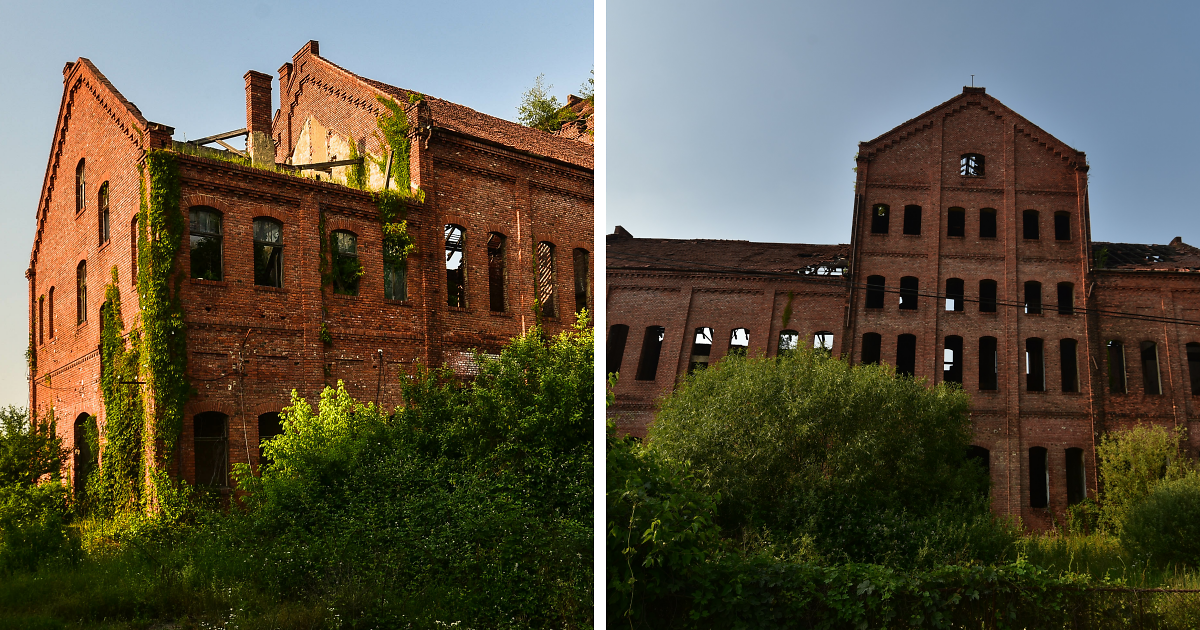
At the edge of Margina, a small commune in Timiș County, Romania, stands a red-brick giant that looks as if it has been paused mid-breath. Its windows are hollow, its roofline is wounded, and vegetation has started doing what vegetation does best: moving in without asking for a lease agreement. This is the abandoned vinegar factory in Margina, Romania, a place where industrial history, rural memory, architectural decay, and post-communist transition all meet under one very dramatic chimney.
To casual travelers, it may appear as just another abandoned factory along a Romanian road. But look closerpreferably from a safe and legal public viewpoint, not by trying to become the main character in a questionable adventure movieand the structure tells a much bigger story. It speaks of beech forests, railway ambitions, chemical production, pickled vegetables, hundreds of workers, nationalization, modernization plans, economic collapse, and the strange sadness of places that were once essential but are now mostly photographed by people who like ruins and moody clouds.
The Margina vinegar factory is more than a crumbling building. It is a symbol of Romanian industrial heritage, rural deindustrialization, and the difficult question of what happens when a community’s working heart stops beating.
Where Is Margina, Romania?
Margina is located in western Romania, in Timiș County, within the historic Banat region. This part of Romania has long been a crossroads of cultures, trade routes, empires, and architectural influences. It sits not far from Lugoj and within reach of Timișoara, the region’s major urban center. The landscape around Margina is rural, green, and quietly scenic, with hills, forests, villages, old churches, and the sort of roads where time seems to travel at a more polite speed.
The commune itself has a history far older than the factory. Margina is associated with medieval settlement patterns, regional fortifications, wooden church heritage, and the mixed cultural story of Banat. Yet for many modern visitors, the old vinegar factory has become one of the most visually striking landmarks in the area. It is not polished tourism. It is not a museum with a gift shop selling vinegar-themed magnetsthough, honestly, that would be weirdly perfect. It is a ruin, and that is precisely why people notice it.
A Factory Born From Railways, Forests, and Ambition
The origins of the Margina vinegar factory date back to the early twentieth century, when investors saw opportunity in the area’s railway connections and natural resources. Historical accounts vary slightly on the exact construction date, with references often placing the factory’s beginnings between 1910 and 1916. What is consistent is the bigger picture: the facility was designed as a wood distillation plant, built with technical expertise linked to German industrial practice and shaped by the economic geography of the former Austro-Hungarian world.
The raw material that gave the factory its purpose was beech wood. The surrounding Romanian mountains and forests supplied plenty of it, and wood distillation was an important industrial process before modern petrochemical production took over many of its roles. Through dry distillation, hardwood could be transformed into useful chemical products, including acetic acid, methanol, acetone, charcoal, and other substances. In simpler terms: people figured out how to turn trees into chemistry. Nature brought the wood; industry brought the boilers, pipes, tanks, and probably a lot of paperwork.
Why Vinegar?
Vinegar may sound humble compared with heavy machinery or petrochemicals, but it wasand remainsa valuable product. In Margina, production expanded beyond wood distillation into vinegar made from wine, along with pickled cucumbers and other preserved vegetables. This was not just a laboratory curiosity. It was food production, trade, agriculture, chemistry, and local employment rolled into one industrial package.
At its peak, the factory helped connect rural Margina to wider European markets. Products such as vinegar, acetone, ethyl alcohol, and related chemical materials were part of a regional industrial network. The site became one of the important employers in the area, reportedly supporting more than 600 workers during the socialist period, with some accounts placing the number around 700 in the 1970s and 1980s. For a rural commune, that was not merely a workplace. That was a gravitational force.
The Golden Years: When the Factory Ran the Clock
For decades, the vinegar factory gave Margina rhythm. Workers came and went. Smoke rose. Machines ran. Railway connections mattered. Families depended on wages earned inside those brick walls. The factory was not a romantic ruin then; it was noisy, productive, practical, and probably smelled like a confusing mix of wood smoke, vinegar, solvents, and ambition.
During the interwar years, the factory broadened its production. It produced acetone, vinegar, and preserved vegetables. Later, after World War II, Romania’s political and economic landscape changed dramatically. In 1948, the facility was nationalized and renamed Distileria de Lemn Severin, meaning Severin Wood Distillery. In later decades, it became linked to the Solventul industrial complex in Timișoara, one of the major chemical and solvent producers in the region.
Under the centralized economy, factories like Margina’s were more than private businesses. They were pieces of the state’s industrial plan. They provided employment, supported local identity, and shaped the physical development of rural settlements. The factory’s buildings, chimney, water tower, production halls, and storage spaces were not random structures. They formed an industrial organism.
After 1989: From Modernization Dreams to Slow Collapse
The Romanian Revolution of 1989 changed everything. Across the country, state-owned factories faced privatization, market pressure, outdated equipment, uncertain investment, and shifting demand. Some survived. Many did not. Margina’s vinegar factory entered the post-communist period with modernization reportedly underway or planned, but the new economic reality was not kind.
Through the 1990s, the factory declined. Production slowed, ownership changed, and valuable equipment was eventually removed or sold as scrap. The site that had once employed hundreds gradually became an abandoned industrial shell. By the late 1990s, the factory had effectively closed, leaving behind brick walls, empty windows, exposed beams, and a landmark that now seemed to ask a difficult question: what is a community supposed to do with the bones of its own industrial past?
This story was not unique to Margina. Throughout Romania and much of Eastern Europe, post-socialist deindustrialization transformed rural and urban landscapes. Factories that had once organized daily life became derelict. Workers lost stable jobs. Young people left. Buildings decayed. Some sites were demolished, some were reused, and otherslike the abandoned vinegar factory in Marginaremained suspended between memory and neglect.
Architecture: Red Brick, Empty Windows, and Serious Gothic Factory Energy
Visually, the factory is unforgettable. Its long red-brick façades, tall arched windows, steep rooflines, and towering chimney give it a powerful industrial character. Even in decay, the building has elegance. The brickwork shows a level of craft that modern box-like warehouses often do not bother with. Today’s industrial buildings frequently look as if they were designed by someone whose favorite shape is “budget rectangle.” Margina’s factory, by contrast, has personality.
The repeated window arches create rhythm. The chimney gives vertical drama. The roof damage exposes the vulnerability of the structure. Vegetation softens the ruin but also signals ongoing deterioration. Trees, vines, and shrubs have moved into courtyards and openings. Nature is not sentimental; it simply sees available space and says, “Fantastic, I’ll take it.”
For photographers, the site is compelling because it offers contrast: brick against sky, industry against greenery, order against collapse, history against silence. For historians, it is important because it captures a chapter of Romanian rural industrialization. For locals, it may carry more complicated feelings: pride, frustration, nostalgia, or disappointment that such a meaningful place was allowed to decay.
Why the Abandoned Vinegar Factory Matters
The abandoned vinegar factory in Margina matters because it represents a type of heritage often overlooked. Castles, churches, and old town squares usually receive attention first. Industrial sites are trickier. They can be polluted, privately owned, expensive to stabilize, and emotionally complicated. Yet they tell the story of workers, technology, trade, modernization, and everyday life.
In Margina, the factory connected natural resources to industry. It turned beech wood, wine, and agricultural produce into goods that traveled beyond the commune. It shaped local employment and identity. It also shows how quickly economic systems can change. A factory can be essential for decades, then become obsolete within a generation. That is not just architecture; that is social history with broken windows.
Industrial Heritage Is Still Heritage
Preserving industrial heritage does not always mean restoring every building to a shiny postcard version of itself. Sometimes preservation means documentation. Sometimes it means adaptive reuse. Sometimes it means stabilizing one façade, creating interpretive signs, developing a safe viewing area, or turning part of the site into a cultural space. The goal is not to pretend the past was perfect. The goal is to avoid erasing it completely.
The Margina factory could be read as a warning and an opportunity. Without intervention, time and weather will continue their quiet demolition work. With imagination, however, the site could become part of a broader regional story about Banat, Romanian industry, rural transformation, and the relationship between memory and development.
Urban Exploration, Safety, and Respect
Abandoned places attract curiosity, and the Margina vinegar factory certainly has the atmosphere that makes cameras nervous with excitement. However, abandoned industrial sites can be dangerous. Roofs may collapse, floors may be unstable, sharp metal and broken glass may be present, and ownership status can make access illegal. No photograph is worth an injury, a legal problem, or the unforgettable embarrassment of explaining to emergency services that you were “just chasing the perfect moody brick shot.”
The safest way to appreciate the factory is from public areas where viewing is permitted. Use a zoom lens, respect fences and signs, avoid climbing, and do not remove objects from the site. Industrial ruins are not free souvenir shops. They are fragile places, and every careless visitor speeds up the damage.
What Visitors Can Combine With Margina
Travelers interested in the abandoned vinegar factory can also explore the wider cultural landscape of Timiș County and Banat. Margina is known for its traditional setting, and the region includes wooden churches, rural scenery, local food culture, and routes that connect historic villages with larger destinations such as Lugoj and Timișoara.
Timișoara, in particular, offers a useful contrast. It is a major western Romanian city with Austro-Hungarian architecture, cultural venues, public squares, and visible urban regeneration. Seeing Timișoara’s revived spaces and Margina’s abandoned factory on the same trip creates a powerful comparison between reuse and neglect, between what gets restored and what remains waiting.
The Emotional Power of Ruins
Ruins are strange because they are both present and absent. The Margina vinegar factory still stands, but the world that made it necessary is gone. The workers are gone. The machines are gone. The smell of production is gone. What remains is structure, silence, and imagination.
That is why abandoned places fascinate people. They let us see time physically. A cracked wall is not just damage; it is a calendar. A missing roof is not just decay; it is weather made visible. Empty windows are not just empty windows; they are the factory looking back at the village like it still has something to say.
And perhaps it does. It says that progress is not automatic. It says that communities need plans for old industrial sites before they become hazards. It says that architecture can be beautiful even when wounded. It says that vinegar, of all things, can leave behind a surprisingly epic monument.
Experience Add-On: A 500-Word Journey Around the Abandoned Vinegar Factory In Margina, Romania
Imagine arriving near Margina on a clear afternoon, the kind of day when the sky looks freshly washed and every brick seems to glow a little warmer than usual. The first thing you notice is the chimney. It rises above the trees like a stubborn exclamation mark, announcing that something important once happened here. Not something cute and decorative, but something loud, practical, smoky, and deeply tied to working life.
From a safe public viewpoint, the factory reveals itself slowly. At first, it is a long red-brick wall. Then the empty windows appear, row after row, each one dark and open. The roof is damaged, the vegetation is thick, and the building has that unmistakable abandoned-site mood: part historic monument, part ghost story, part “please do not stand under that beam.”
The experience is not about thrill-seeking. It is about looking carefully. You begin to imagine the factory in motion. Workers arriving early. Wagons or trucks carrying raw material. Barrels, tanks, pipes, steam, tools, shouted instructions, lunch breaks, tired hands, and the strange pride of knowing that your village helped produce goods sent far beyond its borders. The silence today feels heavier because the place was once so active.
A camera helps, but it can also get in the way. The best moments are often the ones you do not photograph: the wind moving through weeds, the sound of a passing car, the contrast between ordinary village life and this enormous industrial relic standing nearby. It is easy to see why photographers love the site. The factory offers texture everywherebrick, rust, shadow, greenery, broken geometry. It practically poses. If old buildings could have social media profiles, this one would definitely post dramatic sunset photos and mysterious captions.
Yet the most meaningful experience comes from restraint. You do not need to enter the ruin to feel its power. In fact, respecting distance makes the visit better. It reminds you that abandoned heritage is not a playground. It is a fragile historical record. The factory belongs to a larger story of Margina, Banat, Romanian industry, and the uncertain aftermath of economic transition.
Afterward, the surrounding area changes the mood. The rural roads, wooden church heritage, fields, and nearby villages bring the story back to human scale. The factory may dominate the skyline, but it was never just about bricks and chimneys. It was about people. That is what stays with you after leaving Margina: not simply the image of a ruin, but the feeling that a whole working world once stood thereand that remembering it matters.
Conclusion
The abandoned vinegar factory in Margina, Romania is one of those places that refuses to be ordinary. It began as an ambitious industrial facility tied to wood distillation, vinegar production, chemical manufacturing, agriculture, and regional trade. It became a major employer, survived dramatic political changes, and later declined during Romania’s post-communist economic transition. Today, it stands as a red-brick ruin, beautiful and vulnerable, slowly being claimed by nature.
Its value is not only architectural. It is cultural, social, and emotional. The factory reminds us that rural industry shaped communities just as deeply as castles and cathedrals shaped national myths. If preserved, documented, or responsibly interpreted, Margina’s factory could become a powerful symbol of Romanian industrial heritage. If ignored, it may become one more lost landmark remembered only through photographs and stories.
For now, the chimney still rises. The walls still speak. And the old vinegar factory continues to do what ruins do best: make the past impossible to completely forget.
Note: This article is intended for historical, cultural, and travel-interest reading. Abandoned industrial sites may be unsafe or privately owned, so visitors should only view them from legal public areas and respect all local rules.