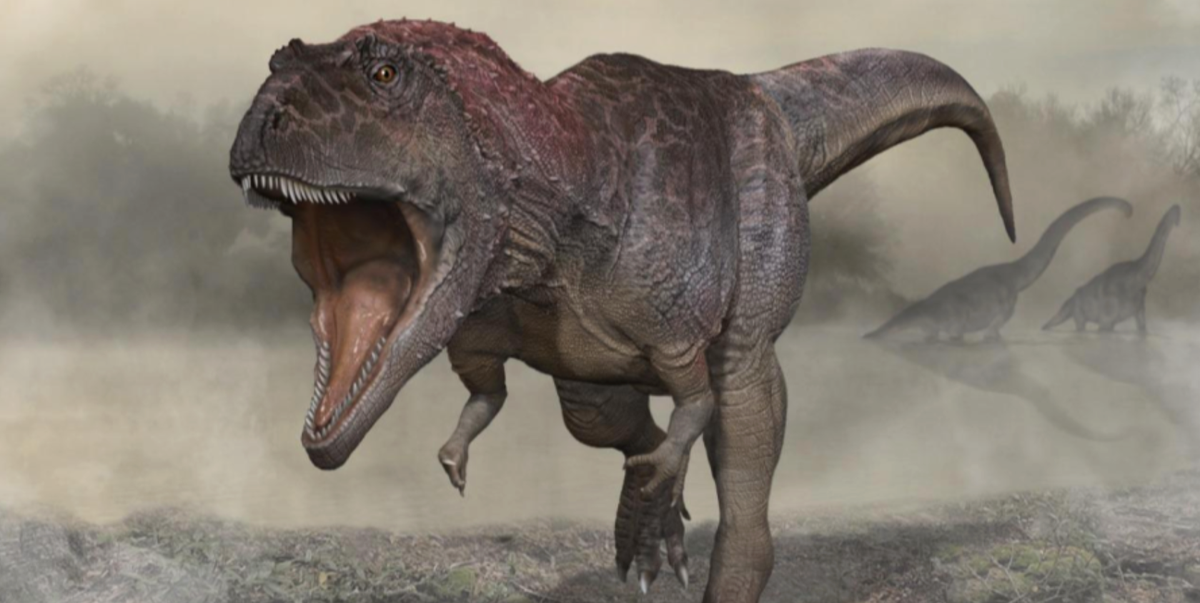
Every few years, paleontology politely taps us on the shoulder and says, “Excuse me, your childhood dinosaur chart needs an update.” This time, the update comes with a massive skull, a meat-eating grin, and arms so short they practically invite internet jokes. Meet Meraxes gigas, a newly described giant predatory dinosaur from Patagonia, Argentina, that looks oddly familiar to anyone who has ever seen a Tyrannosaurus rex skeleton and thought, “Impressive head, questionable arm day.”
But here is the twist: Meraxes gigas was not a tyrannosaur. It belonged to a different branch of carnivorous theropods called carcharodontosaurids, a family that included some of the most intimidating predators ever to stalk the Cretaceous landscape. Even more fascinating, Meraxes lived millions of years before T. rex appeared. That means its tiny arms were not borrowed from the famous tyrant king. Instead, nature seems to have arrived at the same strange body plan more than once: enormous head, powerful jaws, heavyweight body, and front limbs that look like they missed the meeting.
Who Was Meraxes gigas?
Meraxes gigas was a large carnivorous dinosaur that lived roughly 90 to 100 million years ago during the Late Cretaceous Period. Its fossils were discovered in Patagonia, a region now famous for producing spectacular dinosaur remains. The animal measured about 36 feet from snout to tail and weighed around 9,000 pounds, making it an enormous predator even if it was not the absolute largest member of its family.
The name Meraxes comes from a dragon in George R. R. Martin’s fantasy world, which is fitting because this dinosaur had the kind of skull that looks ready for a dramatic entrance. The species name, gigas, means giant. Paleontologists do enjoy a good understatement.
What makes Meraxes gigas especially important is not just its size, but the quality of the fossil. Researchers found one of the most complete carcharodontosaurid skeletons known from the Southern Hemisphere. That matters because incomplete fossils can leave scientists guessing about body proportions. With Meraxes, the evidence was clearer: this animal really did combine a huge skull with very small arms.
Why Everyone Immediately Thought of T. Rex
When people hear “giant meat-eating dinosaur with tiny arms,” the mental image usually arrives wearing a T. rex name tag. Tyrannosaurus rex has become the poster child for awkward forelimbs, even though those arms were likely strong for their size. Meraxes forces us to widen the conversation. It shows that tiny arms were not just a tyrannosaur oddity. They appeared in other giant predators too.
The resemblance between Meraxes and T. rex is an example of convergent evolution. That is when unrelated animals independently develop similar features because they face similar evolutionary pressures. Think of sharks and dolphins: both have streamlined bodies for swimming, but one is a fish and the other is a mammal. In the dinosaur world, Meraxes and T. rex may have followed a similar design recipe despite belonging to different lineages.
Big Head, Tiny Arms: A Dinosaur Design Choice?
The discovery of Meraxes gigas supports an intriguing idea: as some giant theropods evolved larger skulls and stronger bites, their arms became less central to hunting. In other words, when your head becomes the main tool for catching, killing, and processing prey, your forelimbs may stop being the star of the show.
This does not mean the arms were useless. That old joke is fun, but biology rarely keeps expensive body parts around for absolutely no reason. The arms of Meraxes were short, but evidence suggests they may have been muscular. Researchers have proposed several possible functions. The limbs might have helped during mating, assisted the animal in rising from a resting position, or served some social or stabilizing purpose. Scientists are still debating the details, which is polite academic language for “we have bones, but not a time machine.”
The Arms Were Small, Not Silly
It is tempting to laugh at short dinosaur arms because, frankly, they look funny. But from an evolutionary perspective, small does not automatically mean pointless. A bird’s wing, a whale’s flipper, and a horse’s hoof are all modified limbs that became specialized for different jobs. In the case of giant theropods, reduced arms may have been part of a larger anatomical trade-off.
Large skulls require strong neck muscles, balance, and body support. A predator carrying a massive head full of blade-like teeth does not necessarily need long grasping arms. If the jaws are doing most of the work, the body may favor lighter, shorter forelimbs that do not interfere with movement or feeding. The result looks odd to us, but it may have worked beautifully for the dinosaur.
How Meraxes Changes the T. Rex Conversation
For more than a century, scientists and dinosaur fans have wondered why T. rex had such small arms. The discovery of Meraxes does not solve the mystery completely, but it changes the question. Instead of asking only, “Why did T. rex have tiny arms?” we can now ask, “Why did several giant predatory dinosaurs evolve tiny arms independently?”
That broader question is more powerful. It suggests that reduced forelimbs were not an evolutionary accident. They may have been part of a recurring pattern among apex predators with oversized skulls. Meraxes gives researchers a new comparison point, helping them separate features unique to tyrannosaurs from features shared by large meat-eating dinosaurs more generally.
Patagonia: A Hotspot for Dinosaur Discoveries
Patagonia has become one of the most exciting regions in the world for dinosaur paleontology. Its rocks preserve evidence of enormous sauropods, fierce theropods, and ecosystems that looked very different from the North American landscapes where T. rex eventually ruled. The discovery of Meraxes gigas adds another major piece to that puzzle.
The fossil came from rocks associated with the Huincul Formation, a geological unit known for remarkable dinosaur finds. This region has helped paleontologists understand the diversity of large predators in South America before tyrannosaurs rose to fame elsewhere. In Meraxes, scientists found not just another impressive carnivore, but a rare anatomical snapshot of a group that vanished before the end of the Cretaceous.
Meraxes Was Not a T. Rex Ancestor
One common misunderstanding is to imagine Meraxes as a direct ancestor of T. rex. It was not. The two dinosaurs were separated by both time and family history. Meraxes belonged to Carcharodontosauridae, while T. rex belonged to Tyrannosauridae. Their similar proportions developed independently.
This distinction matters because it makes the discovery more interesting, not less. If Meraxes were simply an earlier cousin of T. rex, the resemblance might be expected. But because the two were not close relatives, their shared body plan suggests that evolution repeatedly found the same solution for giant land predators: build a powerful head, keep the arms compact, and let the jaws handle the heavy lifting.
The Skull Was the Star of the Show
The head of Meraxes gigas was large, ornamented, and built for predation. Carcharodontosaurids are named after Carcharodon, the shark genus that includes the great white shark, because their teeth were sharp and serrated. These were not animals designed for nibbling politely. They were large carnivores with skulls adapted for slicing into prey.
In this context, the tiny arms make more sense. A predator with a head like a biological toolbox may not need long forelimbs to subdue prey. The skull, jaws, teeth, neck, and body mass form the main hunting system. The arms become secondary equipment. Not useless, perhaps, but definitely not the headline act.
What Did Meraxes Eat?
Scientists cannot point to a menu and say exactly what Meraxes ate on a Tuesday afternoon 95 million years ago. However, based on its size, teeth, and ecosystem, it was almost certainly a top predator or close to it. It may have hunted or scavenged large dinosaurs, including plant-eating species that shared its environment.
Like modern large predators, Meraxes probably used a mix of opportunity and power. A lion may hunt, steal, scavenge, rest, and then look majestic for documentary cameras. A giant theropod likely behaved with the same practical attitude: calories first, glamour second.
Why Tiny Arms Keep Evolving
The recurring evolution of tiny arms in giant theropods may be tied to body balance, feeding behavior, and the increasing dominance of the head. Large carnivorous dinosaurs had to balance enormous skulls over two legs. Long, heavy arms might have become less useful if they added weight without improving survival.
There is also the possibility that short arms reduced injury risk during group feeding. If several enormous predators gathered around a carcass, long limbs near snapping jaws could be a liability. Shorter arms might have kept valuable body parts out of the danger zone. This idea is still debated, but it shows how a feature that looks comical to humans may have had practical value in a Cretaceous world.
What Meraxes Teaches Us About Evolution
Meraxes gigas reminds us that evolution is not a straight ladder leading to one “best” animal. It is more like a workshop full of repeated experiments. Sometimes, different lineages face similar challenges and produce similar solutions. The tiny-armed, big-headed predator design appears to have been one of those solutions.
This discovery also shows why paleontology is not just about naming new dinosaurs. Each fossil can test ideas about growth, movement, feeding, and extinction. Meraxes helps scientists understand how giant predators changed over time and how different dinosaur families explored similar anatomical strategies.
Experience Notes: Meeting a Dinosaur Like Meraxes in the Imagination
There is a special kind of excitement that happens when a new dinosaur discovery takes a familiar idea and flips it sideways. Many of us first met dinosaurs through museum halls, plastic toys, science books, or movie screens. We learned that T. rex was the big one with tiny arms, and that fact stuck because it was easy to remember and even easier to joke about. Then along comes Meraxes gigas, basically saying, “Actually, this body plan had a fan club.”
Imagine standing in front of a reconstructed skeleton of a giant theropod. The skull dominates your view first. It is not just large; it feels architectural, like a cathedral made for biting. The teeth suggest power. The eye sockets suggest focus. The neck and hips suggest an animal engineered for balance and movement. Then your gaze drops to the arms. They are small enough to make you pause, but not so small that they seem accidental. That contrast is what makes dinosaurs so endlessly interesting. They are familiar enough to recognize as animals, but strange enough to make your brain reboot.
For readers, students, and fossil fans, Meraxes offers a useful lesson in scientific humility. It is easy to assume that a famous feature belongs to one famous animal. Tiny arms? That must be a T. rex thing. But real life is messier and better. Nature repeats patterns. It experiments. It solves similar problems in different places and times. Learning about Meraxes is like discovering that two musicians in different centuries wrote similar melodies because they were both working with the same emotional notes.
The discovery also makes museum visits more rewarding. The next time you see a theropod skeleton, you may look beyond the dramatic teeth and ask better questions. How heavy was the skull? How did the animal balance? Were the arms built for grabbing, display, mating, pushing, or something scientists have not fully understood yet? A fossil is not just a dead thing in a glass case. It is a frozen argument, a set of clues waiting for someone curious enough to ask what they mean.
There is also a fun writing lesson here. Dinosaurs become more memorable when science connects with personality. Meraxes gigas is not just “a carcharodontosaurid theropod from Patagonia,” although that phrase does sound excellent if you want to impress someone at lunch. It is a giant predator with a dragon-inspired name, a skull built like a nightmare toolbox, and arms that spark one of evolution’s funniest serious questions. That combination makes the story stick.
In the end, the experience of learning about Meraxes feels like opening a new door in a house you thought you already knew. Behind that door is a reminder that the dinosaur world was broader, weirder, and more inventive than any single celebrity species can represent. T. rex remains iconic, of course. But Meraxes gigas proves that prehistoric fame has room for another big-headed, tiny-armed legend.
Conclusion: A Small-Armed Giant With a Big Scientific Message
Meraxes gigas may look like a distant echo of T. rex, but its real importance is deeper than resemblance. This dinosaur shows that giant carnivores from separate evolutionary branches could independently develop massive heads and reduced arms. That pattern gives scientists new evidence for understanding how apex predators evolved, how their bodies balanced power and efficiency, and why tiny arms may have been more useful than they appear.
The next time someone laughs at a dinosaur’s short arms, remember Meraxes. Those limbs may not have been made for waving, hugging, or reaching the top shelf, but they were part of a successful predator design that evolution tried more than once. In paleontology, even the smallest arms can carry a very big story.