At Mas Les Vignes, an 18th-century stone farmhouse becomes a thoughtful lesson in slow travel, sensitive restoration, and the increasingly rare pleasure of having nowhere urgent to be.
Some vacation homes try very hard to entertain you. They arrive armed with televisions, game rooms, complicated lighting systems, and enough decorative cushions to establish a small republic. Mas Les Vignes takes a quieter approach. It offers old stone, deep shade, comfortable rooms, a natural swimming pool, and a wooded valley that does not appear remotely interested in your email.
The rural retreat is located near Génolhac in the Cévennes of southern France. It became the first property associated with L’Heure Vide, a hospitality concept created by Dutch couple Michel Mulder and Sofie Sleumer. Translated as “The Empty Hour,” the name captures the project’s purpose beautifully: to give guests time without immediately assigning that time a job.
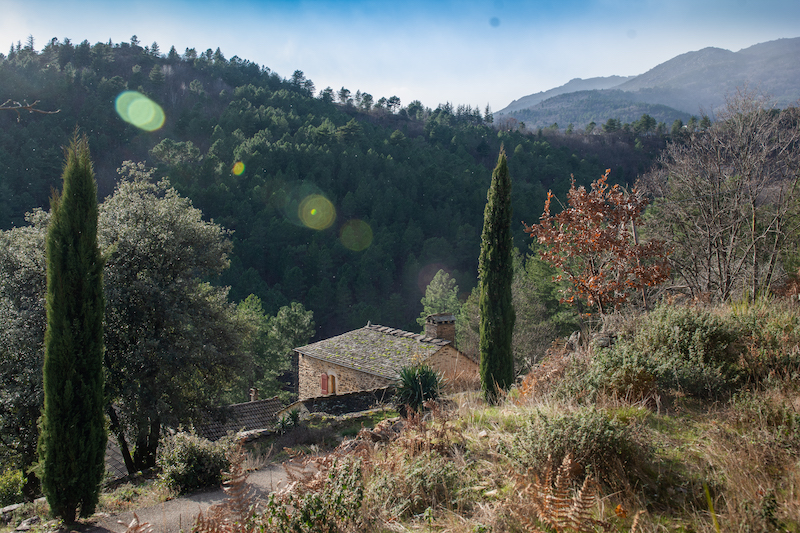
Dating to 1757, Mas Les Vignes is not a newly invented version of country life. Its dry-stone walls, terraces, chestnut timbers, and agricultural past connect it to a living landscape shaped over centuries. The renovation respects that history while introducing contemporary comfort with admirable restraint. Nothing shouts for attention. The house seems to understand that the mountains have already handled the scenery department.
A Rural Retreat Rooted in the Cévennes
The Cévennes occupy the southeastern edge of France’s Massif Central, where granite uplands, limestone plateaus, narrow valleys, rivers, oak woods, and chestnut forests create an unusually varied landscape. Roads bend around mountainsides, villages cling to slopes, and distances that look modest on a map can become wonderfully slow in practice.
Much of this region lies within Cévennes National Park. Unlike many protected wilderness areas, the park has permanent residents whose farming, forestry, and craft traditions remain part of its identity. It has also been recognized as a UNESCO Biosphere Reserve, while the wider Causses and Cévennes cultural landscape joined the UNESCO World Heritage List in 2011.
That designation celebrates more than handsome views. For generations, farmers and herders have shaped the terrain through grazing, transhumance, water management, terraced cultivation, and the construction of dry-stone walls. Historic drove roads, known as drailles, still cross the countryside. Sheepfolds, farmhouses, irrigation channels, and open grazing land reveal a long negotiation between people and difficult geography.
Mas Les Vignes belongs to this story. Its stonework and cascading terraces are not decorative props imported to create “rustic charm.” They are part of the local building vocabulary, formed by available materials, agricultural needs, and the demands of a steep site. That authenticity gives the retreat a quality no mood board can manufacture.
Mas Les Vignes: A Farmhouse With a Long Memory
The property consists of two houses linked by an intimate courtyard. From there, a succession of stone-supported terraces descends through the garden toward a natural swimming pool. Beyond the cultivated edges, the land opens into forested valleys, streams, and the rugged profile of Mont Lozère.
The main farmhouse was structurally sound when Mulder and Sleumer acquired it, but its interiors needed reconsideration. Their objective was not to make the building look younger. Instead, they worked to uncover its character, simplify distracting additions, and allow the original construction to regain visual authority.
The second structure required a more complicated rescue. Formerly used as a stable and cellar, it had damaged exterior walls and needed extensive rebuilding. Floors were removed, the roof came off, and rock had to be excavated so the cellar could become a bathroom. At one stage, little more than three dry-stone walls remained. This was less a quick makeover and more an architectural conversation conducted with masonry, patience, and probably several moments of creative vocabulary.
Local masons and carpenters helped restore the traditional Cévenol farmhouse using regionally appropriate methods and materials. Dry stone, a chestnut-wood frame, and a lauze stone roof preserve the physical language of the original property. Such choices matter because rural architecture in the Cévennes evolved in direct response to the landscape. Thick masonry moderates temperature, small openings control heat and sunlight, and locally sourced stone visually settles a building into its surroundings.
Preservation Without Turning the House Into a Museum
Sensitive restoration can easily become overly solemn. A house may be historically correct yet feel as welcoming as a locked display cabinet. Mas Les Vignes avoids that problem. Its old walls and exposed beams are respected, but guests can still cook, swim, read, spill a little coffee, and generally behave like living people rather than nervous museum interns.
A centuries-old inglenook fireplace anchors the dining area, establishing a natural gathering place. Handmade ceramics, stoneware dishes, vintage discoveries, plants, wooden furniture, and tactile textiles soften the architecture. These elements acknowledge the farmhouse tradition without forcing every object to wear a tiny metaphorical beret.
Interiors That Understand the Value of Less
The interior design uses a calm palette of chalky whites, warm timber, gray stone, muted greens, and earthy neutrals. Whitewashed walls reflect daylight without erasing their uneven texture. The surrounding forest provides color through framed views and scattered plants, creating a quiet relationship between indoors and outdoors.
Contemporary furniture from designers such as Constantin Grcic, Ilmari Tapiovaara, Matthew Hilton, Wouter Scheublin, and Autoban appears alongside objects found at French flea markets and village sales. The combination prevents the retreat from becoming either aggressively minimalist or theatrically rustic. A precisely designed chair may sit near a weathered farmhouse table, and neither seems offended by the arrangement.
This contrast is central to the home’s appeal. Modern pieces provide comfort and clarity, while irregular ceramics and vintage objects add evidence of human hands. The rooms feel edited but not sterile. There is empty space, yet it does not resemble a showroom waiting for a sales associate to materialize.
Comfort That Remains Quietly in the Background
Guest comfort is addressed through good bedding, carefully selected bathroom products, functional kitchens, and spaces intended for groups and families. The property accommodates up to eight guests across four bedrooms, allowing multiple generations or a small group of friends to stay together without requiring everyone to share the same conversation from breakfast until bedtime.
The broader L’Heure Vide idea combines the independence of a private house with selected hotel-style services. The original concept included a pantry of local specialties and natural wines, concierge assistance, and optional housekeeping. It is hospitality without the constant choreography of a conventional hotel: enough support to remove friction, but enough privacy to let guests create their own rhythm.
The Natural Pool and a Garden That Follows the Land
The natural swimming pool is one of Mas Les Vignes’ most memorable features. Rather than dominating the site like a bright blue rectangle dropped from orbit, it sits within the existing sequence of terraces. The restrained design helps it feel connected to the topography and to the agricultural history of the property.
The terraced garden also creates different places to pause throughout the day. One level may catch the morning sun; another offers shade for lunch; a lower terrace leads toward the water. Moving through the property becomes a gentle ritual rather than a commute between amenities.
This layered arrangement reflects the wider Cévennes landscape. Terraces historically made steep ground useful for crops, including chestnuts, vines, and mulberry trees associated with regional silk production. At the retreat, the same land-forming logic now supports gardens, paths, outdoor meals, and long periods of highly productive staring into the distance.
Why the Cévennes Is Made for Slow Travel
The location provides an antidote to tourism organized as a competitive checklist. There are medieval villages, hiking paths, rivers, markets, castles, forests, and mountain viewpoints to explore, but the region rewards attention more than speed.
Nearby Génolhac sits at the foot of Mont Lozère and retains a historic center of narrow streets and stone buildings. Farther afield, travelers can follow old pastoral routes, walk through chestnut groves, swim in secluded river pools, cycle between villages, or visit producers of goat cheese, honey, and other local foods.
After sunset, the landscape offers another reason to slow down. Cévennes National Park was designated an International Dark Sky Reserve in 2018. With limited light pollution across large areas, the night sky becomes part of the destination. Guests accustomed to an urban glow may rediscover that darkness is not an absence of scenery. It is scenery with considerably more stars.
A Living Landscape, Not an Empty Wilderness
Responsible travel in the Cévennes means recognizing that this apparently wild environment is also inhabited and worked. Dry-stone walls require maintenance. Grazing animals preserve open habitats. Farms, footpaths, forests, and water systems are connected to local livelihoods.
Visitors can support that living culture by buying from regional producers, respecting marked paths, following park regulations, conserving water, and treating small villages as communities rather than picturesque sets. Silence is welcome; parking creatively in someone’s doorway is less so.
What Mas Les Vignes Teaches About Restorative Design
The most convincing feature of this Cévennes retreat is not a single chair, fireplace, or view. It is the relationship among them. Architecture, landscape, hospitality, and interior design all encourage a slower pace.
Thick walls create shelter. Limited decoration reduces visual noise. Natural materials add warmth without demanding attention. The courtyard encourages casual meetings, while separate buildings offer privacy. The garden creates opportunities to wander without needing a destination. Even the pool feels like part of the land instead of a device designed to produce holiday photographs.
There are useful lessons here for homes far beyond southern France. Restorative interiors do not necessarily require enormous budgets or historic farmhouses. They begin with reducing clutter, preserving meaningful materials, choosing furniture for touch and comfort, providing soft lighting, and allowing some surfaces to remain pleasantly empty.
The retreat also demonstrates that luxury can be measured in conditions rather than possessions: uninterrupted time, clean air, darkness at night, access to nature, a table large enough for dinner, and a bedroom designed primarily for sleep. In a culture that frequently sells relaxation as another project to optimize, doing less may be the more radical amenity.
Five Experiences That Complete a Stay in the Cévennes
The design of Mas Les Vignes is compelling, but a rural retreat becomes memorable through the hours lived inside and around it. The following experiences show how the house, landscape, and local culture can turn a simple vacation into a genuine reset.
1. Let the First Morning Remain Unscheduled
The best introduction to the retreat may be refusing to improve the morning. Open a window, listen for birds and moving water, and make coffee without immediately consulting a route map. The stone walls keep the bedroom cool while daylight slowly reaches the courtyard.
Breakfast can stretch beyond its normal jurisdiction. Bread, fruit, cheese, and coffee taste more interesting when nobody is eating over a keyboard. The important experience is not the menu but the absence of urgency. Eventually, someone may suggest a walk. Equally, everyone may remain at the table and discuss whether a cloud resembles a sheep. Both are legitimate rural activities.
2. Walk Through Chestnut Country
A trail through the surrounding hills reveals how closely nature and agriculture overlap in the Cévennes. Chestnut groves line many slopes, sometimes growing on terraces constructed generations ago. Some plots remain cultivated, while others have gradually returned to forest.
Walking here engages every sense: dry leaves shift underfoot, warm stone carries the smell of sun, and shaded valleys feel noticeably cooler. Old walls and farm structures appear between trees, turning the route into an informal history lesson. Comfortable shoes are essential. A dramatic scarf is optional but undeniably French-adjacent.
3. Swim, Dry Off, and Resist Documenting Everything
An afternoon at the natural pool offers the most immediate expression of slow travel. The water provides relief from the southern sun, while the surrounding terraces preserve a sense of enclosure without blocking the valley views.
After swimming, the ambitious plan is to lie in the shade with a book. The realistic outcome may be reading three pages and falling asleep. This is not failure. It is the body recognizing favorable working conditions.
Leaving the phone indoors changes the experience. Without a camera, there is no pressure to turn the afternoon into content. The water, wind, and changing light become enough. Ironically, the moments that escape documentation often remain the clearest.
4. Build Dinner Around the Region
A countryside kitchen invites participation. A meal might combine local goat cheese, seasonal vegetables, bread, herbs, honey, chestnut products, and a bottle selected from a nearby producer. The goal is not culinary theater. It is to understand the landscape through ingredients.
Cooking together also changes the social rhythm of the house. One person chops, another sets the table, and someone else offers unrequested expertise while holding a glass of wine. Dinner beside the old fireplace or outdoors on a terrace becomes an event without becoming formal.
When the food is simple and the ingredients are good, conversation supplies the decoration. Plates accumulate, daylight fades, and nobody asks for the check because, delightfully, there is no check.
5. Step Outside After Dark
The night sky may provide the most powerful experience of all. Once the house lights are lowered, familiar constellations emerge among thousands of stars normally hidden by urban brightness. The Milky Way can become visible under favorable conditions, stretching above the dark shapes of the mountains.
Night in the Cévennes also has texture. Insects, leaves, distant water, and occasional animal calls replace the mechanical hum of a city. Standing outside for twenty quiet minutes can recalibrate one’s sense of scale. Daily worries do not disappear, but they may look less qualified to run the entire organization.
That is the deeper promise of Mas Les Vignes. Rest is not merely a soft bed or a free afternoon. It is a temporary release from constant stimulation, decision-making, and performance. The farmhouse provides the setting, but the empty hour must still be accepted by the guest.
Conclusion: The Luxury of an Empty Hour
Mas Les Vignes succeeds because it does not isolate design from place. Its dry-stone construction, chestnut timbers, old terraces, contemporary furniture, natural pool, and understated hospitality work together as parts of one idea. The retreat preserves the character of a 1757 farmhouse while making it comfortable for modern travelers, proving that thoughtful renovation can honor history without sacrificing ease.
More importantly, the property presents a persuasive alternative to louder definitions of luxury. There are no gold-plated distractions competing with the landscape. The rare commodities are privacy, darkness, quiet, natural materials, and unclaimed time.
In the Cévennes, rest does not arrive as a scheduled wellness activity. It appears gradually: over coffee in the courtyard, on a shaded trail, beside the pool, around the dinner table, or beneath a sky crowded with stars. L’Heure Vide gives that experience an elegant name. Mas Les Vignes gives it a home.