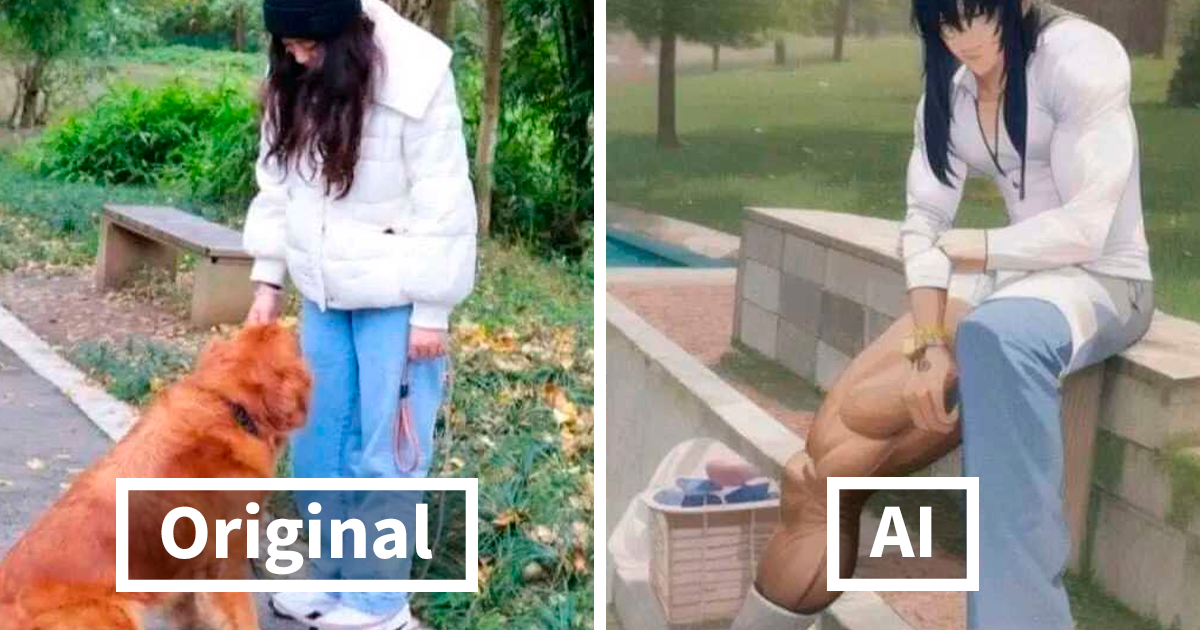
Artificial intelligence can summarize documents, generate code, and analyze complicated data. Then you show it a blurry photo of a dog under a blanket and it confidently announces, “This appears to be a mputer vision systems are remarkably capable, but researchers continue to document basic perception errors, visual hallucinations, and failures caused by ambiguous image details. OpenAI has acknowledged that visual models can still make perception mistakes, while Microsoft researchers describe hallucination as a continuing challenge for large vision-language models. MIT studies have also shown that naturally difficult images can expose major gaps between human and machine recognition. t AI image recognition fails happen when a completely ordinary picture enters the algorithmic imagination machine. A cat becomes a squirrel. A muffin becomes a Chihuahua. A washing machine suddenly has emotional problems. The AI does not simply get the answer wrong; sometimes it writes a tiny screenplay explaining its wrongness.
Here are 25 hilarious types of AI photo confusion inspired by documented computer vision errors, visual ambiguity research, and the wonderfully chaotic situations people keep presenting to image-analyzing systems.
25 Hilarious Times AI Completely Misunderstood a Picture
1. The Chihuahua That Became Breakfast
The legendary Chihuahua-versus-muffin problem deserves the opening ceremony. Small brown dogs photographed from above can share enough visual characteristics with blueberry muffins to create a genuine classification challenge. The resemblance became so famous that researchers and developers have used the comparison when demonstrating difficult computer vision problems. oading a treasured puppy photo and receiving: “The baked item appears slightly overdone.”
Sir, his name is Peanut.
2. A Cat in a Tree Apparently Became a Squirrel
Naturally occurring images can confuse sophisticated object-recognition systems without anyone deliberately modifying the pixels. Research collections of these challenging pictures have included examples where AI interpretation dramatically differs from what a person immediately recognizes. The Verge described the concept memorably with the idea of a human seeing a cat in a tree while the AI sees a squirrel. esumably, has contacted its attorney regarding species reassignment.
3. The School Bus Made Entirely of Abstract Nonsense
In one famous line of computer vision research, artificial patterns that looked meaningless to humans were classified by neural networks as recognizable objects with extremely high confidence. WIRED reported examples including abstract imagery labeled as school buses, peacocks, bagels, and butterflies. AI equivalent of staring at wallpaper for too long and saying, “I definitely see a 2012 Honda Civic.”
4. The Face Hiding in a Coffee Maker
Humans regularly see faces in electrical outlets, clouds, buildings, and kitchen appliances. This phenomenon is called pareidolia. Interestingly, MIT research using thousands of “faces in things” images found important differences between how humans and computer systems detect these illusory faces. t see a cheerful coffee maker smiling at you. AI might see “industrial equipment.”
Congratulations. Somehow the robot is the boring one.
5. Grandma’s Blanket Became a Pizza
Take a close-up photograph of a textured orange-and-red blanket, remove obvious room context, and the visual clues start behaving suspiciously like melted cheese and tomato sauce.
An image classifier focuses on learned patterns. Texture, shape, and color can sometimes push a model toward an incorrect category, especially when the normal contextual clues are weak or missing. Computer vision historically relies on image features and learned relationships to build an interpretation of a scene. nt six months crocheting it. AI recommends adding pepperoni.
6. The Bald Head Mistaken for a Knee
A tightly cropped picture is dangerous territory. Remove the eyes, ears, shoulders, and surrounding scene, and suddenly one smooth curved patch of skin can resemble several body parts.
Human viewers unconsciously use broader context. AI models may overweight the visible region presented to them, particularly when fine-grained visual evidence is incomplete. Research on multimodal hallucination has specifically examined problems with visual grounding and uneven attention to important image details. ws: your knee has a distinguished career in accounting.
7. A Fluffy Dog Became a Floor Mop
Long-haired white dog. Tile floor. Head turned away from the camera.
Human: “Cute dog.”
AI: “Cleaning equipment.”
The confusion is almost insulting until the dog stands up and looks exactly like a mop attempting to remember where it parked.
8. The Rifle That AI Thought Was a Helicopter
Not every visual error happens naturally. Researchers have repeatedly demonstrated adversarial examples: carefully altered images designed to push machine vision toward incorrect classifications. Some alterations can be extremely subtle to human observers. Reporting on adversarial vision research has described a rifle being pushed toward a helicopter classification and road signs being manipulated to confuse machine systems. lab demonstration. Considerably less funny when machines make safety-critical decisions.
9. A Sleeping Baby Became a Burrito
A baby tightly wrapped in a beige blanket is adorable.
It is also, from a purely geometric perspective, suspiciously burrito-shaped.
Add dim restaurant-style lighting and a brown couch, and you have provided AI with the visual equivalent of a trick question.
“Food detected.”
The parents disagree. The baby’s cheeks remain unconvinced.
10. The Beard That Registered as Wildlife
Large gray beard. Extreme close-up. Poor lighting.
Suddenly an image system begins looking for a shaggy animal.
This is a recurring reason AI photo fails are so funny: humans know they are looking at Uncle Dave because they recognize Uncle Dave. A machine analyzing the visual evidence does not share Thanksgiving history, family gossip, or knowledge of Dave’s four-year commitment to becoming a woodland wizard.
11. The Dog With Two Heads
Two similar dogs cuddle together. One body disappears behind the other. Their heads point in opposite directions.
AI attempts scene interpretation.
AI regrets accepting this assignment.
Occlusionwhen objects partially block one anotherhas long complicated visual analysis. Real-world recognition becomes more difficult when the complete shape of an object is not available. Research on naturally challenging images demonstrates that real scenes can produce substantial performance drops compared with cleaner benchmark conditions. man Hand With an Apparently Impossible Finger Situation
Hands have become accidental celebrities in conversations about AI-generated imagery. Fingers overlap, bend, disappear behind objects, and appear at unusual angles.
Show AI a photograph of intertwined hands and ask for a quick description. The resulting explanation may sound like a medical mystery written by someone who recently learned the word “phalange.”
Meanwhile, the humans in the picture are simply holding hands.
13. A Brown Cat Became a Rotisserie Chicken
Curled cat. Warm lighting. Brown fur. Photograph taken from above.
You already know where this is going.
The machine detects something dinner-shaped.
The cat wakes up, looks deeply offended, and provides the most important contextual clue of all: rotisserie chickens rarely knock glasses off tables for entertainment.
14. The Mirror Created an Extra Person
Mirrors are basically unpaid interns working for chaos.
A photograph may contain one person and one reflection, but visual systems must correctly understand that these are representations of the same individual. Reflections, screens, posters, and photographs inside photographs complicate scene relationships.
AI occasionally responds as though a mysterious second person has entered the bathroom.
No ghost. Just a mirror and poor spatial reasoning having a meeting.
15. The Chair Wearing a Jacket Became a Person
Every human has experienced this at 2 a.m.
You wake up. The chair in the corner is clearly a murderer.
You turn on the light. It is your hoodie.
Machine vision can face its own version of this confusion when shape and texture resemble familiar categories. The difference is that humans usually correct themselves. A hallucinating vision-language system may confidently continue describing the “person” and occasionally invent attributes not clearly present in the image. Multimodal research identifies nonexistent objects and incorrect object attributes as common forms of visual hallucination. ncake With a Human Face
Three blueberries accidentally form two eyes and a mouth.
Congratulations. Your breakfast has achieved consciousness.
Humans are especially eager to detect face-like arrangements. MIT’s pareidolia research found a measurable behavioral gap between people and machine detectors, demonstrating that “seeing a face” is more complicated than simply locating two dark points above a horizontal line. dy wants to cut the pancake after it starts looking worried.
17. A Shadow Became an Entire Animal
Some AI descriptions deserve awards for commitment.
A dark shadow appears behind a picnic table. The system decides there is an animal. Then it identifies the animal as a dog. Then it starts describing the dog’s position.
There was never a dog.
This is visual hallucination with a plot. Once an incorrect interpretation enters a model’s response context, later reasoning can build on the bad assumption. Recent research continues to study how hallucinated visual semantics affect subsequent reasoning. ow-Covered Rock Became a Polar Bear
White mound. Dark dot. Arctic-looking environment.
“Polar bear.”
Nope. Rock.
But this is the kind of mistake humans can understand. The context strongly encourages an expected interpretation. Computer vision itself has long been described as an expectation-guided process in which learned models help interpret sensory information.
The rock has not commented on its brief wildlife career.
19. The Sunglasses Became Two Tiny Televisions
Reflective lenses are visual chaos containers. Buildings, clouds, people, and phones can appear inside two curved surfaces barely larger than coins.
Zoom aggressively into sunglasses and ask AI what it sees.
You may receive a detailed description of objects that are actually distorted reflectionsor objects that are not identifiable at all.
Artificial confidence is especially funny when the source image contains approximately twelve useful pixels.
20. The Birthday Cake Became a Building
Architectural cakes are dangerous.
Fondant windows. Tiny doors. Multiple floors. Miniature trees.
Remove the plate and candles from the frame and an AI system may begin discussing architecture.
“The building has decorative exterior detailing.”
Correct, technically.
It also has buttercream insulation.
21. The Person in a Costume Became an Actual Creature
Humans understand costumes because we carry huge amounts of social knowledge. We know people dress as dinosaurs, superheroes, bananas, and occasionally inflatable chickens with suspiciously muscular legs.
A vision model must infer the relationship between person, clothing, and represented character.
Sometimes it skips the “costume” concept completely.
“A dinosaur is standing near several parked cars.”
Local paleontologists rush to the scene. It is Kevin.
22. The Tiny Background Object Became the Main Character
You upload a family vacation photo.
There are six smiling people in the foreground.
AI notices a bicycle occupying 2% of the image.
“This image shows a bicycle outdoors.”
Thank you, Sherlock Silicon.
Research into multimodal hallucination and visual attention suggests that models can distribute attention unevenly across visual information, occasionally missing subtle but essential details or overemphasizing particular image tokens. urry Bird Became a Household Appliance
Bird photography creates perfect conditions for AI confusion. The subject is moving, the camera is zoomed in, wings alter the familiar silhouette, and the background may be messy.
A badly timed frame can transform a majestic hawk into what appears to be an airborne toaster.
AI makes its choice.
Somewhere, a birdwatcher quietly closes the laptop.
24. The Meme Text Changed the Meaning of the Whole Picture
Image understanding increasingly combines visual and language information. That is powerful, but visual and textual signals can create complicated interactions. Google research has explored shared image-text representations, while modern multimodal systems explicitly process images alongside written prompts and descriptions. arcastic caption to a completely ordinary image.
Human readers understand the joke.
AI occasionally treats the caption like sworn testimony.
A meme saying “My dangerous attack beast” beneath a photo of a sleepy Pomeranian may inspire an unexpectedly serious description of aggressive animal behavior.
The Pomeranian is currently asleep inside a slipper.
25. AI Was So Confident That You Almost Believed It
The funniest AI photo fail is not always the strangest answer. Sometimes it is the delivery.
No hesitation. No “possibly.” No “the image is unclear.”
Just digital confidence.
“The photograph clearly depicts a goat operating farm machinery.”
You zoom in.
It is your uncle wearing a beige hat beside a lawn mower.
Overconfident wrong visual predictions remain an active reliability concern in multimodal research. Newer work explores uncertainty measures, external evidence, and decision systems that encourage models to answer cautiously or abstain when visual evidence is insufficient. I Get So Confused by Ordinary Photos?
AI does not experience a photograph exactly as a person does. Human vision involves a complex partnership between the eyes and brain, and people bring memory, expectations, cultural understanding, and lived experience into visual interpretation. A person sees a family member under a blanket and immediately knows, “That’s my brother being weird again.” m analyzes visual information through learned mathematical representations. Modern systems are far more sophisticated than simple color or edge detectors, but training examples still matter enormously. If datasets include labeling errors, incomplete coverage, or systematic bias, the resulting models can inherit problems. Major dataset reviews have identified mislabeled examples, and NIST has warned that AI bias can emerge throughout the development process. n Disappear in a Crop
A full image might clearly show a Labrador lying on a carpet. Crop the photograph until only curly golden fur remains and the classification problem changes dramatically.
Humans often reconstruct missing information using memory or knowledge about the original situation. AI receives what you give it. When visual evidence is ambiguous, recent research shows that vision-language systems can still produce confident interpretations that exceed what the pixels actually support. Is Messier Than a Perfect Dataset
Vacation photos contain reflections. Pets move. Children cover their faces. Birthday candles create smoke. Someone always puts a thumb over the camera.
MIT researchers have specifically investigated images that people can recognize but machine systems find unusually difficult. One reason is that benchmark performance does not automatically guarantee equally reliable recognition under every unusual real-world viewpoint or scene configuration. ld a Story Around One Wrong Guess
This is where a harmless mistake becomes comedy gold.
Suppose a system misinterprets a pillow as a cat. If asked for a detailed description, it may discuss the “cat’s position,” “fur,” and relationship to nearby furniture. The initial error becomes the foundation for everything that follows.
Multimodal hallucination research continues to focus on exactly this problem: responses that sound coherent but do not accurately match the visual input. s Lesson Hidden Inside the Hilarious AI Fails
Laughing at an algorithm for calling a Chihuahua a muffin is harmless. The larger lesson, however, matters.
Image recognition is used in increasingly consequential settings. Researchers and standards organizations have investigated performance differences, adversarial vulnerabilities, biased outputs, and unreliable classifications. An MIT report on commercial facial-analysis systems, for example, documented major error-rate disparities across demographic groups in the systems tested. NIST guidance emphasizes that harmful AI bias is broader than a single algorithm and can arise from human, institutional, and technical factors. ot mean computer vision is useless. Far from it. Machine perception supports image search, scientific analysis, accessibility tools, mapping, medical research, and countless other applications. Google Research describes machine perception as tackling difficult problems across images, video, and other media, while current AI research continues improving visual grounding and fine-detail recognition. e takeaway is simpler: confidence is not evidence of correctness.
When an AI description matters, users should consider the quality of the image, check important details, and avoid treating an uncertain visual interpretation as unquestionable fact.
When the stakes do not matter?
Please continue showing AI strangely cropped pictures of your pets. Humanity deserves joy.
My Experience Watching AI Try to Understand People’s Pictures
Spend enough time testing AI with images and you develop a strange hobby: finding photographs that look completely normal to you but might cause a machine to have a small existential crisis.
My favorite situations are not carefully engineered adversarial tests. They are ordinary camera-roll disasters.
You know the photos. Someone moved at the exact moment the shutter fired. A dog’s nose occupies half the frame. A mirror reflects a television that displays another person. Three relatives overlap during a group hug until everyone appears to share one enormous shoulder.
Those pictures are visual riddles even before AI arrives.
One useful lesson from working with image-analysis systems is that the first description can change dramatically when you provide better context. Show a severely cropped picture of fur and ask, “What is this?” The question is almost inviting a guess. Show the complete photograph and explain that it was taken at a dog park, and the available evidence becomes much stronger.
That experience has made me suspicious of both AI confidence and human expectations.
People often approach artificial intelligence as though it should know what they know. You remember taking the photograph. You know the person in the corner is your cousin. You know the furry object beside the couch is your dog because the furry object recently ate one of your socks.
The AI does not have that history.
When it produces a ridiculous answer, our immediate reaction is, “How could you possibly think that’s a muffin?”
But then you zoom in.
You rotate the screen.
You briefly cover the dog’s eyes with your thumb.
Oh no.
It is a little muffin-ish.
Another entertaining part of testing AI vision is watching one error develop into an increasingly elaborate narrative. A blurry shape becomes a bird. The bird becomes a seagull. The seagull is apparently “looking toward the water.” There is no water. There is no seagull. The original object is a plastic grocery bag stuck on a fence.
The model has gone from visual analysis to nature documentary in approximately three sentences.
This is also why asking follow-up questions can be revealing. Instead of accepting “there is a dog near the table,” ask where the dog is located. Ask what visual details support the identification. Ask whether the image is clear enough to be certain.
Sometimes the system effectively walks back the answer. The mysterious dog becomes “a dark object that may resemble an animal.”
Translation: “Upon further review, I may have invented Steve.”
I have also noticed that AI confusion frequently exposes how weird photography itself can be. Cameras flatten three-dimensional scenes. Telephoto lenses compress distance. Reflections duplicate objects. Shadows hide boundaries. Motion blur stretches familiar shapes into accidental abstract art.
Humans are extraordinarily good at forgiving those problems because we understand the world behind the image.
We do not think a dog literally has no legs because its body disappears into tall grass. We know the legs continue existing. We do not assume two people have fused because one is standing directly behind the other. We understand occlusion, perspective, social situations, and physical reality almost automatically.
AI has improved tremendously at many visual tasks, but the funniest failures remind us that recognizing pixels and understanding a scene are not always identical achievements.
And perhaps that is why these mistakes remain so entertaining.
For a moment, we get to see an ordinary photograph through an interpretation that is totally unfamiliar. A jacket becomes a stranger. A rock becomes a bear. A pet becomes baked goods.
It is wrong.
It is sometimes spectacularly wrong.
But when no important decision depends on the answer, there is something deeply funny about watching advanced technology encounter a picture of a curled-up cat and essentially say, “I believe this is poultry.”
Conclusion: AI Vision Is Brilliant, Weird, and Still Learning
Artificial intelligence can recognize complex scenes and connect visual information with natural language, yet ambiguous pictures continue to reveal the gap between machine perception and everyday human understanding. Research into visual hallucination, difficult natural images, adversarial examples, pareidolia, and dataset quality shows that these errors are real technical challenges rather than merely internet jokes. , a badly identified dog photo usually has extremely low stakes and extremely high entertainment value.
So the next time AI looks at your pet and confidently identifies a croissant, do not get angry immediately. Save the screenshot. Show your friends. Apologize to the pet.
Then perhaps upload a clearer picture.
Note: The humorous scenarios in this article combine documented AI vision failure patterns, widely discussed computer vision examples, and editorially reconstructed everyday photo situations. They are presented to explain genuine visual-recognition limitations without attributing every vignette to one specific AI product or viral post.