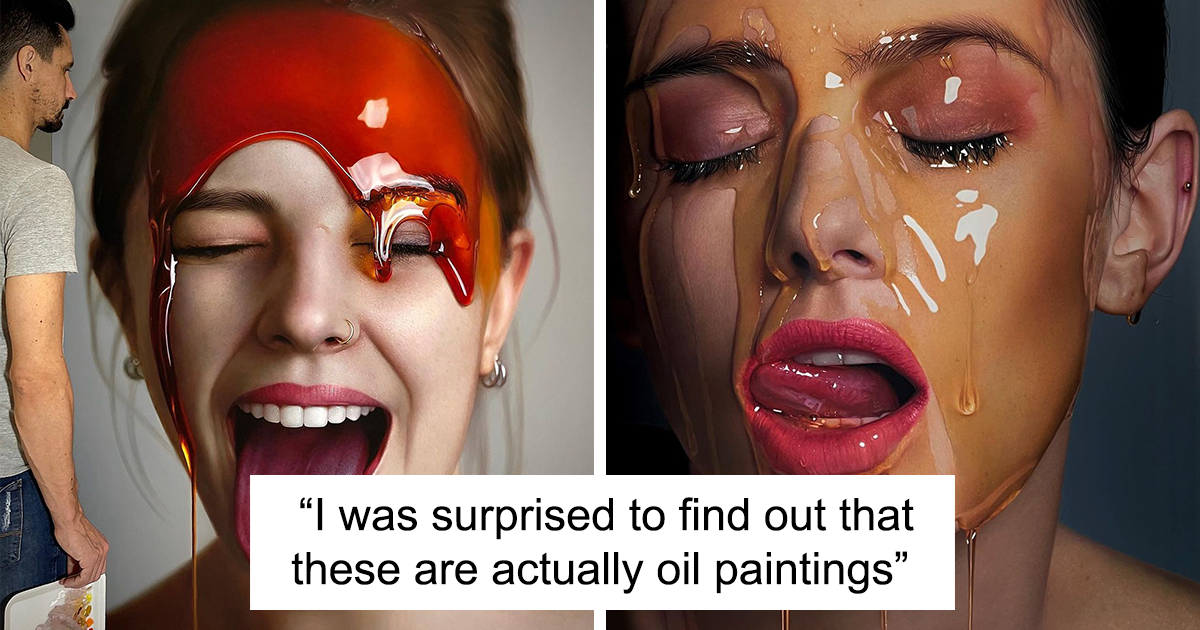
At first glance, Fabiano Millani’s portraits look like they were taken with a high-end camera, edited by a perfectionist, and polished until every pore behaved itself. Then you look closer. The shine on the skin is paint. The wet eyelashes are paint. The honey-like drips, soft shadows, tiny reflections, and almost suspiciously perfect highlights are all paint. Somewhere, a camera is quietly having an identity crisis.
Millani, a Brazilian artist known for hyperrealistic oil portraits, has built a reputation for creating paintings that look like photographs. His work often focuses on expressive faces, luminous skin, water, honey, caramel-like textures, and the kind of details that make viewers zoom in, squint, and say, “Wait, seriously?” The answer is yes: seriously. These are paintings.
The viral appeal of “45 portraits by a Brazilian artist” is easy to understand. In a world flooded with filters, AI images, and camera-ready faces, Millani’s portraits remind us that the human hand can still compete with the lensand sometimes win by being slower, stranger, and more emotionally charged.
Who Is Fabiano Millani?
Fabiano Millani is a Brazilian contemporary realist and hyperrealist painter, widely recognized for oil paintings and drawings that imitate photographic precision. His portraits are especially famous online because they combine technical discipline with sensual surfaces: glistening water, sticky golden honey, wet strands of hair, and skin tones so carefully layered that they seem lit from within.
Born in Brazil, Millani is associated with contemporary realism and has developed a strong following through his portraits, workshops, online courses, and social media presence. He is not simply copying a photograph in paint. His best works turn the photographic look into a stage. Light becomes drama. Texture becomes personality. A drop of honey can feel as important as an eye. That is the magic trick: the painting looks real, but the realism is carefully composed.
Why These Paintings Look Like Photographs
Photorealistic painting is not just “being good at drawing,” though that certainly helps. It is a full system of seeing. The artist must understand proportion, color temperature, edge control, value, anatomy, and how light behaves on different surfaces. In Millani’s case, the challenge becomes even more intense because many portraits include reflective liquids. Water on skin is not one color. Honey is not simply yellow. It carries amber, brown, white highlights, transparent shadows, and tiny distorted reflections.
1. The Skin Has Depth, Not Just Color
One reason Millani’s portraits feel photographic is his treatment of skin. Real skin is never a flat peachy layer. It has cool undertones, warm blush, tiny pores, subtle redness, soft shadows, and areas where light scatters gently. Hyperrealist painters often build this effect through many thin layers, allowing tones to blend without becoming muddy. The result is skin that appears breathable rather than plastic.
2. The Highlights Are Extremely Precise
In a realistic portrait, highlights are tiny troublemakers. Put one in the wrong place and the whole illusion collapses. Millani’s paintings often feature glossy lips, wet eyelashes, liquid drops, and reflective skin. These require pin-sharp highlights placed with surgical confidence. One small white stroke can make a droplet look round, wet, and alive. One careless stroke can make it look like spilled correction fluid. Hyperrealism is not kind to laziness.
3. The Edges Behave Like a Camera Lens
Photography teaches us to read focus. Some edges are crisp; others dissolve. Millani’s portraits often use this language beautifully. Eyes, lips, and wet textures may appear sharper, while surrounding skin or hair can soften into atmospheric blur. That balance creates a camera-like experience without losing the warmth of painting.
Photorealism vs. Hyperrealism: What Is the Difference?
Photorealism emerged as a major art movement in the United States in the late 1960s and early 1970s. Artists used photographs as source material and recreated camera-based images with extraordinary accuracy. Classic photorealism often focused on cars, diners, city streets, storefronts, and everyday American scenes. It was cool, polished, and fascinated by the mechanical eye of the camera.
Hyperrealism goes a step further. It can look photographic, but it often intensifies reality. A hyperrealist portrait may feel more vivid than a photo because the artist exaggerates clarity, texture, contrast, or emotional presence. In that sense, Millani’s work fits comfortably into the hyperrealist tradition. His portraits do not merely say, “This is what a camera saw.” They say, “This is what reality might look like if your eyes had a zoom lens, perfect lighting, and unlimited patience.”
The Power of the Human Face
Portraits have always been magnetic because humans are professional face-readers. We search faces for clues: joy, suspicion, sadness, confidence, fatigue, mystery, and occasionally whether someone has had enough coffee. Millani’s portraits use this instinct. The viewer approaches for the technical shock“How is this paint?”but stays for the emotional pull.
Many of his portraits present faces close to the viewer, often cropped dramatically. This closeness creates intimacy. There is no crowded background competing for attention. No decorative furniture waving from the corner. Just the face, the light, the texture, and the strange feeling that the painted person might blink.
Why Honey, Water, and Caramel Work So Well
One of Millani’s most recognizable visual signatures is the use of glossy liquids on faces. Honey and caramel are especially effective because they bring both beauty and difficulty. They are sticky, translucent, warm-toned, and visually rich. They also create a delicious problem for the painter: every drip must follow gravity, wrap around facial structure, catch light, and still look believable.
These materials add symbolism too. Honey suggests sweetness, temptation, luxury, and sensuality. Water suggests freshness, vulnerability, and transformation. Caramel adds warmth and indulgence. Together, they make the portraits feel less like passport photos and more like cinematic moments. Nobody is getting a driver’s license picture taken with honey dripping down their cheekat least we hope notbut as art, the effect is unforgettable.
The “45 Portraits” Effect: Why Viewers Can’t Stop Looking
A single hyperrealistic portrait is impressive. Forty-five of them become an experience. The viewer starts by admiring the illusion, then begins comparing details. Which face has the most convincing eyes? Which hair texture looks impossible? Which drip of honey deserves its own tiny museum label? The collection format encourages slow looking, even online, where most people scroll faster than a caffeinated squirrel.
That is one reason this kind of art performs well on visual platforms. It offers an instant hook: “These are not photos.” But it also rewards attention. The longer you look, the more you notice the craft. The texture of lips, the moisture at the lash line, the way a shadow curves under the nose, the quiet shift from warm light to cool shadoweach small detail becomes proof of labor.
Technique: The Discipline Behind the Illusion
Hyperrealistic oil painting usually begins with a strong reference image and a precise drawing. Some artists use grids, transfers, projection, or careful measuring to establish accurate proportions. From there, the painting process can involve underpainting, color blocking, glazing, blending, refining, and final detail work. Oil paint is especially useful because it allows smooth transitions, rich color, and slow drying time.
Millani’s style depends on patience. A realistic face cannot be rushed without consequences. The artist must move from big shapes to small details, from shadow masses to pores, from general color to the almost microscopic behavior of light. It is like building a mansion and then hand-polishing every doorknob with a single-hair brush. Dramatic? Yes. Necessary? Also yes.
Why This Art Still Matters in the Age of AI
Today, realistic images can be generated, filtered, edited, and shared in seconds. That might make hand-painted photorealism seem old-fashioned. Instead, it makes it more fascinating. When an artist spends days or weeks building one face in oil paint, the result carries a different kind of value. It is not only the final image; it is the visible evidence of time.
Millani’s portraits invite viewers to think about effort. They ask us to notice the difference between instant output and disciplined craft. A camera captures light quickly. A painter reconstructs it slowly. That slowness becomes part of the artwork’s emotional weight. The painting says, “Someone looked at this face for a long time and cared about every inch.” In a distracted age, that is almost radical.
What Artists Can Learn From Millani’s Portraits
For beginners, Millani’s work can feel intimidating. Looking at one of his portraits while holding a beginner brush is like watching an Olympic gymnast and then tripping over your own yoga mat. But there are useful lessons hidden inside the intimidation.
Study Values Before Details
The illusion of realism depends first on light and shadow. Tiny eyelashes will not save a portrait if the face structure is wrong. Artists should train themselves to see large value shapes before chasing pores, highlights, or individual hairs.
Respect the Reference, But Do Not Become Its Prisoner
Hyperrealistic artists often rely on photographic references, but the strongest paintings still involve artistic judgment. The painter chooses what to sharpen, soften, emphasize, or simplify. A reference is a map, not a bossy landlord.
Texture Is Storytelling
Millani’s liquids are not decorative extras. They shape the mood of the portrait. Texture can communicate freshness, luxury, tension, warmth, or mystery. Artists who want more engaging portraits should think beyond likeness and ask what surfaces can say emotionally.
Why Viewers Love Being Fooled
There is a special pleasure in discovering that something is not what it appears to be. Millani’s paintings deliver that pleasure instantly. The viewer thinks, “Nice photo,” then learns it is a painting, then mentally rewinds the entire image. Suddenly every detail becomes more impressive. The illusion transforms from image to achievement.
This is why photorealistic and hyperrealistic art has such wide appeal. It speaks to experts and casual viewers at the same time. You do not need an art history degree to appreciate the shock of realism. You only need eyes and a willingness to be delighted. If you have ever leaned toward a painting in disbelief, congratulations: you have participated in the oldest art museum sport.
The Emotional Side of Technical Perfection
Some critics argue that hyperrealism can become too technical, too polished, or too focused on “wow” factor. That criticism can be fair when the work stops at imitation. But Millani’s portraits often go beyond technical display because the human face keeps pulling emotion back into the frame. A wet eye, parted lips, a tilted head, or a half-hidden expression can turn technical perfection into atmosphere.
The best hyperrealistic portraits create tension between distance and intimacy. The surface is polished, but the subject feels close. The painting looks like a photograph, but the labor behind it feels deeply human. That tension is exactly what makes the work memorable.
Experience Section: What It Feels Like to Look at Paintings That Look Like Photographs
Spending time with paintings like Fabiano Millani’s is a strangely funny experience because your brain keeps trying to file them in the wrong folder. At first, the image goes into the “photography” drawer. Then you learn it is oil on canvas, and your brain opens the drawer again, looks embarrassed, and quietly moves the file to “painting.” That small mental correction is part of the thrill.
The first thing most viewers notice is the skin. It has that camera-ready realism we associate with beauty campaigns, magazine covers, and dramatic close-up photography. But after a few seconds, the experience changes. You begin to imagine the artist’s hand making those transitions. The cheekbone highlight was not captured in a click; it was built. The shadow under the lower lip was not automatic; it was judged. The wet shine on the eyelashes was not a filter; it was placed with intention. Once that realization lands, the painting becomes more than an image. It becomes a record of decisions.
Another memorable part of the experience is the texture. Honey, water, and caramel-like surfaces make the portraits feel almost touchable. You know you should not touch a painting, of course, unless you want a museum guard to materialize like a disappointed ghost. But visually, the surfaces invite touch. The sticky shine of honey, the cool transparency of water, and the smoothness of painted skin create a sensory reaction. You do not just see the portrait; you imagine how it would feel.
There is also a quiet emotional puzzle in these works. Because the faces are so close, viewers naturally look for personality. Is the subject calm? Confident? Dreamy? Vulnerable? The expression may be subtle, but the realism makes it feel important. A tiny shift in the mouth can change the mood. A slight softness in the eyes can make the portrait feel intimate rather than glamorous. This is where Millani’s portraits become more than technical demonstrations. They make viewers participate.
For artists, the experience can be both inspiring and mildly rude. Inspiring because the work proves what patience and skill can achieve. Rude because it reminds you that “good enough” is sometimes several hundred brushstrokes away. But that is also the gift. Hyperrealistic painting teaches viewers and artists to slow down. It says: look again. Notice more. Reality has layers. Paint can hold them.
In the end, paintings that look like photographs are not impressive simply because they fool us. They are impressive because they reveal how complicated seeing really is. A camera records an instant. A painter studies that instant, breaks it apart, and rebuilds it by hand. Fabiano Millani’s portraits succeed because they combine the shock of realism with the warmth of craft. They remind us that the human face remains one of art’s richest subjectsand that paint, when handled with enough patience, can still make the digital world stop scrolling for a second.
Conclusion
“Paintings That Look Like Photographs: 45 Portraits By A Brazilian Artist” is more than a catchy headline. It points to a real artistic achievement: Fabiano Millani’s ability to transform oil paint into skin, shine, liquid, emotion, and illusion. His hyperrealistic portraits stand at the meeting point of photography and painting, borrowing the clarity of the camera while preserving the soul of the handmade object.
What makes Millani’s work so compelling is not only that it looks real. It is that it makes viewers question how realism works. The portraits invite us to admire technique, but they also reward curiosity. They show us that a face can be both image and mystery, both surface and story. In an era when pictures are everywhere, Millani’s slow, meticulous paintings remind us that looking closely is still a powerful experience. And yes, they are paintings. Your camera can relax now.
Note: This article is an original, publication-ready SEO draft synthesized from publicly available information about Fabiano Millani, contemporary realism, photorealism, and hyperrealistic portrait painting. No source links or citation placeholders have been inserted, so the HTML is clean for web publishing.