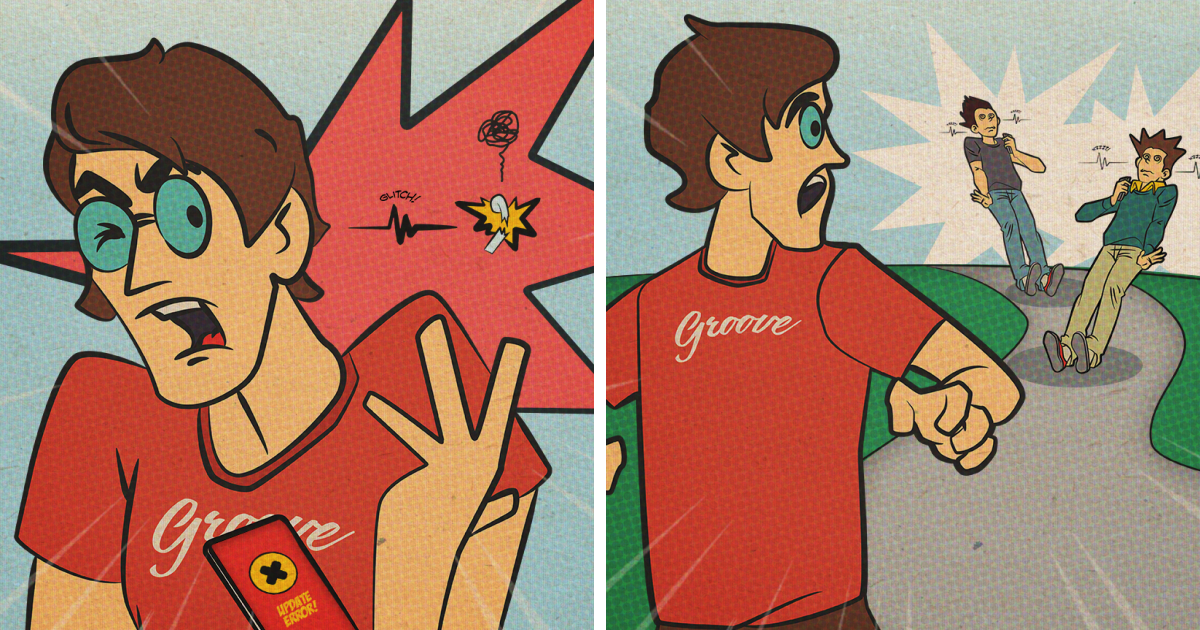
Some stories enter the room politely. Others kick the door open, trip over the carpet, drop a guitar pedal, apologize to a zombie, and then ask whether anyone has seen the Wi-Fi password. “Continuing To The Third Chapter Of My Odd Little Story Of Slackers, Zombies, Technology, And Music” belongs proudly to the second category.
This third chapter of Slackerman’s strange, funny, music-soaked comic universe continues the journey of a man who wakes from a coma into a world that no longer makes sense. That setup alone has enough dramatic fuel for a serious dystopian epic. But the charm of the project is that it refuses to march in a straight line. Instead, it dances, stumbles, riffs, jokes, and occasionally lets monsters wander through the frame like they forgot they were supposed to be scary.
The result is a quirky blend of digital art, zombie comedy, slacker storytelling, technology anxiety, and DIY music culture. It feels like a comic made by someone who has spent late nights with old horror movies, half-finished songs, weird internet tabs, and the stubborn belief that creativity does not require a corporate boardroom. Honestly, that belief deserves its own cape.
Why This Odd Little Story Works
The phrase “odd little story” may sound modest, but it is doing a lot of heavy lifting. Odd stories survive because they do not chase the safest version of entertainment. They create their own gravity. In Slackerman’s case, the mix of slackers, zombies, technology, and music gives the narrative several different engines at once.
The slacker element provides attitude. These are not shiny superhero people with perfect hair and dramatic speeches ready at sunrise. The energy is more human, more messy, and more relatable. The zombie element brings danger and absurdity. The technology angle adds modern tension: screens, systems, machines, and the sense that the world may have updated its software while the main character was unconscious. The music gives everything rhythm, personality, and soul.
That combination matters because it turns the story into more than a simple “what happened after the apocalypse?” setup. It becomes a comedy about disorientation, a mystery about the past, and a creative experiment about how music and comics can share the same stage without stepping on each other’s cables.
The Third Chapter: Looking Back To Move Forward
Chapter three, titled “The Grooveman Chronicles,” takes the story further into the past to explore what happened to Slackerman’s world. That is a smart move for serialized storytelling. After two opening chapters establish character, tone, and weirdness, the third chapter can widen the lens.
Backstory is tricky. Too much of it can feel like someone stopped the movie to read a manual. Too little of it can leave readers wandering around the plot like they lost their parking ticket. A good third chapter balances both. It answers enough questions to reward curiosity while raising new ones to keep the engine humming.
In this case, the backward glance does not drain momentum. It gives the current chaos a history. If a world is full of monsters, strange technology, eccentric characters, and musical mayhem, readers naturally want to know how it got that way. Was it a disaster? A failed experiment? A cultural meltdown? A really intense jam session? The beauty of Slackerman’s universe is that several of those possibilities can sit at the same table without anyone calling security.
Slackers As Unlikely Heroes
Slacker characters have long been useful in comedy and independent storytelling because they resist traditional hero behavior. They do not always rush toward destiny. Sometimes they avoid it, question it, mock it, or ask whether destiny can come back after lunch.
That makes them surprisingly effective in strange fiction. A polished action hero often makes chaos feel manageable. A slacker makes chaos feel real. When the world falls apart, most people are not instantly ready with a tactical plan, a leather jacket, and a perfectly timed one-liner. They are confused. They improvise. They make bad decisions with confidence. They look for snacks.
Slackerman taps into that comic potential. The slacker hero is not powerful because he is flawless. He is interesting because he is out of sync with the world and still forced to move through it. The coma premise sharpens that feeling. He has missed something huge, and now reality has become the worst group project ever: everyone else knows the assignment except him.
Zombies With A Comic Pulse
Zombies are flexible monsters. They can be terrifying, tragic, satirical, silly, or all of the above before breakfast. In American pop culture, zombie stories have often carried social commentary, from consumer habits to crowd behavior to fear of collapse. But zombie comedy adds another layer: it lets audiences laugh at disaster without denying that disaster is frightening.
That is why zombies fit so well inside Slackerman’s musical comic world. They are instantly recognizable, but they can be bent into new shapes. A zombie in a straight horror story is a threat. A zombie in a comic slacker universe might still be a threat, but it might also be a punchline, a background gag, a symbol of routine, or the least productive member of the band.
The key is tone. The story does not need to drown readers in darkness to make its world feel strange. It can use monsters as part of the scenery, as pressure on the characters, and as a reminder that the absurd is sometimes the most honest way to describe a broken world.
Technology As A Source Of Wonder And Confusion
Technology in this kind of story does not have to be explained with a thousand diagrams and a professor pointing at a glowing cube. In fact, the mystery is part of the fun. For a character waking into an unfamiliar world, technology becomes both tool and obstacle.
That is deeply relatable. Modern life already has a mild science-fiction flavor. Software updates arrive like tiny invasions. Devices listen, suggest, correct, organize, distract, and occasionally refuse to connect to Bluetooth for reasons known only to ancient spirits. Add zombies and a warped future, and technology becomes even more interesting.
In Slackerman’s world, technology helps build the feeling that time has moved without permission. The main character is not simply catching up on news. He is decoding a changed reality. That gives the story a clever modern edge. The apocalypse is not just physical. It is informational. It is cultural. It is technological. It is probably also making weird notification sounds.
Music Gives The Story Its Groove
Music is not just decoration here. It is part of the identity of the project. Slackerman’s creator describes the work as a combination of comic books and music, and that hybrid spirit shapes how the story feels. The title of chapter three, “The Grooveman Chronicles,” makes the musical DNA obvious.
Music changes pacing. It gives scenes emotional rhythm. It can make a character feel larger, stranger, funnier, or more vulnerable. In visual storytelling, musical references also help readers imagine sound even when the page itself is silent. A raised eyebrow can have a bassline. A monster entrance can have drums. A confused pause can have the lonely squeak of a cheap keyboard setting called “Cosmic Flute.”
The DIY music angle also matters. Bedroom production, independent recording, and creator-controlled distribution have made it easier for artists to build entire worlds without waiting for permission. That spirit fits the comic perfectly. Slackerman feels like a project built from obsession, humor, experimentation, and the beautiful madness of doing everything yourself.
Digital Art And The Modern Indie Comic
Digital comics have changed how unusual stories find readers. In older publishing systems, a project this specific might have struggled to explain itself in one neat elevator pitch. “It is about slackers, zombies, technology, music, a coma, colorful monsters, comedy, and possibly the fate of the world” is not exactly a tidy sentence for a nervous marketing intern.
Online platforms make room for stranger shapes. They let independent creators publish directly, build an audience gradually, and connect with readers who enjoy niche combinations. That is important because some of the best internet-era storytelling comes from projects that do not feel focus-grouped into smoothness.
Slackerman’s rough-edged charm is part of its appeal. It has the feeling of a personal universe, not a committee product. The humor, digital art, music references, and chapter-based structure all point to an artist building a world piece by piece, track by track, panel by panel.
Why Chapter Three Is Important For Readers
Third chapters often decide whether a series has legs. Chapter one introduces the hook. Chapter two proves the idea can continue. Chapter three begins to show whether the world has depth. In this case, moving into the past suggests that Slackerman is not just a random parade of weird events. It has history, structure, and bigger questions waiting beneath the jokes.
That is what keeps readers engaged. Humor may get people through the door, but curiosity keeps them seated. Once readers start asking “How did this world become so strange?” and “Who caused this?” and “Why does this feel like a music video directed by a sleep-deprived cartoonist?” the series has done its job.
The third chapter also gives the creator more room to experiment. A flashback-heavy or history-focused chapter can introduce new characters, deepen the mythology, and change how earlier scenes are understood. Done well, it makes the first two chapters feel richer in hindsight.
The Comedy Of A World That Forgot To Be Normal
One of the most enjoyable parts of stories like this is the way they treat abnormal events as normal after a while. Monsters? Sure. Strange machines? Of course. A musical backstory? Naturally. A confused hero trying to process it all? Absolutely. Please hand him a map and maybe a snack.
This kind of comedy works because it mirrors how people adapt. Humans are weirdly good at getting used to ridiculous circumstances. Give us enough time and we will complain about the coffee in the bunker before we complain about the bunker. Slackerman’s slacker tone captures that everyday absurdity.
The funniest stories often come from contrast. A huge, strange world becomes funnier when characters respond with casual irritation. A zombie apocalypse becomes more memorable when someone is worried about band practice. Technology becomes more comic when it promises to solve everything and then causes three new problems before lunch.
Specific Examples Of What Makes The Concept Memorable
A Coma As A Story Reset Button
The coma premise is effective because it gives the audience a natural guide. The main character is confused, so readers are allowed to be confused too. As he learns the rules of the changed world, the audience learns with him. This avoids heavy exposition and turns discovery into part of the adventure.
A Music-Comic Hybrid Identity
Many comics reference music, but Slackerman’s project identity appears built around the blend. That makes the story feel like an album with panels or a comic with a soundtrack hiding behind it. The result is a more immersive creative personality.
A Past-Focused Third Chapter
By stepping into the past, chapter three gives readers a reason to re-evaluate the present. This is especially useful in strange fiction, where worldbuilding can be revealed gradually instead of explained all at once.
A DIY Creator Spirit
The project’s bedroom-produced quality is not a weakness. It is a signature. In a digital culture filled with polished sameness, handmade weirdness can feel refreshing. It reminds readers that imagination is still allowed to be scrappy.
SEO Perspective: Why This Topic Has Search Appeal
From an SEO standpoint, the title may be long, but the topic has several useful keyword clusters. Readers may discover it through searches for Slackerman comic, zombie comedy comic, digital art humor, indie webcomic music, slacker zombie story, or technology and music comic. These related search phrases help the article reach fans of webcomics, horror comedy, independent artists, and offbeat digital storytelling.
The strongest search angle is the unusual combination. Many articles compete for broad terms like “zombie comic” or “digital art.” Fewer focus on a comic that mixes zombies, slackers, music, and technology. That specificity can help attract readers who are tired of generic recommendations and want something with personality.
For publishers, the best strategy is to present the article as both a review and a cultural analysis. It should explain what the chapter is, why the concept works, and how it connects to larger trends in indie comics and DIY creativity. That gives search engines useful context while giving human readers something more enjoyable than a keyword sandwich. Nobody wants a keyword sandwich. It tastes like printer toner.
Experiences Related To Slackers, Zombies, Technology, And Music
There is something familiar about the emotional experience behind this story, even if most of us have not personally awakened from a coma into a monster-filled musical dystopia. The feeling of being behind, confused, and surrounded by systems that everyone else seems to understand is extremely modern. You can experience a tiny version of it by opening a new app after an update and realizing all the buttons have moved. Suddenly, you are not a user. You are an archaeologist.
That is why Slackerman’s situation connects with readers. The hero’s world has changed dramatically, but the emotional core is simple: he has to catch up. Many people know that feeling. You leave a hobby for a while and return to find the community has new slang. You stop following music trends and suddenly everyone is listening to genres with names that sound like rejected Wi-Fi passwords. You ignore technology for six months and return to discover your phone now wants to summarize your breakfast emotionally.
The slacker side of the story also feels personal because procrastination is one of the most democratic human experiences. People may differ in background, taste, and ambition, but almost everyone has looked at an important task and thought, “Interesting. What if I cleaned my keyboard instead?” Slacker characters exaggerate that impulse in a way that feels funny rather than judgmental. They remind us that not every hero begins with discipline. Some begin with confusion, avoidance, and a suspiciously strong attachment to the couch.
The zombie element adds another layer to that experience. Zombies often represent repetition, routine, and mindless motion. In a comedy setting, they can resemble the parts of life where everyone moves in the same direction without asking why. A slacker hero surrounded by zombies becomes more than a joke. He becomes the person who is not moving at the expected speed, which might make him useless in one scene and strangely insightful in the next.
Technology, meanwhile, gives the story its modern nervous system. Many creative people know the mixed blessing of digital tools. The same laptop can help produce a song, draw a comic, publish a chapter, promote a project, lose three hours to tabs, crash without saving, and then ask whether you would recommend the experience to a friend. Technology empowers independent artists, but it also creates noise. Slackerman’s world captures that tension beautifully: machines and systems can expand imagination, but they can also make reality feel more confusing.
Music is the emotional glue. Anyone who has worked on a creative project knows the power of a song to unlock a scene, a memory, or a character. Music can turn an ordinary walk into an opening-credit sequence. It can make a joke land differently. It can make a fictional world feel lived-in. In a project like Slackerman, music is not just a theme; it is a method of thinking. The story seems to move in riffs, callbacks, breaks, and strange little solos.
That may be the biggest lesson from this third chapter: weird personal projects matter because they are built from lived obsessions. A creator who loves comics, music, monsters, and absurd humor does not have to choose only one lane. The internet has made it possible for artists to build strange crossroads and invite readers to hang out there. Some visitors will not understand the traffic pattern. Others will hear the groove immediately.
For readers, the experience is refreshing because it does not feel manufactured to please everyone. It feels like a world made by someone following a private creative compass. That is often where the most memorable stories begin. Not with perfect polish, but with a stubborn idea that keeps asking to exist. Add zombies, slackers, technology, and music, and suddenly that idea has a band, a problem, and possibly an undead audience. Honestly, it could be worse. At least the zombies showed up for the gig.
Conclusion
“Continuing To The Third Chapter Of My Odd Little Story Of Slackers, Zombies, Technology, And Music” is memorable because it refuses to behave like a standard genre story. It takes familiar ingredientszombies, a confused hero, comic absurdity, digital art, and musicand remixes them into something personal and proudly strange.
Chapter three matters because it expands the world instead of simply repeating the joke. By looking into the past, it gives the series more depth and gives readers a clearer reason to keep following the chaos. The story’s charm lies in its DIY spirit, its comic timing, and its willingness to let music and monsters share the same messy stage.
In a web culture overflowing with polished sameness, Slackerman’s odd little universe feels like a reminder that creativity can still be homemade, humorous, and wonderfully offbeat. Sometimes the best stories are not the ones that fit neatly into a category. Sometimes they are the ones that shuffle in late, plug in an amp, dodge a zombie, and somehow start playing the perfect song.