On screen, The Wizard of Oz looks like a dream dipped in Technicolor and sprinkled with musical fairy dust. Dorothy skips down the Yellow Brick Road, the Scarecrow flops charmingly, the Tin Man shines like a kitchen appliance with feelings, and the Cowardly Lion turns anxiety into vaudeville. Behind the camera, however, the making of The Wizard of Oz was less “Somewhere Over the Rainbow” and more “Somewhere Under the Studio System, Please Send Help.”
The 1939 MGM classic became one of the most beloved films in American cinema, but its production was a punishing mix of heat, toxic makeup, dangerous stunts, costume misery, rewrites, director changes, injured actors, and studio pressure. The result was movie magic. The process was closer to a glitter-covered endurance test.
That does not mean every creepy rumor about the film is true. The infamous “hanging Munchkin” story, for example, has been widely debunked as a misread background bird, not a tragedy caught on camera. But the real stories are wild enough without help from urban legends. Making The Wizard of Oz was genuinely brutal, especially by modern safety standards.
A Dream Project With Nightmare Logistics
MGM did not treat The Wizard of Oz like a small children’s movie. The studio built it as a prestige fantasy spectacle, hoping to answer the success of Disney’s Snow White and the Seven Dwarfs. It was expensive, ambitious, and technically demanding. That combination is wonderful for posters and terrible for everyone wearing 90 pounds of costume under blazing lights.
The production went through multiple creative hands. Richard Thorpe started as director, but early footage reportedly failed to capture the right fairy-tale tone. George Cukor briefly stepped in, reshaping Judy Garland’s look and performance into the natural Dorothy audiences know today. Victor Fleming then took over most of the Technicolor Oz sequences before leaving for Gone with the Wind, while King Vidor directed the Kansas scenes. In other words, Dorothy needed one road to Oz; MGM needed a traffic controller.
The script also evolved heavily. Early versions had extra characters, different motivations, and a less focused story. Writers and lyricists helped refine the film into the emotional journey we remember: Dorothy wants to go home, the Witch wants the slippers, and three friends discover they already possess the qualities they seek. The final movie feels simple. Getting it there was anything but.
The Technicolor Heat Was No Fairy Tale
The movie’s famous color came at a cost. Three-strip Technicolor required enormous lighting setups, and the sets could become brutally hot. This was not the cozy warmth of a Kansas kitchen. This was “please check whether the Cowardly Lion has become soup” heat.
Actors performed under intense arc lights while wearing heavy costumes, prosthetics, wigs, and makeup. Bert Lahr’s Cowardly Lion costume, made with real lion fur, was especially punishing. The outfit was heavy, hot, and sweaty enough that it reportedly had to be dried between uses. The Lion may have wanted courage, but Lahr probably wanted air conditioning and a sandwich.
The Tin Man Makeup Nearly Killed Buddy Ebsen
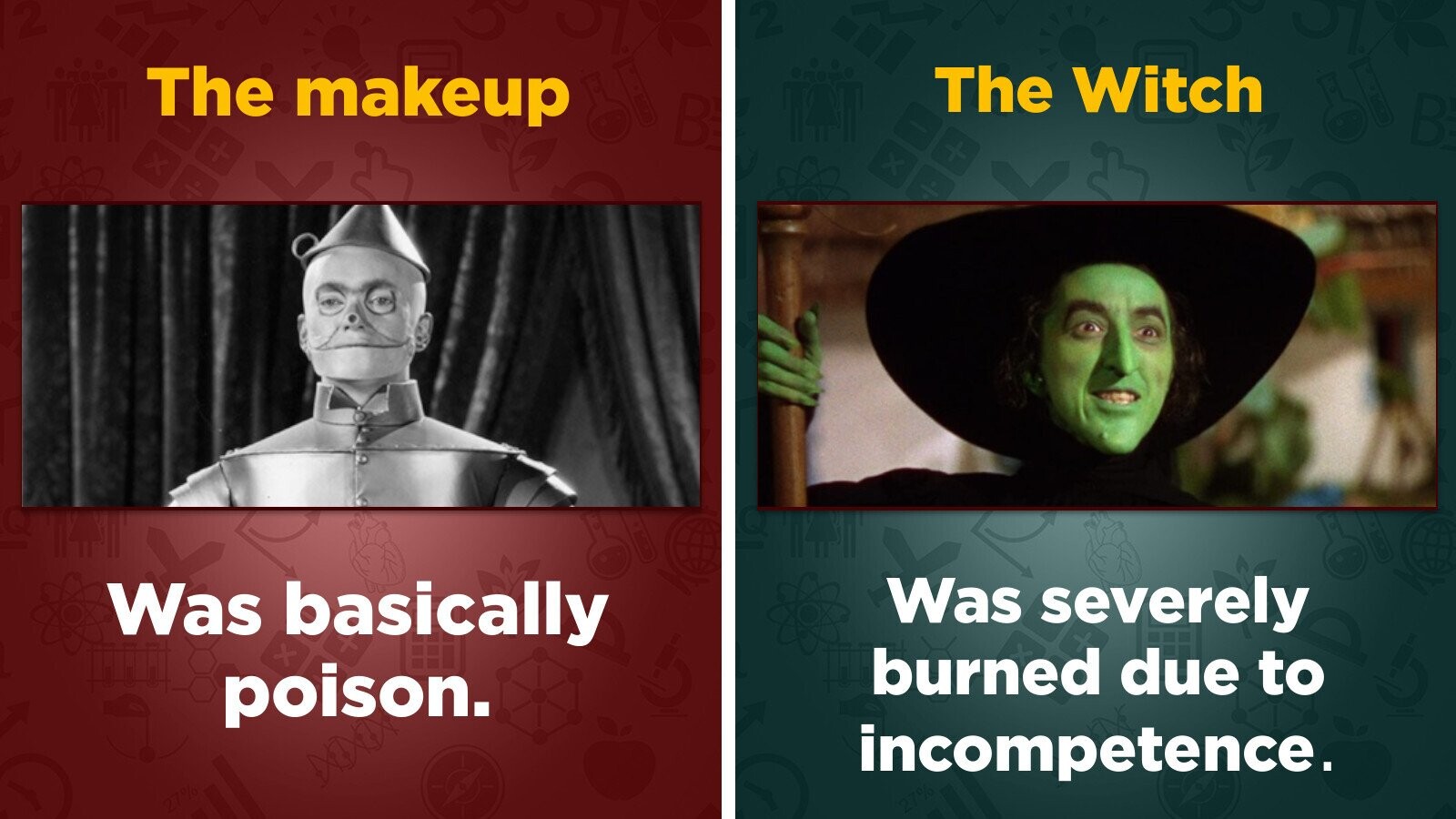
One of the darkest behind-the-scenes stories involves Buddy Ebsen, who was originally cast as the Scarecrow before switching roles with Ray Bolger and becoming the Tin Man. To create the metallic look, makeup artists used aluminum powder. Ebsen inhaled it during filming, became seriously ill, and was hospitalized.
The studio replaced him with Jack Haley, who played the Tin Man in the finished film. The makeup was changed from loose powder to a paste, but even Haley reportedly suffered a serious eye infection. So the Tin Man’s search for a heart came with an unexpected bonus quest: survive the cosmetics department.
Today, this story is often told as a shocking example of how little studios understood workplace safety. But it also reveals something larger about the Golden Age Hollywood machine: actors were replaceable parts in a massive production engine. If one Tin Man could not breathe, another Tin Man was borrowed from another studio and painted silver.
Margaret Hamilton Was Burned During a Fire Stunt
Margaret Hamilton’s Wicked Witch of the West remains one of cinema’s greatest villains. Her performance is so vivid that many viewers forget how physically dangerous the role became. During the Munchkinland scene where the Witch vanishes in smoke and flame, a trapdoor effect went wrong. The flames ignited too soon, burning Hamilton’s face and hand.
The injury was serious enough to keep her away from filming for weeks. Because her green makeup contained copper-based ingredients, the crew had to remove it quickly from the burned areas. After recovering, Hamilton refused to do any more scenes involving fire. That was not diva behavior. That was common sense wearing a pointy hat.
Even more alarming, her stunt double Betty Danko was later injured when a smoke-spitting broomstick prop exploded during a flying sequence. Danko was hospitalized and left with lasting scars. The Wicked Witch did not just melt on screen; the production itself seemed determined to roast anyone associated with her broom.
The Flying Monkeys Had Their Own Problems
The Winged Monkeys are creepy enough without knowing the actors playing them were suspended on wires. During filming, some performers were injured when piano wires snapped and sent them falling. Today, aerial stunt work involves detailed rigging protocols, safety teams, rehearsals, and layers of oversight. In 1939, the attitude was more like, “Tie them up, hope gravity is in a good mood, and roll camera.”
Those sequences still look imaginative because the effects team pushed practical filmmaking as far as it could go. But practical magic often meant practical pain. The actors and stunt performers paid for the illusion with bruises, fear, and hospital visits.
Toto Was Not Safe Either
Even Terry, the Cairn Terrier who played Toto, had a rough time. During filming, she was reportedly stepped on by one of the Witch’s guards and had to recover off set. A temporary dog double was used until she returned.
That detail sounds almost comic until you remember Toto is not a prop. Terry was a working animal on a busy studio set full of crowds, costumes, and chaos. The fact that even the dog needed medical recovery tells you the Yellow Brick Road had potholes.
Judy Garland Faced the Cruel Studio Machine
Judy Garland was only 16 when she played Dorothy, and the role made her a star. It also placed her inside the demanding MGM contract system, where young performers were controlled, managed, and shaped to fit studio expectations. Garland’s weight, appearance, schedule, and public image were all scrutinized.
Biographical accounts of Garland’s early career often describe strict diets, exhausting work, and the broader studio practice of using medication to keep performers working or sleeping on command. Not every lurid story attached to the movie should be accepted without caution, but the larger truth is clear: Garland was a teenager carrying a giant studio fantasy on her shoulders while adults around her treated her less like a child and more like a valuable musical asset.
That makes her performance even more astonishing. Dorothy’s sincerity feels effortless, yet it was created under pressure that would flatten most people faster than a Kansas farmhouse landing on a witch.
The Scarecrow Mask Left Its Mark
Ray Bolger’s Scarecrow makeup was another uncomfortable achievement. His rubber prosthetics helped create the character’s floppy, lovable look, but the mask was hot and restrictive. After filming, Bolger reportedly had temporary marks on his face from the makeup and prosthetic pieces.
The Scarecrow wanted a brain, but Bolger’s real challenge was surviving a face full of rubber under studio lights. His loose-limbed dancing remains joyful because he made discomfort look weightless. That is the secret behind many old Hollywood performances: the actor looks like they are floating while privately wondering whether their skin will ever forgive them.
Asbestos Snow and Other “Helpful” Horrors
One of the most unsettling production details involves the poppy-field snow. Period film productions often used materials that are now known to be dangerous, and accounts of The Wizard of Oz identify asbestos as part of the effects toolkit for snow and fire-resistant materials. In the scene, the snow that saves Dorothy and her friends from the poisonous poppies looks beautiful. Knowing what it may have been made of makes it look like a safety training video from the underworld.
Other effects were more harmless but still odd. The tornado was created with muslin. The Tin Man’s oil was reportedly chocolate syrup. The “steam” from his hat was talcum powder. The horses of a different color were tinted using food-grade gelatin powder. Old Hollywood could be inventive, brilliant, and deeply weird all at once.
The Ruby Slippers Were Built for Technicolor
Dorothy’s ruby slippers are now among the most famous props in American culture, but they were not ruby in L. Frank Baum’s original book. They were silver. MGM changed them to red to take advantage of Technicolor, creating a stronger visual contrast against the Yellow Brick Road.
That decision was genius. It also shows how much of the film’s magic came from practical design choices. The slippers were not just magical objects in the story; they were color technology doing a victory lap. The film’s behind-the-scenes hardship produced images so strong that decades later, a pair of glittering red shoes can still summon an entire movie in one glance.
The “Cursed Movie” Myth Needs a Reality Check
Because so many injuries happened, people often describe The Wizard of Oz as cursed. That is dramatic, clickable, and not completely useful. The better explanation is less supernatural and more uncomfortable: the film was made during an era when studios pushed people hard, safety rules were weaker, and new technologies were being tested in real time.
The “hanging Munchkin” rumor is false. Claims about on-set misconduct involving the Munchkin actors remain disputed and should not be repeated as fact without evidence. But the documented incidents are serious enough: toxic makeup, burns, explosions, wire accidents, dangerous materials, extreme heat, and a teenage star under punishing pressure.
The truth is not that Oz was cursed. The truth is that classic Hollywood could be gorgeous on screen and brutal behind the curtain.
Why the Movie Still Feels Magical
The strange thing is that none of this has ruined the film’s charm. If anything, the contrast makes The Wizard of Oz more fascinating. The movie is not beloved because it was easy to make. It is beloved because, somehow, the cast and crew turned chaos into clarity.
Garland’s “Over the Rainbow” still feels intimate. Bolger still seems boneless. Haley’s Tin Man still has warmth beneath the metal. Lahr’s Lion still steals scenes with comic panic. Hamilton still terrifies children and delights adults. The film still moves from sepia Kansas to color Oz with a shock that feels cinematic even in an age of digital effects.
That is the paradox of The Wizard of Oz: a joyful film made through miserable labor, a children’s classic shaped by adult pressure, and a fantasy about home created by people who probably just wanted to go home at the end of a very long shooting day.
Experiences Related to the Topic: Watching Oz After Knowing the Truth
Rewatching The Wizard of Oz after learning its behind-the-scenes history is a different experience. The first time most people see it, they notice the songs, the slippers, the Witch, and maybe the fact that the flying monkeys look like nightmare pigeons with management issues. But once you know what happened during production, every scene gains a second layer.
The Tin Man’s first appearance, for example, becomes more than a charming introduction. You remember Buddy Ebsen, the actor who never made it into the final role because the makeup made him dangerously sick. Jack Haley’s performance remains delightful, but the silver face now carries a strange invisible history. The character wants oil; the actor probably wanted a safer makeup formula and a doctor who did not have to be summoned because of sparkly lung dust.
The Wicked Witch scenes also hit differently. Margaret Hamilton is so controlled and theatrical that it is easy to forget she suffered real burns while making the role iconic. Her entrance in Munchkinland is still one of the greatest villain reveals in movie history, but the smoke and flame no longer feel like harmless stagecraft. They feel like evidence of how close movie magic can come to real danger.
Even the poppy-field snow becomes uncomfortable. As a child, the scene feels gentle and miraculous: Glinda sends snow, Dorothy wakes up, and everything is fine. As an informed adult, you may find yourself thinking, “Wonderful, the Good Witch has saved everyone with a carcinogenic weather event.” It is not exactly the reaction MGM intended, but history has a rude sense of humor.
Knowing the production story also makes Judy Garland’s performance more powerful. Dorothy is written as innocent, homesick, and emotionally open. Garland gives the role a sincerity that never feels fake. Yet behind that softness was a young performer working inside a studio system that monitored her body, schedule, and image. Her voice turns “Over the Rainbow” into a wish for escape, and that wish becomes more poignant when you realize the actress herself was under enormous pressure.
For modern viewers, the lesson is not to stop loving the film. It is to love it with clearer eyes. Classic movies were made by real people, not nostalgia machines. Their beauty often came from craft, sacrifice, and sometimes unacceptable working conditions. The best way to honor The Wizard of Oz is not to pretend everything was cheerful behind the curtain. It is to recognize the artists who created something lasting while enduring a system that did not always protect them.
That may be why the movie survives. It is not just a fantasy about escaping trouble. It is a fantasy made by people standing inside trouble, building a road out of paint, lights, music, sweat, and stubborn talent. The Yellow Brick Road looks brighter when you know how dark the studio floor could be.
Conclusion
Making The Wizard of Oz was pure hell behind the scenes not because of one spooky curse, but because of a long list of very real production hardships. Buddy Ebsen was hospitalized by Tin Man makeup. Margaret Hamilton was burned. Betty Danko was injured by an exploding broom prop. Winged Monkey performers were hurt by wire accidents. Bert Lahr endured a punishing Lion costume. Judy Garland carried the emotional center of the movie while navigating the pressure of the MGM studio system.
And yet, out of that chaos came one of the most enduring films ever made. The movie’s legacy is not diminished by its troubled production. It is complicated by it. The Wizard of Oz remains magical, but the magic looks different once you understand the cost. Behind every sparkling slipper and painted backdrop was a human being sweating, coughing, falling, burning, singing, or simply trying to finish the day.
Note: This article is based on documented production history, film archives, museum records, classic Hollywood reporting, and fact-checking sources. It avoids repeating unsupported urban legends as fact.